
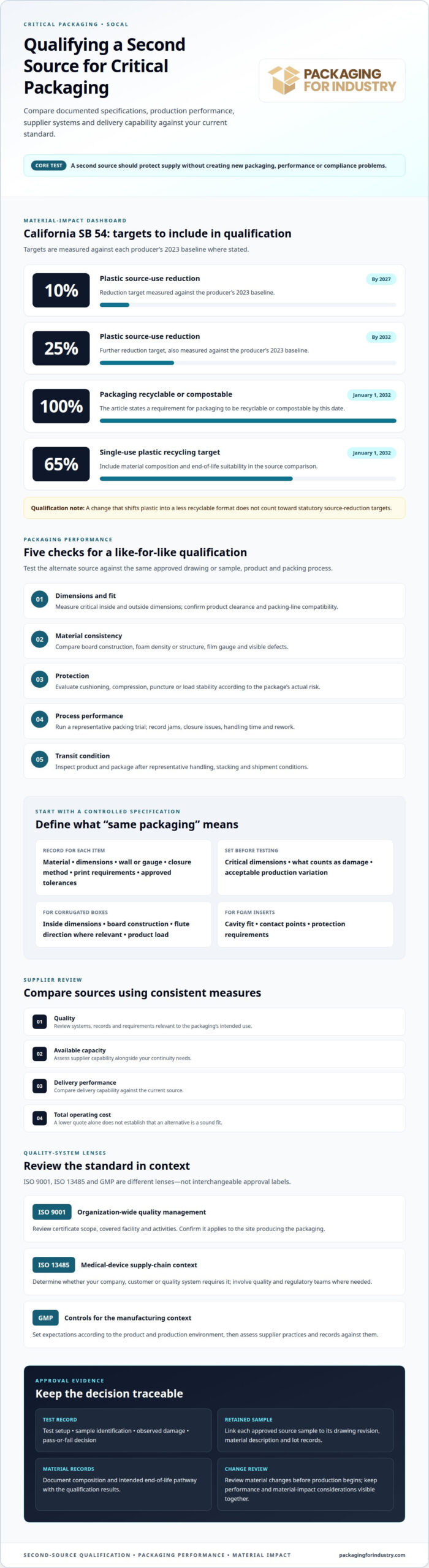
A second source is only useful when it can protect supply without creating new packaging, performance, or compliance problems. How to qualify a second source for critical packaging in SoCal comes down to comparing documented specifications, production performance, and delivery capability against your current standard. California SB 54 sets a 10% plastic source-use reduction target by 2027, measured against each producer’s 2023 baseline.
Qualifying a second source for critical packaging in SoCal takes more than finding a backup supplier. A packaging change can affect product protection, packing-line efficiency, inventory, and material use, so a lower quote alone does not show whether an alternative is a sound fit.
This article explains how to assess supplier capability and packaging performance, and how California SB 54 requirements shape the decision. You’ll also see how to weigh the operational tradeoffs of changing materials or specifications, so you can build a second-source plan around continuity, cost control, and packaging performance.
Key Takeaways
- Define pass/fail criteria for packaging performance, material specifications, and line compatibility before testing an alternate source.
- Match supplier quality systems and any applicable industry requirements to the packaging’s intended use.
- Build qualification timing and cost around the testing, documentation, and production changes the packaging requires.
- Compare suppliers on consistent measures, including quality, available capacity, delivery performance, and total operating cost.
- Use clear specifications, change-control expectations, and quality records to support approval and ongoing oversight of the second source.
What packaging tests and specifications should be included in a supplier qualification?
Start with a controlled specification for the exact packaging item and its intended use. Record the material, dimensions, wall or gauge, closure method, print requirements, and approved tolerances. For corrugated boxes, specify inside dimensions, board construction, flute direction where relevant, and product load. For foam inserts, document cavity fit, contact points, and protection requirements. Evaluate the alternate source against the same approved drawing or sample.
Next, test the package with the product and packing process it must support. Check fit, closure, handling, stacking, and performance through the actual shipping route or a representative distribution sequence. A box that passes a bench check may still slow an automated packing line or let a product shift in transit. Record the test setup, sample identification, observed damage, and pass-or-fail decision so both sources are assessed on the same basis.
- Dimensions and fit: Measure critical inside and outside dimensions, then confirm product clearance and packing-line compatibility.
- Material consistency: Compare samples for board construction, foam density or structure, film gauge, and visible defects.
- Protection: Evaluate cushioning, compression, puncture, or load stability according to the package’s actual risk.
- Process performance: Run a representative packing trial and record jams, closure issues, handling time, and rework.
- Transit condition: Inspect the product and package after representative handling, stacking, and shipment conditions.
Set acceptance criteria before testing. Define which dimensions are critical, what counts as damage, and how much variation production can tolerate. For example, an electronics shipment may require a secure foam fit and protection from movement, while a warehouse pallet load may depend on stable film containment. Keep a retained sample from each approved source and link test results to its drawing revision, material description, and lot records.
California SB 54 adds a material-impact check. Producers must reduce plastic source use by 10% by 2027 and 25% by 2032, measured against each producer’s 2023 baseline. The law also requires packaging to be 100% recyclable or compostable by January 1, 2032, and sets a 65% single-use plastic recycling target by January 1, 2032. A packaging change that shifts plastic into a less recyclable format does not count toward statutory source-reduction targets.
Include material composition and end-of-life suitability in the comparison, not just unit performance. A lighter package may change cushioning, packing speed, or damage exposure. Document those tradeoffs alongside the test results. This evidence makes how to qualify a second source for critical packaging SoCal a repeatable engineering decision rather than a price-only substitution.
Evaluate end-of-life suitability alongside physical performance. Ask each supplier to document the material composition and intended end-of-life pathway for the proposed item, and compare those records with the approved specification. Keep that information with the test results so a material change can be reviewed before approval rather than after production begins. Packaging For Industry (PFI) recommends verifying that California SB 54 source reduction requirements, which include interim deadlines beginning January 1, 2027, are met. Include a review of the proposed packaging’s material use in qualification, and retain the basis for accepting any change so that performance and material-impact considerations remain visible together.
ISO 9001, 13485, GMP for Packaging Supplier Qualification
Use ISO 9001, ISO 13485, and GMP as different lenses for reviewing supplier systems, not as interchangeable approval labels. ISO 9001 concerns quality management across an organization. ISO 13485 is tailored to quality management in medical device supply chains. Good Manufacturing Practices, or GMP, describe controls relevant to the manufacturing context. The right review depends on the product, customer requirements, and how packaging enters your operation.
For ISO 9001, review the certificate’s scope, covered facility, and activities. Confirm it applies to the site producing the packaging, rather than another location or unrelated business function. Then examine whether the supplier’s quality system has clear accountability, management oversight, employee competence, and a process for monitoring performance. A certificate is useful evidence, but it doesn’t by itself establish that every customer-specific requirement is met.
ISO 13485 matters most when packaging supports medical devices or a controlled device supply chain. Determine whether your company, customer, or quality system requires suppliers to follow this standard. Review the supplier’s role in the supply chain and the level of quality oversight your organization expects. For a medical device manufacturer, the review may need input from quality and regulatory teams before procurement approves the supplier.
Set GMP expectations according to the product and production environment. A packaging source serving a food or medical operation may face customer-specific controls that differ from those for general industrial shipments. Identify the applicable GMP expectations internally, then assess whether the supplier’s practices and records align with them. A broad “GMP compliant” statement is not a substitute for defined criteria.
- Scope: Match the standard and certificate coverage to the supplier’s actual site and activities.
- Applicability: Identify whether ISO 13485 or GMP expectations arise from your product, customer, or quality system.
- Evidence: Review audit summaries and quality-system records relevant to the supplier’s role.
- Approval: Document which requirements apply and who within your organization accepts the supplier review.
These frameworks help determine the depth of supplier oversight. Assess a general industrial packaging source through its quality system and customer-specific controls. A medical-device supply chain may require closer alignment between supplier oversight and the manufacturer’s quality processes. Base the decision on actual requirements, not assumptions tied to industry labels.
Before requesting pricing, summarize the relevant quality-system expectations with the packaging application. A packaging quote request can include those requirements so the discussion starts with the right context.
How long does packaging supplier qualification typically take, and what does it cost?
Qualification timing depends on the coordination a packaging change requires. A standard item with a clear purchasing path may involve fewer internal dependencies than custom packaging tied to engineering, quality, operations, and customer approval. Reviewer availability matters too. If a change affects several plants, each site may need to align its operating requirements before procurement can finalize the source decision.
Supplier readiness also affects the schedule. Organized records and responsive contacts help keep questions moving. Delays can arise when drawings are incomplete, decision ownership is unclear, or multiple departments must review the change. A purchasing manager can reduce avoidable waiting by assigning reviewers early and setting internal response expectations.
For planning, map the main timing drivers without assuming every project follows the same sequence:
- Design complexity: Custom dimensions, material combinations, or product-specific geometry can increase coordination.
- Internal approvals: Multiple sites, customer requirements, or regulated workflows may add review dependencies.
- Supplier readiness: Organized records, clear communication, and production planning help prevent avoidable delays.
- Implementation scope: Changes affecting several lines or locations require more coordination than a single-use application.
Qualification cost includes external charges and internal effort. Supplier charges may depend on custom design work, sample development, tooling, or requested evaluations. Internal costs can include engineering time, quality review, purchasing administration, production scheduling, and staff time for implementation. A complex package used across several locations can require more coordination than a stock item used by one team.
Compare qualification costs separately from recurring packaging costs. This helps finance evaluate one-time work without overlooking ongoing freight, inventory, handling, or damage impacts. Define the requested deliverables and scope consistently when comparing proposals. One quote may include design support while another covers only the packaging item, so the totals are not comparable until the scope matches.
Qualification pricing depends on the case and is provided after a quote request; cost factors include design complexity, materials, order quantities, and requested evaluation work. A packaging quote request can describe the application and the scope your team needs evaluated.
Once the work is defined, assign a project owner to coordinate decisions and track open dependencies. This keeps the schedule visible without rushing reviews that protect product, process, or purchasing requirements.
Where California reporting is part of a packaging project, keep the reporting period distinct from the submission date when assigning internal review work. California producers’ annual producer supply report for calendar year 2025 data was due May 31st, 2026. The report submitted in 2026 covered calendar year 2025 data. That distinction can help teams label records consistently and avoid treating the year of submission as the year covered by the report. Include the applicable reporting period and due date in the project’s planning notes, then confirm that the relevant information is available to the people coordinating supplier qualification. These details provide a scheduling reference; they do not establish the qualification timeline or cost for a particular packaging change.
How should companies compare packaging suppliers on quality, capacity, lead time, and total cost
Use one comparison matrix for both sources. Apply the same packaging specification, order profile, and evaluation period to each supplier. Procurement can then distinguish verified performance from sales estimates. For example, compare corrugated box sources using the same approved drawing, order quantity, and delivery location.
Evaluate quality through production and shipment outcomes, not certificates alone. Track incoming inspection results, nonconforming material, corrective-action closure, and packaging-related product damage. Record the item, lot, issue, and disposition for each event. A foam insert that fits correctly but shifts during packing can create rework, even when its dimensions meet the drawing.
Capacity means more than a supplier’s stated maximum output. Compare available production capability with your demand pattern, order frequency, and peak requirements. Review how each supplier handles a demand increase, material constraint, equipment disruption, or allocation decision. Ask for the assumptions behind capacity statements, then document which packaging items and production sites they cover.
Compare lead time as a sequence, not a single estimate. Separate order processing, material procurement, production, transit, and receiving. Check how the supplier communicates schedule changes and handles partial shipments. For operations in Orange County, Los Angeles, or San Diego, compare delivery timing with the actual receiving window and warehouse replenishment point. A short production lead time has limited value if delivery misses the line’s consumption cycle.
Total cost includes more than the quoted unit price. Build a landed and operating-cost view that captures freight, order minimums, inventory needs, inspection effort, packing-line labor, damage, and disposal. For example, a lower-priced package may require extra handling or protective material. Those effects can change the cost per safely shipped product.
- Quality: Compare defect records, corrective actions, inspection burden, and product-damage outcomes.
- Capacity: Assess demonstrated output, demand flexibility, and response to supply interruptions.
- Lead time: Map order-to-receipt stages and measure schedule performance against receiving needs.
- Total cost: Include freight, inventory, handling, waste, and damage alongside quoted pricing.
Set minimum acceptance criteria before scoring suppliers. A high price score should not offset failure to meet a critical quality requirement. Separate pass-or-fail requirements from preferences, then weight the remaining criteria according to operational impact. Engineering may prioritize fit and protection, while warehouse teams focus on replenishment and handling.
For ongoing comparison, review purchase orders, receiving records, and incident reports on a consistent schedule. Share changes in demand forecasts and packaging specifications through controlled updates. This keeps the second source aligned with current operations and makes supplier reviews useful for decisions about cost, continuity, and product protection.
What documentation and quality agreements are needed to approve a second packaging source
Approval needs a traceable record connecting the supplier, packaging item, specification, and release decision. Start with the controlled drawing or specification, including revision, material description, dimensions, tolerances, intended use, and approved sample reference. For example, a purchase order should identify the same revision approved by quality, not an earlier sample or email attachment.
Keep supplier qualification documents in one controlled file. Include the supplier’s facility details, quality-system evidence, key contacts, and manufacturing location. Add the completed supplier questionnaire, risk review, audit findings where applicable, and corrective-action records. If production moves between facilities, document which site is approved for the packaging item. This prevents approval for one operation from being treated as approval for another.
The item-level record should capture the evidence used to release the source. Include sample inspection results, test reports, production-trial observations, deviations, and final approval signatures. A change from one foam design to another, for instance, should connect the revised drawing to new review results. Record who approved the change and when it took effect in your internal system.
A quality agreement or supplier quality addendum should clearly assign responsibilities. It can define notification expectations, nonconformance handling, record retention, complaint investigation, and escalation contacts. State how the supplier submits a proposed material, process, or site change, and whether your team must approve it before implementation. Specific language reduces the chance that procurement and quality interpret the same event differently.
- Specification control: Identify the current drawing, revision, approved materials, and acceptance criteria.
- Change control: Set the notification process for changes to materials, processes, equipment, or manufacturing location.
- Nonconformance response: Define containment, investigation, corrective action, and disposition responsibilities.
- Traceability: Specify the lot or shipment records needed to connect received packaging with supplier production records.
- Approval status: Record qualified items, approved sites, restrictions, and the responsible internal approvers.
Purchase controls should reinforce the agreement. Add the approved item identifier and specification revision to purchasing records. Give receiving teams clear inspection instructions and a process for quarantining material that differs from the approved sample. If procurement uses a new supplier code, link it to the qualification file so order history and quality records remain searchable.
For California operations, keep packaging material descriptions consistent across specifications, orders, and internal reporting. Accurate records help teams understand what changed when comparing an alternate package or evaluating material use. Avoid vague descriptions such as “equivalent packaging.” Name the material and revision so engineering, quality, and purchasing can review the same item.
Packaging For Industry (PFI): Foam Packaging
Packaging For Industry (PFI) supports qualification projects involving protective foam packaging for products that need a controlled fit and cushioning. Use its custom packaging design services when an existing foam layout needs evaluation or a new package must match product geometry and packing requirements. A defined design and specification give your team a basis for reviewing samples and production performance.
After approval, Vendor Managed Inventory (VMI) or Just-In-Time (JIT) inventory management for packaging can help coordinate replenishment with operating needs. These programs suit manufacturers seeking a more predictable packaging supply alongside an approved source. Share your product, packaging requirements, and sourcing goals with PFI to discuss a practical next step.
Contact Packaging For Industry (PFI) or visit packagingforindustry.com to discuss your packaging needs.
Build Resilience Into Your Next Packaging Decision
A second source works best as part of a clear operating plan, not just as a name on a supplier list. Decide who owns the relationship, how purchasing will divide orders, and what conditions would trigger a shift in volume. For teams considering how to qualify a second source for critical packaging in SoCal, those ownership decisions turn qualification into practical supply resilience.
Packaging For Industry (PFI) can discuss your packaging requirements and sourcing goals in the context of your operation. A focused conversation can help identify your team’s priorities and shape a useful next step.
Clear ownership and a defined sourcing plan give your team a practical foundation for moving forward.
Frequently Asked Questions
What are the qualification steps for a second source of critical packaging?
Qualify the alternate source by defining the use case, confirming specifications, reviewing supplier controls, testing samples, and documenting approval. Then run a controlled production trial before adding the source to purchasing records. For example, use a distinct item or supplier code during the trial so receiving staff can identify alternate-source material. Set a release owner and rollback criteria, such as fit problems or packing-line disruption, before the first production order.
What are the risks of changing packaging suppliers, and how can companies mitigate them?
The main risks are inconsistent fit, transit damage, packing-line delays, and confusion between approved and unapproved versions. Reduce them by keeping the existing source active during a controlled transition and introducing the alternate package in a limited production run. Train operators on any handling differences, label trial inventory clearly, and review receiving and damage reports before expanding use. For shipments in Orange County, Los Angeles, and San Diego, include the actual route and handling conditions in the transition review.