
Shipping air is likely the most expensive “product” your company exports from Southern California. If you’re seeing unexpected surcharges on large but light industrial components, you aren’t alone. Many manufacturers struggle with stock box sizes that don’t quite fit their custom parts; this leads to inefficient void fill and ballooning freight invoices. Understanding how to reduce dimensional weight charges from California is no longer just a warehouse concern. It’s a critical financial strategy for protecting your bottom line in a competitive market.
We understand that every inch of wasted space translates directly into lost profit. You’ll learn actionable strategies to optimize your packaging dimensions and slash shipping surcharges when shipping from Southern California logistics hubs. This guide examines how custom corrugated designs and precision foam inserts eliminate wasted volume without sacrificing protection. We’ll show you how to move away from generic catalog solutions and toward an engineered approach. This ensures professional, damage-free delivery for your high-value components across Los Angeles, Orange County, and the Inland Empire while lowering your freight costs per unit.
Key Takeaways
- Master the 2026 DIM formula to understand exactly how carriers bill for package volume rather than just physical mass.
- Discover how to reduce dimensional weight charges from California by partnering with Packaging For Industry (PFI) for custom corrugated solutions that replace oversized boxes and eliminate wasted space.
- Learn why engineered protective foam packaging provides superior component safety in a smaller footprint compared to bulky, traditional void fill.
- Avoid the “rounding up” trap by auditing your most frequent shipments and identifying the top offenders driving up your freight invoices.
- Utilize local Southern California expertise and vendor-managed inventory (VMI) to ensure a steady supply of custom-sized materials for high-volume industrial lines.
Understanding Dimensional Weight (DIM) for California Shippers
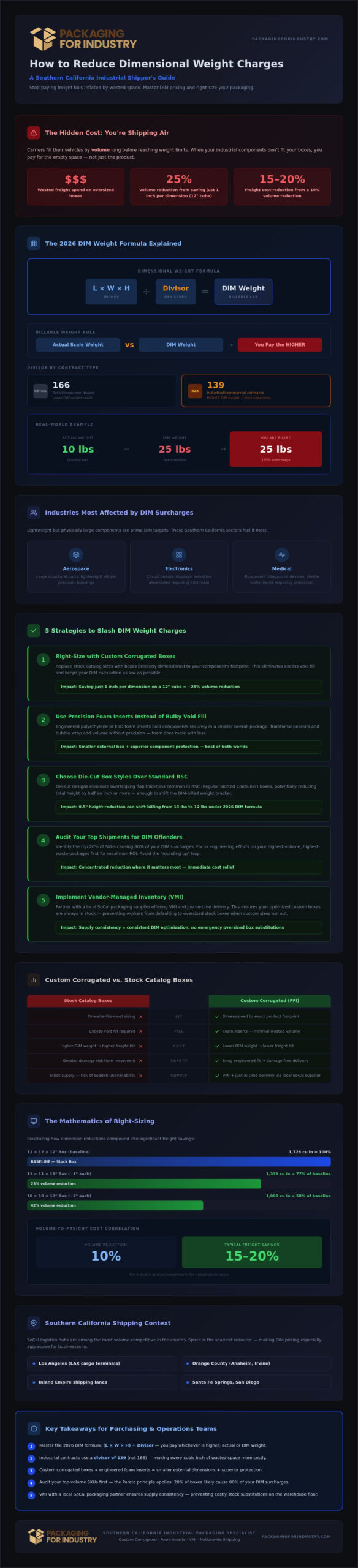
In the high-density logistics hubs of Southern California, from the cargo terminals at LAX to the shipping lanes of the Inland Empire, space is the most valuable commodity. Shipping carriers prioritize package density because their vehicles reach physical capacity by volume long before they reach their weight limits. This reality drives the use of Dimensional Weight (DIM) pricing. DIM weight is a billing technique that calculates the amount of space a package occupies relative to its actual mass. Understanding how to reduce dimensional weight charges from California begins with recognizing that your freight bill is determined by “Billable Weight.” This is the higher value between the package’s actual scale weight and its calculated DIM weight.
The 2026 standard for calculating this value follows a specific mathematical formula: (Length x Width x Height) / Divisor. If your calculated DIM weight is 25 pounds but your industrial part only weighs 10 pounds, you’ll be billed for 25 pounds. For manufacturers in Southern California cities like Anaheim, Irvine, or Santa Fe Springs, this discrepancy often represents the single largest source of hidden shipping waste.
The Role of the DIM Divisor in 2026
The divisor is the numerical factor used by carriers to convert package volume into a billable weight figure. A lower divisor results in a higher dimensional weight, which increases your total shipping costs. While retail shippers might see a divisor of 166, commercial and industrial contracts often utilize a divisor of 139 for domestic shipments. The divisor serves as the primary lever carriers use to adjust pricing based on fuel costs and vehicle capacity. Essentially, the divisor acts as a mathematical density threshold that dictates whether you pay for the physical weight of your product or the total volume of your packaging.
Why Industrial Goods are Prime Targets for DIM Surcharges
Manufacturers in the aerospace, medical, and electronics sectors frequently ship components that are lightweight but physically large. These high-value items require significant protection, yet using standard stock boxes often leads to “shipping air.” When a warehouse uses a one-size-fits-all box for a custom-machined part, the excess volume triggers immediate surcharges. In the competitive logistics environment of Southern California, package density directly influences your negotiated rates. By learning how to reduce dimensional weight charges from California, businesses can move away from bulky void fill and toward precision-engineered solutions that maximize every cubic inch of the shipping container. This shift is critical for maintaining healthy margins when shipping high-volume industrial goods.
Right-Sizing: The Primary Strategy to Lower Packaging Costs
Right-sizing is the most direct path to fiscal efficiency in industrial shipping. Many warehouses rely on a handful of standard box sizes from national catalogs, assuming the convenience outweighs the cost. However, when you ship high-value parts from Southern California, those extra inches of void fill become expensive liabilities. Transitioning to custom-sized containers ensures that your external dimensions are as close to the product’s footprint as possible. This eliminates the need for excessive bubble wrap or peanuts, which often force you into the next size bracket. Learning how to reduce dimensional weight charges from California requires a move away from the “good enough” approach of stock sizing.
Box style also plays a critical role in density. A standard RSC (Regular Slotted Container) is efficient for many applications, but certain products benefit from die-cut designs. These custom styles can eliminate the thickness of overlapping flaps, potentially shaving half an inch off the total height. While half an inch seems negligible, it can be the difference between a package being billed at 12 pounds versus 13 pounds under the 2026 DIM formula. Precision engineering at the design phase prevents these rounding errors from inflating your freight bill.
Custom Corrugated vs. Stock Catalog Boxes
Partnering with a local packaging manufacturer offers a level of precision that stock catalogs cannot match. Catalog suppliers prioritize their own storage efficiency, leading to “one-size-fits-most” options that rarely fit industrial components perfectly. The mathematics of small reductions is staggering. If you reduce each dimension of a 12-inch cube by just one inch, you decrease the total volume by nearly 25%. Industry analysts report that a 10% reduction in package volume often correlates to a 15% to 20% reduction in total freight spend. For manufacturers in Orange County or Los Angeles, these incremental gains accumulate into significant annual capital recovery.
Selecting the Right Wall Strength to Minimize Bulk
A common misconception is that heavy-duty protection requires a massive footprint. Through custom design packaging, we can often utilize high-test single-wall or double-wall corrugated that provides superior stacking strength without adding unnecessary bulk. The goal is to maximize internal protection while minimizing the external cube. For shipments traveling from California to the East Coast, we also consider weather-resistant materials. These maintain structural integrity during humidity shifts, preventing the “box bulge” that can lead to manual carrier audits and unexpected surcharges. You can compare packaging pricing for custom versus stock options to see how much “air” you are currently buying.
Engineering Custom Protection to Minimize Package Volume
While right-sizing the box is essential, the materials inside often dictate the final external dimensions. Many warehouses rely on generic void fill like air pillows or packing peanuts to protect fragile components. These materials require a significant buffer zone to be effective, which inadvertently forces you into a larger container. This “buffer bloat” is a primary cause of inflated freight bills. By switching to engineered protective foam packaging, you can achieve a precision fit that secures the product while minimizing the total cube. This engineering-led approach is a key component of how to reduce dimensional weight charges from California, as it allows for tighter tolerances without compromising safety.
Custom foam end caps and corner protectors focus protection exactly where it’s needed. Unlike loose fill that shifts during transit, foam inserts keep the product centered and immobile. This stability means you can safely reduce the distance between the product and the box wall. Shaving even an inch off each side of a shipping container through better internal engineering can move a shipment into a lower billable weight category. It’s a pragmatic solution that prioritizes both physical protection and fiscal responsibility.
Precision Custom Foam Inserts for Sensitive Gear
Industrial sectors like aerospace components manufacturing require extreme precision. Die-cut foam inserts are designed via CAD/CAM to match the exact geometry of high-value parts. For volume efficiency, we often compare polyethylene (PE) and polyurethane (PU) foam. PE foam is denser and offers high-load bearing properties in a thinner profile, which is ideal for reducing overall package size. Additionally, custom foam allows for kitting multiple components into a single, smaller box. This consolidated approach reduces the number of individual shipments and prevents the accumulation of multiple DIM weight surcharges on a single order.
Anti-Static (ESD) Solutions for Electronics
The semiconductor and electronics industries in Southern California face the double challenge of fragility and electrostatic sensitivity. Standard anti-static bubble wrap is bulky and often requires multiple layers to provide adequate cushioning. Custom ESD foam inserts provide a streamlined alternative. They offer permanent static dissipation while maintaining a low-profile design. This allows for high-density packing of sensitive circuit boards and sensors. By optimizing the internal protection for these high-tech goods, businesses find the most effective way of how to reduce dimensional weight charges from California while maintaining their reputation for damage-free, professional delivery.
Operational Tactics: Auditing, Rounding, and VMI
Carriers utilize automated laser scanners to measure every package. These systems are unforgiving; they round up every fraction of an inch to the next whole number. If a box bulges to 12.1 inches due to poor tape application or internal pressure, you’re billed for 13 inches. This “Rounding Up” trap is a common reason why industrial shippers see costs spike. Learning how to reduce dimensional weight charges from California requires more than just better boxes. It requires operational discipline. We recommend starting with a comprehensive packaging audit to identify your “Top 10” DIM offenders. These are typically the high-volume shipments where a small reduction in volume yields the highest return on investment. By analyzing your last three months of carrier invoices, you can pinpoint exactly which product lines are consistently triggering dimensional weight adjustments.
Controlling Rounding Outcomes through Design
Precision matters during the design phase. By engineering boxes to sit at specific breakpoints, such as 11.75 inches, you create a safety margin that accounts for minor manufacturing variances or slight bulging. Utilizing corner and edge protection helps maintain the crisp, rectangular profile carriers expect. If a box loses its shape and rounds out, the scanner registers the widest point of the arc. CAD/CAM support allows us to verify these external dimensions before you commit to mass production, ensuring your operations don’t accidentally trigger higher weight brackets.
Just-In-Time Supply and VMI Benefits
Operational failures often stem from stockouts. When a warehouse runs out of the correct custom box, staff often resort to the next available size, which is inevitably larger. This “panic packing” creates an immediate surge in shipping costs. Implementing Vendor Managed Inventory (VMI) eliminates this risk by keeping your specific sizes in stock locally in Anaheim. Combined with just-in-time inventory management, this approach reduces your warehouse footprint in expensive Southern California markets. You improve cash flow by only stocking what you need, while ensuring you never have to settle for an oversized container that inflates your freight bill. This is a pragmatic strategy for how to reduce dimensional weight charges from California while streamlining warehouse logistics.
Training warehouse staff is the final piece of the puzzle. Improper tape application can cause box flaps to pull unevenly, creating a “crown” on the top of the box. This crown adds height that scanners will detect. Simple training on H-taping methods and proper void fill levels ensures that the box you designed is the box that actually ships. When staff understand that a single extra inch of bulge can cost the company significant money over a high-volume production run, they become active participants in your cost-reduction strategy.
Partnering with a Southern California Packaging Specialist
Solving the DIM weight challenge requires more than just a calculator; it requires a partner who understands the local logistics landscape. While national catalog suppliers offer generic solutions, they lack the context of your specific production line. For manufacturers in Orange County and Los Angeles, a physical site visit often reveals cost-saving opportunities that an online form would miss. Our team at PFI provides the technical oversight needed to identify where “shipping air” is eroding your margins. By understanding how to reduce dimensional weight charges from California through on-site audits, we help you implement long-term, scalable solutions. You can request a packaging quote to begin a professional review of your current shipping profile.
We prioritize industrial reliability and fiscal responsibility. Our goal is to help you lower packaging costs while ensuring your high-value components arrive without a scratch. With custom sizes available for every product line, you no longer have to settle for the nearest standard dimension. This precision ensures that every cubic inch of your shipment is utilized effectively, preventing the “rounding up” errors that inflate freight bills.
Local Next-Day Delivery and Nationwide Support
Our Anaheim facility is strategically located to provide local next-day delivery to the Inland Empire, San Diego, and the greater Los Angeles area. This proximity is a critical advantage when you need rapid prototyping or physical samples to test a new DIM-optimized design. We don’t just deliver boxes; we provide a holistic system. By integrating custom corrugated with precision foam and high-performance stretch film, we ensure your entire pallet is optimized for both safety and volume efficiency. While our roots are in Southern California, we maintain nationwide shipping capabilities to support your distribution centers across the country.
Request a Custom Cost-Reduction Analysis
The first step toward logistical optimization is a free review of your current shipping dimensions. We focus on B2B repeat orders where even a minor adjustment to a box’s footprint results in massive annual savings. This analysis provides a clear roadmap for how to reduce dimensional weight charges from California by matching your specific product geometry to our custom manufacturing capabilities. During this review, we look for the “Top 10” offenders in your inventory and propose engineered alternatives. This pragmatic approach ensures that your logistics strategy is based on actual shipping data rather than guesswork. If you’re ready to stop paying for wasted space and start improving your supply chain reliability, our team is ready to assist.
Optimize Your Logistics Strategy for Long-Term Savings
Mastering dimensional weight is a necessity for California manufacturers looking to protect their bottom line. Moving away from oversized catalog boxes and toward precision-engineered corrugated solutions eliminates the “shipping air” that inflates carrier invoices. We’ve explored how custom foam inserts and operational audits transform packaging from a cost center into a competitive advantage. It’s about combining engineering precision with logistical efficiency to ensure every cubic inch of your shipment is working for you.
Implementing these engineering and operational shifts is the most effective way of how to reduce dimensional weight charges from California while maintaining a professional delivery standard. Our team at PFI supports your goals with free prototyping and CAD/CAM design support, ensuring a perfect fit before production begins. With specialized expertise in aerospace and industrial sectors, we provide the durability your high-value components require without the unnecessary bulk that triggers surcharges.
We provide local next-day delivery across Southern California to keep your warehouse running at peak efficiency. It’s time to reclaim your margins and streamline your logistics with a steady, dependable partner.
Frequently Asked Questions
What is the standard dimensional weight divisor for 2026?
The standard dimensional weight divisor for 2026 domestic commercial shipments is 139. Carriers like UPS and FedEx use this figure to convert a package’s total cubic inches into a billable weight. For retail or some international lanes, the divisor might increase to 166. Because a lower divisor results in a higher billable weight, California manufacturers must focus on precision box sizing to avoid paying for excess volume on every shipment.
How do I calculate if I am being charged for actual weight or DIM weight?
You determine the billable weight by comparing the physical scale weight against the calculated dimensional weight. First, multiply the box’s length, width, and height, then divide that total by the carrier’s divisor, which is typically 139. If the resulting number is higher than the actual weight of the package, you’ll be billed for the dimensional weight. Checking the “Billable Weight” column on your shipping invoice will confirm which rate was applied.
Can custom-sized boxes really save enough money to offset their cost?
Custom-sized boxes provide a high return on investment because the freight savings significantly outweigh the slightly higher unit price of custom corrugated. Reducing a container by just one inch in each direction can lower the billable weight by several pounds. Over a high-volume production run, these savings accumulate into substantial capital recovery. You can compare packaging pricing to see how custom sizes available from PFI eliminate the expensive “shipping air” found in catalog boxes.
Does UPS or FedEx offer better DIM weight rates for California businesses?
Neither carrier is universally cheaper; instead, the best rates depend on your specific negotiated contract and assigned divisor. Most industrial shippers in Southern California negotiate their own DIM divisors based on their unique shipping density and volume. It’s often more effective to learn how to reduce dimensional weight charges from California through better engineering rather than switching carriers. A density-based audit will reveal which carrier’s zone pricing favors your most frequent routes.
What is the best type of foam for reducing package size?
Polyethylene (PE) foam is generally the best choice for reducing package size because it provides high load-bearing protection in a very thin profile. Its closed-cell structure offers excellent shock absorption, which allows for a smaller “buffer zone” between your product and the box wall. While softer polyurethane foam is useful for light items, the durability of PE foam allows for tighter packaging tolerances that keep your overall box dimensions within lower billing brackets.
How can I avoid the carrier’s ’rounding up’ rule on box dimensions?
You can avoid the “rounding up” rule by designing your packaging to sit safely below whole-inch breakpoints. For example, a box designed at 11.75 inches is less likely to bulge over the 12-inch mark than one designed at exactly 12 inches. Using high-test double-wall corrugated and precision tape application also prevents the box from expanding during transit. These design adjustments ensure that automated carrier scanners don’t trigger an expensive move into the next weight category.
What industries benefit most from custom DIM-optimized packaging?
Industries that ship large but relatively lightweight components, such as aerospace, medical device manufacturing, and electronics, see the greatest financial benefit. These sectors often deal with high-value parts that require significant protection but lack physical mass. Any Southern California B2B operation with recurring shipments can learn how to reduce dimensional weight charges from California by moving toward an engineered approach. This strategy helps lower packaging costs while ensuring sensitive components remain secure during transit.
How does a VMI program help with shipping cost control?
A Vendor Managed Inventory (VMI) program controls costs by ensuring you always have the correct custom-sized boxes in stock. When a warehouse runs out of a specific size, staff often use whatever is available, which is usually an oversized stock box that triggers DIM surcharges. PFI’s VMI program in Anaheim maintains your inventory levels automatically. This prevents “panic packing” and ensures every shipment is optimized for the lowest possible billable weight regardless of order volume.