
Did you know that supply chain disruptions are estimated to erase about 45% of a company’s annual earnings over the course of a decade? For industrial operations, these losses often stem from the sudden absence of specialized supplies like custom-engineered foam or double-wall RSC boxes. When you’re struggling with how to reduce stockouts of critical packaging materials, the problem usually isn’t a lack of effort; it’s a reliance on reactive procurement. Whether you operate in the manufacturing hubs of Orange County and Los Angeles or require reliable nationwide shipping for a multi-site enterprise, inconsistent lead times can stall a facility in hours.
You’ve likely felt the sting of paying high rush shipping fees just to keep a production line moving because a crate delivery was delayed. It’s frustrating to manage inconsistent lead times while warehouse space is already at a premium. This guide provides the exact strategies industrial operations use to stabilize production lines and lower emergency procurement costs. You’ll learn how shifting from a catalog-based ordering model to integrated solutions like vendor-managed inventory (VMI) ensures you never face a packaging-related shutdown again. We’ll outline a clear path toward predictable monthly spending and total logistical reliability.
Key Takeaways
- Understand the financial impact of production delays, where a single missing component can stall a six-figure shipment and trigger expedited freight surcharges.
- Identify the “Custom Lead Time Trap” and why relying on fragmented vendors for specialized corrugated and foam increases your risk of shortages.
- Compare the costs of DIY inventory management against Vendor Managed Inventory (VMI) to free up warehouse space and capital.
- Discover a five-step process on how to reduce stockouts of critical packaging materials, including the use of ABC classification for high-priority SKUs.
- Learn how local, next-day delivery and custom stocking programs in Southern California stabilize supply chains for aerospace and medical manufacturers.
The Real Cost of Packaging Stockouts in Industrial Operations
In industrial manufacturing, the smallest component often creates the largest bottleneck. A $2 corrugated box or a specific set of corner boards might seem insignificant until they aren’t there. When a $100,000 shipment sits on the dock because the right shipping container is missing, the situation escalates from a minor oversight to a “Line Down” crisis. The Real Cost of Packaging Stockouts extends far beyond the price of the missing material. It includes the immediate financial hit of idle labor and the long-term erosion of client trust. For high-stakes sectors like aerospace and medical device manufacturing, a delay isn’t just an inconvenience. It’s a breach of contract that can jeopardize multi-year partnerships.
Beyond the production line, hidden procurement costs accumulate quickly. When supplies run dry, managers often resort to emergency rush orders and expedited freight surcharges. These fees frequently exceed the value of the packaging itself. Additionally, warehouse teams lose productivity when they’re forced to create “makeshift” packaging using whatever scraps are available. This not only wastes time but also increases the risk of transit damage. Learning how to reduce stockouts of critical packaging materials is essential to protecting both your bottom line and your operational integrity.
Calculating Your True Stockout Expense
To understand the full impact, you must use a comprehensive formula: (Production Rate x Time Lost) + Rush Fees. This total represents the baseline loss, but it doesn’t account for the multiplier effect of specialized materials. For instance, custom foam packaging often has significantly longer lead times than standard RSC boxes. If these inserts are missing, the product cannot be safely shipped, regardless of how many boxes you have in stock. In this context, operational friction is defined as the accumulation of administrative workarounds and logistical delays that occur when standard processes are interrupted by missing supplies.
Why Traditional Procurement Fails for Packaging
Many facilities fall into the “Catalog Trap” by relying on massive, third-party suppliers with volatile inventory levels. These suppliers prioritize high-volume stock items and may not have the specialized inventory you need when demand spikes. Traditional procurement also relies on demand forecasting that rarely matches actual production floor usage. This mismatch often leads to “Safety Stock” that either runs out too soon or sits in the back of the warehouse for years, eventually becoming obsolete inventory for retired product lines. Understanding how to reduce stockouts of critical packaging materials requires moving away from these reactive, one-size-fits-all purchasing habits.
Analyzing the Root Causes of Packaging Shortages
Communication silos between the production floor and the purchasing department often mask the true rate of consumption. While a buyer might see a steady flow of orders based on historical data, the floor team experiences a sudden spike that exhausts supply before the next replenishment. This is where the “Custom Lead Time Trap” becomes dangerous. Unlike standard items, custom corrugated boxes require specific production scheduling and tooling. We ensure our clients have custom sizes available for any product line, but without a managed strategy, these specialized items are vulnerable to lead-time variability that off-the-shelf catalog items don’t face.
Supply chain fragmentation further complicates the issue. Using multiple vendors for boxes, foam, and stretch film creates a system where a single missing component halts shipping. If your foam arrives but your crates don’t, your production floor remains stalled. This fragmentation makes it difficult to understand how to reduce stockouts of critical packaging materials because the data and accountability are spread across too many different platforms. When global material shortages for paper or resin occur, these fragmented systems are the first to fail under pressure.
The Complexity of Custom vs. Stock Materials
Specialized materials require a level of compliance that standard packaging does not. For instance, mil-spec packaging must meet rigid government standards, requiring longer lead times for documentation and specific material sourcing. Similarly, custom-engineered crates involve unique lumber grades and specific assembly processes that cannot be rushed. Understanding the difference between “stock” and “engineered” is vital for accurate forecasting, as the latter lacks the immediate availability of a catalog SKU.
Inventory Visibility and Data Entry Gaps
Relying on manual “count-and-call” inventory methods is a primary cause of “phantom stock,” where inventory appears in your ERP but doesn’t exist on the floor. This happens because packaging usage often bypasses automated tracking, as it’s viewed as a consumable rather than a primary bill-of-materials item. Mastering inventory management fundamentals is impossible without real-time visibility into what’s actually being taped, wrapped, and shipped. To fix these visibility gaps, you can request a quote for a managed stocking program that helps you learn how to reduce stockouts of critical packaging materials by tracking your specific usage patterns.
Internal Management vs. Vendor Managed Inventory (VMI)
Deciding between DIY inventory control and a managed program is the pivot point for any operation looking at how to reduce stockouts of critical packaging materials. For many facilities, internal management is a labor-intensive process that requires constant manual oversight. Purchasing managers spend valuable hours each week to manually track usage and follow up on vendor lead times. This administrative burden is often a hidden expense that businesses overlook when they compare packaging pricing from various suppliers. By shifting this responsibility to a logistics partner, your team can focus on production rather than paperwork.
The financial trade-off between bulk buying and just-in-time replenishment is another critical factor. While buying in massive quantities might seem like a way to secure discounts, it ties up significant capital in stagnant stock. This approach also places the risk of damage or obsolescence entirely on your company. If a product line is retired or a design changes, the custom foam or branded boxes remaining in your warehouse represent a total loss. Adopting inventory management best practices through a partnership model allows you to lower packaging costs by only paying for what you need as it arrives on your dock.
What is Packaging VMI?
A Vendor Managed Inventory (VMI) program is a strategic system where the supplier monitors and replenishes your stock based on pre-established Min/Max levels. Instead of your purchasing department reacting to an empty shelf, the supplier proactively delivers supplies before they run out. This removes the constant burden of inventory tracking and replaces it with scheduled reviews. These reviews, conducted on a weekly or monthly basis, ensure that stocking levels remain aligned with actual production floor usage rather than the outdated forecasts that often lead to shortages.
Financial Benefits of Managed Stocking Programs
The most immediate advantage of a managed program is the significant improvement in cash flow. By reducing on-hand inventory values, you free up capital for other operational needs. This model eliminates the “minimum order” surprises often associated with custom boxes and engineered foam. Additionally, moving inventory off-site or maintaining leaner stock levels reduces your warehouse footprint. This allows you to reclaim floor space for additional production lines or equipment, directly contributing to your facility’s overall efficiency. Implementing these programs is a proven method for those researching how to reduce stockouts of critical packaging materials without increasing their overhead or storage requirements.
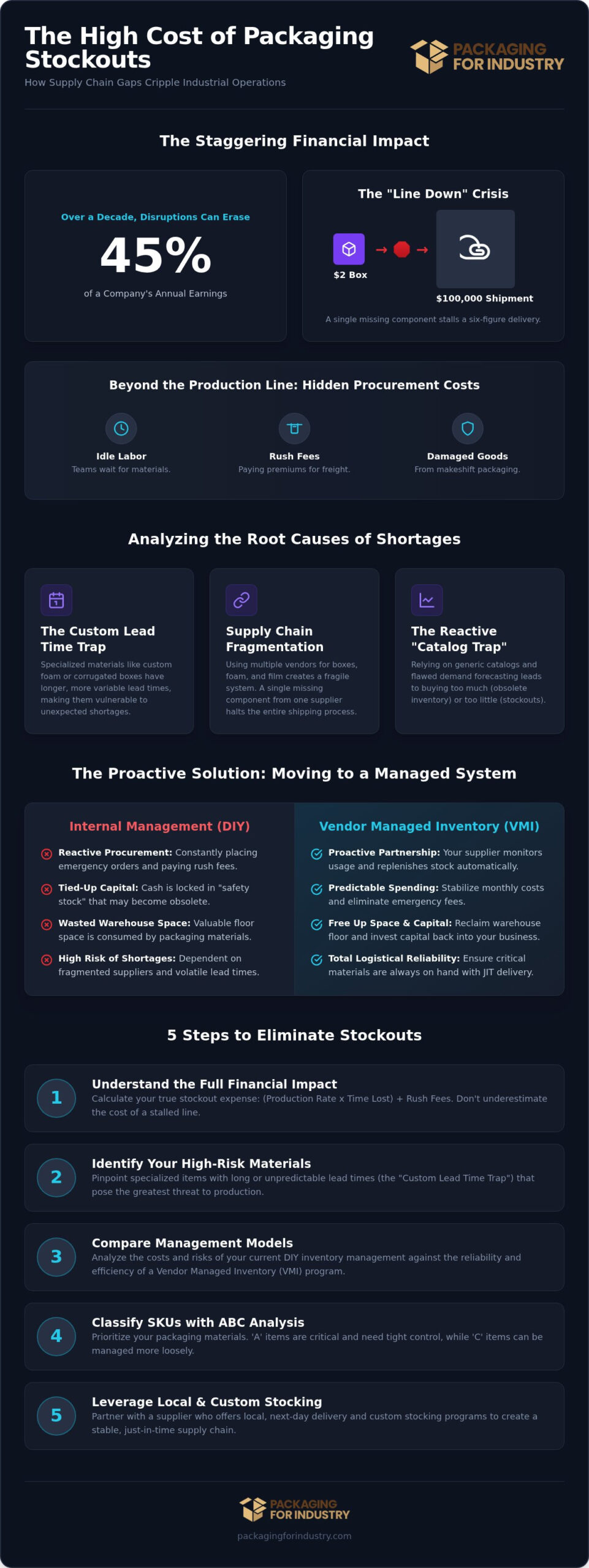
5 Steps to Reduce Stockouts of Critical Materials
Transitioning from reactive ordering to a proactive system requires a structured approach. This process ensures you have the right materials at the right time without over-burdening your warehouse floor. By following a specific set of steps, you can master how to reduce stockouts of critical packaging materials and eliminate the stress of “line down” emergencies. This methodology focuses on visibility, prioritization, and supply chain efficiency.
Step 1: The Critical SKU Audit
The first step is to distinguish between items that are essential for shipment and those that are merely convenient. In industrial terms, a critical packaging material is any component whose absence immediately halts the production line or prevents a finished product from leaving the facility. While standard supplies like tape or stretch film are necessary, they are often easily sourced. Focus your audit on custom inserts, mil-spec boxes, or specialized crates with long lead times. Review your historical usage data to identify seasonal peaks or promotional spikes that could catch your purchasing department off guard.
Once you’ve identified your critical SKUs, implement an ABC classification system. “A” items are those with high volume or lead times exceeding three weeks. “B” items have moderate usage, and “C” items are standard stock that can be replaced quickly. By prioritizing your “A” items, you focus your management energy where a stockout would be most damaging to your operations.
Step 3: Consolidating Your Supply Chain
Managing ten different vendors for ten different packaging parts creates unnecessary logistical risk. If one vendor fails to deliver a foam insert, your boxes and pallets are useless. Consolidating your needs into a single partner for integrated packaging solutions reduces administrative errors and ensures all components arrive in sync. During the consolidation process, you should request a packaging cost-savings analysis to identify redundant materials and streamline your inventory. This holistic view makes it much easier to track usage and maintain steady supply levels.
After consolidation, establish realistic Min/Max levels. These reorder triggers should not be static; they must account for production spikes and the “Custom Lead Time Trap” mentioned earlier in this guide. Finally, leverage Packaging Kitting to further reduce risk. By pre-assembling components, such as placing foam protection inside custom corrugated boxes before they reach the production floor, you ensure that every part of the unit is ready for immediate use. This eliminates the bottleneck of having one part of a packaging system while waiting on another.
Eliminating Shortages with PFI’s Southern California Solutions
Proximity is the ultimate defense against downtime. For manufacturers in Orange County and Los Angeles, relying on a national catalog supplier often means waiting days or weeks for specialized items to cross the country. This geographic gap is a primary cause of production delays. PFI solves this by leveraging our local Anaheim-based facility to provide next-day delivery across the Southern California corridor. This local presence allows you to maintain lower inventory levels on-site while knowing that replenishment is only a few miles away. It’s the most effective way to address how to reduce stockouts of critical packaging materials without over-ordering.
The “PFI Advantage” centers on providing industrial expertise rather than the price-gouging common in large-scale catalogs. We offer Just-In-Time (JIT) delivery, ensuring you receive your corrugated boxes and cushioning materials exactly as your production schedule dictates. This approach lowers warehouse storage pressure and stabilizes your monthly spend. By working with a local partner, you gain a level of logistical oversight that national distributors simply can’t match.
Local Reliability for SoCal Manufacturers
Being close to major Anaheim and Irvine manufacturing hubs allows us to reduce lead times from weeks to days. If a production spike occurs, a local supplier can react immediately. Our next-day support extends through the Inland Empire and San Diego, providing a reliable safety net for the region’s busiest industrial zones. This local reliability ensures your supply chain remains fluid and predictable, regardless of market volatility.
Securing Your Custom Supply Chain
Specialized sectors like aerospace and medical manufacturing cannot afford the “Catalog Trap.” These industries require precision-engineered solutions that standard suppliers don’t stock on their shelves. PFI manages the production of long lead-time items, such as custom-engineered foam and heavy-duty crates, so they are ready before you need them. We provide free prototyping and CAD/CAM support to ensure a perfect fit before any item enters our stocking program. This proactive management is the final piece of the puzzle in how to reduce stockouts of critical packaging materials. Request a packaging quote to start your stocking program today.
Securing Your Supply Chain for Long-Term Operational Stability
Transitioning from reactive catalog ordering to a managed stocking program eliminates the risk of production line downtime. By leveraging local Southern California proximity, your facility can reduce lead times for specialized supplies from weeks to days. Focusing on critical SKU prioritization through ABC classification ensures that high-stakes materials like custom-engineered foam and mil-spec boxes are always ready for use. This guide has provided a clear roadmap on how to reduce stockouts of critical packaging materials by moving toward a partnership-based procurement model.
PFI specializes in custom-engineered industrial packaging and VMI programs specifically designed for manufacturers and the aerospace sector. We offer local next-day delivery throughout the region to keep your operations running without interruption. Our team acts as a logistical fixer, addressing your storage pressures while stabilizing your monthly packaging spend.
You don’t have to manage the stress of potential shortages alone. A steady, predictable supply chain is within reach. We’re ready to help you optimize your inventory and protect your bottom line.
Frequently Asked Questions
What are the main causes of packaging material stockouts?
Stockouts typically result from inconsistent lead times for custom-engineered materials and a lack of visibility into actual production floor usage. Relying on manual “count-and-call” methods often leads to significant data gaps in your ERP system. Additionally, managing multiple fragmented vendors for boxes, foam, and film increases the risk of a single component delay halting your entire production line. Transitioning to integrated supply management is a key strategy for those learning how to reduce stockouts of critical packaging materials.
How much safety stock of boxes should I keep on hand?
The ideal safety stock level depends on your specific production spikes and the lead times of your suppliers. For standard RSC boxes, a two-week buffer may suffice, but custom-engineered corrugated requires a larger margin due to specialized production runs. Instead of guessing, we recommend establishing Min/Max levels based on historical usage audits. This approach ensures you have enough inventory to cover delays without over-ordering and clogging your valuable warehouse floor space.
Can Vendor Managed Inventory (VMI) really lower my packaging costs?
VMI lowers overall costs by eliminating expensive rush shipping fees and emergency procurement surcharges. It improves cash flow because you aren’t tying up capital in massive bulk orders that sit stagnant in your warehouse. By delegating inventory monitoring to a partner like PFI, you also reduce the labor hours your purchasing team spends on recurring orders. These programs provide a cost-saving alternative to high catalog pricing while ensuring total supply reliability.
How does local supply help reduce stockouts in Southern California?
Local supply removes the geographic risk of long-distance freight delays. For manufacturers in Anaheim, Irvine, or San Diego, having a partner with a Southern California facility means replenishment can happen in 24 hours. This proximity allows you to operate with leaner on-site inventory because backup stock is stored nearby. It effectively bridges the gap between production needs and supplier lead times, providing a safety net that national distributors simply can’t match.
What is the lead time for custom industrial corrugated boxes?
Lead times for custom corrugated boxes typically range from several days to multiple weeks depending on the complexity of the die-cutting and tooling required. Unlike stock sizes that are ready to ship, custom runs depend on manufacturer machine schedules. PFI manages these long lead-time items through our stocking programs, producing the boxes in advance so they’re available for immediate delivery. This proactive approach ensures your custom supply chain remains uninterrupted by production bottlenecks.
How do I identify which packaging materials are “critical” for my production?
A critical packaging material is any component whose absence immediately halts your production line or prevents a finished product from shipping. You can identify these by conducting a packaging audit and using ABC classification. “A” items, such as custom-engineered foam inserts or mil-spec crates, are critical because they have no off-the-shelf substitutes. Understanding these priorities is a fundamental step in mastering how to reduce stockouts of critical packaging materials at your facility.
What happens if my production volume suddenly increases in a VMI program?
VMI programs are designed to be flexible. When your production volume increases, the scheduled inventory reviews identify the spike in consumption and trigger earlier replenishment. Because we maintain backup stock based on your “Max” levels, your facility is protected against sudden demand surges. We work closely with your operations team to adjust reorder points as your business grows, ensuring that your packaging supply always keeps pace with your actual output.
Is VMI suitable for custom foam inserts and specialized crates?
VMI is actually most beneficial for custom foam inserts and specialized crates because these items have the longest lead times and the highest risk of causing a shutdown. Off-the-shelf substitutes don’t exist for engineered protection used in aerospace or medical device shipping. By including these custom components in a managed stocking program, we ensure the engineering and production work is done ahead of time. This guarantees that your most complex packaging is always in stock.