
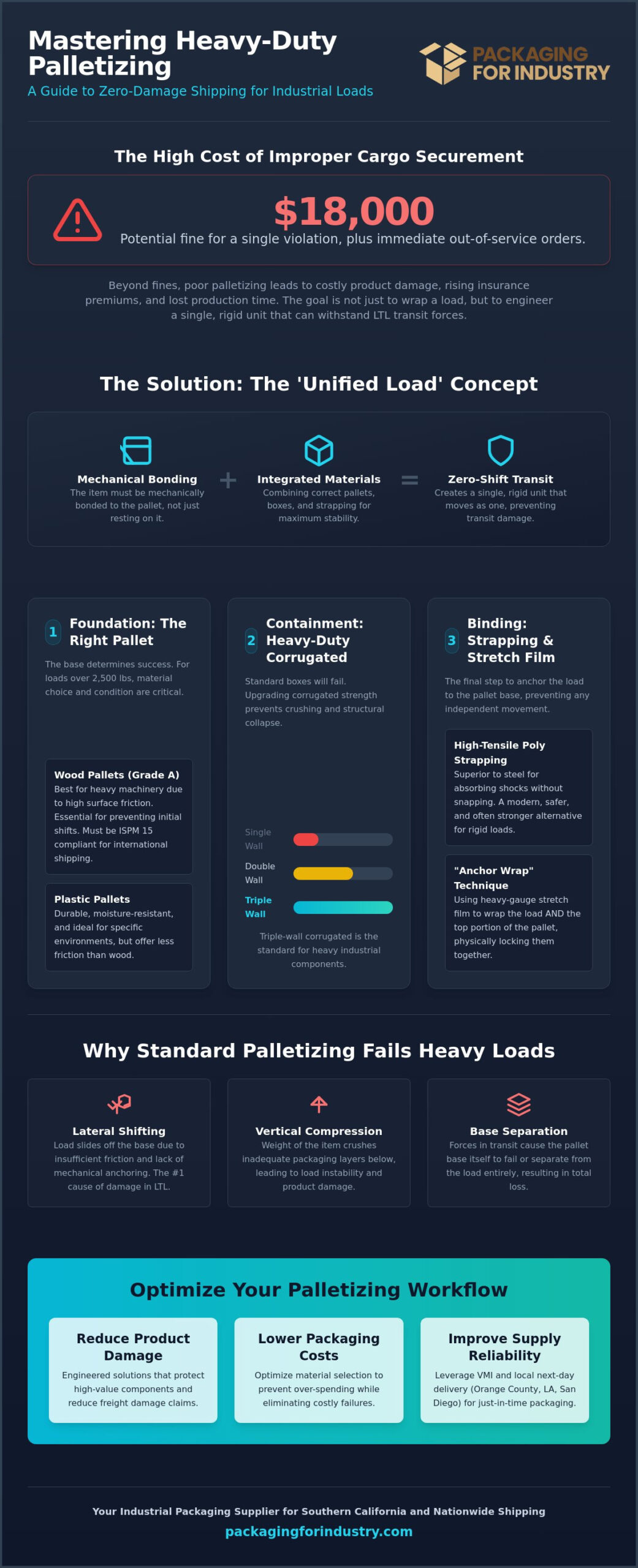
A single cargo securement violation can result in fines of up to $18,000 and immediate out-of-service orders. For warehouse managers and logistics professionals, the stakes of learning how to secure heavy items on a pallet have never been higher. You’re likely already dealing with rising freight insurance premiums and the frustration of inconsistent palletizing standards that lead to costly transit damage.
We understand that stabilizing a heavy industrial load isn’t just about wrapping it tightly; it’s a precise engineering challenge. This guide will help you master techniques designed to survive the physics of LTL freight. We’ll examine the specific material selections, such as high-strength polyester strapping and anti-slip layer sheets, that ensure zero-damage delivery. From Southern California manufacturing hubs like Orange County and San Diego to national distribution routes, these optimized methods will help you reduce material waste while maintaining strict compliance with FMCSA cargo securement rules and Working Load Limit requirements.
Key Takeaways
- Identify why standard single-wall boxes fail and when to upgrade to heavy-duty double or triple-wall corrugated for industrial components.
- Discover how to secure heavy items on a pallet using the “anchor wrap” technique to prevent load shifting during unpredictable LTL transit.
- Evaluate the engineering differences between high-tensile polyester strapping and steel when securing rigid, high-value equipment to a pallet base.
- Understand the fiscal impact of freight damage and how custom-engineered palletizing solutions can reduce insurance premiums and carrier surcharges.
- Learn how Southern California manufacturers leverage local next-day delivery and VMI programs to maintain supply reliability for heavy-duty packaging materials.
The Fundamentals of Palletizing Heavy Industrial Loads
Securing heavy industrial components is not about merely placing an item on a wooden base. It requires an engineering mindset where the payload and the pallet become a single, rigid unit. When you master how to secure heavy items on a pallet, you transition from hoping for the best to ensuring predictable, damage-free transit. The cost of failure is steep. Beyond the immediate loss of high-value components, manufacturers face lost production time, freight damage claims, and carrier surcharges for poorly stabilized loads. It’s a logistical reality that a single failed shipment can erase the profit margin of an entire production run.
Safety is the primary driver in industrial logistics. OSHA standard 29 CFR 1910.176(b) mandates that all tiered materials must be stable and secure against sliding or collapse. To meet this, weight distribution is paramount. A load with an off-center gravity point increases the risk of vehicle instability and pallet failure during sharp turns or sudden braking. Proper palletization ensures that the center of gravity remains low and centered, protecting both the product and the personnel handling it throughout the supply chain.
Why Standard Palletizing Fails for Heavy Items
Standard methods often rely on friction alone, which is insufficient for heavy loads. In a Less-Than-Truckload (LTL) environment, shipments are frequently cross-docked and subjected to high-frequency vibration and shock. Common failure points include lateral shifting, where the load slides off the base, and vertical compression, where the weight crushes the packaging layers below. Without specialized heavy-duty pallets, the base can separate entirely under the stress of G-forces in the cargo bed. These forces aren’t just theoretical; they are the primary cause of base separation in industrial shipments that haven’t been mechanically bonded to their foundation.
The ‘Unified Load’ Concept for Industrial Logistics
In professional logistics, the item must be mechanically bonded to the pallet. This means the containment system, whether it’s high-tensile strapping or heavy-gauge stretch film, must act as an anchor. Friction helps, but mechanical containment prevents the payload from moving independently of the pallet. At PFI, we advocate for an integrated material selection process known as the PFI Method. This approach combines the structural strength of triple-wall corrugated with precision-engineered strapping patterns to create a truly unified load. This is essential for manufacturing operations in Los Angeles and Orange County that ship high-value machinery. By treating the packaging and the product as one system, you can lower packaging costs through damage reduction rather than just buying cheaper materials.
Selecting the Right Foundation: Heavy-Duty Pallets and Skids
The foundation determines the success of the entire containment strategy. When logistics managers evaluate how to secure heavy items on a pallet, they start with the base’s load-bearing capacity. For shipments exceeding 2,500 lbs, you must choose between wood and plastic based on the environmental conditions and the item’s surface. While plastic is durable and moisture-resistant, wood provides the necessary surface friction to keep heavy machinery from shifting during the first few miles of transit. This friction is a mechanical advantage that helps the load and the pallet move as a single unit.
Inspection is a non-negotiable step in industrial shipping. Before loading high-value components, check for split stringers, decaying wood, or protruding fasteners that could puncture packaging. Following safe palletizing procedures reduces the risk of base failure when the load is lifted by a forklift or pallet jack. For international logistics, verify that your pallets carry the ISPM 15 heat-treatment stamp. This compliance is essential to avoid customs delays and potential fines when shipping heavy industrial goods across borders.
Wooden Shipping Pallets: Grades and Weight Capacities
Professional logistics operations typically distinguish between Grade A and Grade B wooden shipping pallets. Grade A pallets are either new or have never required stringer repairs; they’re the standard for high-value industrial components. Understanding the difference between static and dynamic load ratings is equally vital. A pallet may support 5,000 lbs while stationary on a warehouse floor, but its dynamic rating is often significantly lower. Always specify your dynamic load requirements when you request a packaging quote for heavy-duty applications.
Custom Skids and Crates for Non-Standard Equipment
Standard 48×40 pallets often fail to provide the necessary footprint for oversized industrial machinery or aerospace parts. In these cases, custom-engineered skids offer a tailored solution that matches the item’s specific weight distribution. For high-precision equipment, integrating foam-lined crates provides both cushioning and superior lateral support. These custom structures prevent the “teeter-totter” effect common with narrow-base items on wide pallets. By matching the skid to the equipment’s CAD specifications, you eliminate the risk of base separation. This ensures the payload remains a unified part of the shipping platform throughout its journey.
Structural Containment: Heavy-Duty Corrugated and Corner Protection
Building on a solid foundation, the next phase of learning how to secure heavy items on a pallet involves structural containment. Standard single-wall boxes are designed for light retail or consumer goods; they lack the burst strength required for industrial components. When heavy parts shift internally, they create concentrated pressure points that easily puncture standard corrugated material. Professional-grade packaging relies on the science of vertical stack strength to prevent box sag during long-term warehouse storage. This is especially critical for Southern California manufacturers who face high-vibration transit across Los Angeles and Orange County, where moisture and humidity can also weaken standard cardboard over time.
Strict compliance with FMCSA cargo securement rules requires that your load remains immobilized throughout the journey. If your boxes fail and the contents shift, the entire pallet’s stability is compromised. This is why material selection is a financial decision, not just an operational one. Choosing the wrong grade of corrugated leads to the very shipping damage that drives up insurance premiums and ruins client relationships.
Double-Wall and Triple-Wall Corrugated Boxes
For loads exceeding 500 lbs, manufacturers should transition to double-wall or triple-wall industrial corrugated boxes. Triple-wall corrugated offers maximum puncture resistance and can often replace heavy wooden crates for specific applications, effectively reducing both tare weight and total shipping costs. When managing high volumes of loose or irregular components, Gaylord boxes and bulk bins provide the necessary lateral containment to keep the payload centered on the pallet and prevent item migration during sudden stops.
The Critical Role of Cardboard Edge Protectors
Strapping alone can be destructive if it’s applied directly to the corners of a box. Heavy-duty cardboard edge protectors are essential because they distribute strap tension across the entire surface of the load. This prevents strap-crush, which often leads to loose bindings and total load failure mid-transit. These protectors also mitigate the pyramid effect, where top-heavy pallets lean or collapse because the corners aren’t reinforced. Edge guards increase vertical load capacity by up to 20%. By stabilizing the columns of your stack, these protectors ensure that even the heaviest shipments remain square and secure from the warehouse floor to the final destination.
The Science of Binding: High-Performance Stretch Wrap and Strapping
Binding is the final technical step in achieving a unified load. Understanding how to secure heavy items on a pallet requires a focus on containment force rather than just the number of wraps applied. Simply adding more layers of thin, consumer-grade film won’t suffice for 2,000 lb components. Instead, operators must select a film gauge that matches the load’s weight and profile. A critical oversight in many warehouses is the failure to use an anchor wrap. This technique involves extending the film around the pallet base itself, mechanically bonding the payload to the foundation. Without this anchor, the item can slide off the pallet during transit, regardless of how many layers are applied to the top sections.
Consistency is the enemy of shipping damage. Manual wrapping often leads to irregular tension, which creates weak points in the containment. Utilizing machine stretch film allows for precise pre-stretch levels, often reaching 200% to 300%. This ensures that the film is applied at its maximum strength, providing a consistent hold that reduces material costs and improves load reliability for Southern California manufacturers shipping out of Anaheim or Los Angeles.
Optimizing Stretch Film for Heavy Loads
Blown film is the preferred choice for heavy industrial applications due to its superior puncture resistance and high load-holding force. While cast film is quieter and clearer, it lacks the toughness required for sharp-edged machinery or irregular parts. Using high-performance stretch film allows logistics hubs to achieve higher containment force with fewer revolutions. This optimization reduces material waste while ensuring the load remains rigid during the high-vibration environment of long-haul trucking. The goal is to reach a specific containment force target measured in pounds, ensuring the film acts as a structural component of the palletized unit.
Strapping and Banding Techniques for Maximum Security
Strapping provides the heavy-duty mechanical containment that film alone cannot offer. When choosing between steel and Polyester (PET) strapping, the decision rests on the load’s behavior. Steel is ideal for rigid, non-settling items like large steel beams or heavy castings. However, PET strapping is often superior for industrial components that might settle or compress during transit because it maintains tension through its elongation recovery properties. Tensile strength is the maximum amount of pulling stress a strap can withstand before it snaps or deforms. For heavy-duty PET, friction seals are often preferred over metal seals as they create a bond nearly as strong as the strap itself. Proper strap placement should always align with the structural points of the item to avoid lateral shifting during aggressive forklift maneuvers.
Optimizing Your Palletizing Workflow with PFI
Mastering the technical aspects of how to secure heavy items on a pallet is only the first step toward operational efficiency. The true challenge lies in maintaining a consistent supply of high-performance materials and ensuring that every load meets rigorous safety standards. At Packaging For Industry (PFI), we act as a strategic partner for manufacturers in Anaheim and Los Angeles, providing the engineering expertise needed to eliminate shipping damage while controlling total packaging spend. Our approach moves beyond selling supplies; we focus on custom-engineered systems where every component, from the pallet base to the final strap, works in unison.
Supply reliability is a critical factor for high-volume operations. Through our Vendor Managed Inventory (VMI) programs, we monitor your stock levels and provide local next-day delivery to ensure your production line never stalls due to a lack of critical supplies. We also offer free prototyping for new or unique payloads. This allows your team to verify that the containment strategy for a specific heavy component is perfect before a full-scale rollout. This proactive “fixer” mindset helps Southern California businesses avoid the professional stress of freight claims and carrier surcharges.
Custom Packaging Engineering for Aerospace and Automotive
High-value sectors like aerospace and automotive require precision that standard packaging cannot provide. We specialize in designing custom crates and foam inserts that accommodate complex geometries and off-center gravity points. By utilizing CAD/CAM support, we create prototypes that maximize protection while minimizing tare weight. This optimization directly impacts your bottom line by reducing freight costs and material waste. For example, we recently helped an Orange County manufacturer solve a persistent damage issue with heavy transmission components by replacing generic boxes with custom-sized triple-wall corrugated and precision-cut polyethylene foam. The result was a zero-damage transit record and a significant reduction in total packaging costs.
Next-Day Delivery and Supply Reliability in Southern California
Proximity is a major advantage for Southern California manufacturing hubs. Our facility is strategically located to provide rapid response times for just-in-time manufacturing packaging. Whether your facility is in the Inland Empire, San Diego, or the greater Los Angeles area, our local delivery fleet ensures you have the materials you need exactly when you need them. This local presence allows us to offer hands-on consulting and on-site assessments of your current palletizing workflow. We understand the specific logistical pressures of the SoCal region and provide the stability and dependability required to keep your supply chain moving efficiently.
Achieving Zero-Damage Logistics for Heavy Loads
Securing industrial components requires more than just high-quality materials; it demands an integrated engineering strategy. By transitioning to a unified load concept, you ensure that every heavy item remains mechanically bonded to its foundation throughout the high-vibration environment of long-haul transit. Success depends on selecting the right combination of heavy-duty pallets, triple-wall corrugated, and high-tensile strapping. Mastering how to secure heavy items on a pallet is a critical step in lowering your total cost of ownership and protecting your professional reputation.
Packaging For Industry (PFI) provides the stability your supply chain needs. We specialize in aerospace and industrial packaging solutions, offering free prototyping and CAD design to ensure your protection is precise. With local next-day delivery in Southern California, we help manufacturers in Los Angeles and Orange County maintain supply reliability without the stress of excessive inventory.
Your operations deserve a partner that values long-term reliability and tangible results. Let’s optimize your workflow and eliminate shipping damage together.
Frequently Asked Questions
How many layers of stretch wrap do I need for a heavy pallet?
High-performance stretch film typically requires 3 to 5 layers for heavy industrial loads. However, the total containment force achieved is more critical than the number of revolutions. You must include at least three “anchor wraps” around the pallet base to ensure the payload doesn’t slide off the foundation. This mechanical bond is essential for maintaining stability during the frequent stops and turns of local Southern California delivery routes.
What is the best strapping material for securing heavy machinery?
Polyester (PET) strapping is the superior choice for heavy machinery that may settle or compress during transit. It maintains tension through its elongation recovery properties, unlike steel which can become loose if the load shifts. Steel strapping remains the standard for rigid, non-compressible items with sharp edges that could cut through plastic. Your selection should balance tensile strength requirements with the specific settling characteristics of your equipment.
Do I need a double-wall or triple-wall box for items over 100 lbs?
Items over 100 lbs generally require double-wall corrugated boxes at a minimum to ensure adequate burst strength. If you’re stacking multiple units or shipping high-value aerospace components, triple-wall corrugated is necessary to prevent vertical compression. Triple-wall provides the structural integrity needed to survive high-vibration environments. Using the correct grade helps manufacturers in Los Angeles and Orange County reduce shipping damage and lower insurance premiums.
How do I prevent my heavy load from shifting during LTL transit?
You prevent shifting by creating a unified load where the payload and pallet move as a single, rigid unit. This involves using high-performance film and edge protectors to distribute tension across the entire stack. Learning how to secure heavy items on a pallet effectively means moving beyond simple friction. You must use mechanical binding techniques, such as strapping that anchors the item directly to the stringers of the pallet.
What are the carrier requirements for palletizing heavy industrial goods?
Carrier requirements follow FMCSA cargo securement rules, which mandate that tie-downs have an aggregate Working Load Limit (WLL) of at least 50% of the cargo weight. Loads must be stable, blocked, and interlocked according to OSHA standard 29 CFR 1910.176(b). Poorly stabilized loads often incur UPS or FedEx surcharges. Carriers may reject shipments that don’t meet these engineering-backed standards for safe, damage-free transit.
Should I use edge protectors with steel strapping?
Yes, you should always use edge protectors with steel strapping to prevent “strap-crush.” Steel has no elasticity and can easily cut into box corners or damage the finish of industrial parts. Edge protectors distribute the high tension of the strap across a wider surface area. This reinforcement increases vertical load capacity by up to 20% and ensures the straps remain tight throughout the entire journey.
What is the maximum weight a standard wooden pallet can hold?
A standard 48×40 GMA wooden pallet is typically rated for a dynamic load of 2,500 lbs. If your payload exceeds this weight, you should transition to custom-engineered skids or heavy-duty pallets designed for specific weight distributions. Always inspect pallets for split stringers or decaying wood before loading. Using an inadequate foundation is a primary cause of base separation and catastrophic load failure during forklift maneuvers.
Can PFI help design a custom palletizing solution for unique equipment?
PFI specializes in custom engineering for unique or high-value equipment through CAD design and free prototyping. We help manufacturers in Anaheim and San Diego develop containment systems for complex aerospace and automotive parts. Our team ensures your how to secure heavy items on a pallet strategy is optimized for both safety and cost reduction. We provide local next-day delivery to keep your Southern California production lines running efficiently.