
What if preventing a packaging stockout didn’t mean filling every open warehouse slot? When custom boxes, foam, or crates take longer to replenish, a shortage can interrupt production or shipping. But buying extra stock can tie up capital and warehouse space. Learning how to stop worrying about packaging stockouts starts with managing replenishment, not simply holding more inventory.
A reliable process gives your team visibility into usage, lead times, storage capacity, and production schedules. That helps keep essential packaging available without constant manual checks or unnecessary emergency orders. Packaging For Industry supports recurring packaging needs with Vendor Managed Inventory (VMI), Just-In-Time (JIT) inventory management, custom packaging, and stock packaging programs.
This guide explains how to identify packaging items that need closer oversight, set practical replenishment levels, and choose an inventory approach that fits your operation. You’ll also see how scheduled inventory reviews and planned deliveries can help protect production schedules while keeping purchasing and storage needs in check.
Key Takeaways
- Packaging shortages can stall production, packing, or shipping even when finished goods are available. Identify the operational impact before setting inventory priorities.
- To learn how to stop worrying about packaging stockouts, compare physical counts with inventory records and review usage, purchasing cadence, lead times, and operating schedules together.
- Reorder points, VMI, and JIT distribute planning and inventory responsibilities differently. Compare their review cadence, storage needs, and workload to find the right fit for your operation.
- Plan recurring stock items separately from custom or long-lead packaging, then set replenishment priorities around actual usage and available storage.
- PFI’s replenishment assessment considers packaging items, usage history, lead times, storage space, and production or shipping schedules to support a practical supply plan.
Why packaging stockouts disrupt production, shipping, and purchasing
A packaging stockout occurs when an item required to produce, pack, or ship an order is unavailable. It might be a box, foam insert, or stretch film, but the effect can reach beyond the empty shelf: work may pause, finished products may wait for packing, and outbound shipments may miss their planned schedule. The general concept is described in What is a Stockout?, but packaging shortages have a distinct operational impact because packaging is often the final requirement before a product can move.
How packaging shortages interrupt an otherwise ready-to-run operation
A production line can have materials, labor, and finished goods ready while lacking the packaging needed to protect or prepare products for shipment. A substitute may not fit the product, provide the intended cushioning, or work with the established packing process. That can create handling issues or increase the risk of shipping damage. Teams may need to pause, repack, or rearrange shipment priorities.
Repeated shortages also pull staff away from planned work. Buyers spend time expediting orders, operations teams coordinate around available supplies, and warehouse staff may need to separate shipments until the correct materials arrive. Emergency purchasing can add cost and administrative work, while hurried substitutions can create new problems. A dependable plan helps prevent this cycle without treating every packaging item as a reason to stockpile.
Why packaging supply risk differs from finished-goods inventory risk
A finished-goods shortage means a product is unavailable to fulfill demand. A packaging shortage can block production or shipment even when the product itself is ready. Packaging demand follows production volume and shipping activity, so schedule changes can quickly affect consumption of recurring supplies. Stock boxes, tape, and film may need a different replenishment plan from custom boxes, foam, or crates designed for specific products and projects.
That distinction matters when deciding what to monitor. Recurring stock items often have observable usage patterns, while custom packaging may require project-specific design and longer replenishment planning. A sudden change in product mix can also alter which packaging components are needed. Treating all supplies as interchangeable inventory can hide these differences and leave a critical item without a clear replenishment plan.
Preventing stockouts isn’t simply a matter of buying more. Excess packaging occupies warehouse space and ties up working capital, while too little can disrupt packing and shipment. The practical goal is to balance availability with actual use, replenishment lead times, and storage capacity. For manufacturers and distribution teams, understanding how to stop worrying about packaging stockouts begins with identifying which missing items could halt the next operational step, then planning for those items accordingly.
Find the packaging stockout risks hiding in your replenishment process
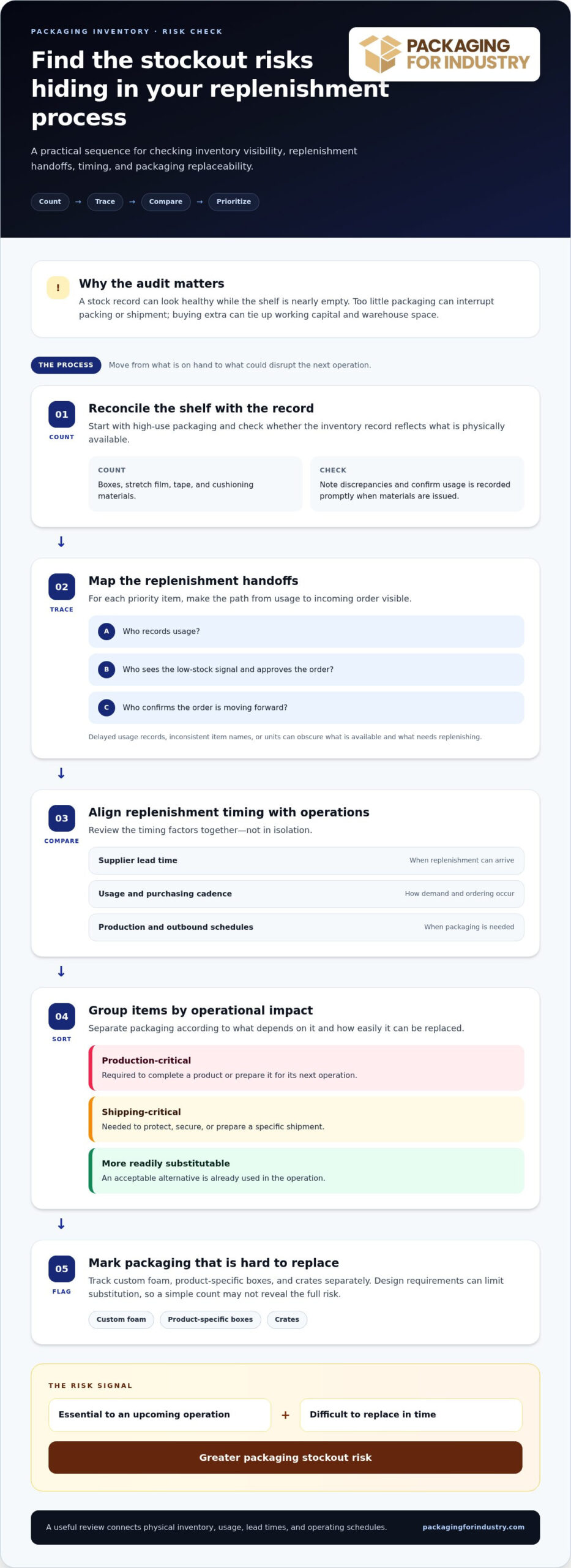
Before changing order quantities, find out where your current process loses visibility. A stock record can look healthy while the shelf is nearly empty, or a purchasing team may not know that production is using a packaging item faster than planned. To understand how to stop worrying about packaging stockouts, inspect the flow of information as carefully as the inventory itself.
Separate data and process problems from supply lead-time risks
Start with a physical count of high-use boxes, stretch film, tape, and cushioning materials, then compare each count with the inventory record. Note discrepancies and check whether usage is recorded promptly when materials are issued. Delayed withdrawal records can make a low-stock item appear available, while inconsistent item names or units can make purchasing history difficult to interpret.
Next, map the replenishment handoffs. For each priority item, identify who records usage, who sees the low-stock signal, who approves the order, and who confirms that the order is moving forward. Compare those steps with the item’s supplier lead time and the schedule for production or outbound shipments. If your process uses JIT, Forbes’ Just-in-Time (JIT) Inventory Explained provides context for considering how replenishment timing affects inventory planning.
Prioritize items by operational impact and replacement flexibility
Classify packaging by what depends on it and how easily your team can replace it. A useful audit separates items into three groups:
- Production-critical: Packaging required to complete a product or prepare it for its next operation.
- Shipping-critical: Materials needed to protect, secure, or prepare a specific shipment.
- More readily substitutable: Items with an acceptable alternative already used in the operation.
Then flag custom foam, product-specific boxes, and crates separately. Their design requirements can limit substitution, so a simple count alone may not reveal the risk. A packaging item carries greater stockout risk when it is essential to an upcoming operation and difficult to replace in time.
Turn the audit into a usable risk register
Record each item’s physical and recorded quantity, recent usage pattern, purchasing cadence, lead time, operational role, and responsible owner. Add notes when a scheduled production run, shipping period, or custom order could change demand. This gives your team a practical view of internal process gaps and supply timing constraints, rather than treating every low balance as the same problem.
Review the register with purchasing, warehouse, and production staff so the people who use packaging can flag changes before they become urgent. If your audit identifies recurring items or custom packaging needs that require closer replenishment planning, you can request a packaging quote based on the items and schedules involved.
Compare packaging stockout prevention methods: reorder points, VMI, and JIT
The right replenishment method depends on who will monitor packaging, how predictable usage is, and how much inventory space the operation can commit. Company-managed reorder points, Vendor Managed Inventory (VMI), and Just-In-Time (JIT) inventory can each support recurring supply, but they assign planning work differently. Comparing them turns the question of how to stop worrying about packaging stockouts into a practical decision about process, not simply stock quantity.
| Approach | Who manages replenishment | Review cadence | Storage and planning considerations |
|---|---|---|---|
| Reorder points | Your team monitors counts and places orders | As inventory is checked or a trigger is reached | Requires accurate records, assigned ownership, and space for the stock level you set |
| VMI | Supplier and customer coordinate planned replenishment | Scheduled reviews, such as weekly, biweekly, or monthly | Uses an agreed on-site supply buffer and reduces routine monitoring work for your team |
| JIT | Deliveries are coordinated around operational demand | Based on planned or on-demand delivery needs | Supports leaner routine stock, with a buffer for production spikes |
When internal reorder points may suit stable, easy-to-track packaging
A reorder point can work well for packaging with consistent usage, clear inventory records, and an employee responsible for checking stock and ordering on time. Set the trigger to account for expected consumption during supplier lead time, plus the buffer your operation needs, rather than waiting until an item is nearly gone. The method still depends on dependable counts and follow-through. It won’t, by itself, resolve a delayed supply or a custom item that takes longer to replenish.
How VMI and JIT differ for recurring packaging supply
With VMI, the supplier and customer coordinate scheduled inventory reviews and planned replenishment against agreed minimum and maximum levels. Packaging For Industry’s review cycle can be weekly, biweekly, or monthly, depending on the program. Its VMI program maintains a 30-60 day supply buffer for on-site inventory. This approach can reduce the purchasing team’s routine monitoring workload while keeping replenishment connected to usage, lead times, storage, and operating schedules. Learn more about Vendor Managed Inventory for packaging.
JIT focuses on coordinating deliveries with demand rather than maintaining a larger routine stock position. PFI’s JIT inventory management provides on-demand deliveries with a 30-60 day buffer for production spikes. It can suit operations that want planned supply while preserving space, but it still requires coordination around upcoming needs. The best model may vary by item: predictable stock packaging can follow internal reorder points, while recurring or harder-to-manage items may benefit from a managed approach.
Compare the methods against the items your operation uses, available storage, lead times, and the staff time required to maintain each process. A packaging plan built around those operating realities can support supply continuity without defaulting to excess inventory. For a replenishment approach tailored to your packaging needs, request a packaging quote.
Build a packaging replenishment plan that fits real usage and lead times
A useful replenishment plan connects packaging demand to purchasing decisions and operating schedules. Build it around the materials your team actually uses, then assign clear responsibility for reviewing and adjusting the plan. For packaging for warehouses and distribution centers, this gives purchasing and operations a shared process that can adapt as shipment volume and product requirements change.
Set up the review using actual packaging and production information
Start with an item-level view of what packaging you use, how quickly it moves, supplier lead times, and available storage. For packaging for manufacturers, connect that review to the production schedule. Warehouse teams should also account for the packaging used to protect, store, and ship goods.
- Build the item list. Record each packaging material by a clear description and identify whether it’s a recurring stock item or custom-designed. Include packaging used at production stations, for product protection, and to prepare outbound loads.
- Review usage and purchasing. Compare recent consumption with order history to see whether buying patterns reflect actual demand. When you compare packaging pricing, consider order quantities and how each item’s use affects the purchasing plan. Bulk packaging pricing can be useful to evaluate, but a larger order should still fit available storage and expected consumption.
- Account for lead times and specifications. Track replenishment timing for each item. Note where custom sizes are required or where packaging has specific fit or protection requirements, since a general substitute may not meet the same need.
- Connect requirements to schedules. Review upcoming production runs and shipping plans for changes that could affect material use. Flag a new product configuration or a large shipment before it changes demand at the packing area.
- Assign ownership. Identify who reviews inventory, makes replenishment decisions, and communicates schedule changes. Make it clear how production and warehouse staff share updates that could change packaging needs.
Adjust the plan without replacing one shortage with excess stock
Set practical minimum and maximum levels for recurring supplies, then revisit them as actual use, product requirements, lead times, and storage capacity change. Keep custom boxes, foam, and crates visible as distinct requirements when their specifications limit substitution. Account for local packaging delivery needs in the timing plan, and compare expected use with on-hand quantities before changing order levels.
Track shortages, emergency orders, excess stock, and obsolete materials by item. These patterns can show whether a trigger, schedule update, or purchasing quantity needs adjustment. Reviewing them helps teams pursue lower packaging costs without creating avoidable shortages or filling storage areas with materials that no longer match current requirements.
How Packaging For Industry helps keep recurring packaging available
Packaging For Industry supports manufacturers and warehouse, aerospace, food, medical, and electronics businesses with packaging needs tied to ongoing production and shipping. PFI combines industrial packaging knowledge with inventory planning, helping teams coordinate recurring materials and packaging designed for specific products. For businesses in Orange County, Los Angeles, and San Diego, PFI provides local packaging support, including next-day delivery across Southern California’s Orange, Los Angeles, San Diego, Riverside, and Ventura counties. Nationwide support is available for certain products and larger recurring programs.
Match the packaging program to recurring and custom requirements
PFI supplies corrugated boxes, foam packaging, stretch film, tape, cushioning, and crates as part of a broader packaging range. Stock packaging can support repeat use, while custom boxes, foam, and crates can be designed around product and shipment requirements. Connecting the materials in one plan helps purchasing and operations consider product protection, storage needs, and supply continuity together.
For recurring items, PFI’s VMI and JIT programs provide structured ways to coordinate replenishment with business needs. PFI also offers custom packaging design, packaging kitting, and assembly services. These services help businesses simplify packaging purchasing, improve supply visibility, and align materials with how products move through production and shipping.
Take the next step toward a more reliable packaging supply
For a useful quote discussion, prepare a list of packaging items, usage history, known lead times, and storage constraints. Include upcoming schedule changes and any custom packaging requirements. This information helps connect your supply needs with the right mix of recurring and project-specific packaging.
Make packaging availability part of routine planning
Make packaging replenishment a shared operating practice, not a task that depends on someone noticing an empty shelf. Give one person responsibility for coordinating updates, and make it easy for production and warehouse teams to flag demand changes before they affect a scheduled run or shipment.
Use each review to ask a forward-looking question: what is changing in the products, schedules, or packaging requirements that could affect the next replenishment decision? This keeps the plan useful as operations shift, rather than relying on fixed assumptions. That’s a practical way to approach how to stop worrying about packaging stockouts while keeping inventory decisions connected to day-to-day work.
With a clear process and a packaging partner that supports custom and stock packaging, your team can focus less on last-minute supply concerns and more on keeping orders moving.
A more dependable packaging flow starts with a clear replenishment plan. Request a packaging quote from PFI to discuss recurring stock, custom packaging, and inventory support for your operation.
Frequently Asked Questions
What packaging items should a business include in a stockout prevention plan?
Include packaging materials whose absence could leave a work area unable to complete its assigned task. Map supplies to the stations or shipping steps that consume them, and note whether an item supports one product line or several. This reveals shared materials that could affect multiple workflows at once. Also flag items that are easy to overlook, such as protective components packed inside a box rather than stored with the main cartons.
Can Vendor Managed Inventory help prevent packaging stockouts?
Yes. VMI can be useful when routine packaging checks compete with other purchasing responsibilities. For a clear program, agree on who communicates demand changes, how packaging usage is recorded, and how inventory questions move between the supplier and your team. This is especially helpful when different departments use the same materials. Clear coordination reduces the chance that each group assumes someone else is monitoring a shared supply.
How often should packaging inventory be reviewed?
Choose a review rhythm based on how quickly usage changes and how much time is available to respond before a shortage affects work. PFI’s VMI review cycles can be weekly, biweekly, or monthly. Add an extra review after a meaningful shift, such as a new product configuration, a change in shipment volume, or a production schedule adjustment. Reviewing exceptions as well as regular balances helps your team spot changing demand without treating every item as equally urgent.
Is Just-In-Time packaging the same as Vendor Managed Inventory?
No. The approaches aren’t identical, though a business may use them for different packaging items. Consider JIT when coordinating deliveries around a known operational need is the priority. VMI may fit items that benefit from supplier-supported oversight as usage changes. For example, a company could plan deliveries around a scheduled project while managing frequently used packaging through a separate recurring program.
How can a company avoid over-ordering while preventing packaging shortages?
Before placing a replenishment order, check whether usable stock is already in another storage area or location and whether open orders are still due. Review packaging after product or design changes, too, so purchasing doesn’t replenish materials that no longer match current needs. These checks help teams base decisions on usable inventory and current requirements, rather than responding to one low count with a larger order than operations can consume.
Can a packaging stocking program cover custom boxes and foam?
Yes. Custom packaging can be included in a stocking plan when it supports recurring production or shipping needs. Keep versions distinct if a box or foam insert changes with a product revision; otherwise, staff could select packaging that no longer matches the item. Clear item identification and communication about design updates help purchasing and operations maintain continuity while avoiding confusion between current and superseded packaging.
Does PFI offer next-day packaging delivery across the United States?
No. PFI’s next-day delivery is available in Southern California’s Orange, Los Angeles, San Diego, Riverside, and Ventura counties, not across the entire United States. PFI also supports nationwide needs for certain products and larger recurring programs, but nationwide support does not mean nationwide next-day delivery. For planning, distinguish the delivery location from the packaging program itself, especially if your operation has sites in multiple regions or needs materials supplied on a recurring basis.
What information should I prepare to request a packaging quote?
Along with the packaging items and purchasing history, note what each item protects or supports and whether the need is recurring or tied to a specific project. If relevant, provide product dimensions, shipment or packing requirements, and the delivery destination. Identify any planned product changes that could affect specifications. This context helps focus the quote discussion on suitable materials and how your operation will use them.