
In San Diego, where innovation-driven sectors like electronics and aerospace represent 46% of all manufacturing employment, the cost of moisture-related failure can cripple a company’s bottom line. You already know that high-performance components require more than just a sturdy box; they need a controlled environment to prevent expensive scrap, rework, and shipping delays. Procuring the correct humidity indicator cards for electronics packaging San Diego facilities rely on is a critical step in verifying that your moisture barrier system remains intact from the assembly line to the end user.
This guide will teach you how to select and procure the right humidity indicator cards to protect sensitive electronics from moisture damage during transit and storage. We will explain the technical shift toward cobalt-free cards driven by REACH regulations and the specific requirements of the J-STD-033D standard. You will also learn how partnering with a local supplier for bulk industrial packaging can lower your costs and eliminate the stress of managing recurring inventory needs through vendor-managed programs. By the end of this article, you’ll have a clear path to maintaining compliance and ensuring your products arrive in perfect working condition.
Key Takeaways
- Identify the specific risks San Diego’s coastal humidity poses to electronics and how visual indicators provide a necessary fail-safe during storage and transit.
- Learn how to select compliant humidity indicator cards for electronics packaging San Diego manufacturers require to meet J-STD-033D and REACH standards.
- Understand the three-part moisture barrier system and where to place indicators for the most accurate relative humidity readings inside your packaging.
- Discover the logistical advantages of sourcing moisture control supplies from a local partner to reduce lead times and lower your overall packaging costs.
- Explore how Vendor Managed Inventory (VMI) programs prevent critical packaging shortages and ensure you’re always ready for recurring production needs.
Protecting Sensitive Electronics in San Diego’s Coastal Climate
San Diego’s coastal climate presents a specific challenge for local manufacturers. While the marine layer is a staple of Southern California weather, it introduces high levels of ambient humidity that can infiltrate storage areas and staging docks. For companies in the semiconductor, medical device, and aerospace sectors, this moisture isn’t just an inconvenience; it’s a direct threat to product integrity. Using humidity indicator cards for electronics packaging San Diego firms rely on provides a critical visual fail-safe. These cards act as an early warning system, alerting end-users if moisture levels have breached the protective barrier. This allows for desiccant replacement or component inspection before damage becomes permanent.
The Cost of Moisture Damage in High-Value Logistics
Moisture damage often remains invisible until a component reaches the assembly line or, worse, the end customer. Oxidation and corrosion on PCBAs can lead to catastrophic failure during the solder reflow process, a phenomenon often called “popcorning.” As high-value electronics move through the global supply chain, they encounter varying climates and pressure changes that can compromise even the best seals. A Humidity indicator card provides the necessary proof that the internal environment remained stable. By implementing these visual checks, manufacturers can significantly reduce warranty claims and lower packaging costs by catching issues before they escalate into bulk failures.
Regulatory Compliance: J-STD-033 and Beyond
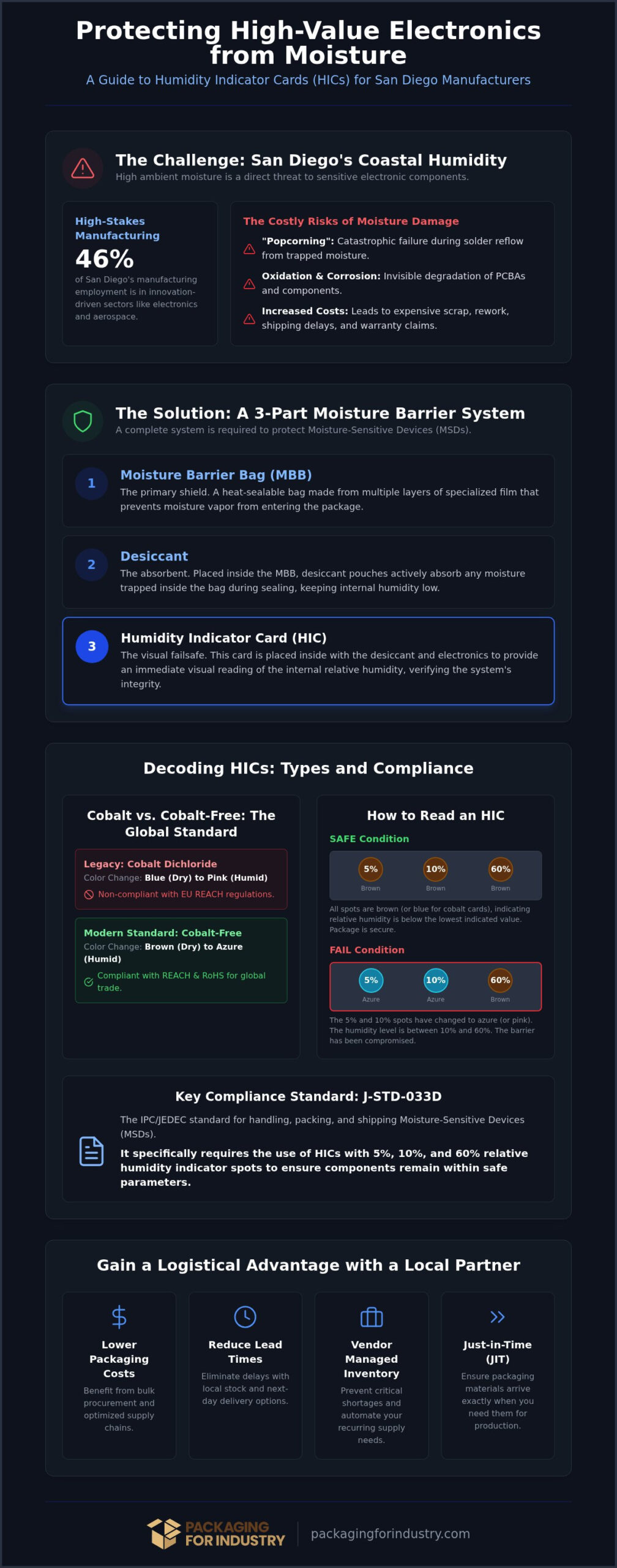
Compliance isn’t optional for serious manufacturing operations. The IPC/JEDEC J-STD-033D standard dictates strict protocols for handling, packing, and shipping moisture-sensitive devices (MSDs). This standard specifically requires the use of HICs with 5%, 10%, and 60% relative humidity indicator spots to ensure components remain within safe parameters. PFI specializes in providing materials that meet these rigorous military and aerospace packaging specifications. We help local firms maintain compliance with global standards, ensuring that every shipment meets the high-reliability requirements of government and industrial contracts. If you need to verify your current moisture control protocol, you can request a packaging quote to ensure your supplies meet the latest revisions.
Understanding Humidity Indicator Card (HIC) Types and Standards
Humidity indicator cards serve as the primary visual diagnostic tool for sealed moisture-sensitive packaging. These instruments consist of chemically impregnated paper that undergoes a visible color change when exposed to specific levels of relative humidity (RH). For local manufacturers, selecting the correct humidity indicator cards for electronics packaging San Diego shipments require is a matter of both engineering precision and regulatory compliance. These cards provide a low-cost, reliable method for monitoring the internal environment of a moisture barrier bag without needing expensive electronic sensors.
Applications generally fall into two categories: reversible and non-reversible. Reversible cards change color as humidity fluctuates, allowing you to see the current state inside a package. In contrast, non-reversible cards provide a permanent record if a specific threshold was breached at any point during transit. Depending on the level of detail your quality control team needs, you can choose between 3-spot, 4-spot, or 6-spot configurations. More spots provide a more granular look at the moisture levels, which is vital for components with high sensitivity levels.
Cobalt-Free vs. Standard HICs
Traditional HICs used cobalt dichloride, which changes from blue to pink. However, European Union REACH regulations now classify cobalt dichloride as a Substance of Very High Concern (SVHC). This shift has made cobalt-free cards the industry standard for global trade. Modern alternatives typically use a brown-to-azure or yellow-to-blue color scale. If your manufacturing operation exports to Europe or Asia, using cobalt-free HICs ensures you remain compliant with RoHS and REACH standards. It’s a proactive step that prevents customs delays and environmental penalties while protecting your brand’s reputation for quality.
Reading the Relative Humidity (RH) Levels
Most industrial cards follow thresholds like 5%, 10%, and 60%. A change at the 5% or 10% level suggests the desiccant is reaching capacity and may need replacement. The 60% mark is often a critical fail indicator; if this spot changes color, the components may have suffered permanent damage. Scientific research on the Impact of Environmental Factors on Failure Rates confirms that even brief exposure to high humidity can lead to latent defects in sensitive circuitry. Staff should be trained to interpret these color zones under consistent industrial lighting to avoid misreading a “Safe” level as “Unsafe.” If you’re unsure which configuration fits your specific aerospace or electronics project, you can compare packaging pricing and options with a local expert to find the most cost-effective compliant solution.
Choosing the Right HIC for Your Electronics Packaging Needs
Selecting the right humidity indicator cards for electronics packaging San Diego companies use involves more than just meeting a basic standard. You must evaluate the specific Moisture Sensitivity Level (MSL) of your components to determine the necessary response time of the indicator. High-sensitivity items, such as advanced microprocessors or medical sensors, require cards that react quickly to even minor humidity spikes. This sensitivity must be balanced against your desiccant capacity. If your desiccant is undersized for the package volume, the HIC will reach its “unsafe” threshold too early, leading to unnecessary re-baking or disposal of perfectly good components.
San Diego’s logistical environment adds another layer of complexity. Transit through coastal humidity zones or staging in non-climate-controlled warehouses can create micro-climates inside your shipping containers. Temperature fluctuations during transport also affect how moisture interacts with the air inside the bag. We recommend choosing cards with trigger points that align with your specific storage duration and the anticipated environmental stress of your distribution route. Customization options are also available for branding or specific RH trigger points to match proprietary quality control protocols.
3-Spot vs. 6-Spot: Application Framework
3-spot cards are often the most pragmatic choice for high-volume manufacturing of less sensitive items. They provide a clear, binary status check at 5%, 10%, and 60% relative humidity. However, for critical aerospace and medical components where failure is not an option, 6-spot cards offer a more granular view. They allow quality control teams to track moisture trends over time, providing data on whether a seal is slowly failing or if a desiccant is nearing the end of its life. Investing in more complex cards is a fiscally responsible decision when protecting high-value assets where a single latent defect could cost thousands in warranty claims.
Integration with Moisture Barrier Bags
The HIC is only effective if it’s visible. Proper placement involves ensuring the card is either visible through a transparent window or positioned so it’s the first thing a technician sees upon opening the container. These cards must be compatible with anti-static and ESD-safe materials to prevent electrical discharge damage during the packing process. You can request a packaging quote to bundle HICs with moisture barrier bags and custom foam inserts, ensuring a fully integrated protection system that simplifies your procurement and reduces overall supply chain risk.
Best Practices for Using HICs in Moisture-Barrier Systems
A humidity indicator card is only one component of a high-performance moisture-barrier system. To ensure total protection, you must employ the “Three-Part System” which consists of a Moisture Barrier Bag (MBB), a desiccant pouch, and the HIC itself. These components work in tandem to create a dry micro-environment for your components. For the most accurate relative humidity readings, place the card at the center of the package. Positioning it too close to the bag’s seal or directly against a desiccant pouch can result in skewed data that doesn’t represent the true environment around the electronic device. When using humidity indicator cards for electronics packaging San Diego warehouse managers must ensure that bulk stock is kept in airtight containers. Leaving a container open in a coastal facility for even an hour can prematurely activate the cards, rendering an entire batch useless and driving up your operational costs.
Installation and Sealing Protocols
The method of sealing your package significantly impacts how your HIC performs. Vacuum sealing is the preferred method for high-reliability electronics as it removes the moisture-laden air that can saturate a desiccant too quickly. However, you must avoid direct contact between the HIC and sensitive metal surfaces of your components. The chemicals in the indicator spots can occasionally cause localized corrosion if pressed directly against a lead frame or PCBA. If a card arrives “tripped,” meaning the color has changed to the unsafe threshold, you must follow J-STD-033 protocols. This usually involves baking the components to remove absorbed moisture before they can be safely soldered, a process that adds time but prevents catastrophic field failures.
Reducing Shipping Damage with Integrated Solutions
Moisture control shouldn’t be an afterthought in your logistics planning. By combining HICs with custom foam packaging, you address two threats simultaneously: physical shock and environmental degradation. This integrated approach ensures that sensitive components are cushioned while humidity levels are monitored. Many of our clients utilize packaging kitting services to streamline their production lines. This ensures every kit contains the exact amount of desiccant and the correct HIC configuration required for the specific job. Documenting the HIC status upon receipt at your facility improves supply chain accountability and helps you identify which carriers or routes may be compromising your packaging integrity.
Bulk HIC Procurement and VMI for San Diego Manufacturers
Sourcing humidity indicator cards for electronics packaging San Diego facilities shouldn’t be a logistical bottleneck. While global catalog suppliers offer convenience, they often fail to provide the localized support and wholesale pricing necessary for high-volume manufacturing. By choosing a local partner, you eliminate the high freight costs associated with shipping bulk orders across the country. Local procurement also ensures that your supply chain remains resilient against national transit delays. PFI offers local next-day delivery to manufacturing hubs throughout San Diego County, providing a level of responsiveness that distant distributors cannot match. This proximity allows us to act as an extension of your own warehouse, reducing your on-hand inventory requirements and improving your cash flow.
Wholesale pricing models offer a significant advantage over standard retail catalogs. When you buy in industrial quantities, the total cost of ownership drops as we help you optimize your shipping configurations and reduce waste. We focus on the intersection of engineering and economics, ensuring that your moisture control protocol is both compliant and cost-effective. By bundling HICs with other consumables like stretch film and corrugated boxes, you can streamline your vendor list and simplify your accounting processes.
Streamlining Purchasing with VMI
Packaging shortages can halt a production line just as easily as a missing component. Our Vendor Managed Inventory (VMI) programs take the guesswork out of procurement by managing your HIC and moisture barrier bag stock based on actual usage. Instead of reacting to a stockout with expensive emergency rush orders, you benefit from a steady, predictable supply of critical moisture-control consumables. This proactive approach frees up valuable warehouse space, as we maintain the bulk of your inventory at our facility and deliver only what you need for your current production cycle. It shifts the burden of inventory management from your purchasing team to our logistics experts, allowing your staff to focus on core manufacturing operations.
Request a Quote for San Diego Industrial Packaging
Every electronics build has unique requirements, and a one-size-fits-all approach to packaging rarely yields the lowest total cost of ownership. We provide custom sizes available for various HIC and desiccant configurations to match your specific product sensitivities and MSL requirements. Beyond just components, you have access to PFI’s custom design packaging expertise to create a fully optimized protection system. Whether you need to bundle indicators with heavy-duty corrugated boxes or anti-static foam inserts, our team can engineer a solution that maximizes protection while minimizing material waste. You can contact our San Diego service team today to request a packaging quote and compare our wholesale pricing against your current supplier.
Secure Your Supply Chain with Local Moisture Control Expertise
Protecting high-value electronics in Southern California requires a methodical approach to moisture management. By integrating compliant humidity indicator cards for electronics packaging San Diego manufacturers can verify the integrity of their shipments and avoid the high costs of moisture-related failures. Whether you’re navigating the transition to cobalt-free chemistry or looking to optimize your warehouse through vendor-managed inventory, the right local partner makes the difference. PFI provides specialized aerospace and electronics expertise, ensuring your packaging meets the most rigorous industrial standards.
Our local San Diego delivery and support team eliminates the lead times and shipping costs associated with national catalog distributors. By bundling your moisture control components with custom foam and corrugated solutions, you create a comprehensive system of protection that safeguards your bottom line. We’re here to help you streamline your procurement and ensure your products arrive in perfect working condition every time.
We look forward to helping you lower your packaging costs and improve your operational reliability.
Frequently Asked Questions
Are humidity indicator cards reusable after they change color?
Reversible humidity indicator cards are designed to fluctuate with ambient conditions. You can reset them by placing them in a low-humidity environment or using a fresh desiccant. However, industry standards like J-STD-033D specify that if the 60% relative humidity spot has changed color, the card must be replaced. This ensures the integrity of the monitoring system and prevents the use of compromised indicators in high-value electronics shipments where accuracy is critical.
What is the difference between cobalt-free and standard HICs?
The primary difference lies in chemical composition and regulatory compliance. Standard cards use cobalt dichloride, which changes from blue to pink but is classified as a Substance of Very High Concern under EU REACH regulations. Cobalt-free alternatives use safer chemical indicators that typically transition from brown to azure or yellow to blue. Choosing cobalt-free humidity indicator cards for electronics packaging San Diego manufacturers export globally ensures compliance with international environmental and safety standards.
Do humidity indicator cards comply with IPC/JEDEC J-STD-033?
Yes, specific humidity indicator cards are manufactured to meet the rigorous requirements of IPC/JEDEC J-STD-033D. This standard is the industry benchmark for handling, packing, and shipping moisture-sensitive devices. Compliant cards must feature indicator spots at the 5%, 10%, and 60% relative humidity levels. Using these certified cards is essential for aerospace and semiconductor firms to maintain quality control and meet military-spec packaging requirements for long-term storage and transit throughout the supply chain.
How many humidity indicator cards come in a standard bulk pack?
Most industrial humidity indicator cards are sold in bulk containers to maintain their chemical integrity. A standard pack typically contains 125 or 200 cards per moisture-sealed can. These bulk quantities are ideal for high-volume manufacturing environments where consistency is key. Purchasing in these configurations allows you to compare packaging pricing effectively and ensures your warehouse team always has enough stock on hand for recurring packaging needs and high-speed production runs.
What color should the humidity indicator card be if the package is safe?
The “safe” color depends entirely on the chemical composition of the card you are using. For traditional cobalt-based cards, a blue color indicates a dry, safe environment. For modern cobalt-free cards, the safe state is typically represented by a brown or yellow color. If the spots transition to pink, azure, or blue, it signifies that the relative humidity threshold has been breached and the internal environment is no longer considered dry enough for sensitive components.
Can I buy humidity indicator cards for local delivery in San Diego?
PFI provides local next-day delivery for humidity indicator cards for electronics packaging San Diego companies rely on for their daily operations. By sourcing locally, you reduce transit times and eliminate the high freight costs associated with national catalog suppliers. Our San Diego service team supports the entire county, from Oceanside to Chula Vista, ensuring that your production lines never face delays due to a lack of critical moisture control supplies.
How long do HICs last inside a sealed moisture barrier bag?
Inside a properly vacuum-sealed moisture barrier bag with an adequate amount of desiccant, a humidity indicator card will remain effective for 12 to 24 months. The actual lifespan depends on the quality of the seal and the moisture vapor transmission rate of the bag material. If the bag is opened or the seal is compromised, the HIC will react to the ambient air within minutes, providing an immediate visual status update for your team.
Do you offer custom HIC configurations for aerospace applications?
We offer custom configurations and specialized trigger points tailored for high-stakes aerospace and defense applications. These custom sizes available ensure that your monitoring system aligns perfectly with the specific moisture sensitivity levels of your components. Our engineering-minded approach allows us to bundle these specialized indicators with mil-spec crates and custom foam packaging. You can request a packaging quote to discuss your specific technical requirements and ensure full compliance with aerospace standards.