
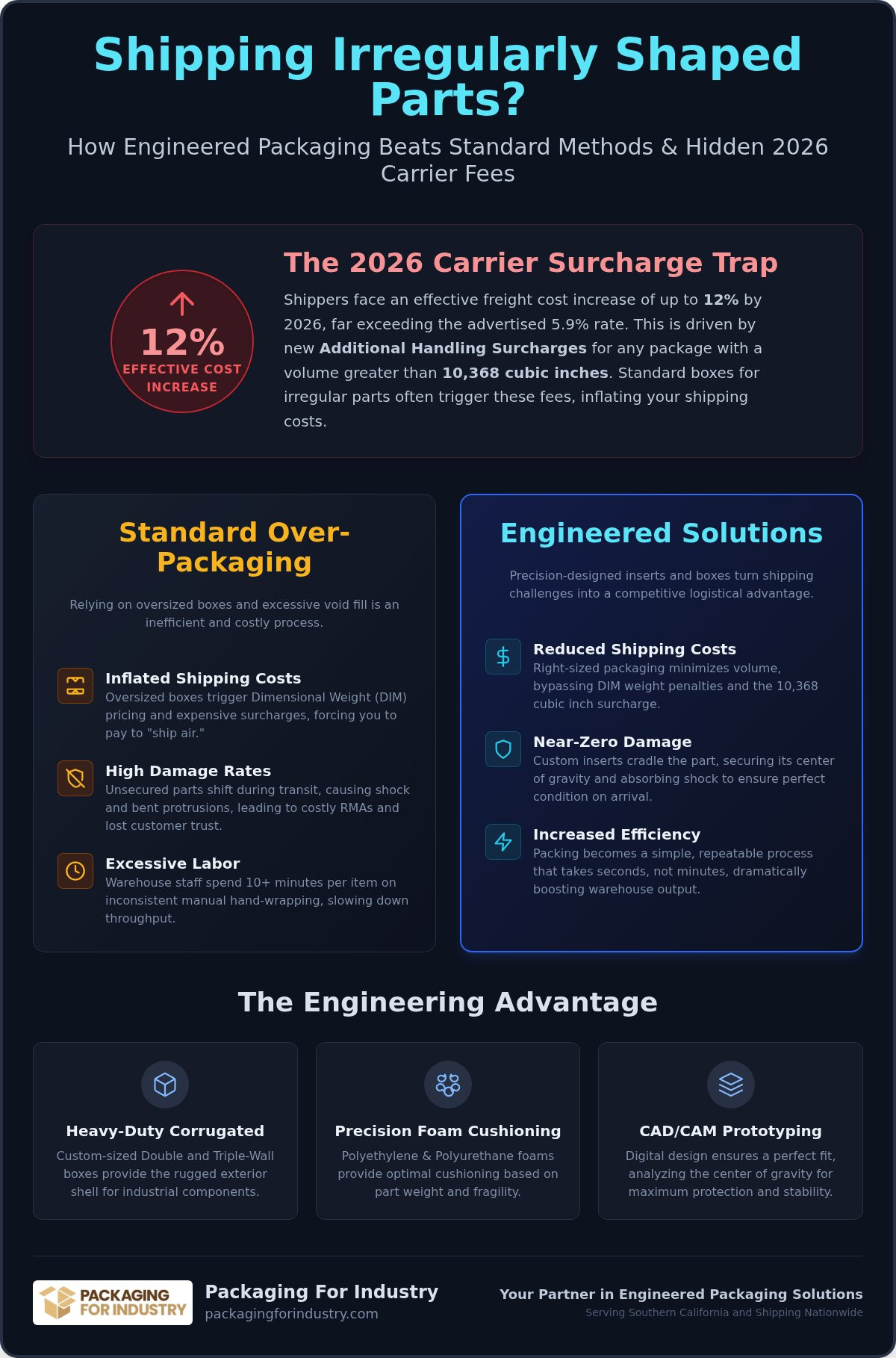
Shippers are currently facing an effective cost increase of up to 12% in 2026, far exceeding the advertised 5.9% general rate increase. This financial strain is largely driven by new carrier thresholds that apply Additional Handling Surcharges to any package exceeding 10,368 cubic inches. If you’re shipping components with awkward dimensions, you already know the frustration of paying to “ship air” and the labor-intensive process of hand-wrapping fragile protrusions in layers of bubble wrap. It’s a significant drain on your bottom line and your warehouse throughput. This guide demonstrates how engineered packaging solutions for irregularly shaped parts can eliminate transit damage while simultaneously lowering your total landed cost per part.
We’ll explore how custom-tailored foam inserts and specialized corrugated designs bypass 2026 carrier surcharges, simplify the packing process for your warehouse staff, and ensure your industrial components arrive in perfect condition. By shifting from manual wrapping to engineered protection, you can achieve near-zero damage rates and maintain a more predictable, efficient supply chain. Discover how precision engineering turns your most difficult shipping challenges into a competitive logistical advantage.
Key Takeaways
- Identify how custom-engineered inserts outperform manual hand-wrapping to eliminate shipping damage and reduce excessive warehouse labor.
- Evaluate the technical advantages of specific packaging solutions for irregularly shaped parts, including the use of heavy-duty double and triple-wall corrugated boxes.
- Master the selection between polyethylene and polyurethane foam to provide optimal cushioning based on part weight and fragility.
- Leverage CAD/CAM prototyping and center-of-gravity analysis to create packaging that bypasses 2026 carrier Additional Handling Surcharges.
- Optimize your regional supply chain using Southern California local delivery and Vendor Managed Inventory (VMI) programs to maintain stock reliability.
The Hidden Costs of Shipping Irregularly Shaped Parts
Irregularly shaped parts are defined by their non-rectilinear forms, uneven weight distribution, or fragile protrusions. These components, such as manifold assemblies, turbine blades, or specialized medical hardware, don’t sit flush within standard corrugated boxes. When you force a non-standard part into a standard container, you aren’t just wasting material; you’re inviting logistical inefficiency. Standard RSC boxes often fail to protect “weak points” on industrial machinery because they lack the internal structure needed to keep the part stationary during transit.
The 2026 carrier landscape has become significantly more punitive for manufacturers shipping non-conforming items. While UPS and FedEx announced a 5.9% general rate increase, the effective cost for many industrial shippers is actually between 8% and 12%. This discrepancy is due to new 2026 cubic volume thresholds. Effective January 26, 2026, both major carriers apply an Additional Handling Surcharge to packages with a cubic volume greater than 10,368 cubic inches. This policy specifically targets bulky, lightweight parcels that cannot be processed through automated sorting systems, making specialized packaging solutions for irregularly shaped parts an economic necessity.
Understanding Dimensional Weight (DIM) Surcharges
Dimensional weight is a carrier mechanism used to maximize cargo space profitability by billing based on the package’s volume rather than its actual mass. Carriers calculate DIM weight by multiplying the length, width, and height of a box and dividing by a specific factor. If the dimensional weight is higher than the actual weight, you’re billed at the higher rate. Relying on oversized boxes filled with loose void-fill is a “silent profit killer” because it artificially inflates your package’s volume. By engineering the package to fit the part’s exact profile, you can significantly lower packaging costs and avoid the Large Package Surcharge, which can exceed $250 for volumes over 17,280 cubic inches.
Damage Beyond the Surface: Internal Component Shock
When an irregular part is not secured, it creates uneven G-force distribution during drops or vibrations. Even if the box remains intact, the internal component can shift, leading to bent protrusions or internal calibration failures. Utilizing packaging engineering principles allows for the design of custom inserts that cradle the part’s center of gravity. Without this precision, the risk of damage increases, leading to a costly Return Merchandise Authorization (RMA) process. Beyond the freight cost of the return, shipping damage erodes customer trust and disrupts production schedules for your clients.
There is also a significant labor drain associated with non-engineered packaging. In many Southern California warehouses, staff spend 10 minutes or more hand-wrapping a single manifold in layers of bubble wrap. This manual process is inconsistent and expensive. Transitioning to custom packaging solutions for irregularly shaped parts simplifies the workflow. When the packaging is designed for the part, warehouse staff can secure the item in seconds, improving throughput and reducing total landed cost per part.
Custom Engineered Inserts vs. Standard Over-Packaging
Standard packaging methods often rely on an abundance of bubble wrap, packing peanuts, and oversized RSC boxes. This “over-packaging” approach is a silent profit killer. It consumes excessive storage space and forces warehouse staff to guess the necessary level of protection for each unique item. By contrast, custom packaging solutions for irregularly shaped parts replace guesswork with precision engineering. These systems integrate multiple materials, such as polyethylene foam and heavy-duty corrugated, into a single cohesive unit designed for a specific component’s geometry.
The return on investment for custom design becomes clear when analyzing total landed costs. While the initial material price for a custom insert may be higher than generic rolls of wrap, it significantly reduces freight expenses by minimizing package volume. It also eliminates the need for a wide variety of “stock” supplies, which simplifies your procurement process. If you’re looking to lower packaging costs, examining the total labor and freight savings is the most effective starting point.
The Labor Comparison: Manual Wrap vs. Engineered Fit
Warehouse throughput is frequently bottlenecked by complex packing requirements. Manual wrapping of a manifold or turbine blade can take upwards of five minutes per unit. A custom-engineered insert allows for “drop-in” packing, reducing that time to approximately 30 seconds. This standardized process removes human error, ensuring every part is protected identically regardless of which staff member handles the shipment. This commitment to standardized, high-quality protection is a hallmark of elite manufacturing, much like the precision-engineered gear from Fairtex used in professional training. By simplifying the workflow, you increase production line speed without adding headcount or sacrificing quality.
Precision is non-negotiable in the aerospace sector. Delicate turbine parts with intricate geometries often suffer from bent fins or surface abrasions when shipped in standard containers. By implementing Aerospace Packaging Solutions, manufacturers have replaced manual hand-wrapping with custom foam inserts. This transition has helped industrial clients reduce damage rates to near zero. The combination of shock-absorbing foam and rigid outer casing ensures that even the most fragile protrusions remain stationary during high-vibration transit. These packaging solutions for irregularly shaped parts provide the reliability required for high-value industrial assets.
Core Materials for Protecting Non-Standard Components
Selecting the right material is a balance of engineering and economics. While generic paperboard might work for uniform boxes, high-value industrial parts require higher structural integrity. For machinery exceeding 150 lbs, custom wood crates provide the necessary rigidity to prevent base shifting and internal movement. On a pallet level, corner and edge protection like V-board and corner guards are essential to stabilize non-uniform loads, ensuring that protrusions don’t snag or puncture adjacent freight during handling.
Die-Cut Foam Inserts for Precision Fit
Protective foam is not a one-size-fits-all category. Polyethylene (PE) foam is a closed-cell material ideal for heavy parts that require high load-bearing support and vibration dampening. In contrast, Polyurethane (PU) is an open-cell, softer foam better suited for delicate electronics or components with highly polished surfaces. When shipping electronic assemblies, anti-static and ESD foam options are critical to prevent electrostatic discharge during transit. Using the wrong density can lead to “bottoming out,” where the foam compresses fully and transfers the shock directly to the part.
One of the most effective packaging solutions for irregularly shaped parts involves the use of foam end caps. These die-cut components suspend the part in the center of the box, creating a “crush zone” that keeps the item away from impact points. This suspension method is particularly useful for parts with fragile external sensors or fins that cannot touch the outer walls of the container. You can explore our full range of Protective Foam Packaging to see which density and material combination suits your specific application.
Triple-Wall Corrugated and Gaylord Boxes
For automotive engine parts, industrial pumps, and heavy hardware, standard single-wall boxes are insufficient. Double-wall or triple-wall corrugated offers the stacking strength and puncture resistance required for industrial environments. These heavy-duty materials are often used in packaging solutions for irregularly shaped parts where the weight distribution is uneven, putting extreme stress on specific points of the container. Triple-wall corrugated can often replace heavy wood crates for parts weighing several hundred pounds, reducing both material costs and freight weight.
Weather-resistant and mil-spec corrugated options provide additional security for international transit or long-term storage in humid conditions. When managing bulk shipments of smaller irregular parts, custom-sized Gaylords offer an efficient way to consolidate freight. These large-scale containers can be fitted with internal dividers or custom packaging kitting to prevent parts from clashing during movement. By matching the box strength to the load’s specific PSI requirements, you ensure the integrity of the entire supply chain.
The Design and Prototyping Process at PFI
PFI approaches packaging as a technical discipline rather than a commodity purchase. Our design process begins with a detailed initial consultation to map the physical properties of your component. We focus specifically on identifying the part’s center of gravity and any fragile protrusions that might be susceptible to shear forces. By understanding these variables, we can develop packaging solutions for irregularly shaped parts that maintain stability throughout the entire shipping cycle. This proactive engineering prevents the part from rotating or shifting, which is the leading cause of transit damage in non-standard industrial loads.
CAD/CAM Support for Complex Geometries
Engineering-minded design is the most effective defense against oversized containers. Using advanced CAD/CAM software, we create a digital blueprint that optimizes the internal volume of the package. This precision prevents the “shipping air” problem that triggers 2026 carrier surcharges. Our Custom Design Packaging Services also focus on end-user ergonomics. We design for kitting and assembly, ensuring that your customers can unpack complex machinery safely and efficiently without specialized tools. This holistic approach ensures the package performs as well on the receiving dock as it does on the assembly line.
Prototyping: The “Measure Twice, Cut Once” Philosophy
Digital models are essential, but they cannot replace a physical sample. For irregular parts, a digital scan might miss a subtle 1/8″ protrusion that could lead to a structural failure during transit. PFI provides free prototyping to ensure a perfect fit before you commit to a full production run. This “measure twice, cut once” philosophy eliminates the risk of receiving thousands of unusable inserts. It allows your team to test the actual “drop-in” speed for warehouse staff, verifying the labor savings discussed in previous sections.
Our local Southern California manufacturing facilities allow us to produce these prototypes with minimal lead times. Clients in Anaheim, Irvine, and Los Angeles benefit from rapid iteration cycles, moving from a concept to a validated physical sample in days. This speed is critical for manufacturers facing tight production deadlines or sudden product design changes. You can start this process by requesting a packaging quote to define your project requirements.
Once a prototype is produced, it undergoes testing and validation. We simulate the stresses of the shipping environment, including drop tests and vibration analysis. This ensures the structural integrity of the corrugated and the shock absorption of the foam inserts meet your specific protection standards. By validating the design physically, we provide the peace of mind that your high-value industrial components will arrive at their destination in factory condition. Standard packaging solutions for irregularly shaped parts often skip this step, but PFI considers it a fundamental part of our commitment to logistical optimization.
Optimizing Supply Chains for Southern California Manufacturers
Industrial packaging efficiency isn’t solely defined by the design of the box; it’s also determined by the reliability of the supply chain. For manufacturers in Southern California, proximity to your packaging partner is a strategic advantage. PFI provides local next-day delivery to key industrial hubs, including Anaheim, Orange County, Los Angeles, and the Inland Empire. This local presence ensures that your production lines never stall due to a shortage of specialized materials. While we offer nationwide support through a robust partner network, our regional footprint allows for the rapid response times required in high-stakes sectors like aerospace and medical device manufacturing.
VMI and JIT: Solving the Storage Problem
Custom packaging solutions for irregularly shaped parts, particularly those involving bulky foam inserts or heavy-duty triple-wall corrugated, can consume significant warehouse floor space. Maintaining a high stock level of these items is often impractical for lean manufacturing environments. PFI’s Vendor Managed Inventory (VMI) program addresses this challenge by shifting the burden of stock management to our team. We monitor your usage levels and replenish specialized inserts automatically, ensuring you always have the right protection on hand without overstocking your facility.
This approach integrates seamlessly with Just-In-Time (JIT) delivery protocols. By delivering packaging only as it’s needed for specific production runs, you free up valuable square footage for revenue-generating assembly activities. VMI also eliminates the need for expensive emergency rush orders on custom-engineered items. These rush orders often disrupt logistical flow and increase total landed costs. It’s a pragmatic way to lower packaging costs while maintaining 100% supply reliability for your most complex components.
PFI: Your Southern California Packaging Partner
Working with a local supplier in Anaheim provides direct access to experienced packaging specialists who understand the unique operational challenges of the region. We support the specialized industrial clusters in Irvine, Costa Mesa, and Torrance, where precision and compliance are paramount. Whether you’re shipping sensitive medical hardware or heavy aerospace components, our team is available for on-site consultations to identify new efficiencies in your packing process.
This local partnership extends beyond simple delivery. It provides a constant feedback loop between your warehouse staff and our engineering team. If a part design changes or a new shipping route increases vibration risks, we can adjust your packaging solutions for irregularly shaped parts in real-time. For multi-location industrial clients, PFI leverages a nationwide manufacturing network. This ensures that the same high standards of protection and supply reliability are met across all your facilities, from Southern California to the East Coast.
Securing Your Supply Chain with Engineered Precision
Managing non-standard industrial components requires a shift from manual hand-wrapping to precision engineering. By adopting custom packaging solutions for irregularly shaped parts, you eliminate the financial drain of DIM weight surcharges and the operational stress of transit damage. PFI acts as a technical consultant to ensure your aerospace and mil-spec components remain stationary and secure through every stage of transit. Our free prototyping process guarantees a perfect fit before production begins, which removes the risk of costly design errors or material waste.
For manufacturers in Anaheim, Irvine, and Los Angeles, our local next-day delivery and VMI programs provide the supply reliability needed for high-volume production. Transitioning to an engineered approach isn’t just about protection; it’s about optimizing your total landed cost and warehouse throughput. We’re ready to help you solve your most complex logistical challenges with durability and fiscal responsibility.
We look forward to helping you streamline your logistics and protect your most critical industrial assets.
Frequently Asked Questions
How do you calculate shipping costs for irregularly shaped items?
Carriers calculate shipping costs based on dimensional (DIM) weight or actual weight, whichever is higher. For irregular items, the total volume of the outer container determines the billable weight. Effective January 26, 2026, UPS and FedEx apply Additional Handling Surcharges to packages with a cubic volume greater than 10,368 cubic inches. Implementing engineered packaging solutions for irregularly shaped parts minimizes this exterior footprint, helping you avoid these costly surcharges and reducing your total freight spend.
Can I get a custom foam insert for a single high-value part?
We specialize in high-value, low-volume protection for sensitive industrial components. While we support bulk production, our free prototyping service ensures a guaranteed fit for individual aerospace or medical assemblies. This approach is ideal for specialized machinery where a single instance of transit damage leads to significant financial loss. We analyze the part’s center of gravity to design a one-off insert that provides maximum shock absorption during handling, ensuring your asset arrives in factory condition.
What is the best way to prevent damage to fragile protrusions on industrial parts?
The most effective method is using custom foam end caps to suspend the part in the center of the container. This technique creates a “crush zone” that prevents fragile fins, sensors, or connectors from touching the outer walls of the box. By isolating these weak points from impact zones, you achieve near-zero damage rates. We typically utilize high-density polyethylene foam for heavy industrial loads to ensure that fragile protrusions remain stationary throughout the entire shipping cycle.
How does custom packaging reduce my total labor costs in the warehouse?
Custom inserts eliminate the need for time-consuming manual processes like hand-wrapping parts in bubble wrap or layers of stretch film. Standardizing the packing process with “drop-in” inserts allows warehouse staff to pack complex components in approximately 30 seconds rather than several minutes. This increased throughput reduces the labor hours required per shipment and removes the variability of human error, ensuring every part is protected to the same engineering standard regardless of who handles the shipment.
Is custom packaging for irregular parts more expensive than standard boxes?
While the initial material cost for a custom insert is higher than a generic RSC box, the total landed cost is lower. Custom designs reduce the overall package volume, which helps you avoid 2026 DIM weight surcharges and Large Package Surcharges that can exceed $250. When you factor in reduced damage rates and lower warehouse labor expenses, engineered packaging solutions for irregularly shaped parts provide a superior return on investment compared to standard catalog supplies.
Do you offer ESD protection for irregularly shaped electronic components?
We provide full ESD protection using specialized anti-static and conductive foam materials. These are essential for irregularly shaped electronic assemblies in the aerospace and medical sectors to prevent electrostatic discharge during handling and transit. Our engineering team can design custom inserts that combine ESD properties with high shock absorption, ensuring your sensitive hardware is protected from both physical impact and electrical damage within a single integrated unit, tailored specifically to your component’s unique geometry.
How long does the prototyping process take for custom packaging designs?
Our local Southern California manufacturing capabilities allow for rapid prototyping, often completed within a few business days. Because we handle design and production in-house, we can iterate quickly on complex geometries. This speed is a critical advantage for manufacturers in Anaheim and Irvine who face tight production deadlines. Once you request a packaging quote and provide part specifications, we move immediately into the CAD/CAM design phase to produce a physical sample for your validation.
Do you provide local delivery in Los Angeles and Orange County?
PFI offers local next-day delivery throughout Southern California, including Orange County, Los Angeles, San Diego, and the Inland Empire. Our Anaheim-based fleet ensures that regional clients receive their custom corrugated boxes and foam inserts exactly when they’re needed for production. This proximity supports our Vendor Managed Inventory (VMI) and Just-In-Time (JIT) programs, allowing you to maintain lean warehouse operations without risking stockouts of critical packaging supplies, while also offering nationwide shipping capabilities.