
A single “dead on arrival” sensor represents much more than a lost component. It’s a stalled production line and a damaged professional reputation that costs far more than the hardware itself. If you’ve dealt with the fallout of delicate controls compromised by electrostatic discharge or transit vibration, you know that standard shipping materials often fail to meet industrial requirements. Securing custom packaging for industrial sensors and controls is a specialized engineering challenge that requires a precise balance of technical protection and fiscal responsibility.
You’re likely looking for a way to stop the cycle of transit damage without overpaying for oversized boxes or waiting weeks for custom foam inserts. This guide will show you how to engineer high-performance shipping protection that secures your systems while reducing volumetric weight surcharges. We’ll explore how to integrate ESD-safe foam with precision-cut corrugated boxes to achieve zero-damage shipping cycles. From rapid prototyping to vendor-managed inventory, you’ll learn how to streamline your logistics and ensure your sensors arrive ready for immediate, reliable operation.
Key Takeaways
- Understand the integrated approach required to protect delicate electronics from the three primary transit threats: electrostatic discharge, physical impact, and high-frequency vibration.
- Learn how to engineer custom packaging for industrial sensors and controls using specialized ESD foam and material densities that absorb shock without increasing bulk.
- Discover how right-sizing your heavy-duty corrugated boxes can significantly lower packaging costs by reducing UPS and FedEx dimensional weight surcharges.
- Explore how Vendor Managed Inventory (VMI) and just-in-time delivery models eliminate production bottlenecks and the stress of emergency packaging shortages.
- Identify the value of free prototyping and CAD/CAM design support to ensure a precise fit for your control systems before committing to bulk production.
The Critical Requirements for Industrial Sensor Shipping
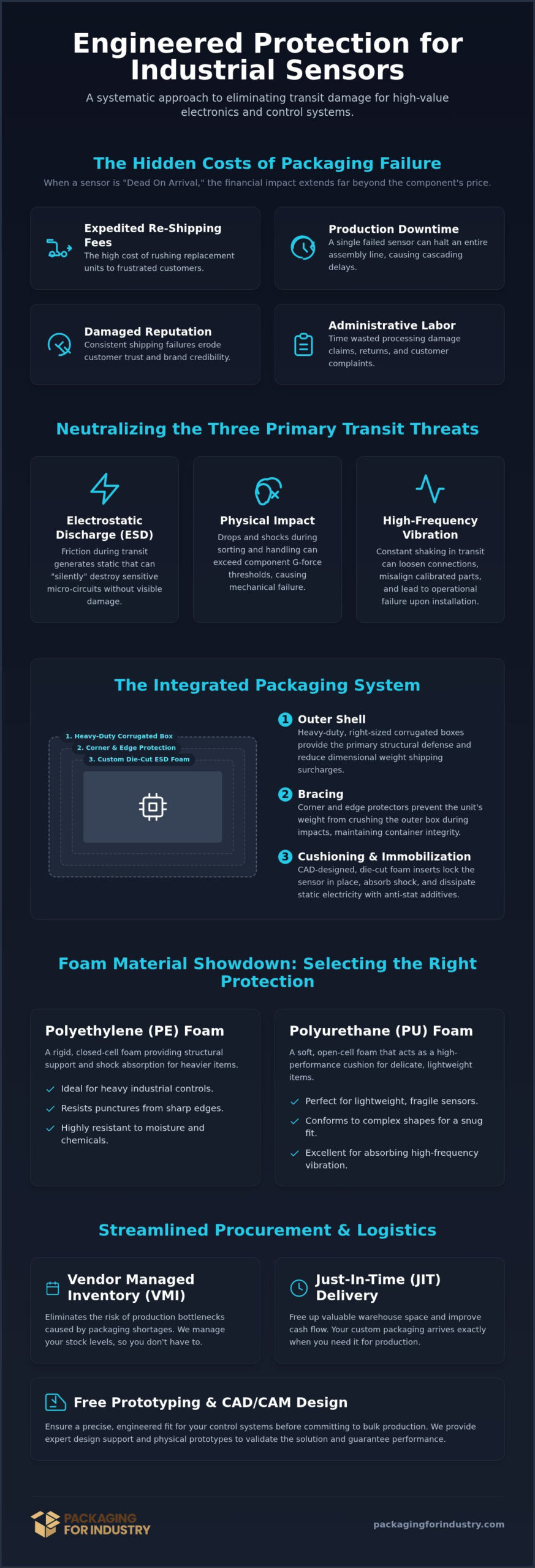
Industrial sensor packaging is not merely a container; it’s a multi-layered, integrated system designed to neutralize environmental stressors. While a standard box might suffice for hardware store tools, high-precision sensors require a combination of heavy-duty corrugated outer shells and precision-engineered internal cushioning. Effective custom packaging for industrial sensors and controls must address three primary threats: electrostatic discharge (ESD), physical impact, and high-frequency vibration.
Relying on off-the-shelf catalog boxes often leads to catastrophic failure. These generic solutions lack the structural integrity to withstand the rigors of LTL (Less Than Truckload) freight or the aggressive handling of modern parcel sorting facilities. When a sensor arrives “dead on arrival,” the financial impact extends far beyond the cost of the replacement part. Common hidden costs include:
- Expedited re-shipping fees for replacement units.
- Production downtime for your end-user or assembly line.
- Erosion of brand reputation and customer trust.
- Administrative labor spent on damage claims and RMA processing.
Understanding Electrostatic Discharge (ESD) Risks
During transit, the constant movement of a sensor against standard plastic or foam generates triboelectric charging. This friction creates static electricity that can easily fry delicate micro-circuits without leaving any visible external damage. Surface protection alone is insufficient for high-value electronics. High-performance protective foam packaging utilizes “pink” anti-static additives to dissipate charges before they reach sensitive components. This creates a safe environment that maintains the electronic integrity of the control system throughout the entire logistics cycle. It’s a proactive measure that prevents the “silent” failures often discovered only after installation.
Vibration and Impact Protection
Control panels and sensors often have specific G-force thresholds that, if exceeded, result in internal mechanical failure. Standard dunnage like bubble wrap allows for “shifting,” which creates internal momentum that magnifies impact forces during a drop. Professional custom packaging for industrial sensors and controls utilizes die-cut foam inserts to lock the component in place. This eliminates movement and absorbs the kinetic energy of transit shocks. For larger control housings, we often recommend corner and edge protection to prevent the weight of the unit from crushing the corrugated exterior upon impact. This integrated approach ensures that the outer shell and the internal cushion work together to neutralize shocks.
Custom Foam Inserts: Engineering the Perfect Fit
Protecting high-value electronics requires more than just filling empty space. It demands an engineered interior that matches the specific geometry of your hardware. By utilizing CAD/CAM design support, we create custom packaging for industrial sensors and controls that eliminates the guesswork of manual packing. While foam-in-place methods offer a quick fix, they often lack the repeatable precision and professional presentation required for industrial-grade equipment. Die-cut foam provides a consistent, snug fit that ensures every component remains exactly where it was placed during assembly.
The effectiveness of these inserts relies heavily on material density. A foam that’s too soft will bottom out under heavy impact, while a foam that’s too rigid will transfer the shock directly to the sensor. Our engineering team reviews your product’s weight and fragility to determine the optimal density, ensuring your logistics chain remains damage-free. This technical approach prevents the over-packaging that leads to excessive material waste and increased shipping costs.
Polyethylene vs. Polyurethane Foam for Sensors
Choosing the right material depends on the sensor’s mass and fragility. Polyethylene (PE) is a closed-cell, rigid foam that’s ideal for heavy industrial controls or components with sharp edges that might puncture softer materials. It provides excellent structural support and is highly resistant to moisture. Conversely, Polyurethane (PU) is an open-cell, soft foam designed for lightweight, delicate sensors. It acts as a high-performance cushion that absorbs minor vibrations that could recalibrate sensitive instruments. Both materials are available in ESD-safe versions to prevent the static buildup discussed in the previous section.
Custom Die-Cut Foam vs. End Caps
For complex sensor arrays or kits with multiple cables and accessories, full die-cut inserts offer the most comprehensive protection. This method allows for packaging kitting, where all related parts are organized into a single, professional insert. This organization speeds up the assembly process at the destination and reduces the risk of missing components. If you’re shipping standardized sensor housings, foam end caps might be a more cost-effective alternative. End caps suspend the unit in the center of the box, providing a generous “crumple zone” without the material cost of a full insert. You can request a packaging quote to see which configuration best fits your budget and protection needs.
Optimized Corrugated Boxes for Control Systems
The outer box serves as the primary barrier against the physical rigors of the global supply chain. When engineering custom packaging for industrial sensors and controls, we specify double-wall or triple-wall corrugated materials to handle the high-density weight of control systems. To further stabilize these loads during palletized transit, we often incorporate corner boards. These vertical reinforcements significantly increase stacking strength and protect the box edges from being crushed by high-tension stretch film or heavy stacking in freight trailers. This structural reinforcement ensures that even the heaviest control housings remain secure from the warehouse floor to the final installation site.
For international shipments or environments with fluctuating humidity, we provide weather-resistant coatings that prevent corrugated fibers from softening. This is essential for maintaining the box’s integrity during long-duration sea or air freight. Additionally, custom printing allows you to include high-visibility handling instructions and “Fragile” warnings, which are critical for ensuring warehouse personnel treat your sensitive instrumentation with the necessary care.
RSC Boxes vs. Die-Cut Designs for Manufacturers
Standard RSC boxes remain the most economical choice for high-volume sensor components that fit traditional dimensions. They are easy to assemble and provide reliable protection for bulk manufacturing orders. However, for specialized control units or complex sensor kits, Custom Corrugated Boxes designed as die-cuts offer superior precision. These containers are engineered to fold around your specific hardware and foam inserts, creating a compact and professional package. Because we have custom sizes available for every industrial application, you can eliminate the redundant materials and excessive void fill often required with stock containers.
Reducing Freight Costs with Precision Sizing
Freight spend is frequently dictated by volume rather than actual weight. Carriers use dimensional weight calculations, which means you’re effectively paying to ship “air” if your containers are larger than necessary. With custom sizes available across our entire corrugated line, we help you right-size your containers to match your specific sensor kits. PFI performs detailed packaging reviews to identify these inefficiencies, allowing you to lower packaging costs while improving the structural integrity of your shipments. This data-driven approach ensures your logistics budget is spent on component protection rather than unnecessary carrier surcharges.
Procurement Strategies: VMI and Just-In-Time Delivery
A sophisticated sensor production line is only as efficient as its packaging supply chain. If your assembly team finishes a batch of high-value controls but lacks the specific custom packaging for industrial sensors and controls required to ship them, your operations ground to a halt. Packaging shortages create immediate bottlenecks that lead to missed delivery deadlines and strained customer relationships. For manufacturers handling custom-engineered items with longer design lead times, the risk of an “emergency order” is a constant operational stressor that impacts the bottom line.
Implementing a stocking program for your protective materials transforms this reactive process into a proactive asset. By maintaining a buffer of your specific die-cut foam and heavy-duty boxes, you ensure that your shipping department is never the cause of a lead-time delay. This reliability is especially critical for electronics manufacturers who must balance high output with the delicate nature of their hardware. Reliable supply chains don’t just happen; they’re engineered through careful inventory planning.
Packaging Inventory Management for Electronics
Our Vendor Managed Inventory Services eliminate the burden of manual tracking. We conduct regular usage reviews to monitor your stock levels and trigger replenishments before a shortage occurs. This system allows you to reduce warehouse clutter by storing your bulky corrugated boxes and foam inserts off-site at our facility until they’re needed. It’s a pragmatic way to optimize your floor space for revenue-generating manufacturing rather than passive storage. We handle the logistical heavy lifting so your team can focus on production.
Next-Day Delivery in Southern California
Proximity is a major advantage for tech hubs across the region. We provide local next-day delivery to manufacturers in Irvine, Anaheim, and San Diego. This local supply chain support improves your cash flow by allowing for smaller, more frequent deliveries that align with your actual production schedule. While we specialize in Southern California logistics, we also provide robust nationwide shipping support for multi-location sensor distributors. Whether you’re a local startup or a national manufacturer, our goal is to provide a reliable supply of custom packaging for industrial sensors and controls that scales with your business needs.
Choosing the Right Packaging Partner for Your Sensors
Selecting a supplier for your custom packaging for industrial sensors and controls requires a shift in mindset from purchasing commodities to investing in engineering. Catalog companies specialize in high-volume, generic stock, but they often lack the technical expertise to design a protective system for sensitive electronics. A true packaging partner doesn’t just sell you a box; they analyze your product’s fragility and shipping environment to create a repeatable, high-performance solution. This distinction is critical when your hardware costs thousands of dollars per unit and cannot afford transit failure. Before making a final decision, it’s essential to compare packaging pricing not just on unit cost, but on the total value of damage reduction and engineering support provided.
Integrated solutions are the hallmark of a professional operation. When you source your heavy-duty corrugated boxes, ESD foam inserts, and industrial tapes from a single vendor, you ensure that every component is designed to work in unison. This holistic approach eliminates the compatibility issues that often arise when mixing materials from different suppliers. It also simplifies your procurement process, reducing administrative labor and ensuring that your entire shipping kit arrives on a single pallet, ready for the assembly line.
From CAD Design to Final Production
Precision electronics require precision packaging. We utilize CAD/CAM design support to translate your sensor’s physical dimensions into a protective blueprint. The process begins with a comprehensive review of your hardware, followed by the development of a digital prototype. This allows for immediate adjustments before any physical materials are cut. We offer free prototyping to ensure the fit is perfect before moving into bulk production. This stage is vital for identifying potential failure points in a controlled environment. If you’re looking to optimize your existing workflow, you can request a packaging cost-reduction analysis to identify hidden inefficiencies in your current materials.
The PFI Advantage for Industrial Electronics
PFI combines deep industrial experience with competitive wholesale pricing that challenges the largest national catalog suppliers. We understand the specific challenges faced by electronics manufacturers, particularly the financial impact of UPS and FedEx dimensional weight surcharges. By right-sizing your containers and selecting the appropriate board grades, we help you lower packaging costs without compromising the safety of your components. Our team serves as a steady partner, offering the stability of a seasoned consultant and the agility of a local manufacturer. You’re not just buying supplies; you’re securing a system of logistical optimization that protects your reputation and your bottom line.
Contact Packaging For Industry for a Custom Quote
Secure Your Sensor Supply Chain for Long-Term Reliability
Engineering a resilient logistics cycle for high-precision electronics requires moving beyond generic catalog supplies. By integrating technical protection like ESD-safe foam with right-sized, heavy-duty corrugated boxes, you eliminate the high costs of transit damage and dimensional weight surcharges. Securing custom packaging for industrial sensors and controls isn’t just about protection; it’s about building a reliable supply chain that supports your production schedule without interruption.
PFI specializes in these high-stakes environments. We offer free prototyping and CAD design support to ensure your components fit perfectly before you commit to bulk production. As specialists in ESD and aerospace-grade packaging, we understand the specific tolerances required for delicate controls. For manufacturers in Los Angeles, Orange County, San Diego, and the Inland Empire, our local next-day delivery ensures your lines keep moving without the stress of inventory shortages. We’re here to help you optimize your logistics and protect your bottom line.
Our team is ready to analyze your current packaging spend and demonstrate how engineered solutions provide both physical security and fiscal efficiency. We look forward to partnering with you to streamline your industrial operations.
Frequently Asked Questions
What is the best foam for shipping sensitive industrial sensors?
The best foam depends on your sensor’s weight and fragility. Polyethylene (PE) is superior for heavy industrial controls due to its rigid support and moisture resistance, while Polyurethane (PU) provides soft cushioning for delicate, lightweight instruments. Both materials are available in anti-static versions to protect sensitive circuits. We analyze your product’s mass to determine the optimal density, ensuring your custom packaging for industrial sensors and controls provides maximum shock absorption without excess material.
How do I prevent ESD damage during the shipping process?
You prevent ESD damage by using dissipative materials that neutralize static charges generated by friction during transit. We recommend using pink anti-static foam or conductive bags as a baseline for all electronic components. These materials prevent the buildup of triboelectric charges that can fry micro-circuits without leaving external signs of damage. For high-value controls, an integrated approach combining ESD-safe inserts with grounded outer packaging ensures your sensors arrive in perfect working condition.
Can custom packaging help reduce my FedEx or UPS shipping surcharges?
Custom packaging reduces shipping surcharges by eliminating redundant “air” inside the box. Carriers calculate costs based on dimensional weight, so oversized boxes directly increase your freight bill. We right-size your corrugated containers to the exact dimensions of your sensor kit, which lowers your total logistics spend. This engineering-led approach ensures you don’t pay for empty space while maintaining the necessary “crumple zones” required for safe industrial transit and handling.
Do you offer free prototypes for custom sensor foam inserts?
We provide free prototyping and CAD/CAM design support for custom sensor foam inserts. This service allows you to verify the fit and protection levels of your custom packaging for industrial sensors and controls before committing to a bulk production run. Our engineers work with your hardware to create a precise digital blueprint, ensuring every cable and accessory is organized. This proactive step eliminates the risk of design errors and ensures repeatable performance across your supply chain.
What is the difference between anti-static and conductive foam?
Anti-static foam, typically pink, contains additives that prevent the buildup of static electricity caused by friction. It’s ideal for surface protection inside a box. Conductive foam, usually black, contains carbon and actively drains existing static charges away from the component. Choosing between them depends on your specific electronics and the sensitivity of the sensor’s circuits. We help you evaluate your hardware to select the material that provides the most effective grounding for your specific application.
How does a Vendor Managed Inventory (VMI) program work for packaging?
A Vendor Managed Inventory (VMI) program transfers the responsibility of stock tracking to our team. We conduct weekly or monthly usage reviews at your facility to monitor current packaging levels. When stock reaches a pre-determined threshold, we automatically trigger a replenishment order. This system eliminates the stress of emergency packaging shortages and allows you to store bulky materials off-site at our warehouse until they’re needed for production, optimizing your warehouse floor space.
Are there specific requirements for shipping sensors internationally?
International shipping requires structural integrity and compliance with global standards. We recommend heavy-duty triple-wall corrugated boxes with weather-resistant coatings to withstand high humidity and long transit times. If you use wooden pallets or crates, they must meet ISPM-15 heat-treatment standards to pass through customs safely. Our team ensures your packaging system is engineered to handle the increased physical stressors of ocean or air freight while meeting all necessary regulatory and customs demands.
Can I get local next-day delivery for my packaging supplies in Orange County?
We offer local next-day delivery for manufacturers and distributors located throughout Orange County. This service covers major tech hubs in Irvine, Anaheim, and Brea, as well as surrounding areas in Los Angeles and San Diego. Local delivery improves your cash flow by allowing for smaller, more frequent shipments that align with your actual production schedule. It eliminates the need for large on-site storage and ensures you always have a reliable supply of industrial packaging materials.