
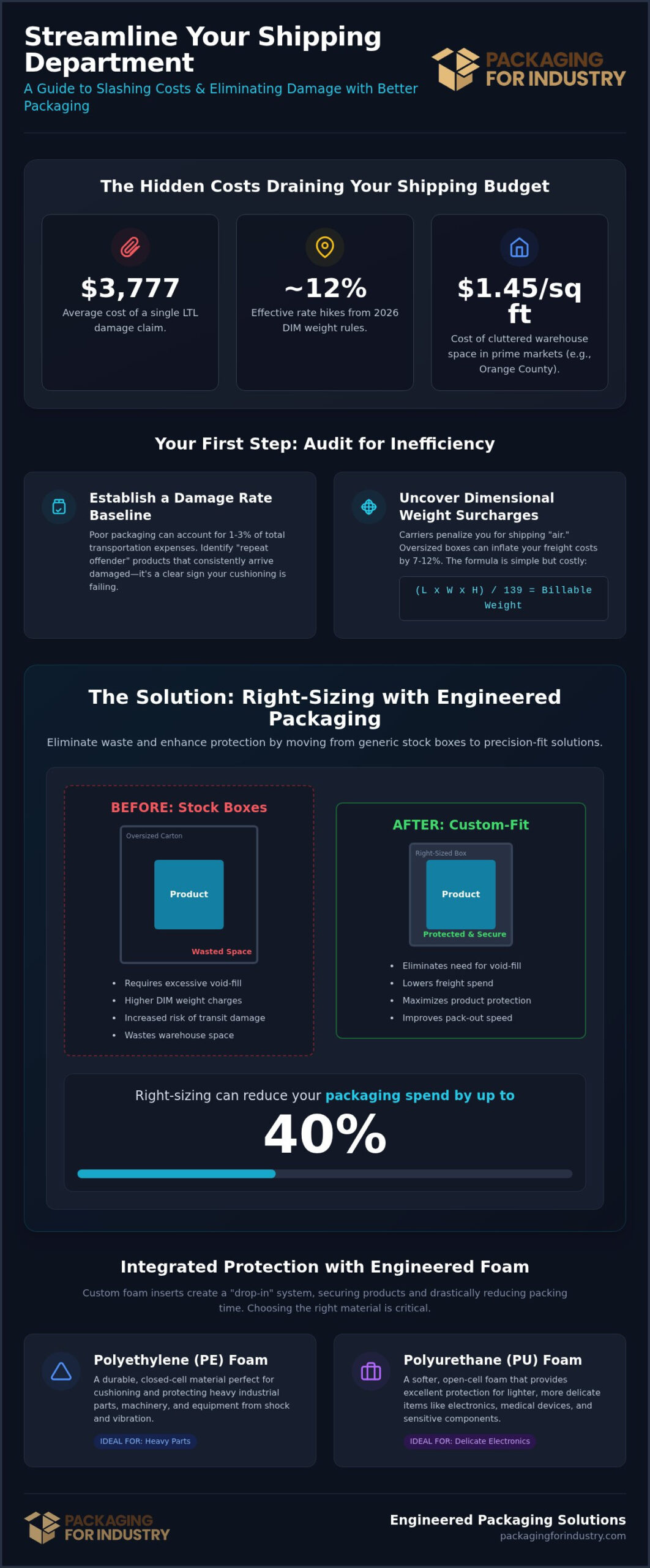
Did you know that poor packaging is responsible for up to 3% of your total transportation expenses, with a single LTL damage claim now averaging $3,777? You’ve likely felt the sting of the 2026 carrier rate hikes, where effective costs for many industrial shippers have climbed by nearly 12% due to stricter dimensional weight rules. It’s frustrating to watch your margins shrink while warehouse floor space remains cluttered with excess inventory. With industrial lease rates in Orange County reaching $1.45 per square foot, you aren’t alone in thinking about making my shipping department more efficient with better packaging to reclaim that lost revenue.
Efficiency is no longer optional. We understand that your goal is a seamless logistical flow where every box is the right size and every shipment arrives intact. This guide will show you how to eliminate shipping bottlenecks, slash transit damage, and lower operational costs through precision-engineered materials and smart inventory management. We’ll explore the impact of the 2026 DIM weight changes, the benefits of Vendor Managed Inventory (VMI), and how right-sizing your corrugated boxes can reduce your packaging spend by 40% while improving your bottom line.
Key Takeaways
- Identify hidden costs by auditing your damage rate baseline and analyzing how oversized boxes trigger expensive dimensional weight surcharges.
- Understand the tactical advantages of making my shipping department more efficient with better packaging through custom-engineered corrugated and foam inserts.
- Secure your shipments and prevent transit damage by selecting the right stretch film and unitization methods for your specific warehouse volume.
- Eliminate the risk of packaging stockouts and reduce administrative overhead by implementing a reliable Vendor Managed Inventory (VMI) program.
- Learn to select an industrial packaging partner that offers technical engineering and local next-day delivery to keep your production lines moving.
Auditing Your Shipping Department for Packaging Inefficiency
Before you can begin making my shipping department more efficient with better packaging, you must identify your current operational leaks. Many managers overlook the cumulative cost of transit damage, wasted labor, and poorly utilized warehouse space. A professional audit provides the data necessary to move from reactive shipping to a proactive, engineered strategy. Without a baseline, you’re simply guessing which changes will impact your bottom line.
Start by evaluating your warehouse floor space. If your facility is cluttered with oversized stock boxes, you’re paying a premium for storage. With industrial lease rates in Orange County averaging $1.45 per square foot, inefficient inventory management is a direct hit to your margins. You should also track the labor hours spent on complex packing processes. If your team is using multiple layers of loose materials to protect a single item, your throughput is suffering. Every extra minute spent at a packing station is a bottleneck that prevents you from matching production speed.
Calculating the Cost of Transit Damage
Establish a “Damage Rate Baseline” to understand exactly where your protection is failing. It’s estimated that poor packaging accounts for 1% to 3% of total transportation expenses. For LTL shipments, the average cost of a single damage claim in 2026 is approximately $3,777. This figure doesn’t even account for the administrative labor or the cost of replacement parts. Identify “repeat offenders” in your product line that consistently sustain edge or corner damage. This is a clear sign that your current cushioning materials aren’t meeting the industrial standards required by modern Packaging Engineering. High damage rates are a symptom of inadequate material selection, and they’re entirely preventable with the right engineering.
The Hidden Drain of Dimensional Weight Surcharges
Carrier pricing in 2026 is driven by density rather than just actual weight. UPS and FedEx now use a domestic DIM divisor of 139 and round every fractional inch up to the next whole number. If you’re shipping “air” in an oversized carton, you’re paying for space you don’t need. This inefficiency can increase your effective freight costs by 7% to 12% over the base rate. Utilizing custom corrugated boxes allows you to right-size your packaging. This eliminates the need for messy void-fill and ensures you aren’t being penalized for shipping empty volume. Right-sizing can reduce your packaging costs by as much as 40%, directly lowering your freight spend by optimizing every cubic inch of the shipping container.
Right-Sizing with Custom Engineered Corrugated and Foam
After identifying your operational leaks, the next step in making my shipping department more efficient with better packaging is moving away from generic Regular Slotted Carton (RSC) boxes. While stock boxes are readily available, they often create “air” that you pay to ship. Custom-fit corrugated dimensions eliminate the need for messy void-fill like packing peanuts or crumpled paper. For heavy industrial equipment, utilizing heavy-duty double-wall or triple-wall corrugated provides the structural integrity necessary for stacking and long-haul transit without the risk of box failure.
Engineering a solution specifically for your product ensures that every cubic inch of the container serves a purpose. We recommend leveraging free prototyping to test the fit and protection of your design before committing to a full production run. This proactive approach prevents costly mid-stream adjustments and ensures your packaging matches your production speed from day one.
Engineering Integrated Protection
Integrating custom protective foam packaging into your boxes creates a “drop-in” system that significantly reduces packing time per station. Die-cut foam inserts are engineered to hold products securely, eliminating movement that causes surface scratches or internal component failure. When selecting materials, it’s vital to choose the right foam density for your weight class. Polyethylene (PE) foam is a durable, closed-cell material ideal for heavy industrial parts, while Polyurethane (PU) foam is softer and better suited for delicate electronics. In sectors like custom design packaging for aerospace and medical components, these engineered tolerances are critical for maintaining product calibration. Adopting these precision designs aligns with the principles of Sustainable Packaging by reducing total material volume while maximizing protection.
Streamlining with Packaging Kitting
One of the most effective ways to boost throughput is through packaging kitting. This process organizes all necessary packaging components, such as the box, foam inserts, and corner boards, into one ready-to-use set. By receiving pre-assembled crates or foam-lined boxes, your warehouse staff spends less time searching for individual supplies and more time fulfilling orders. This eliminates the “search time” that often slows down the packing line during peak production periods. If you’re ready to optimize your floor space and speed up your fulfillment, you can request a packaging quote to see how an integrated kitting solution fits your workflow.
Maximizing Load Stability with Advanced Logistics Supplies
Efficiency doesn’t stop at the individual box level. Once your products are right-sized and kitted, your focus must shift to unitization. If your palletized loads shift during transit, the engineered protection inside the boxes cannot perform its job. Unitizing your loads correctly is a vital step in making my shipping department more efficient with better packaging. This process begins with standardizing your pallet selection. Whether you utilize standard heat-treated wood for international export or custom-sized pallets for specialized racking, the foundation of your load determines its stability throughout the supply chain.
Standardized pallets ensure that your warehouse equipment and carrier trucks operate at peak capacity. When boxes overhang the pallet edge, they lose up to 30% of their compression strength. By matching your pallet size to your box dimensions, you create a solid, stackable unit that resists the vibrations and vertical shocks common in LTL shipping. This structural integrity is essential for maintaining the “engineered protection” we discussed in previous sections.
Optimizing Pallet Wrap Efficiency
Proper stabilization requires more than just several layers of plastic. You must achieve the correct “containment force,” which is the total pressure the stretch film exerts on the load to keep it together. High-performance films allow you to reach this force with less material, reducing both waste and the cost per pallet. For high-volume warehouse operations, switching from manual hand-wrapping to machine stretch film ensures consistent application. This transition eliminates the variability of manual labor and prevents the loose wraps that frequently lead to load failure during abrupt transit stops.
The Role of Corner Boards in High-Density Storage
Warehouse space is a significant overhead, so maximizing vertical storage is essential for fiscal responsibility. Using corner and edge protection provides the structural reinforcement needed to stack pallets higher without crushing the bottom layers. These cardboard corner guards protect fragile edges from the high tension of plastic strapping and accidental forklift impact. By reinforcing the vertical corners of a pallet, you significantly increase the load’s stacking strength. Industry professionals recognize that integrating corner boards is a primary defense against the structural collapses that cause a significant portion of palletized shipping damage. This simple addition ensures that high-value goods remain pristine from the initial racking to the final delivery destination.
Eliminating Shortages via Vendor Managed Inventory (VMI)
Implementing a Vendor Managed Inventory (VMI) program is a decisive step in making my shipping department more efficient with better packaging. In a standard warehouse environment, “inventory distortion”—the combined cost of being out-of-stock or overstocked—is a significant financial drain. VMI solves this by shifting the responsibility of monitoring and replenishing stock to your supplier. This strategic partnership ensures you always have the corrugated boxes and foam inserts you need without tying up excess capital in slow-moving materials.
Beyond the peace of mind, VMI dramatically reduces your administrative burden. You no longer need to issue frequent emergency purchase orders or pay rush shipping fees when supplies run low. By offloading the replenishment cycle to a trusted partner, you’re making my shipping department more efficient with better packaging by ensuring your team never halts production due to a box shortage. This allows your purchasing department to focus on high-value procurement rather than routine packaging replenishment.
How a VMI Program Works Step-by-Step
The process begins with a comprehensive assessment of your usage history, lead times, and available storage space. We establish “Min/Max” levels based on your actual consumption patterns to ensure a consistent supply. Once these parameters are set, the supplier performs scheduled review cycles. Depending on your production volume, these reviews occur on a weekly, biweekly, or monthly basis. This methodical approach ensures that your inventory levels remain optimized, preventing the 20% to 30% annual carrying costs associated with holding excess stock.
Just-in-Time (JIT) Delivery Benefits
For high-volume manufacturers, Just-in-Time inventory management is the gold standard for operational efficiency. JIT delivery ensures that packaging arrives exactly when it’s needed for the production line. This is particularly valuable in Southern California, where high industrial lease rates make every square foot of floor space a premium asset. By receiving supplies on a JIT basis, you can convert box storage areas into revenue-generating production zones. Additionally, this system prevents material obsolescence. If a product design changes, you aren’t stuck with thousands of outdated custom boxes, allowing your business to remain agile and responsive to market demands.
Choosing the Right Industrial Packaging Partner
Selecting a supplier is the final and most critical step in making my shipping department more efficient with better packaging. Many procurement managers make the mistake of choosing a partner based solely on a catalog’s unit price. However, a low price per box often hides the higher costs of freight, transit damage, and inefficient packing labor. You need a partner that offers technical engineering capabilities rather than just a list of stock SKUs. A specialist understands how to balance material durability with economic reality, ensuring your protection levels match the value and fragility of your components.
Total cost transparency is essential for long-term fiscal responsibility. Your partner should be able to demonstrate how an engineered solution reduces your billable weight and eliminates the need for excessive secondary materials. This expertise is particularly vital for companies operating in specialized sectors like aerospace or those requiring mil-spec packaging. These industries demand precise tolerances and documented reliability that general catalog suppliers simply cannot provide. By choosing a consultant who understands these technical requirements, you secure a steady and dependable supply chain.
The Southern California Advantage
Proximity is a major factor in operational speed. Working with a local partner allows for next-day delivery in cities like Anaheim, Irvine, and Los Angeles. This local support is invaluable when you need fast prototyping for a new product launch or an on-site review of your current packing stations. Beyond the immediate coastal areas, PFI supports the Inland Empire and San Diego regions with reliable logistics and personalized service. Local delivery doesn’t just save time; it significantly reduces the shipping costs you pay on the packaging materials themselves, keeping your overhead predictable.
Requesting a Packaging Cost-Reduction Analysis
If you’re serious about making my shipping department more efficient with better packaging, you should start with a comprehensive packaging cost savings review. A specialist can identify hidden surcharge issues, such as the 2026 DIM weight penalties, that general suppliers often miss. This analysis looks at your entire workflow, from the initial design phase to the final delivery, to identify where materials are being wasted or where protection is inadequate. Transitioning from a one-size-fits-all approach to an engineered system is the most effective way to protect your margins and improve reliability.
Ready to streamline your department? Request a custom packaging quote from PFI today.
Take Command of Your Shipping Logistics
Achieving operational excellence requires a shift from buying generic boxes to engineering comprehensive systems. By auditing for DIM weight surcharges and integrating custom foam protection, you eliminate the “air” that drains your budget. Implementing a VMI program further streamlines your workflow by removing the stress of inventory tracking and emergency orders. These strategies are the foundation of making my shipping department more efficient with better packaging in an increasingly expensive carrier market.
PFI supports these goals with specialized expertise in aerospace and medical packaging. We provide free prototyping to ensure a perfect fit and offer local next-day delivery across Southern California to keep your production lines moving without delay. Our team focuses on the intersection of engineering and economics to deliver protection that actually lowers your total cost of ownership.
Transforming your warehouse from a cost center into a streamlined asset starts with a single engineered design. We’re ready to help you build a more reliable and cost-effective shipping operation today.
Frequently Asked Questions
How can I reduce shipping damage without significantly increasing costs?
You reduce shipping damage by shifting from high-volume generic void fill to engineered protection like custom foam inserts and corner boards. While individual material costs might seem higher, you save money by eliminating the $3,777 average cost of an LTL damage claim. Precision engineering ensures that protection is applied exactly where it’s needed, such as on fragile edges or internal components, without adding unnecessary weight or material volume to the shipment.
What is the difference between standard and custom corrugated boxes for shipping efficiency?
Standard RSC boxes often result in shipping “air,” which triggers expensive dimensional weight surcharges under 2026 carrier rules. Custom corrugated boxes are manufactured to your product’s exact dimensions, which is a key strategy for making my shipping department more efficient with better packaging. This right-sizing approach reduces total material waste and lowers freight costs by maximizing shipment density, ensuring you only pay for the space your product actually occupies.
How does dimensional weight (DIM) affect my shipping department’s budget?
Dimensional weight affects your budget by penalizing low-density packages that take up significant space in a carrier’s truck. In 2026, both UPS and FedEx use a DIM divisor of 139 and round fractional inches up to the next whole number. If your box is larger than necessary, you’re billed at a higher weight regardless of the actual product heaviness. This can increase effective shipping rates by 7% to 12% over base prices.
What are the benefits of a Vendor Managed Inventory (VMI) program for packaging?
A VMI program eliminates the risk of production-stopping stockouts while freeing up valuable warehouse floor space. Your supplier monitors usage and replenishes stock based on agreed-upon Min/Max levels, which reduces the administrative burden on your purchasing team. This system improves cash flow by ensuring you only hold the inventory you need for current production cycles, effectively converting a fixed storage cost into a variable operational expense.
Can custom foam inserts actually speed up my packing process?
Yes, custom foam inserts significantly speed up packing times by providing “drop-in” protection that requires no measuring or cutting. Warehouse staff can secure a product in seconds rather than spending minutes wrapping it in bubble or loose-fill materials. When combined with packaging kitting, these pre-assembled sets eliminate the time spent searching for multiple supplies, allowing your shipping stations to maintain a pace that matches your high-speed production lines.
How do I know if I need heavy-duty double-wall or triple-wall boxes?
You generally need heavy-duty double-wall or triple-wall boxes if your product exceeds 80 lbs or requires high vertical stacking strength for long-haul transit. Triple-wall corrugated is often used as a lightweight, cost-effective alternative to wooden crates for industrial machinery. These materials provide the puncture resistance and structural integrity necessary to withstand the vibrations of LTL shipping, ensuring your high-value goods remain protected without the weight of traditional crating.
What is the best way to stabilize a pallet for long-distance industrial shipping?
The most effective way to stabilize a pallet is to achieve the correct containment force using high-performance stretch film and corner protectors. Corner boards reinforce the vertical integrity of the load, allowing for higher stacking and protection against strap-crush. For industrial shipments, using machine-applied stretch film ensures a consistent, tight wrap that prevents the shifting or “toppling” that causes 1% to 3% of transportation expenses to be lost to damage.
Does Packaging For Industry offer local delivery in Southern California?
Packaging For Industry (PFI) provides local next-day delivery from our Anaheim headquarters to businesses throughout Orange County, Los Angeles, and the Inland Empire. We also maintain reliable logistics support for the San Diego region and offer nationwide shipping through our partner network. This local presence is a major advantage for making my shipping department more efficient with better packaging, as it allows for faster turnaround on custom prototypes and VMI replenishment.