
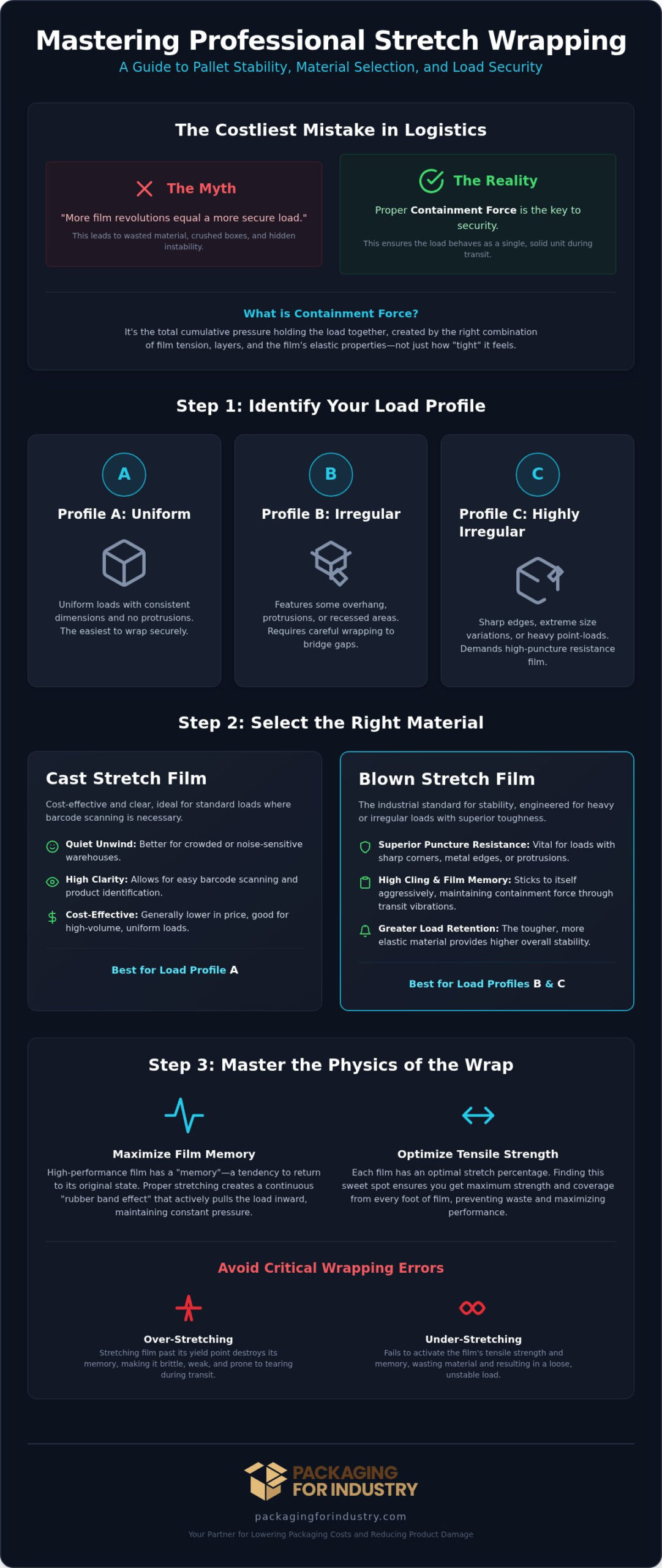
The common belief that more film equals more security is one of the costliest mistakes in industrial logistics. If your warehouse team is simply adding extra revolutions of stretch film to compensate for unstable loads, you aren’t just wasting material; you’re likely failing to achieve the containment force required for safe LTL shipping. Mastering professional stretch wrapping techniques for pallet stability is the only way to ensure your products arrive intact without inflating your packaging budget. We understand the pressure of rising material costs and the professional stress caused by high damage rates during transit.
You probably agree that inconsistent wrapping quality among staff is a liability that your operations can’t afford. This article provides the professional techniques and material selection strategies required to eliminate transit damage and optimize your stabilization process. We’ll explore how to calculate proper containment force, select the right high-performance films for your specific loads, and implement a standardized wrapping protocol that works for your entire team. From local next-day delivery in Orange County and Los Angeles to nationwide logistics support, our goal is to turn your packaging department into a center of efficiency and fiscal responsibility.
Key Takeaways
- Learn why containment force is the primary driver of load security and how it differs from simple film tension.
- Determine whether cast or blown stretch film is better suited for your application based on puncture resistance and clarity requirements.
- Implement standardized stretch wrapping techniques for pallet stability to eliminate transit damage and reduce film waste.
- Compare the operational benefits of manual versus machine wrapping to optimize your team’s throughput and consistency.
- Access PFI’s specialized packaging audits and local Southern California support to lower your total cost of logistics.
The Physics of Pallet Stability: Why Containment Force Matters
Containment force isn’t just about how tight the film feels to a warehouse worker’s touch. It’s the total cumulative pressure holding the load together. In professional logistics, “tightness” refers to the tension applied to the film during application, whereas “containment” is the actual result of that tension combined with the number of layers and the film’s elastic recovery. While machines measure this with precision, manual operators must also understand how to apply consistent force to avoid load shifting. If your team focuses only on tension without considering the physics of the load, you’re likely to see the film snap or the boxes crush while the pallet remains unstable.
Using high-performance stretch film and specific stretch wrapping techniques for pallet stability reduces the “total cost of ownership” by preventing the high costs associated with pallet failure. These costs include more than just damaged goods. They encompass administrative time for damage claims, the logistics of processing returns, and potential safety risks for forklift operators and retail staff. Effective stabilization ensures that the load behaves as a single unit, resisting the lateral forces common in LTL shipping environments.
Understanding Load Profiles (A, B, and C)
To achieve stability, you must first categorize your cargo based on its physical profile. This categorization dictates how you apply the film and which gauge you select:
- Profile A: These are uniform loads with no protrusions. They’re the easiest to wrap because they have consistent dimensions and no sharp corners to puncture the film.
- Profile B: These loads are irregular, featuring some overhang or recessed areas. They require more specific wrapping patterns to bridge gaps and maintain pressure across uneven surfaces.
- Profile C: These are highly irregular loads with sharp edges or extreme size variations. They often require specialized materials like Stretch wrap with higher puncture resistance or the addition of corner protectors to prevent the film from failing at the edges.
The Role of Tensile Strength and Film Memory
High-performance film relies on “film memory,” which is the material’s tendency to return to its original state after being stretched. When applied correctly, it creates a continuous rubber band effect that pulls the load inward. Over-stretching the film past its yield point destroys this memory, making it brittle and prone to tearing. Conversely, under-stretching wastes material because the film doesn’t reach its optimal tensile strength. Matching the film gauge to the cargo weight is essential. A thin film on a heavy Profile C load will fail regardless of how many layers you apply. Utilizing the right stretch wrapping techniques for pallet stability involves finding the precise balance between film stretch and layer count to maximize this memory effect.
Selecting the Right Material: Cast vs. Blown Stretch Film
Material choice isn’t just a procurement decision; it’s a structural one. Selecting the wrong film can negate even the most advanced stretch wrapping techniques for pallet stability. Most operations settle for standard cast film because it’s cost-effective and clear. It’s quiet on the unwind and allows warehouse teams to scan barcodes through the layers without issue. However, cast film lacks the high cling and puncture resistance required for more demanding or irregular loads. If your pallets are consistently shifting, the issue might not be the operator’s technique but the film’s inability to maintain its hold.
Blown film is the industrial standard for stability on heavy or irregular loads. It’s manufactured using a cooling process that creates a much tougher, more elastic material. While it’s noisier and has a slight haze, its superior puncture resistance is vital for Profile C loads with sharp metal edges or protruding wood. Evaluating different pallet packaging methods reveals that the mechanical properties of blown film provide a higher level of one-sided cling. This ensures that the film sticks to itself even under the extreme vibration common in LTL shipping.
When to Use Blown Film for Industrial Loads
Blown film is the preferred choice for heavy machinery or loads with sharp metal edges that would easily pierce cast alternatives. Despite the higher noise levels during application and lower clarity, its performance in variable environments is unmatched. In the high heat of an Inland Empire warehouse or the cold storage facilities common in Southern California, blown film maintains its structural integrity better than cast film. It resists necking, which is the narrowing of the film when pulled, ensuring consistent coverage from top to bottom.
The Efficiency of Pre-Stretched Hand Film
For manual operations, pre-stretched film is a game-changer for both economics and ergonomics. This material is mechanically stretched during manufacturing, meaning your warehouse staff doesn’t have to exert massive physical force to reach the film’s yield point. It significantly reduces worker fatigue while maintaining the high tension required for stability. By utilizing PFI’s stretch film offerings, facilities can reduce material waste by up to 40%. Because the film is already at its optimal length, operators apply less material to achieve the same containment force. If you’re unsure which gauge matches your load profile, you can compare packaging pricing and material specs with our specialists to find the most cost-effective fit.
Manual vs. Machine Wrapping: Choosing Your Method
Deciding between manual and machine application is a pivotal operational choice that impacts both your bottom line and your load integrity. While manual wrapping is often the starting point for low-volume or highly customized pallets, it frequently fails to maintain the rigorous stretch wrapping techniques for pallet stability required for long-haul transport. Semi-automatic wrappers serve as a middle ground, providing the consistency that manual labor lacks without the capital intensity of a fully automatic line. For high-throughput manufacturing facilities operating 24/7, fully automatic systems are the only viable path to maintaining logistical flow and fiscal responsibility.
Calculating the break-even point for a pallet wrapper involves more than just comparing the equipment price to labor hours. You must factor in the reduction in film usage, the drop in damage claims, and the improvement in warehouse safety. For many mid-sized operations in Southern California, the transition to a semi-automatic wrapper pays for itself within 12 to 18 months through these efficiencies alone. Standardizing the application process ensures that every pallet leaving your dock meets the same high standard of security, regardless of which shift is on the floor.
The Hidden Costs of Manual Wrapping
Manual application carries significant invisible liabilities that often outweigh the initial savings of avoiding equipment costs. Beyond the obvious material expenses, the risk of worker injury is a primary concern. According to OSHA’s material handling and storage standards, materials must be secured to prevent sliding or collapse. When workers wrap manually, they struggle to maintain consistent containment force, leading to unpredictable damage rates. The physical strain of the “dizzy factor” and repetitive back movements often leads to fatigue, which further degrades the quality of the wrap. Workers also tend to over-wrap as a safety measure, which leads to substantial material waste and higher packaging costs.
How Machines Standardize Pallet Stability
Machines eliminate the guesswork from your stabilization process by applying film with mathematical precision. They use programmable wrap patterns tailored to specific product lines, ensuring that every pallet receives the exact amount of reinforcement needed at the base, middle, and top. Most modern wrappers offer precise pre-stretch ratios of up to 300%, which maximizes film yield and significantly lowers your cost per pallet. Integrating these systems with a Vendor Managed Inventory program ensures that your film replenishment is automated, preventing production delays. This standardized approach to stretch wrapping techniques for pallet stability provides the peace of mind that every load is compliant and secure.
Step-by-Step Techniques for Secure Pallet Loads
The actual execution of stretch wrapping techniques for pallet stability determines whether your load survives the first hard brake of a delivery truck. Most shipping damage occurs because the load and the pallet are not properly bonded. Following a rigorous, step-by-step application process ensures that your cargo remains a single, cohesive unit throughout the entire supply chain. It’s about moving beyond “good enough” wrapping to a standardized protocol that guarantees consistent results for every shipment leaving your dock.
- Step 1: Secure the anchor to the pallet base. You must tie the film to the pallet itself, not just the first layer of boxes. This prevents the cargo from sliding off the wood foundation.
- Step 2: Apply 3 to 5 base layers. This creates a strong foundation. These initial revolutions are the most critical for preventing lateral load shifting during transit.
- Step 3: Upward spiral with a 50% overlap. This ensures consistent coverage across the entire surface. It prevents weak points where the film could puncture or lose containment force.
- Step 4: Reinforce the top. For tall or top-heavy loads, apply a cross-hatch or “X” pattern across the top to pull the corners together and stabilize the upper center of gravity.
- Step 5: Inspect for gaps. Check the middle of the load for any “belly” or areas where the film isn’t maintaining full contact. If you see daylight between the film and the product, you need more layers or higher tension to ensure stability.
The ‘Pallet Bond’ Technique
Wrapping the bottom 2 inches of the wooden pallet is mandatory for professional logistics. If the film only touches the boxes, the entire load can slide off the wood base during transit, leading to catastrophic failure. Use roping techniques, where the film is bunched into a tight cord, to increase strength at this critical pallet interface. This creates a structural tether that anchors the cargo to its foundation, providing the peace of mind that your shipment will withstand LTL handling.
Integrating Corner and Edge Protection
Applying cardboard edge protectors before the first wrap is a critical step most guides miss. These guards allow for higher film tension without crushing your heavy-duty corrugated boxes. By using edge protection, you distribute the containment force evenly, preventing the film from damaging the corners of your containers. This technique is a standard practice for our clients in Orange County and the Inland Empire who require zero-damage delivery for high-value goods.
Optimizing Your Logistics with PFI’s Load Stabilization
Achieving zero transit damage requires more than just applying the right stretch wrapping techniques for pallet stability; it demands a comprehensive evaluation of your entire logistical flow. At PFI, we act as a partner in your operational success by conducting custom packaging audits that pinpoint the exact root cause of shipping failures. Whether the issue stems from improper film gauge or a lack of structural reinforcement, our team provides an engineered solution that integrates high-performance stretch film with custom pallets and protective foam packaging. This holistic approach ensures that every component of your load works in unison to resist the forces of LTL transport.
The intersection of engineering and economics is most apparent in our Vendor Managed Inventory (VMI) programs. By tracking your film consumption and wrapping efficiency, we eliminate the administrative burden of manual ordering. This data-driven approach links your daily wrapping operations directly to our supply chain, ensuring you never face a stockout that halts production. We treat your packaging as a critical system of protection rather than a collection of commodities. Most national suppliers overlook the link between wrapping technique and inventory replenishment, but we see it as a vital component of a streamlined warehouse.
Custom Engineering for Aerospace and Industrial Sectors
High-stakes industries like electronics and aerospace require specialized stabilization that generic suppliers cannot provide. We offer custom engineering for sensitive aerospace components, utilizing anti-static (ESD) films and precision-cut foam to prevent both physical and electrical damage during transit. Our process includes free prototyping for complex stabilization challenges, allowing you to test a solution before committing to a bulk order. This level of oversight provides the reliability required for military-spec and high-precision manufacturing where tolerance for error is zero.
The PFI Advantage: Local Service, Industrial Expertise
Southern California manufacturers choose PFI because we provide the agility of a local partner combined with deep industrial expertise. While national catalogs offer one-size-fits-all options, we deliver tailored cost-saving analyses that compare high-performance films against generic alternatives. Our local footprint enables next-day delivery across Los Angeles, Orange County, San Diego, and the Inland Empire, ensuring your warehouse stays operational without the need for massive on-site safety stock. We don’t just sell materials; we deliver an entire system of logistical optimization and professional peace of mind. To secure your supply chain and reduce your total cost of ownership, Request a professional packaging quote today.
Standardize Your Load Stabilization for Long-Term Reliability
Efficiency in the warehouse translates directly to the bottom line when you move from arbitrary wrapping to engineered stabilization. We’ve explored the critical role of containment force, the structural differences between cast and blown film, and the specific application protocols that prevent load shifting. Implementing professional stretch wrapping techniques for pallet stability is the most effective way to eliminate transit damage while simultaneously reducing material waste. By focusing on the physics of the load rather than just the amount of film used, you protect both your product and your profit margins.
PFI provides the technical expertise and logistical support required to maintain these high standards. Our team specializes in high-precision sectors, including Aerospace and Defense, where load integrity is non-negotiable. With VMI programs designed to prevent packaging shortages and local next-day delivery across Orange County, Los Angeles, and San Diego, we ensure your operations remain fluid and cost-effective. We’re ready to help you optimize your packaging process and provide the peace of mind that comes with a secure, reliable supply chain.
Frequently Asked Questions
How many layers of stretch wrap should be on a pallet?
Most industrial loads require 3 to 5 layers at the base to ensure a secure foundation. The middle and top typically need 2 to 3 layers, depending on the weight and height of the cargo. Heavier or irregular loads often require additional reinforcement at the bottom to prevent sliding. It’s essential to monitor containment force rather than just counting revolutions to ensure your stretch wrapping techniques for pallet stability meet shipping standards.
What is the difference between hand wrap and machine wrap film?
Hand wrap rolls are shorter and lighter, designed for manual application by warehouse staff. Machine wrap rolls are much larger and engineered to withstand the high tension and pre-stretch ratios of semi-automatic or fully automatic wrappers. Machine film can often be stretched up to 300% of its original length, whereas hand film is applied at much lower stretch levels. This often leads to higher material costs per pallet for manual operations.
Can I use stretch wrap to secure heavy machinery to a pallet?
You can use stretch wrap for heavy machinery, but it should be a high-gauge blown film for superior puncture resistance. Blown film provides the necessary cling and durability to handle sharp edges and high weight. For extreme industrial loads, we recommend combining stretch film with heavy-duty strapping and custom pallets. This ensures the machine is fully anchored to the base and won’t shift during LTL transport.
Does stretch wrap expire or lose its cling over time?
Stretch film doesn’t have a formal expiration date, but it can lose its cling and structural integrity over time. Exposure to extreme heat, humidity, or UV light can degrade the resin, making the film brittle or less adhesive. We recommend rotating your inventory and storing rolls in a cool, dry environment. If your film is over a year old or has been stored in a Southern California warehouse without climate control, you should test its containment force before use.
How do I prevent my boxes from being crushed by the stretch film?
Using corner and edge protection is the most effective way to prevent box crushing. These cardboard or plastic guards distribute the film’s tension across a wider surface area, protecting the structural integrity of your corrugated boxes. This allows your team to apply the high containment force needed for stability without damaging the product. It’s a standard practice for aerospace and medical shipments where external packaging must remain pristine.
Is pre-stretched film better for preventing worker injuries?
Pre-stretched film significantly reduces the risk of worker injuries like back strain and repetitive motion fatigue. Because the film is already stretched during manufacturing, workers don’t have to pull with massive physical force to reach the material’s yield point. It’s lighter and easier to handle, making it a safer choice for manual wrapping operations. This approach helps standardize your stretch wrapping techniques for pallet stability while protecting your most valuable warehouse assets.
How do I calculate how much stretch film I need per pallet?
To calculate film usage, multiply the pallet’s circumference by the number of layers applied, then factor in the height and overlap percentage. For a standard 48×40 pallet, the circumference is 176 inches. If you apply 15 revolutions with a 50% overlap, you’ll use approximately 220 feet of film per load. Modern machine wrappers often include built-in counters that provide exact material usage data, which is vital for comparing packaging pricing and optimizing your budget.
What is the best way to wrap an irregular or ‘Profile C’ load?
The best way to wrap a Profile C load is to use a high-gauge blown film and implement roping techniques. Roping involves bunching the film into a cord to create extra strength at critical points. You should also apply additional base layers to anchor the irregular shape to the pallet securely. Using corner protectors helps bridge gaps in the load profile, ensuring the film maintains consistent containment force even across protruding or recessed areas.