
A single rusted shipment to an international customer can erase months of manufacturing profit in a single transit cycle. When your high-value components sit on a dock at the Port of Long Beach or endure a 30-day ocean voyage from San Pedro, standard catalog supplies often fail to provide a sufficient barrier against salt-heavy air. This inconsistency leads to high scrap rates and expensive rework that drain your bottom line. Implementing mil-spec packaging for corrosion prevention Southern California isn’t just about meeting a military requirement. It’s about applying a proven engineering standard to protect your commercial assets against aggressive maritime environments.
We understand that you need reliability and fiscal efficiency, not just more material. This guide outlines how to integrate military-grade moisture barriers and vapor corrosion inhibitors into your workflow to ensure zero-rust delivery to your customers. We’ll explore the technical specifications of materials like MIL-PRF-131L and demonstrate how these systems streamline your packing process while securing your international supply chain. By the end, you’ll know how to leverage a local partner to optimize your logistics and eliminate the professional stress of oxidation damage.
Key Takeaways
- Identify the specific environmental risks at the Port of Long Beach and San Pedro that cause oxidation during 45-day maritime transits.
- Compare the technical performance of VCI layers against hermetic moisture barrier bags to determine the best defense for your specific components.
- Implement mil-spec packaging for corrosion prevention Southern California to eliminate expensive rework costs and ensure zero-rust delivery to global customers.
- Secure your shipments with ISPM 15 compliant custom crating designed to withstand the multi-directional movement of ocean freight.
- Leverage local vendor-managed inventory and next-day delivery from Anaheim to maintain a lean, responsive packaging supply chain.
The Southern California Export Challenge: Why Sea Freight Demands Superior Protection
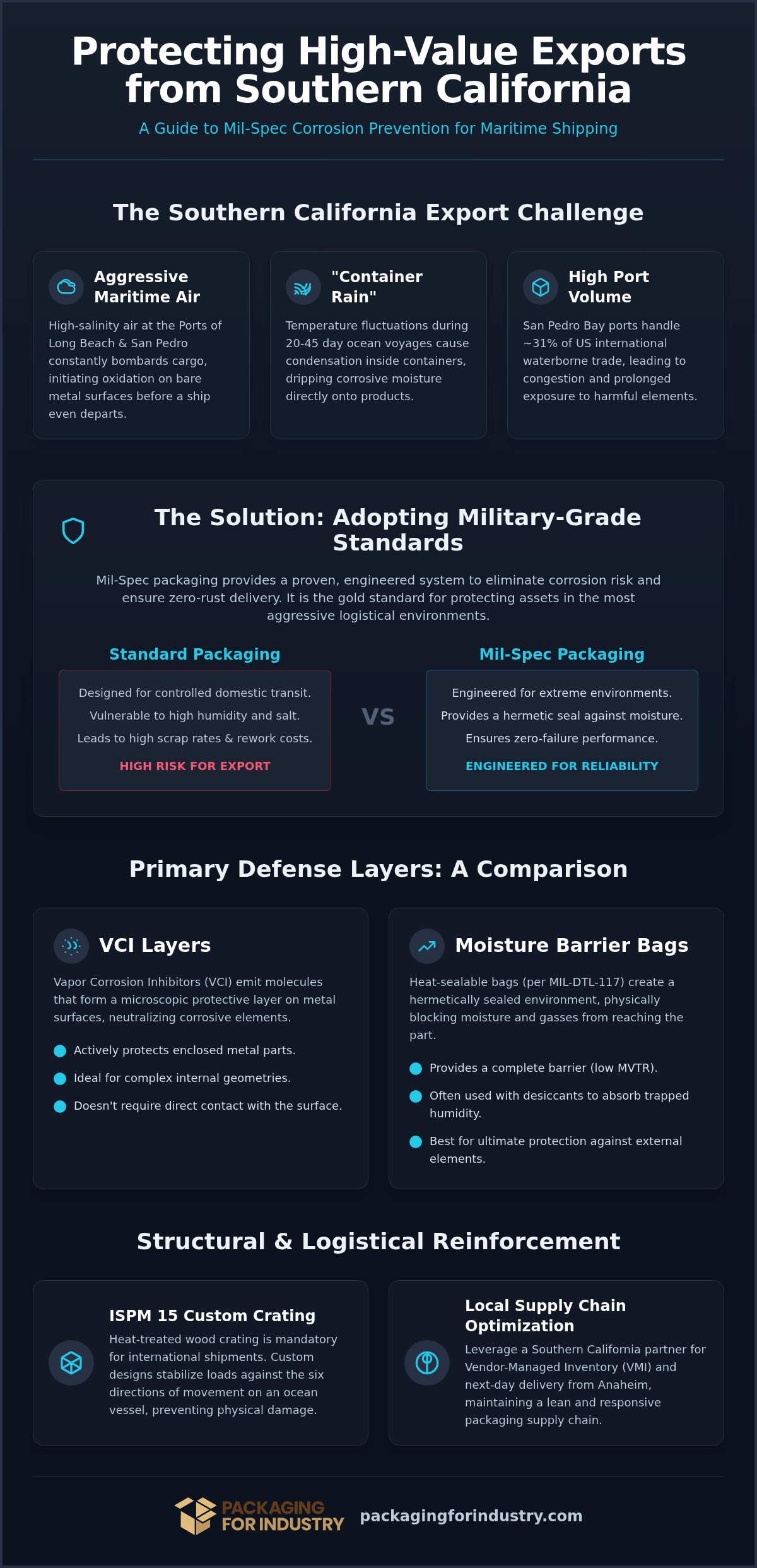
The San Pedro Bay port complex handled approximately 31% of all containerized international waterborne trade in the U.S. in 2025. This massive volume means your industrial components often sit in staging areas where they’re exposed to high salinity air and extreme humidity before they even board a vessel. For manufacturers, mil-spec packaging for corrosion prevention Southern California is a technical necessity because the local environment is fundamentally hostile to bare metal. When parts transition from an inland facility in Anaheim to the docks, they face a 20 to 45-day journey where oxidation risks grow exponentially.
One of the most destructive factors during this transit is “container rain.” As the ship moves through different climate zones, internal temperatures inside the steel container fluctuate wildly. This phenomenon turns trapped humidity into liquid water that drips directly onto your cargo. Without a robust barrier, this cycle of evaporation and condensation rapidly destroys surface finishes. The financial impact isn’t just the cost of the part. It’s the cost of rejected shipments, international freight for returns, and the damage to your reputation with global customers.
Salt-Air Exposure in San Pedro and Long Beach
Corrosion doesn’t wait for the ship to leave the harbor. Proximity to the coast means salt spray is a constant factor during peak port congestion. Aerospace and automotive components with tight tolerances are particularly vulnerable. Even a microscopic layer of oxidation can render a high-precision part unusable, leading to expensive rework or total scrap. Protecting these bare metal surfaces requires more than just a standard box; it demands a system rooted in military specification packaging standards designed for these exact conditions.
Logistics Chain and Handling Risks in SoCal
Moving freight from a warehouse in Orange County to the port involves multiple touchpoints. Every time a pallet is moved, the integrity of the packaging is tested. Standard domestic packaging often doesn’t have the moisture-vapor transmission rate (MVTR) required for maritime transit. Utilizing custom design packaging ensures your load is stabilized for the six directions of movement on a ship while maintaining a hermetic seal. This proactive approach lowers packaging costs by preventing the far higher expenses associated with cargo damage and supply chain disruptions.
Understanding Mil-Spec Standards for Corrosion Prevention
Military specifications, or Mil-Spec, represent a standardized system designed to survive the most punishing logistical environments. The Department of Defense established these protocols to ensure that critical equipment remains functional after months of exposure to salt spray and humidity. For commercial entities, adopting mil-spec packaging for corrosion prevention Southern California provides a reliable framework that eliminates the uncertainty of international shipping. These standards move beyond generic protection by utilizing engineered materials like V3C and W5C weather-resistant corrugated board and chemically neutral wraps that won’t react with sensitive metal surfaces.
Common Military Specifications for Packaging
Two primary standards govern the majority of corrosion prevention strategies for exporters. MIL-STD-2073, specifically Revision E, Change Notice 4, serves as the standard practice for military packaging. It outlines the methods for preservation based on the item’s weight, fragility, and susceptibility to environmental damage. Supplementing this is MIL-DTL-117, which covers the requirements for heat-sealable bags used in preservation. These bags are engineered to provide a superior barrier against moisture and corrosive gasses. MIL-SPEC is a rigorous benchmark that ensures zero-failure performance in extreme climates.
Why Mil-Spec Trumps Standard Packaging
Standard packaging supplies are often designed for domestic transit where environmental variables are controlled. They rarely undergo the rigorous durability testing required by military standards, such as vibration, impact, and moisture resistance trials. For high-value manufacturing operations, the consistency of Mil-Spec materials is a major operational advantage. It ensures that every bag and every box meets the same high-performance threshold, regardless of the batch size. This consistency is vital when you need to maintain a reliable bulk material supply from a local partner.
Adopting these standards also significantly extends the shelf life of your components. While standard materials might fail after a few weeks of humidity exposure, Mil-Spec systems can protect parts for months or even years in storage. This reliability is essential for businesses that manage complex international supply chains or maintain long-term inventory. When you compare packaging pricing, it’s important to weigh the upfront material cost against the financial security of a zero-rust guarantee. If you’re looking to upgrade your current protection levels, you can request a packaging quote to see how these materials fit your specific application. We have custom sizes available to meet the exact dimensions of your components, reducing material waste and optimizing your total spend.
Primary Defense Layers: VCI vs. Moisture Barrier Bags
Selecting the appropriate defense layer is a critical decision in your logistics strategy. For mil-spec packaging for corrosion prevention Southern California, the choice usually lies between active chemical inhibitors and passive physical barriers. Each technology serves a specific purpose depending on the complexity of the part and the duration of the ocean transit from San Pedro or Long Beach. Understanding these differences allows you to lower packaging costs by applying the right level of protection without over-engineering the solution. We ensure these materials are highly accessible for your operations, with custom sizes available to fit everything from small precision fasteners to large engine blocks.
The Mechanics of VCI Protection
VCI technology works by emitting protective vapors that condense on all metal surfaces within an enclosed space. These molecules create a monomolecular layer that inhibits the electrochemical process of oxidation. It’s particularly effective for components with deep recesses or internal chambers where manual application of rust preventatives is impossible. You can implement this through various mediums, including VCI poly bags, specialized VCI stretch film, or kraft paper. This method is efficient because it requires no degreasing or cleaning once the part arrives at its destination. It’s a “dry” protection method that keeps parts ready for immediate assembly, which is a significant advantage for high-volume manufacturing lines.
Heavy-Duty Moisture Barrier Systems
While VCI provides an active shield, heavy-duty moisture barrier bags offer a more robust passive defense for extreme maritime conditions. These bags, often constructed from foil or Mylar laminates, are designed to meet MIL-PRF-131L standards. They create a hermetic seal that prevents salt air and water vapor from ever reaching the component. For these systems to be effective, heat-sealing is mandatory to maintain the integrity of the environment. You should also include humidity indicator cards inside the bag. These provide a clear visual record of the internal environment to the customer upon delivery, ensuring total accountability for the shipment’s condition.
To manage the humidity trapped inside the bag at the time of sealing, you must use desiccants. Calculating the correct amount of activated clay or silica gel is vital; it’s based on the surface area of the barrier material and the total volume of the enclosure. For electronics or aerospace sensors, you’ll need to specify materials that also meet MIL-PRF-81705F standards. These provide integrated electrostatic discharge (ESD) protection alongside moisture barriers. This dual-layer approach prevents sensitive circuits from being damaged by static buildup during handling while simultaneously blocking corrosive elements. This is the standard for high-value exports that cannot risk even a minor surface failure during their time at sea.
Custom Crating and Load Stabilization for Overseas Transit
A high-performance moisture barrier bag is only effective if it remains unpunctured throughout the journey. Custom crating acts as the essential outer housing that protects these delicate inner layers from the physical stresses of maritime logistics. To improve warehouse efficiency and streamline assembly at the destination, we often provide kitting services, where all related components and hardware are organized and secured within a single engineered crate. This systematic approach ensures that every part, from large turbine housings to small fasteners, remains immobilized and protected by the appropriate mil-spec packaging standards.
Integrating custom foam inserts provides a dual benefit of shock absorption and additional corrosion protection. For smaller sub-components or secondary hardware packed within the same shipment, we utilize heavy-duty RSC boxes (Regular Slotted Containers) that are specifically sized to prevent movement inside the larger crate structure. This multi-layered stabilization prevents the “rattle” effect that often leads to micro-abrasions on polished surfaces, which are the primary sites for localized oxidation during long-term storage or transit.
ISPM 15 and Heat-Treated Wood Standards
International regulations are uncompromising regarding solid wood packaging. All solid wood thicker than 6mm must be heat-treated to a core temperature of 56°C for at least 30 continuous minutes to eliminate timber pests. This ISPM 15 standard is enforced rigorously at major global ports, and non-compliant packaging can lead to your entire shipment being quarantined or rejected upon arrival. Using certified wooden shipping pallets and crates ensures your documentation is in order for customs clearance, preventing costly delays and ensuring your international customers receive their orders on time and in perfect condition.
Engineering for High-Value Aerospace Components
Aerospace manufacturers often deal with oversized or oddly shaped parts that require specialized handling. Protecting these assets from salt spray and physical impact requires a holistic design that goes beyond a simple wooden box. To maintain structural integrity under the weight of heavy components, the use of corner boards and edge reinforcements is vital. These reinforcements prevent the crate from collapsing and stop heavy-duty strapping from cutting into the wood. By integrating internal VCI emitters within a custom crate, we maintain a saturated protective atmosphere around the part, ensuring your high-value assets are ready for immediate use upon arrival.
Optimizing Your Export Packaging Strategy with PFI
Managing an international supply chain from Southern California requires more than just high-quality materials; it requires a logistics partner that understands the specific pressures of maritime transit. PFI serves as a strategic extension of your operations, providing the engineering expertise and inventory support necessary to maintain zero-rust delivery standards. By implementing mil-spec packaging for corrosion prevention Southern California, we help you eliminate the financial drain of rejected shipments and inconsistent protection. Our approach centers on custom-tailored solutions that align with your specific bottom-line goals and operational constraints.
VMI and JIT for SoCal Exporters
Many manufacturers struggle with the warehouse footprint required to store bulky export crates, heavy-duty corrugated boxes, and large quantities of moisture barrier materials. Our Vendor Managed Inventory (VMI) program addresses this by stocking your specialized supplies at our facility. We monitor your usage and trigger replenishment cycles automatically, which eliminates lead-time surprises and ensures you never run out of critical VCI bags or heat-treated pallets. This model improves your cash flow by moving inventory costs from a bulk upfront expense to planned, predictable cycles. Our Just-In-Time (JIT) delivery system means we match your production and shipping schedules exactly, delivering supplies to your dock right when they’re needed for the next export container.
Local Expertise and Next-Day Delivery
Proximity to the Port of Long Beach and San Pedro is a major advantage for our clients. From our facility in Anaheim, we provide rapid support to industrial hubs in San Pedro and Carson. This local presence allows us to offer next-day delivery on stock items and fast turnarounds on custom orders. We don’t just supply materials; we solve engineering challenges. We offer free prototyping for custom export crates and foam inserts, allowing you to verify the fit and protection levels before committing to a bulk production run. This proactive design phase is essential for mil-spec packaging for corrosion prevention Southern California because it ensures every layer of the “Zone Defense” strategy works in harmony.
If you’re facing high scrap rates or inconsistent protection from standard catalog supplies, we recommend requesting a custom packaging audit. Our team will evaluate your current workflow and identify specific areas where you can lower packaging costs and improve reliability. We focus on practical, business-centric solutions that streamline your packing process and provide total peace of mind during 45-day ocean voyages.
Secure Your Global Supply Chain with Military-Grade Protection
Securing your international exports requires a methodical approach to environmental defense. By combining active VCI layers with hermetic moisture barriers and engineered crating, you eliminate the variables that lead to oxidation damage. This “Zone Defense” strategy doesn’t just protect parts; it protects your customer relationships and your bottom line. Implementing mil-spec packaging for corrosion prevention Southern California is the most reliable way to transition from high scrap rates to a zero-failure delivery model.
As aerospace packaging specialists, we provide the technical oversight needed to navigate complex maritime logistics. Whether you’re shipping from the Port of Long Beach or San Pedro, our local team in Anaheim offers next-day delivery and ISPM 15 compliant heat-treated crates to keep your operations moving. We’re ready to help you lower packaging costs while improving the reliability of your global supply chain.
Take the first step toward a more efficient, rust-free shipping process today.
Frequently Asked Questions
What is the best way to protect bare steel parts during sea freight?
A multi-layered “Zone Defense” approach is the most effective method for protecting bare steel. This involves using a VCI layer to protect complex internal surfaces and a hermetic moisture barrier bag to block salt air. This system ensures that even if the outer barrier is compromised, the chemical inhibitor continues to safeguard the metal. It’s the standard for high-value components moving through the Port of Long Beach.
Do I need VCI or a moisture barrier bag for shipping from Long Beach to Asia?
You typically need both for long-duration maritime transit. VCI provides active chemical protection for internal geometries, while a moisture barrier bag creates a physical seal against the high humidity of the Pacific. For a 45-day voyage, relying on a single layer increases the risk of oxidation. Combining these technologies is the core of mil-spec packaging for corrosion prevention Southern California.
How much desiccant do I need for a standard shipping container?
Desiccant requirements are calculated based on the surface area of the barrier material and the total volume of the sealed enclosure, not just the container size. For mil-spec applications, you must use the formula provided in MIL-STD-2073 to determine the exact units of activated clay or silica gel. This prevents internal condensation caused by temperature shifts, often referred to as container rain, during transit from San Pedro.
Are PFI export crates ISPM 15 compliant for international shipping?
Yes, all PFI wooden shipping pallets and crates are fully ISPM 15 compliant and heat-treated to meet international standards. We provide the necessary IPPC stamps and documentation required for customs clearance in Europe and Asia. Using certified wood packaging is essential to avoid shipment rejection or quarantine at foreign ports, ensuring your components reach their destination without regulatory delays or unexpected fees.
Can VCI film be used with custom foam inserts?
VCI film is highly compatible with custom foam inserts, provided the foam is chemically neutral. We often prototype solutions that integrate VCI-compatible polyethylene foam to stabilize parts within a VCI-lined box or bag. This combination provides both structural shock absorption and chemical corrosion protection. It’s an efficient way to protect sensitive aerospace components that require precise positioning during rough maritime handling and multi-stage logistics.
What happens if my parts arrive with surface rust?
Surface rust often results in immediate shipment rejection and expensive rework or scrap costs. Beyond the direct financial loss, it damages your reputation with international customers and disrupts their production schedules. If you experience oxidation issues, we recommend a custom packaging audit to identify failures in your current barrier system. Upgrading to mil-spec packaging for corrosion prevention Southern California can eliminate these recurring losses and streamline your logistics.
Does PFI offer next-day delivery to the Port of Long Beach area?
PFI provides local next-day delivery from our Anaheim facility to industrial hubs in Long Beach, San Pedro, and Carson. Our proximity to the San Pedro Bay port complex allows us to support manufacturers with rapid replenishment of critical export supplies. This local service is part of our commitment to improving supply reliability for Southern California exporters who need to maintain tight shipping schedules without carrying excessive inventory.
How can I lower my export packaging costs without risking damage?
You can lower packaging costs by optimizing material usage through custom-engineered designs rather than using oversized, generic supplies. Implementing a Vendor Managed Inventory (VMI) program also reduces your internal handling and storage expenses. By using the right mil-spec materials for the specific transit risk, you avoid the massive costs associated with shipping damage, returns, and international freight claims, leading to a lower total cost of ownership.