
A protective material isn’t automatically a safe match for a polished surface. Contact points, part geometry, and movement inside the package all matter. Choosing non-abrasive packaging for polished metal finishes means assessing how the complete packaging design interacts with the part, not relying on a material name or a generic cushion. If a scratch or scuff can affect a finished component, a poor fit can create problems for shipping and production.
You need packaging that protects the finish, fits the part, and works with your handling and shipping process. This guide compares protective materials and packaging formats, and explains what to document before requesting a custom packaging quote. PFI’s CAD-engineered packaging design can combine foam and outer packaging around the component and shipping method. Free prototypes and samples give your team a chance to review fit before a full rollout. For manufacturers in Orange County, Los Angeles, and San Diego, that review can help connect the packaging design to local production and shipping needs.
Key Takeaways
- Set protection requirements based on the component’s finish, geometry, contact points, and shipment context, not the packaging material name alone.
- Compare inserts, end caps, pads, foam-lined packaging, and corrugated outer protection by their roles in cushioning, separation, and containment.
- For non-abrasive packaging for polished metal finishes, document part count, orientation, sensitive surfaces, and packaging quantities to guide a specific design.
- Review a prototype for fit and packing steps before production to identify adjustments and support a smoother rollout.
- PFI’s custom foam, corrugated packaging, and CAD-engineered designs can be tailored to the component and shipping method. Free prototypes and samples are available for review.
Why Polished Metal Finishes Need a Packaging Selection Framework
A material name alone can’t establish whether packaging suits a polished surface. “Foam,” “paper,” or “protective film” describes a category, not how a specific product will interact with a particular finish. The goal of non-abrasive packaging for polished metal finishes is to reduce the risk of contact-related scuffs, scratches, or finish contamination with a design that accounts for the part, its surfaces, and its route through handling and shipping.
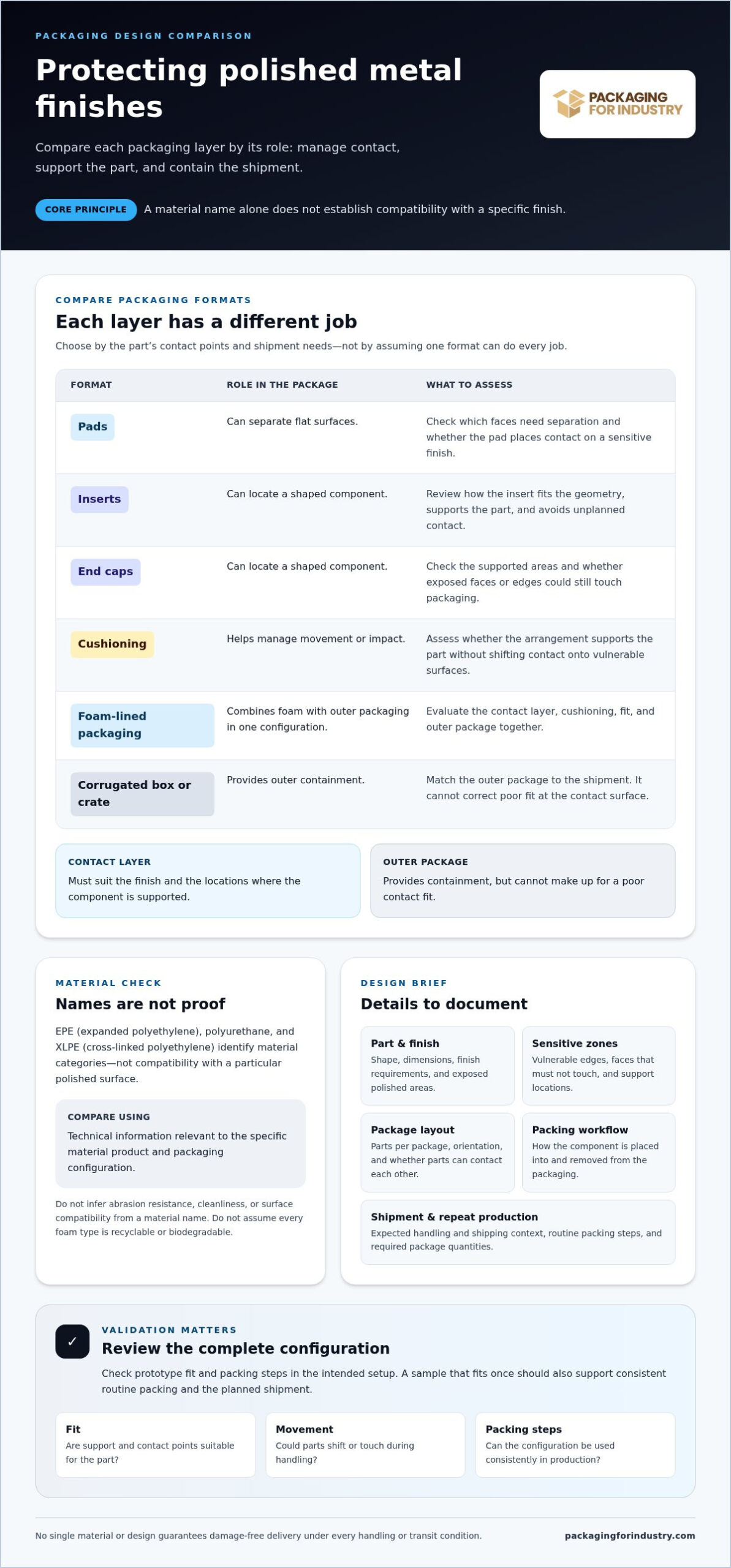
Packaging selection is a system decision. The layer touching the component needs to suit the finish and contact locations. Cushioning helps manage movement or impact, while the corrugated box or crate provides outer containment. These roles work together, but they aren’t interchangeable. A strong outer package can’t correct poor fit at the contact surface, and a suitable contact layer can’t make up for an outer package that doesn’t suit the shipment.
What does non-abrasive packaging mean for polished metal?
It means limiting avoidable contact risks and evaluating the actual packaging configuration rather than assuming a material label guarantees compatibility. Finish requirements may also include keeping surfaces clean and managing environmental exposure. Since corrosion can affect metals through different processes, buyers can review the general principles of Corrosion when considering preservation needs. No single material or design guarantees damage-free delivery under every handling or transit condition.
Begin with the contact interface. Identify which faces may touch packaging, where support is needed, and whether parts could shift during normal handling. Then assess cushioning and the outer package as separate design functions. This helps buyers compare options based on the actual issue. For example, a heavier outer container won’t solve a poor fit at the contact points, while a soft contact layer alone may not provide enough support for the shipment.
Which polished components need a tailored packaging assessment?
Polished metal parts, finished panels, and other high-value industrial components can have different contact challenges. A broad panel exposes a large finished face, while a shaped component may have narrow edges, recesses, or protrusions that concentrate contact. Irregular geometry can make generic cushioning fit poorly, leaving surfaces unsupported or creating unplanned contact.
Record the finish requirements and identify exposed faces, edges, and other sensitive areas. Include part dimensions, orientation, and the number of components in each package. Consider how the item is placed into and removed from packaging, along with its expected handling and shipping context. These details turn the protection goal into a usable design brief.
Repeat shipments add procurement requirements. A design that works for one carefully packed sample must also suit routine production, consistent packing steps, and the required package quantities. Documenting those needs helps align surface protection with warehouse workflow and purchasing plans. PFI’s custom packaging design can be tailored around the component and shipping method, giving your team a practical starting point for reviewing fit and refining the specification.
How to Assess Material Contact with Polished Metal Surfaces
A useful assessment turns the protection goal into information a packaging design can act on. Document the component and finish, map where packaging may touch it, compare candidate materials using relevant evidence, then validate the fit in the intended configuration. This keeps the decision focused on the actual part instead of broad claims about a material category.
What product details should buyers document first?
Prepare a short product profile before comparing materials. Include the component’s shape and dimensions, exposed polished areas, vulnerable edges, and any surfaces that must not touch another part. State which faces need protection and whether components can contact one another during packing. Clear details help translate finish sensitivity into contact and separation requirements.
Capture the operating context, too. Record the number of parts per package, their intended orientation, how they’re placed into and removed from the packaging, and whether the design will support repeat production shipments. This helps assess whether the packaging can be used consistently by the people packing the product, not just whether one component appears to fit.
How should buyers compare foam and separator materials?
EPE (expanded polyethylene), polyurethane, and XLPE (cross-linked polyethylene) are material categories, not proof of compatibility with a particular polished surface. Compare them using technical information relevant to the specific material product and packaging configuration. Don’t infer abrasion resistance, cleanliness, or surface compatibility from a foam name alone. Also, don’t assume every foam type is recyclable or biodegradable.
Assess format and material together. A pad may separate flat surfaces, while an insert or end cap may locate a shaped component. A cushioning arrangement may support the part without placing contact where the finish is most vulnerable. These are design questions, not automatic advantages of any one format. PFI offers protective foam packaging, including die-cut inserts, end caps, and sheets, for consideration as part of a component-specific design.
Ask for evidence that matches the claim. A general description such as “soft” or “protective” doesn’t establish how a material performs against a particular finish. For an abrasion-resistance or surface-compatibility claim, look for applicable technical documentation or test results that identify the material and conditions assessed. Results for a different material, surface, or configuration are background information, not direct validation.
Then assess fit in the proposed arrangement. Check whether the part stays supported, intended separation is maintained, and contact occurs at the planned locations. A prototype or sample can reveal fit issues before a design is used for repeat shipments. Once you’ve documented the requirements and review criteria, request a packaging quote for a solution tailored to the component and shipment.
Compare Non-Abrasive Packaging Formats for Polished Metal
Packaging formats solve different parts of the protection problem. A contact layer may separate or support a finished surface, cushioning may help control movement, and an outer box or crate contains the packed load. Compare each option by its role and fit, then assess how the formats work together. No format is automatically suitable for every finish, part shape, or shipment.
| Format | Contact protection and separation | Cushioning and outer-package role | Buyer considerations |
|---|---|---|---|
| Custom foam insert | Can be shaped to locate a component and define intended contact areas. | May support the part within a larger package; does not replace the outer container. | Assess how the shape fits the part and whether it suits repeat packing. |
| Foam end caps | Can cover or support defined ends of a component. | Can form part of the cushioning arrangement inside a box or crate. | Consider whether the ends are the right support points for the part. |
| Pads | Can separate surfaces or provide a layer at selected contact points. | Provide limited positioning by themselves; work within a broader package design. | Consider how pads stay in place and how parts are separated during packing. |
| Foam-lined packaging | Can provide a lined surface across selected interior areas. | Combines an inner contact layer with a box structure. | Review the lining’s coverage, fit, and interaction with the component. |
| Corrugated box or crate | Usually serves as the outer enclosure rather than the finish-contact layer. | Contains the packed product and supports the overall shipment design. | Choose the format around the shipment, part size, and handling needs. |
When are custom foam inserts, end caps, or pads worth evaluating?
Start with the component’s shape and intended support points. A custom insert can be designed around a complex profile, while end caps or pads may suit protection focused on specific areas. Compare the layout against part orientation, packing steps, and the required quantity per package. PFI’s protective foam packaging includes die-cut inserts, end caps, and sheets that can be incorporated into custom packaging designs.
How should the outer box or crate support the inner protection?
The outer package and surface-contact layers have separate jobs. Corrugated boxes or crates contain and support the shipment, while the inner design manages the component’s position and contact. Select the outer format based on component size, shipment method, and handling requirements. Bulky or complex shipments may call for a crate as part of a coordinated packaging design.
For recurring production, consider how quickly and consistently the package can be assembled. An intricate insert may provide a tailored fit but require careful orientation during packing; a simpler arrangement may be easier to repeat, depending on the part. A prototype lets the team review fit and packing steps before rollout. Treat non-abrasive packaging for polished metal finishes as a configuration to assess, not a universal claim about a material.
Build and Validate a Packaging Specification Before Production
A clear specification turns a finish-protection goal into a package that can be quoted, prototyped, and reviewed before production. Capture product details, packing requirements, shipment context, and the criteria your team will use to assess a sample. That gives design and procurement teams a shared reference for comparing options and planning repeat orders.
What information helps create a useful packaging quote?
Gather the details that define the component and its journey. Include dimensions, photographs or drawings, finish-sensitive areas, and surfaces that must stay separated. Explain the part’s orientation and how many components go in each package. If you have multiple component versions, identify them separately so the proposed arrangement reflects the items actually being shipped.
Describe the current process, too. Note how workers handle and pack the part, how packages are consolidated, and the shipment method and destination type. Include expected packaging quantities and whether demand recurs. If custom packaging lead-time planning affects purchasing or production, state that requirement without assuming a particular turnaround. PFI’s custom packaging design service uses these project details to develop a tailored design.
A practical specification should make the following clear:
- Component dimensions, configuration, and identifying drawings or photos.
- Finished surfaces, protected edges, and areas where contact must be avoided.
- Part count per package, orientation, and the intended pack-out sequence.
- Packaging quantities, recurring demand, and any purchasing constraints.
- Shipment context, including handling steps and the outer-package format in use.
- Review criteria for the prototype, such as component placement and packing consistency.
Be specific. “Protect the polished face” is a useful objective, but a marked drawing showing that face, its edges, and intended support locations gives a designer clearer direction. These details also help you compare a custom packaging quote against the needs of your production process.
How can a prototype help assess packaging fit?
A sample gives your team a chance to review the proposed arrangement before full rollout. Place the component into the package using the intended sequence. Check that it sits in the expected orientation, that contact points match the design, and that parts remain separated as planned. Note any difficulty during packing or removal. These observations can reveal fit or workflow adjustments that a drawing alone may not show.
Document the review rather than relying on memory. Record the sample configuration, who evaluated it, which handling and shipment conditions were represented, and any changes requested. Assess the sample against your operation’s requirements and use applicable product and shipping requirements to guide further validation. A prototype supports design review, but it can’t guarantee damage-free delivery under every condition.
Once your requirements and prototype observations are organized, take the next step toward packaging tailored to your component.
Source Custom Non-Abrasive Packaging for Polished Metal with PFI
Once the component, finish requirements, and shipment context are documented, turn them into a packaging design your team can review. Packaging For Industry (PFI) combines custom foam, corrugated packaging, and CAD-engineered design to help manufacturers develop a configuration suited to the product and shipping method. The objective is a practical design to evaluate, not a promise that any package will prevent damage under every condition.
What can PFI tailor for polished metal shipments?
Options include custom foam inserts, end caps, and foam sheets paired with an appropriate corrugated outer package. The design can account for component geometry, orientation, packing sequence, and shipment method. For example, a shaped component may need a foam layout that supports selected areas, while the outer box contains the packed configuration. Material and contact suitability depend on the specific design and should be evaluated for the application.
PFI’s custom packaging design service uses CAD-engineered designs to address project requirements. This lets buyers consider part fit and outer packaging together. For recurring shipments, the design process can also account for package quantities and packing steps, helping purchasing and operations work from a consistent specification.
Free prototypes and samples are available for custom packaging designs. Reviewing a sample gives your team a chance to assess component placement and the proposed pack-out before a full rollout. Use that review to identify adjustments and record the agreed configuration. A prototype supports evaluation; it doesn’t guarantee a particular shipping outcome.
How can buyers move from packaging requirements to a quote?
Share the information that will help shape a useful proposal. A concise request can include:
- Component dimensions, drawings or photographs, and relevant part variations.
- Finish-sensitive areas and any surfaces that need separation or specific support.
- Part count per package, orientation, and expected packaging quantities.
- How the component is handled, packed, and shipped, including the outer-package format.
- Recurring purchasing needs and any requirements that affect production planning.
These details connect the design to the real packing operation, not only the component drawing. If your team has existing packaging or observations from previous shipments, include them as context for the design review. PFI can use your requirements to develop a tailored packaging approach, then provide a prototype or sample for fit review before production planning advances.
For non-abrasive packaging for polished metal finishes, a clear specification helps align the contact design, outer packaging, and purchasing requirements. Bring those details together and request a quote for packaging tailored to your component and shipment.
Put Your Packaging Requirements Into Motion
Make the next step an internal decision: agree on what a successful packaging solution needs to support, who will evaluate it, and how the approved design will fit your purchasing process. This gives operations and procurement a shared basis for managing non-abrasive packaging for polished metal finishes as a repeat business requirement, not an isolated shipping concern.
With your priorities established, PFI can help translate them into a custom packaging proposal tailored to your operation. Share the requirements that matter to your team and request a quote.
A clear specification is a practical foundation for consistent packaging decisions. Take the next step with PFI to develop a design around your component and shipping needs.
Frequently Asked Questions
Can foam packaging scratch polished metal?
Yes. Foam packaging can scratch a polished surface if the material or packing conditions create damaging contact. For non-abrasive packaging for polished metal finishes, include cleanliness in your handling procedure. Inspect foam before use, keep it away from metal chips or shop debris, and replace pieces that are torn or visibly contaminated. A clean packing area and careful handling help prevent particles from causing marks.
Which foam types are used for packaging polished metal components?
Packaging foam options include polyethylene, polyurethane, expanded polyethylene, expanded polypropylene, cross-linked polyethylene, and ESD foam. Narrow the choice by the component’s additional requirements, such as static control or whether parts are packed individually or assembled into a kit. For repeat orders, document the selected material and design revision so purchasing can maintain consistency during replenishment.
How do you keep polished metal parts from rubbing against each other in a shipment?
Use a packing layout that assigns each item a defined position, then make the loading sequence easy to follow. For mixed part numbers, identify each location clearly and provide a pack-out diagram or work instruction at the packing station. A final count and placement check can catch missing separators or incorrectly loaded components before the package is closed, especially when similar-looking parts share a shipment.
Can custom foam inserts be designed for irregular polished metal parts?
Yes. Custom inserts can be designed for irregular components. For parts with multiple versions, provide an accurate sample or drawing for each version and identify differences that affect fit. Keep the approved drawing or sample reference with the packaging record. That helps the team identify when a part revision may require a packaging review instead of continuing to use an insert based on an outdated component shape.
What information should I provide when requesting a polished-metal packaging quote?
Along with component and shipment details, include the part number, drawing revision, and any expected design changes. Share current packaging quantities and, if available, the package or material identifiers your purchasing team uses. Note warehouse constraints, such as where packaging is stored or how it reaches the packing station. These operational details help connect the proposed packaging to purchasing records and day-to-day use.
Does PFI provide prototypes or samples for custom packaging?
Yes. PFI provides free prototypes and samples for custom packaging designs. Document who approved the sample, which component revision was used, and when the packaging specification was accepted. Keep that record accessible to purchasing and production teams so they can identify the intended design when reordering or reviewing a future product or process change.