
What if the packaging that protects an aviation component could also make replenishment easier to plan? For aviation suppliers, transit damage to fragile, heavy, or high-value parts can disrupt shipping and operations. Yet packaging that’s hard to source consistently can create a different problem: delays, excess stock, and pressure on warehouse space. Effective aviation supply chain packaging Orange County businesses can rely on needs to account for both the part and the flow of packaging through the operation.
PFI helps aerospace and aviation businesses match packaging to the component, shipping method, and repeat-use needs. Custom packaging design, CAD/CAM support, prototypes, and samples help shape fit-for-purpose solutions using options such as corrugated boxes, protective foam, and crates. Stock packaging and stocking programs can support recurring requirements, while local next-day delivery throughout Southern California helps keep supplies moving. In this article, learn how to assess packaging protection, compare custom and stock options, and plan a dependable supply with an Orange County packaging partner. We’ll also look at how kitting and managed inventory can help coordinate packaging with production and shipping needs.
Key Takeaways
- Start by documenting the component, handling needs, shipment method, and recurring volume to guide packaging decisions.
- Compare corrugated boxes, foam, and crates by how each can protect the part, then consider whether combining materials better fits the shipment.
- Evaluate packaging fit, warehouse footprint, packing workflow, and repeat-order consistency alongside protection.
- For aviation supply chain packaging Orange County operations, plan local delivery and replenishment around production schedules and storage capacity.
- PFI’s custom design support, prototypes, stock packaging, kitting, and managed inventory programs can help coordinate component protection with dependable supply.
Aviation Supply Chain Packaging in Orange County: Start With the Shipment Risk
A component can arrive damaged because its packaging didn’t match its shape, weight, finish, or journey. A different problem arises when the right packaging isn’t available for the next production run or dispatch. For aviation suppliers in Orange County, packaging decisions need to address both shipment risk and the steady flow of supplies that keeps work moving.
Aviation supply chain packaging coordinates component protection with the packaging materials and replenishment needed to support production and shipping. The protective package is one part of the process. Planning packaging orders, storage, and repeat supply connects that protection to the broader principles of supply chain management.
Which aviation components need a packaging plan?
Fragile assemblies, heavy parts, high-value components, irregular shapes, and finish-sensitive surfaces can each present different packaging concerns. A part’s dimensions and contact points help determine how it should be supported and kept from shifting. Handling also matters: consider how the component will be packed, moved, loaded, and unpacked, along with the shipment method and its destination.
There’s no single configuration for every aviation component. Corrugated boxes, protective foam, and crates can serve different roles, and the right approach depends on the part and shipment context. PFI’s custom packaging design can account for the component, shipping method, and repeat-use needs, rather than relying on a standard package that may not fit.
Where packaging problems create operational friction
Transit damage can trigger replacement work, disrupt a scheduled shipment, and add customer-service tasks while teams investigate and resolve the issue. Poor fit can also waste warehouse space or make packing more cumbersome. A packaging review helps connect the damage risk to practical design choices, including how a part is supported and how the complete package is handled.
Supply gaps create a separate operational risk. If custom packaging runs short, routine production or dispatch may pause while teams source a substitute or wait for replenishment. That can lead to emergency purchasing, inconsistent packaging from order to order, or extra inventory occupying valuable space. Recurring usage, stock levels, and ordering patterns belong in the packaging plan alongside part protection.
PFI serves aviation and aerospace businesses with custom and stock corrugated boxes, protective foam, crates, packaging reviews, prototypes, and kitting. Boxes, foam, and crates can be combined into an integrated solution for a specific component, while stocking and managed inventory programs support repeat requirements. For industry-specific context, explore PFI’s aerospace packaging solutions.
How Corrugated, Foam, and Crates Protect Aviation Shipments
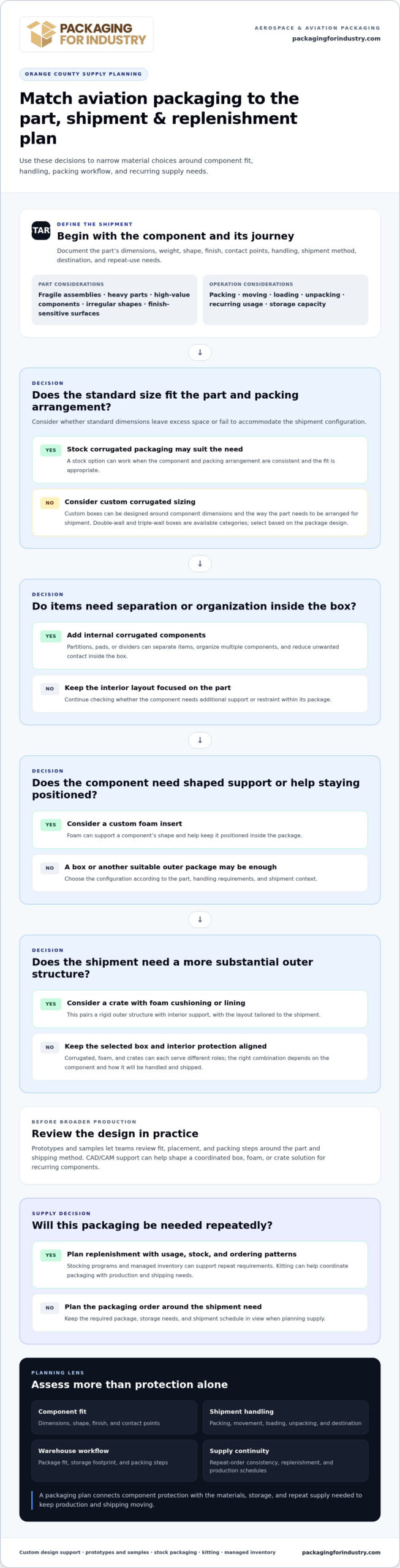
Each packaging material addresses a different part of the shipment risk. Corrugated boxes create an outer enclosure and can organize components with internal partitions. Foam cushions parts and helps limit movement inside the package. Wood crates provide a rigid outer structure for shipments that need a different form of containment. The right combination depends on the component, how it will be handled, and how it will ship.
Start packaging selection with the product and shipment requirements, then choose materials that fit the protection need and packing workflow. Double-wall and triple-wall boxes are available categories, but the choice should be based on the specific package design rather than an assumed performance rating. The Aviation Suppliers Association offers background on aircraft-parts packaging and references including ATA Specification 300 and MIL-STD-2073-1 in its overview of packaging aircraft parts.
When aviation suppliers consider custom corrugated boxes
Custom corrugated boxes can be designed around a component’s dimensions and the way it needs to be arranged for shipment. Partitions, pads, or dividers can separate items, organize multiple components, and reduce unwanted contact inside the box. Stock packaging may suit repeatable needs when the part and packing arrangement are consistent. Custom sizing can be useful when standard dimensions leave excess space or don’t accommodate the shipment configuration. Explore PFI’s corrugated box options for custom and stock packaging.
When foam inserts or crates may be part of the solution
Custom foam inserts can support a component’s shape and help keep it positioned within its package. For a part that needs a more substantial outer structure, a crate may be paired with foam cushioning or lining. This combination brings together interior support and an exterior enclosure, with the layout tailored to the specific shipment rather than applied as a standard configuration.
Before moving into broader production, prototypes and samples give teams a practical way to review fit, placement, and packing steps. PFI provides CAD/CAM support, prototypes, and samples for custom packaging, helping teams assess a design around the part and shipping method. A coordinated box, foam, and crate solution can also help standardize how a recurring component is packed.
For aviation supply chain packaging Orange County buyers can plan around specific parts and repeat shipments, compare the protection approach with packing time, storage, and replenishment needs. If you’re evaluating a custom configuration, request a packaging quote for a solution tailored to the shipment.
How to Compare Aviation Packaging Options for Your Operation
Compare packaging against the full job, not just the container. A useful review starts with the part and shipment, then accounts for how often the packaging is used, where it will be stored, and how it will be replenished. This gives purchasing, operations, and shipping teams a shared basis for evaluating options.
What information helps specify a packaging solution?
Gather the details that shape the design discussion:
- Part: dimensions, weight, shape, fragile areas, and finish-sensitive surfaces.
- Shipment: shipping method, destination, and relevant handling steps during packing, loading, and unpacking.
- Usage: whether this is a one-time shipment, a recurring production requirement, or an order that repeats on a regular schedule.
- Operations: current packing steps, available storage space, and replenishment needs.
Keep documented requirements separate from assumptions. If a customer specifies technical, testing, or compliance requirements, have the responsible customer team verify them before they become design criteria. PFI can use CAD/CAM design support, prototypes, and samples to develop and review packaging around the application.
How to compare a custom design with stock packaging
Assess both options against the same practical criteria: protection needs, fit, packing steps, storage footprint, and repeat-order consistency. Stock packaging may work well when components and packing methods are consistent. A custom design may better address a product-specific shape or help organize a recurring packing process. Compare the trade-offs in material use, warehouse space, and ease of packing rather than assuming one option is automatically more efficient.
Include freight dimensions in the review. Package size can affect dimensional charges and possible carrier surcharges, so assess the packed dimensions alongside weight and protection requirements. For example, 2026 UPS and FedEx guidance includes cubic-volume thresholds for certain additional-handling and large-package surcharges. These thresholds don’t make reducing package size the only goal: the package still needs to suit the component and shipment.
For aviation supply chain packaging Orange County operations, review the design and replenishment plan together so a suitable package can be reordered consistently. PFI’s custom packaging design services support application-specific development, while stock options can serve repeatable needs. Comparing both helps teams make a considered choice without relying on a one-size-fits-all assumption.
Orange County Packaging Supply: Plan for Delivery and Replenishment
A packaging plan needs to account for more than the next shipment. Aviation suppliers in Anaheim, Irvine, and across Orange County may use different combinations of boxes, foam, and crates across production runs. If packaging arrives late or takes up too much space, teams can face purchasing pressure or interruptions to packing and dispatch. Planning local packaging delivery around production schedules helps keep recurring requirements in view.
PFI provides local next-day delivery throughout Southern California, including Orange County. For businesses in Anaheim, the Anaheim packaging service area page provides more local information. Teams can also review usage patterns and compare packaging pricing as they plan stock levels, balancing reliable availability with warehouse space.
What local packaging delivery can support
A local packaging source can support replenishment of materials used regularly for industrial shipments. Identify which items move consistently, how much storage they require, and when production or dispatch schedules will need them. For changing or product-specific requirements, custom sizes available can help align packaging with the application. Coordinating these details gives purchasing and operations a clearer basis for planning supplies across Orange County.
Planned replenishment can reduce packaging shortages and purchasing friction by connecting expected usage with an organized restocking approach.
How stocking programs support repeat packaging demand
Start by reviewing packaging usage history, supplier lead times, available storage space, and production schedules. Separate steady, recurring items from materials used only for occasional shipments. This helps teams set practical stock priorities without filling warehouse space with packaging that moves infrequently.
Agreed review cycles can help teams track usage and adjust replenishment as demand changes. PFI offers stocking programs for recurring packaging needs, along with vendor managed inventory for packaging. Inventory planning can connect stock levels with actual usage, helping reduce stockout risk while keeping replenishment aligned with operational needs.
For aviation supply chain packaging Orange County operations, coordinate stock planning with production and shipping teams, then review the plan as usage patterns shift.
Work With PFI on Aviation Supply Chain Packaging in Orange County
PFI is an industrial packaging supplier serving aerospace and aviation businesses in Orange County. Buyers can coordinate custom and stock corrugated boxes, foam, and crates with packaging design and recurring supply planning. CAD/CAM support, prototypes, and samples help teams develop packaging around a component and its shipping process, while kitting can support repeat packing workflows.
To prepare for a custom packaging quote, share the details that help define the application and purchasing need:
- Component: dimensions, weight, shape, and protection concerns.
- Shipment: shipping method and relevant handling context.
- Supply needs: estimated usage, order patterns, and storage constraints.
- Current challenges: packaging fit, damage concerns, replenishment gaps, or packing workflow issues.
These details help PFI assess whether custom or stock packaging is the right starting point. For example, buyers comparing a corrugated box quote with a foam packaging quote can explain how the materials work together in the shipment. An industrial packaging supplier near Anaheim can also help connect packaging selection with local supply planning for Orange County operations.
From custom design and prototypes to material selection and replenishment planning, PFI helps aviation teams address component protection and packaging availability as connected operational needs. Share your requirements to discuss options tailored to your application.
Build a More Dependable Aviation Packaging Plan
For aviation suppliers, packaging decisions work best when component protection and replenishment are planned together. Match the package to the part, handling, and shipping method, then compare fit, packing workflow, storage needs, and repeat-order consistency. This practical approach helps Orange County teams address transit risks while keeping packaging aligned with production and dispatch.
PFI supports aviation supply chain packaging Orange County businesses need with custom packaging design, prototypes, and samples. Corrugated boxes, protective foam, and crates can be combined into an integrated solution tailored to the application. For recurring requirements, stocking programs and local next-day delivery throughout Southern California help coordinate packaging availability with ongoing operations.
Share your component details, shipment context, current packaging concerns, and estimated usage to start a focused conversation about options for your operation.
With a considered packaging design and a dependable supply plan, your team can move forward with greater confidence in both component protection and day-to-day readiness.
Frequently Asked Questions
What packaging is used for aviation components?
Aviation components may be shipped in corrugated boxes, protective foam packaging, crates, or a combination of materials. The right option depends on the part’s size, weight, shape, protection needs, handling, and shipment method. For example, a custom foam insert can help position a component inside a box, while a crate may be part of the solution for a shipment with different containment needs. Packaging should fit the specific application.
Where can aviation suppliers find packaging in Orange County?
Packaging For Industry is headquartered in Anaheim and supports aviation supply chain packaging Orange County businesses need through custom and stock industrial packaging. Its options include corrugated boxes, foam packaging, and crates, with design support for application-specific needs. PFI also serves businesses in Los Angeles, San Diego, and Riverside, with local next-day delivery throughout Southern California. Buyers can plan packaging alongside recurring usage and replenishment needs.
Can custom packaging help reduce shipping damage to aviation parts?
Custom packaging can address fit and positioning issues that may contribute to shipping damage. A design based on component dimensions, handling, and shipment context can help support the part and organize its placement inside the package. PFI provides custom packaging design support, prototypes, and samples so teams can review fit before broader production. Packaging design supports damage reduction, but results depend on the specific part and shipment conditions.
How do I request a quote for aviation supply chain packaging?
To request a quote, share the component’s dimensions and weight, the protection concerns, and relevant shipping or handling context. Include whether the need is a one-time shipment or recurring, along with estimated usage, current order patterns, and storage constraints. This information helps PFI assess custom and stock packaging options and related supply planning. Keep sensitive technical data out of a general quote request.
Does PFI offer custom foam and corrugated packaging for aerospace suppliers?
Yes. PFI supplies foam packaging, including custom die-cut foam, and custom and stock corrugated boxes for aerospace and aviation businesses. CAD/CAM support, prototypes, and samples can help teams review a packaging design around the component and packing process. PFI can also combine boxes, foam, and crates into an integrated packaging solution, aligning the packaging materials with the application instead of relying on a one-size-fits-all configuration.
Can a packaging supplier help manage recurring aviation packaging inventory?
Yes. PFI offers vendor managed inventory and stocking programs for recurring packaging needs. Planning can consider usage history, lead times, storage space, and production or shipping schedules, with agreed review cycles to support replenishment. This approach helps teams manage stockout risk while avoiding unnecessary on-site inventory. It can be useful for recurring custom packaging, such as boxes or foam, as well as regularly used stock packaging supplies.
Does PFI deliver aviation packaging in Anaheim and Orange County?
Yes. PFI provides local next-day delivery throughout Southern California, including its Orange County service area. Based in Anaheim, the company supports aviation and aerospace businesses that need packaging supplies coordinated with production and shipping. PFI also serves Los Angeles, San Diego, and Riverside. Delivery planning can be paired with stocking programs to help keep recurring packaging available without relying solely on last-minute purchasing.