
Are you paying more to ship air and protective wrap than you are to ship your actual product? For many industrial manufacturers, securing packaging solutions for oversized products feels like a constant trade-off between excessive freight surcharges and the risk of catastrophic transit damage. You’ve likely experienced the frustration of a high-value asset arriving at a client’s site with structural damage or seeing your warehouse floor space consumed by bulky, disorganized packaging stock. It’s a logistical bottleneck that creates unnecessary professional stress and drains your bottom line through preventable carrier fees.
We understand that oversized shipping requires more than just a larger box; it requires an engineered approach to structural integrity and freight economics. This guide will show you how to select heavy-duty packaging that protects your assets while reducing dimensional weight fees and optimizing load density. We’ll explore the benefits of double-wall and triple-wall corrugated materials, custom foam protection, and how programs like vendor-managed inventory (VMI) ensure you have the right supplies without the warehouse clutter. By the end of this article, you’ll have a clear strategy to standardize your large-scale shipping and improve your supply chain reliability.
Key Takeaways
- Understand the specific weight and girth thresholds that require specialized packaging solutions for oversized products to avoid structural failure during transit.
- Compare the cost-efficiency of triple-wall corrugated boxes against custom wood crates to optimize freight weight and minimize carrier surcharges.
- Learn how custom foam inserts and edge protection provide the necessary blocking and bracing to eliminate internal shifting of heavy industrial components.
- Discover how Vendor Managed Inventory (VMI) programs can reclaim warehouse floor space by streamlining the procurement of bulky packaging stock.
- Utilize CAD/CAM prototyping to design precision-fit packaging that eliminates the risks and damage rates associated with makeshift or “patchwork” solutions.
The Engineering Challenge of Packaging Solutions for Oversized Products
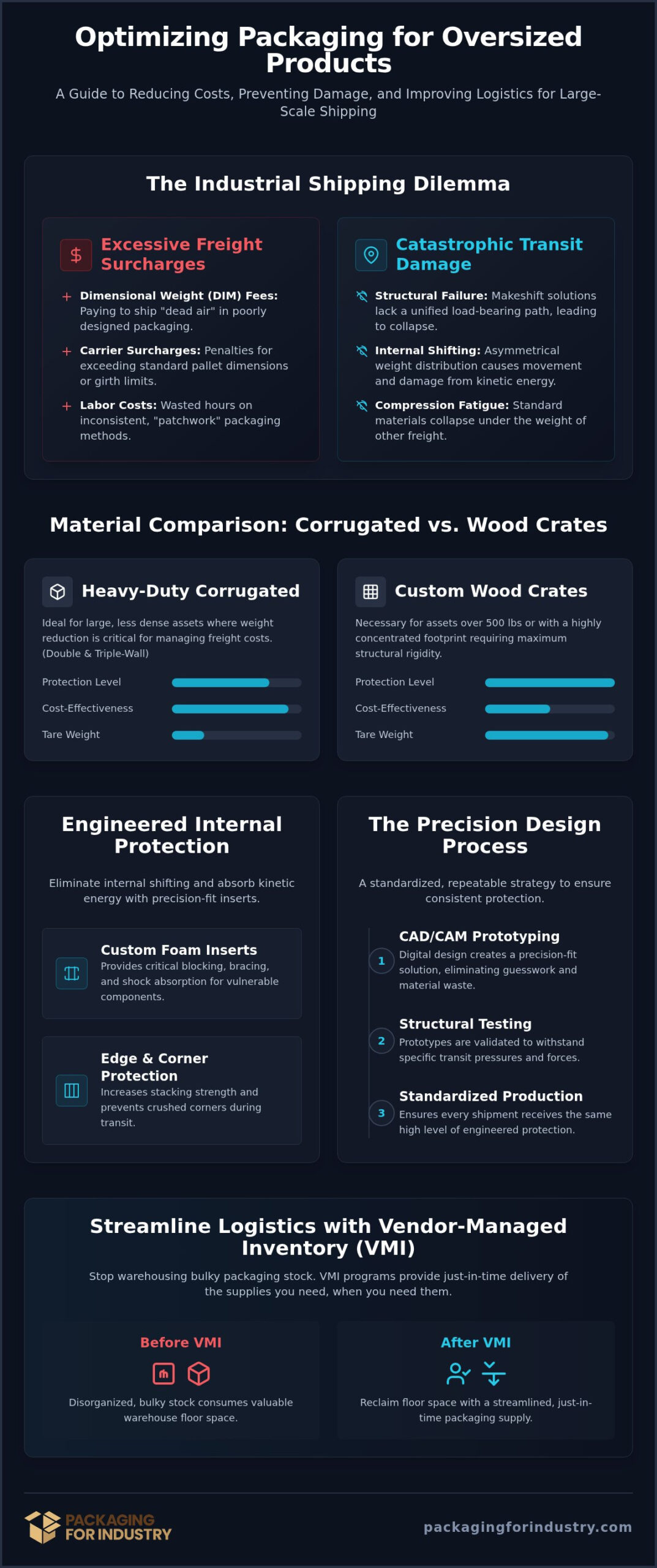
In industrial logistics, “oversized” isn’t a vague descriptor. It’s a technical classification for items that exceed standard pallet dimensions or trigger carrier girth surcharges. Effective packaging solutions for oversized products must account for both the physical footprint and the structural vulnerabilities inherent in large-scale shipping. When teams rely on “patchwork” packaging; such as taping multiple boxes together or using excessive void fill; they invite structural failure. These makeshift methods lack a unified load-bearing path, which leads to crushed corners and compromised internal assets during the rigors of transit.
Stability is another critical engineering factor. Large equipment often features an asymmetrical center of gravity. If the packaging isn’t engineered to brace these specific heavy points, the item will shift. This movement generates kinetic energy that standard containers cannot absorb. Beyond physical protection, there’s the fiscal impact of Dimensional Weight (DIM). Carriers charge based on the space a package occupies. Poorly designed oversized packaging often includes unnecessary “dead air,” which results in massive freight surcharges that erode your profit margins.
Why Standard Corrugated Fails Large Assets
Single-wall corrugated boxes simply lack the vertical stacking strength required for heavy industrial components. In a long-haul LTL environment, your product might sit under hundreds of pounds of other freight. Standard fiberboard often suffers from compression fatigue, where the fluting collapses under sustained pressure. While a box might have a high Edge Crush Test (ECT) rating, that doesn’t guarantee it can withstand the lateral forces or “burst” pressures caused by heavy items shifting internally. You need double-wall or triple-wall corrugated boxes to provide the necessary rigid shell for bulky assets.
Identifying the Need for Engineered Jumbo Packaging
If your warehouse team spends hours “figuring out” how to wrap a shipment, you’re losing money on labor and risking inconsistent protection. High damage claim rates are the most obvious sign that your current method is failing. When a product’s weight or dimensions necessitate heavy-duty fiberboard, switching to engineered packaging solutions for oversized products is a strategic move. These solutions eliminate the guesswork and provide a standardized, repeatable process. Investing in precision-fit containers reduces the hidden costs of transit damage and ensures your gear arrives in “factory-ready” condition.
Comparing Material Options: Heavy-Duty Corrugated vs. Custom Crates
Deciding between heavy-duty fiberboard and timber is a critical pivot point when selecting packaging solutions for oversized products. The choice often hinges on a specific weight threshold. Typically, when a single item exceeds 500 pounds or has a highly concentrated footprint, the structural rigidity of wood becomes necessary. However, for many large but less dense assets, advanced corrugated materials provide a superior balance of protection and fiscal efficiency. You can compare packaging pricing to see how these materials impact your total landed cost.
Cost-benefit analysis must look beyond the initial purchase price of the container. While a custom wood crate offers maximum durability, it adds significant tare weight. This weight increases fuel surcharges and base freight rates. Conversely, triple-wall corrugated can often handle heavy loads while remaining light enough to keep your DIM weight costs manageable. For international shipments, wood also requires ISPM-15 heat-treatment certification to prevent pest migration. If your supply chain is domestic and focused on one-way transit, high-performance fiberboard is often the more pragmatic choice.
The Case for Heavy-Duty Corrugated Boxes
For manufacturers looking to lower packaging costs without sacrificing safety, custom corrugated boxes in double-wall or triple-wall configurations are often the ideal solution. These containers provide high stacking strength and excellent puncture resistance while remaining significantly lighter than wood. They’re particularly effective for large electronic assemblies or automotive components. Another operational advantage is disposal. Your end recipient can easily break down and recycle fiberboard, whereas disposing of large timber crates often requires specialized waste handling. This can be a point of friction in the customer experience if not managed correctly.
When Custom Wood Crates Are Mandatory
Certain high-value assets, such as aerospace turbines or sensitive medical imaging equipment, require the absolute defense of a rigid timber structure. Wood crates are mandatory when you’re dealing with irregular footprints that require internal blocking and bracing to prevent shifting. These structures support concentrated loads that would otherwise pierce through the bottom of a corrugated container. When your logistics involve multiple touchpoints or extreme environmental exposure, engineering custom crates ensures that your product remains immobile and protected from impact. This level of precision is essential for ensuring long-term reliability and eliminating the professional stress of high-value damage claims.
Internal Protection: Custom Foam and Edge Guarding
External shells provide the first line of defense, but the internal engineering determines if your asset survives the trip. For oversized items, blocking and bracing are mandatory. Without these, heavy components shift, creating internal momentum that can breach even the strongest triple-wall corrugated. Effective packaging solutions for oversized products rely on precision-engineered internals to immobilize the payload and absorb shock. This is particularly critical in Southern California’s busy shipping hubs like Los Angeles and the Inland Empire, where frequent handling increases the risk of vibration-induced damage during transit.
Foam Engineering for Large Payloads
Choosing the right material is a balance of weight, density, and shock absorption. Polyethylene (PE) foam is a closed-cell material ideal for heavy industrial gear due to its high load-bearing capacity and resistance to moisture. For more delicate instrumentation within an oversized assembly, Polyurethane (PU) foam provides softer, open-cell cushioning for lighter loads. Our engineering team acts as a proactive problem-solver, identifying potential failure points before they leave your warehouse. We utilize CAD/CAM support to design custom foam packaging that accounts for the specific G-force sensitivity of your equipment. This engineering phase often results in foam end caps or custom-cut kitting trays that secure multiple components within a single jumbo box. For oversized electronic assemblies, anti-static (ESD) foam is essential to prevent electrostatic discharge during the friction and movement of long-haul transit.
Load Stabilization and Exterior Protection
Once the internal components are secured, the entire unit must be stabilized against external forces. High-tension banding is often necessary for bulky items, but this can easily crush the edges of corrugated containers or damage the product finish. Utilizing corner and edge protection distributes the pressure of these straps, maintaining the structural integrity of the outer box. To complete the assembly, we apply high-performance stretch film to secure the oversized load to its pallet or skid. This creates a unified unit that resists shifting during LTL handling and protects against dust or moisture. This methodical approach to stabilization turns a fragmented collection of supplies into a holistic system of protection. For irregular shapes, custom-designed partitions or corrugated build-ups provide the final layer of stability, ensuring that every square inch of your asset remains immobile and protected from impact.
Procurement Logistics: Managing Bulky Packaging Inventory
Storing packaging solutions for oversized products creates a unique physical burden that standard inventory models often overlook. Jumbo boxes, triple-wall corrugated sheets, and custom timber crates occupy massive square footage, often sitting as “dead inventory” while taking up space needed for finished goods. This inefficiency doesn’t just tie up capital; it complicates internal logistics and increases the risk of damage to the packaging itself before it’s even used. For high-volume manufacturers, the cost of “stocking air” within large containers can be as significant as the cost of the materials themselves.
Optimizing Your Warehouse Floor Space
Implementing a Vendor Managed Inventory (VMI) program is the most effective way to reclaim your floor space and eliminate packaging stockouts. Instead of ordering bulk quantities of oversized containers to hedge against lead time fluctuations, we manage the replenishment cycle for you. This model shifts the storage burden from your facility to ours. You only keep what’s immediately necessary for your current production run on-site. This proactive approach reduces the capital tied up in slow-moving oversized stock and ensures that custom-engineered items are available exactly when your production line requires them.
Local Delivery Advantages for SoCal Manufacturers
For facilities in Anaheim, Irvine, and Santa Ana, sourcing from a local supplier offers a distinct competitive advantage. Long lead times from out-of-state catalog suppliers often force manufacturers to over-order, which further exacerbates warehouse congestion. By utilizing a local partner, you can leverage Just-In-Time (JIT) delivery to keep your operations lean. This is especially critical for specialized sectors like aerospace and medical device manufacturing, where production schedules are rigid and delays are costly.
Sourcing manufacturing packaging solutions locally also lowers your inbound freight costs. Large, bulky items are expensive to transport even when empty; paying to ship a jumbo box across the country is fiscally irresponsible. By choosing a partner with local next-day delivery capabilities in Orange County and Los Angeles, you eliminate the high shipping fees associated with nationwide catalog distributors. This consolidated approach to industrial supply reduces purchasing overhead and ensures your team stays focused on production rather than managing a cluttered warehouse floor.
Step-by-Step: Designing Your Oversized Packaging Solution
Developing effective packaging solutions for oversized products requires a methodical engineering process. It’s not a matter of simply scaling up a standard box; it involves a detailed technical analysis. We begin with a rigorous initial assessment of your asset’s physical properties. Our team analyzes exact dimensions, weight distribution, and the specific fragility of internal components. This data allows us to identify where your product needs the most support and where we can reduce material use to keep your freight costs low. By understanding the center of gravity and potential impact points, we build a foundation for a container that performs under pressure.
Once the assessment is complete, we move into the prototyping phase. We utilize CAD/CAM support to create precision-fit designs that account for every contour of your equipment. Before a single production run begins, we verify the structural integrity through testing. This ensures the container can withstand stacking pressures and lateral forces without failure. Finally, we implement the solution through specialized kitting and assembly. This provides your warehouse team with a ready-to-use system that streamlines their operations and eliminates the “patchwork” guesswork that leads to damage.
The Value of Free Prototyping
Physical samples are the only way to eliminate the risks associated with large-scale shipping. Our engineering team focuses on creating packaging solutions for oversized products that balance durability with economic efficiency. Through free prototyping, you can perform fit tests and refine your custom design packaging before committing to a bulk order. This phase is critical for reducing material waste and ensuring your shipment complies with carrier regulations for oversized freight. By catching design flaws in the sample stage, you avoid the professional stress and financial loss of a failed production run.
Ready to Optimize Your Oversized Shipping?
At PFI, we act as an industrial consultant to help our clients lower packaging costs while maintaining total asset protection. We understand the high-stakes requirements of aerospace and aviation logistics and the precision needed for medical device transport. Our Southern California facilities are equipped to handle the most complex oversized challenges with local next-day delivery and VMI support. Don’t let bulky items drain your warehouse space or your budget. Take the first step toward a more reliable supply chain and a more efficient operation today.
Request a Quote for Oversized Packaging
Optimize Your High-Value Asset Protection
Securing bulky or heavy equipment requires a shift from standard containers to engineered systems. By balancing structural integrity with freight economics, you can eliminate transit damage while lowering your total shipping costs. Whether your operations require triple-wall corrugated boxes or custom timber crates, the goal remains the same: ensuring your product arrives in factory-ready condition without the burden of excessive carrier surcharges. Implementing professional packaging solutions for oversized products transforms your logistics from a source of stress into a repeatable, efficient process.
As specialists in aerospace and industrial machinery, PFI provides the technical expertise needed to handle your most complex shipping challenges. Our Southern California team offers free CAD/CAM prototyping to ensure a precision fit before you commit to a full production run. With local next-day delivery and VMI programs, we help you reclaim warehouse floor space and maintain a reliable supply of critical materials. We’re ready to help you standardize your large-scale shipping and improve your operational reliability.
Take control of your industrial logistics and build a more resilient supply chain with a partner that understands the intersection of engineering and economics.
Frequently Asked Questions
What is considered an ‘oversized’ product for industrial packaging?
In the industrial sector, an ‘oversized’ product generally refers to any item that exceeds the standard 48-inch by 40-inch pallet footprint or carrier girth limits. For parcel carriers like UPS or FedEx, this typically means a combined length and girth exceeding 130 inches. These assets often require specialized packaging solutions for oversized products, such as triple-wall corrugated or custom crates, to maintain structural integrity during LTL transit and avoid significant carrier penalties.
When should I use triple-wall corrugated instead of a wood crate?
Triple-wall corrugated should be utilized when you need a high strength-to-weight ratio for items up to approximately 500 pounds. It provides a lightweight alternative to timber, which helps you lower packaging costs and reduce fuel surcharges. However, if your equipment features a highly concentrated load or requires maximum defense against extreme impacts during international transit, a custom wood crate is the mandatory engineering choice for long-term reliability and asset protection.
How do I avoid UPS or FedEx oversized surcharges?
You can avoid these expensive surcharges by optimizing your Dimensional Weight (DIM) through precision-engineered packaging. Our team uses CAD/CAM support to eliminate ‘dead air’ within your containers, ensuring the box is no larger than necessary for protection. If your products consistently trigger ‘over maximum limit’ fees, we often recommend transitioning to palletized LTL shipping to consolidate costs and improve the overall stability of your bulky shipments while avoiding parcel penalties.
Can PFI design custom foam inserts for irregularly shaped heavy products?
Yes, we design and manufacture precision-cut foam inserts specifically for asymmetrical or irregularly shaped industrial components. By utilizing Polyethylene (PE) or anti-static (ESD) foams, we create internal blocking and bracing that secures the asset’s center of gravity. This engineered approach prevents the product from shifting within the jumbo box, effectively eliminating internal damage and ensuring that your most complex gear arrives at its destination in factory-ready condition without the need for makeshift void fill.
Do you offer local next-day delivery for large-format boxes in Orange County?
We offer reliable local next-day delivery for large-format boxes and supplies across Orange County, Los Angeles, and the Inland Empire. Our Anaheim-based fleet specifically supports manufacturers in Irvine, Santa Ana, and Brea who operate on Just-In-Time (JIT) schedules. Sourcing locally allows you to compare packaging pricing against national catalog suppliers and realize significant savings by eliminating the high inbound freight costs typically associated with shipping bulky, empty containers over long distances.
What information do I need to provide for a custom oversized packaging quote?
To receive a precise custom quote, you should provide the exact dimensions, total weight, and the fragility level of your product. It’s also helpful to specify the shipping method, such as LTL or international ocean freight, so we can recommend the appropriate material like double-wall fiberboard or heat-treated timber. If you have specific requirements for custom sizes available or need kitting services, including those details will ensure a more accurate fiscal and technical assessment.
How does Vendor Managed Inventory (VMI) work for bulky packaging supplies?
Vendor Managed Inventory (VMI) is a strategic program where PFI monitors and replenishes your bulky packaging supplies at your facility. This model eliminates the need for you to store massive quantities of jumbo boxes or triple-wall sheets on your warehouse floor. By shifting the inventory management to us, you reclaim valuable square footage for production, reduce capital tied up in slow-moving stock, and ensure you never experience a stockout during critical production runs.
Are your wood crates and pallets ISPM-15 compliant for international shipping?
All our industrial wood crates and pallets are available with ISPM-15 heat-treatment certification to meet international export regulations. This process ensures that the timber is free of pests and is properly stamped for global transit. Providing compliant wood packaging is essential for avoiding costly customs delays or shipment rejections at international ports. We handle the documentation and precision engineering so your oversized assets move through the global supply chain without any logistical friction.