
With warehouse wages in Southern California reaching upwards of $21 per hour in 2026, can your current pack-out process still justify its own payroll? Most operations managers feel the squeeze as hourly rates climb and containerboard prices see unprecedented hikes. It’s frustrating to watch throughput stall because a complex kitting process requires hours of specialized training for every new hire. You likely recognize that manual handling is your largest controllable expense; yet, it remains the hardest to optimize without the right tools.
We’re here to show you how strategic packaging design to reduce labor costs transforms your shipping department from a bottleneck into a streamlined profit center. You’ll learn how custom-engineered corrugated boxes and pre-assembled foam inserts can slash pack-out times and eliminate assembly errors. This guide covers how to lower packaging costs by simplifying workflows so they require less skilled labor. We’ll explain how to compare packaging pricing for high-efficiency designs that increase your throughput and lower your total cost of ownership. From local next-day delivery in Los Angeles and Anaheim to nationwide shipping, we provide the industrial solutions your warehouse needs to stay competitive.
Key Takeaways
- Learn why the unit price of a corrugated box is a misleading metric and how to calculate the true cost of “touch time” in your packing process.
- Discover specific engineering features, such as auto-bottom designs and custom die-cuts, that optimize packaging design to reduce labor costs by making assembly intuitive.
- Understand how to outsource warehouse labor through kitting and pre-assembly services that deliver ready-to-use packaging components directly to your production line.
- Follow a practical four-step audit to identify bottlenecks in your packing stations and eliminate material waste through a professional time-motion study.
- See how Southern California manufacturers can leverage free prototyping and local next-day delivery to lower total operational expenses without risking production stops.
The Hidden Impact of Packaging on Labor Costs
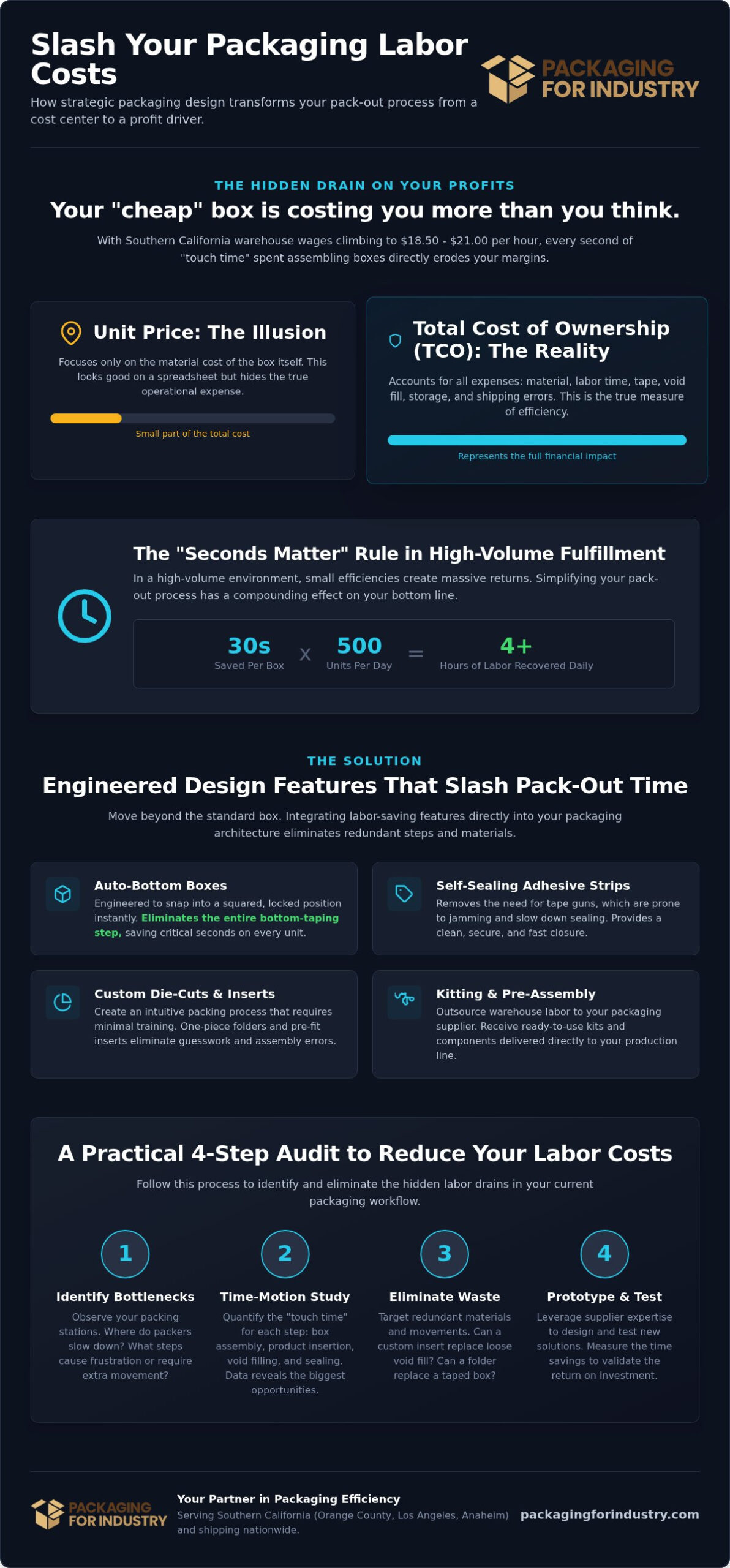
For many operations managers, the procurement process focuses heavily on the unit price of a box. While this looks good on a spreadsheet, it ignores the reality of the warehouse floor. The true cost of your packaging isn’t just the material; it’s the “touch time” required to transform that material into a shippable unit. In regions like Southern California, where warehouse wages in cities like Anaheim and City of Industry average between $18.50 and $21.00 per hour as of September 2026, every extra second spent on manual handling erodes your margins.
Strategic packaging design to reduce labor costs targets the three primary drains on warehouse productivity: complex assembly, excessive void-fill application, and redundant sealing steps. While standard functions of modern packaging include protection and transport, an unoptimized design forces workers to act as “origami experts” rather than efficient packers. When a box requires multiple folds or internal dividers that don’t align correctly, your throughput drops and your labor expenses climb.
Total Cost of Ownership (TCO) vs. Unit Price
Total Cost of Ownership (TCO) accounts for the material price plus the labor, tape, and storage costs associated with that item. A stock RSC box might be cheaper upfront, but if it requires four strips of tape and two minutes of manual foam fitting, it’s actually more expensive than a custom-engineered solution. Custom boxes that snap into place or use self-sealing strips eliminate the need for secondary materials and reduce the physical strain on your team. When you calculate TCO, you often find that “cheap” boxes are the primary cause of production bottlenecks that delay shipments and increase overtime.
The “Seconds Matter” Rule in High-Volume Fulfillment
In a high-volume environment, small efficiencies scale rapidly. If your team ships 500 units a day, saving just 30 seconds per box through better design recovers over 4 hours of labor daily. This isn’t just about speed; it’s about simplicity. Complex packing instructions lead to high training times and frequent errors, especially during peak seasons when turnover is high. By implementing a packaging cost savings strategy through design, you create an intuitive workflow. Simple, one-piece folders or pre-inserted foam blocks allow new hires to reach full productivity in minutes rather than days. Effective packaging design to reduce labor costs ensures that your throughput remains high even when your most experienced staff members are unavailable.
Engineering Efficiency: Design Features That Slash Pack-Out Time
While many operations managers focus on expensive automation machinery, the physical architecture of the box itself is often the fastest path to a high return on investment. When you request a corrugated box quote for high-volume lines, the focus should shift from simple material weight to total assembly speed. Standard RSC styles are the industry staple; however, they force workers into a repetitive cycle of bottom-taping and squaring that slows down the entire line. Transitioning to packaging design to reduce labor costs means selecting styles like die-cut folders or five-panel folders that arrive flat but deploy instantly. These designs allow your team to focus on the product rather than the container, ensuring that the packing station never becomes the bottleneck of your production line.
By integrating labor-saving features directly into the box architecture, you eliminate redundant movements and reduce the need for secondary materials like tape and void fill. If you are looking to optimize your assembly process, you can request a corrugated box quote to see how custom dimensions and engineered features can eliminate these hidden labor drains.
Self-Sealing and Auto-Bottom Corrugated Solutions
Auto-bottom corrugated solutions are engineered to snap into a squared, locked position the moment they are opened. This removes the bottom-taping step entirely from the workstation, which can recover thousands of minutes of labor over a standard production month. When these are paired with self-sealing adhesive strips, you eliminate the need for manual tape dispensers and the associated downtime of tape gun jams. This streamlined motion reduces the physical fatigue that leads to late-shift slowdowns. If you are ready to evaluate these efficiencies for your facility, you can compare our high-speed designs against your current stock to see the immediate impact on throughput.
Custom Foam Inserts vs. Manual Void Fill
Traditional void fill like bubble wrap or packing peanuts is a significant labor drain because it is imprecise. It requires workers to manually wrap items or estimate fill levels, leading to inconsistent protection and wasted material. Precision-engineered foam packaging eliminates this variability. Using a one-piece clamshell or custom-fit insert allows a packer to simply drop a component into a pre-defined cavity and close the box in seconds. This “one-motion” packing is essential for delicate electronics or medical devices where speed must be matched by absolute security. It also simplifies training; a new hire can master a foam-lined custom corrugated box in minutes without complex folding instructions.
Kitting and Pre-Assembly: Moving Labor to the Supplier
The most effective way to optimize your payroll is to remove the labor-intensive assembly process from your facility entirely. Packaging kitting is the process of pre-assembling multiple packaging components, such as corrugated boxes, foam inserts, and edge protectors, into a single, ready-to-use unit before it reaches your production line. Instead of your team spending time pulling individual SKUs from different warehouse racks, they receive a finished assembly that’s ready for immediate pack-out. This shift is a key component of packaging design to reduce labor costs, as it effectively outsources the most time-consuming part of the packing process to your supplier.
At our Anaheim facility, we perform this “heavy lifting” for you. By consolidating multiple components into one kit, you reduce your warehouse footprint and simplify inventory management. This is especially vital for Southern California businesses facing high real estate costs in Los Angeles and Orange County. Receiving “ready-to-use” assemblies allows your staff to focus on high-value production tasks rather than folding cardboard or fitting foam. When you request a packaging quote for kitted solutions, you’re investing in a strategy that slashes your internal touch time.
Streamlining High-Mix Production Lines
In sectors like aerospace and defense, packaging requirements are often complex and strictly regulated. Managing these requirements on a high-mix production line usually demands extra labor for oversight and quality control. Transitioning from a “parts” mindset to a “solution” mindset through kitting ensures total consistency. When components are pre-assembled, assembly errors and shipping damage are significantly reduced because the human element is simplified. You don’t need a specialist to figure out how to layer foam or secure heavy-duty double-wall boxes; the kit dictates the correct process every time. This consistency is essential for packaging for manufacturers who can’t afford the delays caused by improper packing.
Vendor Managed Inventory (VMI) as a Labor Saver
Labor costs aren’t confined to the warehouse floor; they also accumulate in your procurement and administrative departments. Managing dozens of packaging SKUs requires constant monitoring, purchase orders, and follow-ups. Our VMI services act as a force multiplier for your purchasing team by automating these tasks. We monitor your stock levels and use Just-In-Time (JIT) delivery across Southern California, including Riverside and the Inland Empire, to ensure you never face the chaos of a stockout.
This proactive approach eliminates “emergency orders” that force your production line to stop or require expensive expedited shipping. By integrating VMI, you can lower packaging costs by reducing administrative overhead. It’s a reliable way to manage supply while ensuring your warehouse operations remain focused on fulfillment rather than inventory troubleshooting. Local packaging delivery ensures that your kits arrive exactly when the production line is ready for them.
A 4-Step Audit to Reduce Your Packaging Labor Costs
Most facilities accept their current pack-out speed as an unchangeable reality. However; without a formal audit, you’re likely ignoring significant “labor leaks” that accumulate over thousands of units. A systematic review of your packing stations allows you to quantify the impact of packaging design to reduce labor costs. This process moves beyond the cost of materials and looks directly at the efficiency of the human element in your supply chain. Identifying where your workers lose time is the first step toward reclaiming your operational margins.
Step 1: Identify the “Labor Leaks”
Start by conducting a time-motion study on your current packing stations. Track how long it takes a worker to assemble a single unit from start to finish. You should look for specific points where workers struggle; common issues include folding complex corrugated inserts or applying excessive amounts of tape to secure a loose fit. Interviewing your warehouse staff often provides the most direct feedback on packaging pain points. They’re the ones who deal with the “origami” boxes and uncooperative foam daily. Their insights can pinpoint exactly which designs cause the most frustration and fatigue.
Step 2: Prototyping and Testing
Once you’ve identified the bottlenecks, work with a packaging manufacturer to create optimized samples. Using CAD/CAM support allows for the rapid development of prototypes that are faster to assemble. We recommend running “race” tests where you pit your current design against the new, optimized version. This validates the labor savings in a real-world environment. It’s critical to ensure that these speed gains don’t compromise safety; verify the new design maintains the necessary protection levels for your specific product through drop tests or vibration simulations.
Step three involves evaluating material waste and over-packing tendencies. If workers are using excessive bubble wrap or void fill to compensate for a poorly sized box, they’re wasting both material and time. Finally, Step 4 is a professional consultation. A specialized review of your entire workflow can reveal opportunities for kitting or VMI that internal teams might overlook. Implementing packaging design to reduce labor costs requires a holistic view of your operation, from the moment a box is unfolded to the final palletization. A professional review ensures your design isn’t just protecting the product, but also protecting your bottom line.
Why Choose PFI for Your Cost-Reduction Strategy?
Selecting a packaging supplier isn’t just about finding a vendor; it’s about securing a partner who understands the intersection of engineering and economics. Packaging For Industry (PFI) brings deep expertise in aerospace packaging and heavy industrial equipment, where precision is non-negotiable. We provide comprehensive material support, including custom corrugated solutions, precision-cut foam, heavy-duty crates, and high-performance stretch film. Our focus on packaging design to reduce labor costs ensures that your materials work for you, not against you. Unlike standard catalog options, we have custom sizes available for any industrial application, ensuring a perfect fit that reduces the need for manual void fill.
Manufacturers in Southern California face unique pressures, from rising wages to tight production schedules. We address these challenges through free prototyping and custom design services. This allows you to test and validate labor-saving features before committing to a full rollout. By engineering out the complexity of your pack-out process, we help you achieve faster throughput and lower your total cost of ownership. You can compare our bulk packaging pricing to see how integrated solutions lower your total spend while improving reliability across your entire operation.
Local Support for Southern California Manufacturers
Our strategic location in Anaheim allows us to provide rapid response times that nationwide suppliers cannot match. We understand the specific logistics challenges within the Irvine and Santa Fe Springs industrial hubs. Local packaging delivery is more than a convenience; it’s a safeguard against production stops. Our team can perform on-site visits to conduct time-motion studies, providing direct access to engineering teams for fast design iterations. Whether you’re in Orange County, Los Angeles, San Diego, Riverside, or the Inland Empire, our local next-day delivery keeps your supply chain moving. This proximity makes us the ideal packaging for manufacturers, warehouses, and distribution centers across the region.
Request a Custom Packaging Quote
Starting your cost-reduction analysis is straightforward. The PFI commitment goes beyond supplying materials. We focus on how to reduce shipping damage and lower packaging costs through smarter engineering. We help you compare packaging pricing to ensure you’re getting the best value for your specific application. If you’re ready to eliminate bottlenecks and simplify your warehouse operations, it’s time to consult with an expert who knows the Southern California industrial landscape.
We look forward to helping you build a more reliable and cost-effective supply chain today.
Frequently Asked Questions
How does custom packaging design actually reduce labor costs?
Custom packaging design to reduce labor costs focuses on removing manual steps from the pack-out process. By creating self-squaring boxes or pre-fitted foam inserts, you eliminate the time workers spend folding cardboard or measuring void fill. This transition allows your staff to pack more units per hour, effectively reducing the headcount required for high-volume fulfillment. It’s about engineering the material to perform the repetitive work that a person previously had to do manually.
Is custom packaging more expensive than buying stock boxes in bulk?
While stock boxes have a lower unit price, they often incur higher indirect costs. Manual assembly, excessive taping, and the time spent applying bubble wrap add up quickly on your warehouse payroll. Custom solutions are designed for speed, meaning the labor savings usually outweigh the material price difference. When you factor in reduced shipping damage and faster pack-out times, custom packaging is often the most cost-effective choice for high-volume industrial operations.
What industries benefit most from packaging kitting services?
Any industry with complex assembly requirements, such as medical device manufacturing, electronics, or aerospace, sees the highest ROI from kitting. These sectors often require multiple protective layers that are time-consuming to assemble on-site. By receiving a pre-assembled kit, your team avoids the labor-intensive process of pulling various SKUs and fitting them together. This “ready-to-use” approach is a proven way to lower packaging costs in high-mix production environments.
Can changing my box design really eliminate the need for tape?
Yes, specific design features like auto-bottoms and self-sealing adhesive strips can remove tape from your workflow entirely. These containers are engineered to lock into place and seal securely without manual dispensers. Eliminating tape doesn’t just save on material costs; it also reduces the repetitive motion strain on workers’ wrists and hands. This simplification makes the packing process more intuitive and significantly faster for new or temporary warehouse staff.
How do I calculate the labor savings of a new packaging design?
You calculate savings by measuring the “touch time” per unit with your current design versus an optimized prototype. Multiply the seconds saved by your average daily volume and your hourly wage. For example, saving 45 seconds per unit in a warehouse shipping 400 boxes daily recovers five hours of labor every day. This data-driven approach allows you to justify the investment in custom solutions by demonstrating a clear, measurable return on payroll expenses.
Does PFI offer local delivery for custom packaging in Southern California?
Yes, we provide local next-day delivery throughout the region to prevent production stops. If you are searching for a reliable packaging supplier near me in Anaheim, Los Angeles, or the Inland Empire, PFI is positioned to support your production schedule without the delays of nationwide shipping. Our local fleet ensures your custom boxes and foam inserts arrive exactly when your warehouse team needs them to maintain peak throughput.
What is the typical lead time for a custom labor-saving packaging prototype?
We offer free prototyping to help you validate labor-saving designs before committing to a full production run. Typical lead times for a custom prototype range from a few days to a week, depending on the complexity of the foam or corrugated components. Because we are a local packaging supplier near me for Southern California businesses, we can iterate designs quickly based on your direct feedback from the warehouse floor.