
What if the packaging protecting your product is also adding avoidable weight, volume, or handling work? If products arrive damaged, standard boxes don’t fit, or freight costs keep climbing, the design may not match your product or shipping process. The right packaging engineering services Orange County manufacturers choose should address those connected problems, not simply produce a new box.
Choosing a partner means looking beyond a packaging concept. You need a design that protects products in transit, fits shipping requirements, and works consistently on the production or warehouse floor. Packaging For Industry connects design decisions with those operational needs through custom packaging design, CAD/CAM support, prototypes, and packaging reviews.
This article explains how to assess a partner’s approach, from documenting product and shipping requirements to reviewing a prototype and planning repeat supply. You’ll also learn how custom corrugated boxes, foam, and crates can work together when one material isn’t enough, and how right-sized packaging can help manage shipping expense. The goal is a practical path from packaging problem to production-ready solution with a dependable Orange County packaging supplier.
Key Takeaways
- Identify whether recurring damage, poor fit, excess packaging, or difficult pack-out calls for a custom-engineered solution rather than stock packaging.
- Use product dimensions, fragility, handling, shipping route, and pack-out steps to shape packaging requirements before design begins.
- Compare packaging engineering services Orange County providers by their discovery process, design support, prototype access, material range, and production handoff.
- Prepare for a smoother project by documenting the packaging problem and aligning operations and purchasing on what the solution needs to accomplish.
- See how PFI’s custom design support can bring boxes, foam, and crates together in an integrated packaging approach.
When Do Orange County Businesses Need Packaging Engineering Services?
Recurring shipping damage, packaging that doesn’t fit the product, excess material, or a slow, awkward pack-out can signal that the current setup needs more than a box change. Stock packaging can work well when product dimensions are consistent, standard cushioning provides adequate protection, and employees can pack orders without extra adjustments. If teams routinely add filler, modify boxes, or reposition products to make them fit, those workarounds may point to a design problem.
Packaging engineering services Orange County businesses use should account for both the product and how it moves through the operation. Requirements depend on the item’s dimensions and fragility, the shipping method and route, and the production workflow. Packaging engineering brings design, evaluation, materials, and production considerations together instead of treating the package as a stand-alone purchase.
What problems justify hiring a packaging engineer?
Look for a recurring pattern, not just the latest damaged shipment. Repeated impact marks in the same area, shifting components, crushed corners, or inconsistent outcomes between shipments can help identify where package fit or protection is failing. Heavy or fragile components, unusual shapes, and products that need specialized cushioning may also be difficult to protect with standard packaging.
Review the work inside the facility, too. If employees repeatedly fold, trim, reinforce, or reposition packaging during pack-out, the package may not match the product or process. Track practical indicators such as damage frequency, material use per shipment, packing steps, and time spent correcting fit. These observations give the design process a useful baseline without assuming a particular solution or promising a specific result.
Which Orange County businesses benefit from custom packaging design?
Custom design can help manufacturers shipping parts or finished equipment, aerospace suppliers handling components that need controlled placement, and electronics companies protecting delicate products. Medical device businesses may also need packaging tailored to product geometry and their established handling workflow. The right design depends on the item and its shipping conditions, not simply on the industry label.
Warehouses, distributors, and production teams can benefit when they pack the same product repeatedly or manage several product sizes. A well-matched package can make routine handling more consistent and reduce improvised steps at the packing station. For example, an Anaheim manufacturer and an Irvine warehouse may have different pack-out constraints, even when shipping similar items. PFI is headquartered in Anaheim and supports Orange County industrial buyers with packaging design and engineering. Its custom packaging design services can address needs that stock boxes alone don’t resolve.
Before starting, define the operational question the project needs to answer: Is the priority fewer damaged shipments, a better fit, less packaging material, or a smoother pack-out? More than one may matter. Clear priorities connect packaging decisions to shipping and production needs, and give purchasing and operations a shared basis for evaluating the design.
What Does a Packaging Engineering Project Include?
A packaging engineering project turns an agreed business need into a design that can be reviewed, refined, and prepared for production. Packaging engineering matches protective design to product and process requirements. The work goes beyond producing a drawing: it connects the design concept to a usable package and a practical production handoff.
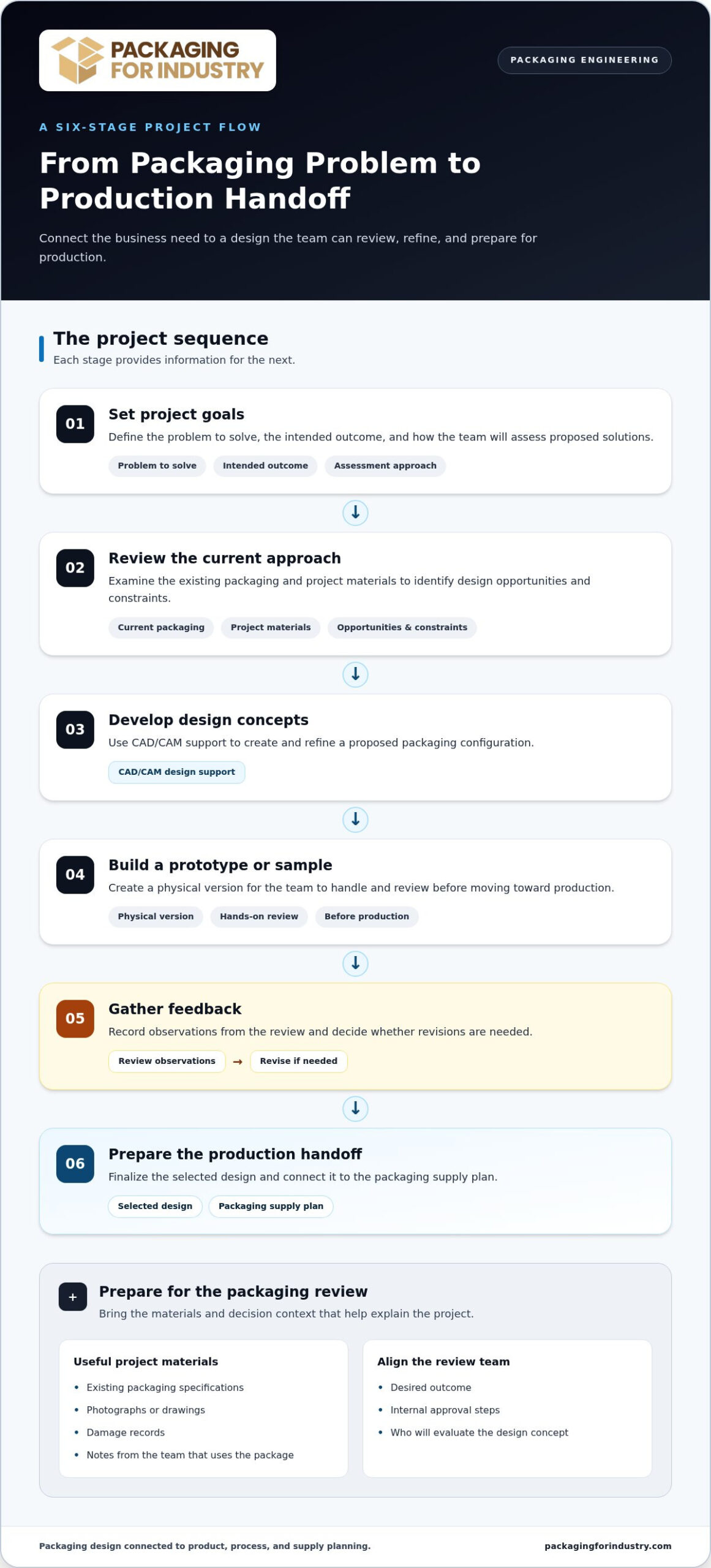
Packaging engineering services Orange County buyers engage typically move through a sequence of defined stages:
- Set project goals: Identify the problem to solve, the intended outcome, and how the team will assess proposed solutions.
- Review the current approach: Examine existing packaging and project materials to identify design opportunities and constraints.
- Develop design concepts: Use CAD/CAM support to create and refine a proposed packaging configuration.
- Build a prototype or sample: Create a physical version for the team to handle and review before moving toward production.
- Gather feedback: Record observations from the review and decide whether revisions are needed.
- Prepare the production handoff: Finalize the selected design and connect it to the packaging supply plan.
Each stage provides information for the next. A design concept gives the team something concrete to assess; feedback guides revisions, and the final handoff helps purchasing and operations work from an agreed packaging design. The RIT Packaging Science Program reflects the multidisciplinary nature of the field, where packaging design connects technical work with broader industry needs.
What information should buyers prepare for a packaging review?
Gather materials that explain the project’s goals and current setup. These may include existing packaging specifications, photographs, drawings, damage records, or notes from the team that uses the package. Identify the desired outcome, internal approval steps, and who will evaluate design concepts or samples.
For recurring projects, include order patterns and the teams responsible for purchasing, receiving, and using the packaging. This helps shape recommendations around routine procurement and implementation. A focused review can distinguish essential project criteria from preferences the team can weigh as concepts develop.
How do prototypes support packaging decisions?
Prototypes let the team review a proposed design as a physical sample before moving toward broader production. Employees can assess whether the package is straightforward to assemble, whether components work together as intended, and whether the design is practical for the people who will use it. A sample also gives reviewers a shared reference point for specific feedback.
PFI’s custom packaging design services include CAD/CAM support, prototypes, and samples. Review and refinement are tailored to the project rather than treated as a fixed testing protocol. Once your team has defined its goal and gathered relevant project details, request a packaging quote to discuss design support and next steps.
How to Evaluate Packaging Engineering Services Before You Hire
Compare project deliverables and the production handoff, not just the proposed material or unit price. A useful engineering partner documents decisions, explains revisions, and carries the approved design into repeat purchasing. When evaluating packaging engineering services Orange County buyers need, look for a process that makes responsibilities and next steps clear to both operations and purchasing.
A useful packaging comparison evaluates the full pack-out, not just one material. It should also account for how the design moves from review to routine use, including who approves changes and how the team will reorder the finished packaging.
| Evaluation area | What to compare |
|---|---|
| Requirements discovery | Does the provider capture project goals, stakeholders, approval steps, and success criteria? |
| Design support | Are recommendations documented clearly enough for operations and purchasing to assess and approve? |
| Prototype access | Can the team review a sample and provide specific feedback before production planning? |
| Material range | Can the provider coordinate corrugated boxes, foam inserts, and crates when the project calls for multiple components? |
| Production handoff | Will the approved design and ordering details support repeat purchases and consistent implementation? |
Which deliverables should a buyer compare?
Look for a record of the agreed requirements, design recommendations, sample review, and any revisions. These details help the team understand what was selected and why, and give purchasing a clearer basis for future orders. For projects that include cushioning, protective foam packaging can be assessed as one part of a coordinated design. Make sure feedback and design changes are captured before the project moves toward production.
Implementation support matters, too. The handoff should help the people ordering and using the packaging work from the approved design rather than relying on informal instructions or memory. That makes the transition from prototype review to recurring procurement more organized.
How can packaging design address freight and damage concerns?
Include current carrier billing information when reviewing the package configuration. This gives the team a practical way to identify possible surcharge exposure and decide whether further design review is warranted. Carrier charges depend on shipment details and carrier rules, so an engineering review can inform decisions but should not promise a specific fee reduction.
A packaging review can also compare the current purchasing and packaging approach with proposed alternatives to identify practical cost-reduction opportunities. PFI’s cost-reduction analysis supports that evaluation as part of the broader design discussion. To describe your project and discuss next steps, request a packaging quote.
How Orange County Operations Can Plan a Packaging Engineering Project
Good project planning continues beyond design approval. Teams also need to decide how a new package will be introduced, who owns the transition, and how the change fits purchasing and production schedules. Setting responsibilities early helps prevent a finished design from becoming an isolated engineering deliverable that’s difficult to adopt across the operation.
How should buyers organize project requirements and stakeholders?
Assign a project lead to coordinate decisions across purchasing, operations, warehouse, shipping, and product teams. Set a review schedule, define who can approve design changes, and agree on how teams will record feedback. This creates a clear decision path and helps avoid late revisions caused by stakeholders seeing the design at different stages.
Before implementation, agree on the criteria the team will use to approve the final packaging. These might include internal handling expectations, storage and replenishment procedures, or consistency across shifts and locations. Separate approval responsibilities from consultation: some teams provide input, while designated decision-makers resolve trade-offs and authorize the next stage.
Plan the changeover as well. Decide how the current packaging will be phased out, when the new design should enter use, and how staff will receive updated instructions. If employees assemble a new configuration, allow time for them to become familiar with it before relying on it for routine production. A coordinated rollout makes it easier to identify process questions and route them to the right owner.
How can local supply planning support the finished design?
Map the approved packaging design to purchasing and inventory workflows. Determine how new specifications will be added to ordering records, who will submit replenishment requests, and how storage will support planned production. For packaging with several coordinated components, plan how the operation will track each item so the complete set is ready when needed.
PFI’s Anaheim headquarters supports industrial operations across Orange County and Southern California, including Los Angeles, San Diego, and Riverside. For businesses planning packaging around local operations, Anaheim packaging support can connect design decisions with ongoing supply planning. PFI provides local next-day delivery across Southern California.
Once a design is established, recurring programs such as vendor-managed inventory or just-in-time inventory management can help align replenishment with ongoing use. The right approach depends on how the business manages ordering, storage, and supply responsibility. Establishing those roles before rollout helps the approved design move into regular purchasing and production.
Packaging Engineering Services in Orange County: How PFI Supports the Project
PFI connects packaging design decisions with the realities of manufacturing, shipping, and recurring supply. Its engineering support includes custom packaging design, CAD/CAM assistance, prototypes and samples, packaging reviews, and cost-reduction analysis. The project can address more than package appearance: it can account for how the product needs protection and how the packaging will be used throughout the operation.
A design can combine components when one material alone doesn’t meet the project’s needs. A custom corrugated box can provide the outer structure, protective foam can position and cushion a product, and a crate can support larger or more demanding shipping needs. PFI supplies custom corrugated boxes, foam, and crates, helping buyers consider packaging as a coordinated system rather than separate purchasing decisions.
What makes PFI relevant to industrial packaging projects?
PFI works with industrial and manufacturing buyers whose packaging needs to support product protection, shipping, and practical handling. Its manufacturing packaging solutions connect custom design with production requirements, including pack-out and repeat use. PFI is headquartered in Anaheim and serves Orange County and broader Southern California, including Los Angeles, San Diego, and Riverside, with a focus on industrial packaging needs.
After the design is defined, the supply plan matters, too. For organizations that repeatedly order the same packaging, vendor-managed inventory or just-in-time inventory management can help align replenishment with ongoing requirements. Packaging kitting and assembly services can also support how components are prepared for use. These options are most useful when specifications and recurring needs are clear, so the supply approach supports the approved package.
What should an Orange County packaging quote include?
Useful project details help shape a relevant design and supply recommendation. Share the product’s dimensions and weight, any fragile or sensitive areas, and the current packaging materials or configuration. Describe the concern you want to address, such as product damage, poor fit, difficult pack-out, or packaging that takes up too much storage space.
Include shipment methods and patterns, approximate order quantities or recurring demand, and the timing or production schedule the packaging needs to support. Photos, a sample of the existing package, or notes from a packaging review can also clarify the project. You don’t need a finished specification to start; PFI tailors its design and supply recommendations to the product, shipping conditions, and operational requirements.
A clear quote request gives purchasing, operations, and packaging support a shared starting point. It frames the conversation around the full requirement, from materials and package design to repeat orders and supply planning. PFI can connect engineering support with a packaging approach and recurring supply options suited to the project.
Turn Packaging Requirements Into a Better-Managed Process
A packaging design continues to deliver value when teams treat it as an operating standard, not a one-time purchasing decision. After implementation, assign an owner to review shipment condition, pack-out consistency, material use, and replenishment needs. That follow-through can help identify when a product, shipping pattern, or production workflow changes enough to warrant another packaging review.
For businesses considering packaging engineering services Orange County, turn a specific packaging concern into a project brief. Note what needs to improve and how your team will recognize progress. Then bring that objective to a partner who can connect the design with day-to-day handling and supply needs.
With a clear starting point, your team can move toward packaging that supports dependable operations and gives purchasing a stronger basis for planning.
Frequently Asked Questions
How much do packaging engineering services cost in Orange County?
Pricing depends on project complexity, material choices, and production volume, so a quote is based on the packaging requirement rather than a standard rate. A custom box project may differ from one requiring coordinated foam and crate design. Share the product, expected quantities, and scope of support you need for a project-specific quote for packaging engineering services Orange County.
Can a packaging engineer help reduce shipping damage?
A packaging engineer can review damage patterns and assess whether package fit, cushioning, or component placement needs to change. For example, if damage repeatedly appears on one edge, the review can examine how the product is positioned and supported inside the package. The design can then be adjusted to address the observed issue, though results depend on the product and shipping conditions.
Can packaging engineering help address UPS or FedEx surcharges?
Packaging engineering can help assess whether package dimensions, packed weight, or shipment configuration contribute to surcharge exposure. Reviewing the packed package and relevant carrier billing details can help identify design options, such as reducing unnecessary space while preserving product protection. Carrier charges depend on the shipment and carrier rules, so a redesign can inform decisions but cannot guarantee that a surcharge will be eliminated.
What should I send a packaging engineer before requesting a quote?
Send product dimensions and weight, photos or a sample of the current package, and a brief description of the issue you want to solve. Include the shipping method, typical order quantity, and any damage observations. If possible, show how the item is packed now, including the placement of inserts or cushioning. These details help define the project and make the quote discussion more specific.
Does packaging engineering include prototypes or samples?
PFI provides prototypes and samples as part of its custom packaging design support. A sample gives your team a chance to place the product in the proposed package and assess fit, access, and assembly at the work area. It can also help reveal whether an insert or closure adds a step for packers. The review and any refinements are shaped around the project’s requirements.
Can one packaging project combine boxes, foam, and crates?
PFI can develop an integrated solution using corrugated boxes, foam packaging, and crates when the project calls for multiple components. For example, a custom foam insert can position a product inside a corrugated box, while a crate may form part of the shipping configuration. The appropriate arrangement depends on the item, its handling needs, and the planned shipment, not on using every material by default.
Does PFI serve businesses outside Anaheim in Orange County?
Yes. PFI serves industrial and manufacturing businesses across Orange County, not only those based in Anaheim. The team also serves businesses in Los Angeles, San Diego, and Riverside. If your operation has multiple facilities or recurring packaging needs, include the relevant locations and usage patterns in your project details so the design and supply plan reflects how your sites work.