
Did you know that a single package exceeding the 50-pound threshold can trigger an Additional Handling Surcharge of up to $60 from carriers like UPS or FedEx? For many industrial manufacturers, these hidden fees are just the beginning of a larger logistical headache. When you’re shipping heavy-duty equipment, standard corrugated boxes often fail, resulting in products breaking through box bottoms and expensive transit damage. We understand that inconsistent material supplies and rising surcharges create significant professional stress. Finding the right packaging for heavy and dense products isn’t just a matter of protection; it’s a strategic move to ensure fiscal responsibility and operational stability.
In this engineering guide, you’ll learn how to design high-strength solutions that eliminate damage and lower packaging costs. We’ll explore how to integrate double-wall or triple-wall corrugated with custom foam inserts and load stabilization to create a predictable shipping environment. Whether you’re operating out of Orange County, San Diego, or shipping nationwide, PFI provides the technical expertise to optimize warehouse space and reduce surcharges. We’ll cover the specific material requirements for concentrated loads, the 2026 ISTA 3E testing standards, and how the custom sizes available from PFI can streamline your entire logistics flow.
Key Takeaways
- Understand why concentrated loads require specialized packaging for heavy and dense products to prevent bottom-bursting and puncture damage during transit.
- Learn when to specify heavy-duty double-wall or triple-wall corrugated board grades to ensure your industrial goods have the necessary structural burst strength.
- Discover why high-density polyethylene (PE) foam is a superior solution for blocking and bracing heavy items compared to standard paper or peanut void fill.
- Identify the operational thresholds where transitioning from corrugated boxes to custom wood crates or bulk bins becomes a cost-effective necessity for your supply chain.
- Explore how integrated engineering and custom prototyping from PFI can lower packaging costs and improve reliability through a single, specialized supplier.
The Physics of Shipping Heavy and Dense Products
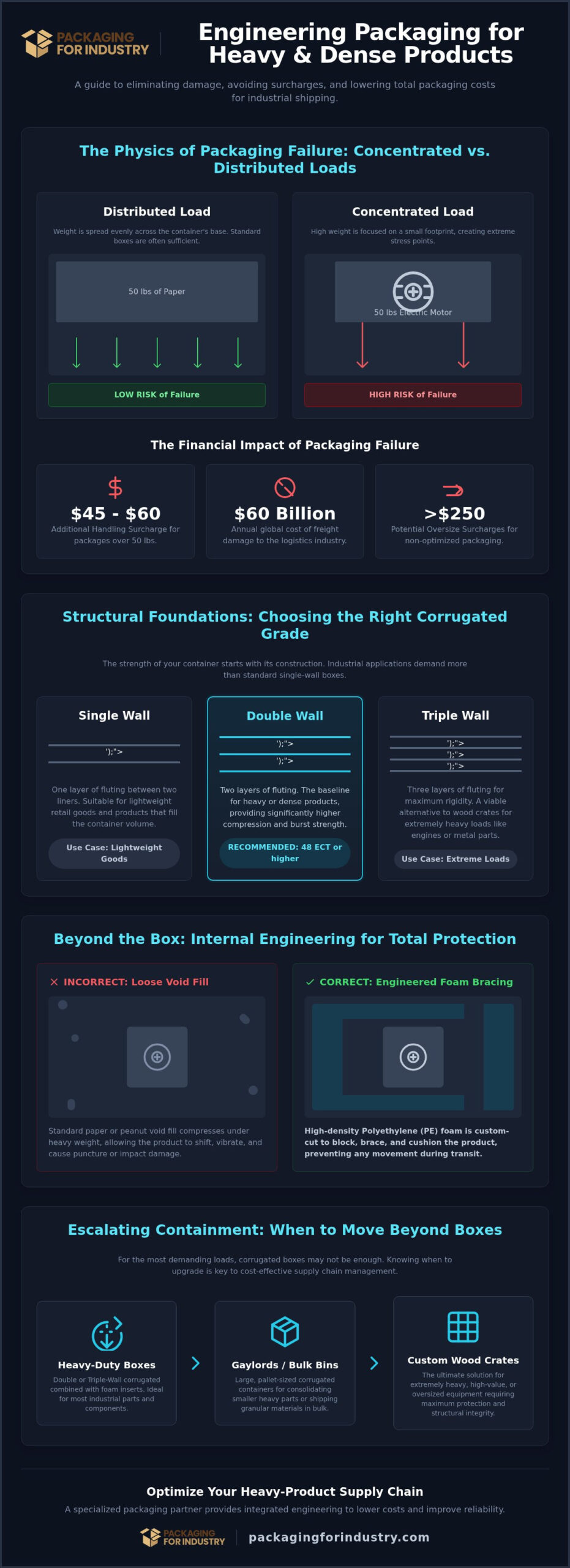
Shipping industrial components requires a shift in how you view structural integrity. In logistics, dense products are defined as high-weight items with a relatively small physical footprint. These are often referred to as concentrated loads. Unlike consumer goods that fill the entire volume of a container, a dense product like a metal casting or a lead-acid battery focuses its entire weight on a fraction of the box’s base. This concentration of force is why standard RSC (Regular Slotted Container) boxes frequently fail. While traditional Corrugated fiberboard is remarkably strong, it’s often engineered for distributed weight rather than the localized pressure of industrial parts.
When packaging for heavy and dense products isn’t engineered correctly, the most common result is bottom-bursting or side-wall puncture. This failure doesn’t just happen during lifting. It often occurs while the product is stationary in a warehouse. Stacking strength is essential for warehouse efficiency and worker safety. If the bottom container in a stack cannot support the vertical load above it, the entire column will buckle. This leads to collapsed pallets, damaged inventory, and a high risk of workplace injury. Proper engineering ensures that the box walls, not the product itself, bear the weight of the stack.
Concentrated vs. Distributed Loads
The difference between a concentrated and a distributed load is the primary reason why standard weight-limit stamps on boxes are often misleading for industrial users. Consider the difference between shipping 50 pounds of printer paper and a 50-pound electric motor. The paper distributes its weight evenly across the entire bottom surface of the box. The motor, however, might exert all 50 pounds of force onto four small mounting bolts. This creates extreme stress points that can easily pierce single-wall corrugated material. Load density is the specific ratio of an object’s weight to its volume, and high load density is the leading cause of structural box failure in the manufacturing sector. Effective base-loading techniques are required to spread this weight across a larger surface area.
The Cost of Packaging Failure
Packaging failure carries both immediate and long-term financial consequences. Direct costs include the expense of replacing the damaged product and the cost of expedited replacement shipping. According to data from FleetWorks, freight damage costs the global logistics industry between $50 and $60 billion annually. Beyond the product itself, poorly engineered packaging for heavy and dense products triggers significant carrier penalties. UPS and FedEx apply an Additional Handling Surcharge for packages exceeding 50 pounds, which typically ranges from $45 to $60 per package. If your packaging isn’t optimized for its weight and dimensions, you may also face Oversize surcharges that can exceed $250. These fees quickly erode profit margins, making it vital to lower packaging costs through better structural design.
Structural Foundations: Corrugated Board Grades and Fluting
Selecting the correct board grade is the first step in engineering reliable packaging for heavy and dense products. While single-wall boxes suffice for lightweight retail goods, industrial applications in sectors like aerospace or heavy manufacturing require the structural rigidity of double-wall or triple-wall construction. Double-wall corrugated consists of two layers of fluting and three liners, providing significantly higher resistance to compression and bursting than standard containers. It’s the baseline requirement for any item that exerts high pressure on a small footprint.
For dense metal parts, automotive components, or heavy hardware, we typically specify heavy-duty double-wall with a 48 ECT rating or higher. This ensures the box doesn’t buckle under its own weight when stacked three or four pallets high in an Inland Empire distribution center. If your goods face long-haul transit or outdoor storage, weather-resistant corrugated treatments can prevent moisture from compromising the paper fibers. You can explore our custom corrugated boxes to find a board grade tailored to your specific manufacturing requirements and environmental challenges.
ECT vs. Mullen Burst Strength: Which Matters for You?
Choosing between these two testing standards depends on your specific logistics environment. The Edge Crush Test (ECT) measures the top-to-bottom compression strength of the board. It’s the most reliable metric for calculating stacking strength and determining how high you can safely stack pallets in a warehouse. In high-volume facilities across Los Angeles and Anaheim, maximizing this vertical strength is essential for safety and space optimization. Conversely, the Mullen Test measures burst strength, or the force required to puncture the box wall. For dense, irregular industrial parts with sharp edges, Mullen-rated boxes are often the superior choice because they resist the internal punctures that lead to total package failure.
Fluting Profiles for Heavy-Duty Applications
The fluting, or the arched paper between the liners, determines the box’s protective characteristics. C-flute is the standard for general industrial use, offering a balance of stacking strength and cushioning. However, for extreme loads, we recommend a B/C double-wall combination. This profile pairs the puncture resistance of B-flute with the stacking strength of C-flute. When weights exceed the limits of standard corrugated, triple-wall construction serves as a lightweight, cost-effective alternative to wood crates. It provides the extreme durability needed for aerospace components or heavy machinery. If you’re unsure which grade fits your application, you can request a packaging quote to receive a technical recommendation from our engineering team.
Beyond the Box: Protective Foam and Internal Engineering
While the corrugated container provides the outer shell, the internal engineering determines whether the contents survive the rigors of the supply chain. Standard void fill materials like crumpled paper or packing peanuts are fundamentally unsuitable for packaging for heavy and dense products. These materials lack the compressive strength required to support concentrated loads. Under the weight of a heavy industrial part, lightweight void fill simply collapses. This allows the product to shift and eventually strike the box wall or burst through the bottom. Proper internal protection requires a shift from simple cushioning to structural blocking and bracing.
Effective protection relies on high-density Polyethylene (PE) foam. Unlike soft cushioning designed for lightweight fragile items, PE foam acts as a structural component that locks the product in place. We often utilize custom foam end caps to suspend heavy items, ensuring they never make direct contact with the box walls. This suspension technique absorbs kinetic energy during drops or vibrations, protecting the most sensitive components of your machinery. You can learn more about these engineered solutions by exploring our custom foam packaging options.
Foam Density and Load Bearing
Engineering a solution for heavy machinery or aerospace components requires precise density calculations. We typically specify 1.7lb or 2.0lb density PE foam to ensure the material can support the product weight without failing. Lower density foams are prone to “creep,” which is a gradual deformation that occurs during long transit cycles or extended storage. If the material selection is incorrect, the foam may bottom out. This means it compresses completely and loses its ability to protect the item from impact. High-density PE foam prevents bottoming out by maintaining its thickness and structural integrity under constant, heavy pressure.
Custom Kitting and Assembly for Heavy Parts
Optimizing your internal logistics is essential for maintaining a predictable supply chain and fiscal responsibility. Utilizing packaging kitting services allows your assembly team to receive pre-organized inserts and components. This reduces labor time and eliminates warehouse clutter by providing exactly what is needed for each shipment. For air or sea freight, where multi-axis movement is constant, we design custom inserts that prevent heavy parts from shifting during turbulent transit. Additionally, for heavy electronic components or medical devices, we provide anti-static (ESD) foam. This specialized material protects against physical impact while simultaneously preventing damage from electrostatic discharge.
Specialized Containment: Gaylords, Crates, and Bulk Bins
When the weight density of your industrial goods exceeds the structural capacity of even the highest-rated corrugated board, your logistics strategy must transition to specialized containment solutions. This shift usually happens when individual units or bulk loads create extreme pressure points that risk total container failure. For manufacturers dealing with high-volume dense products, Gaylord boxes and bulk bins offer a scalable way to move thousands of pounds safely. However, maintaining the integrity of these loads requires more than just a large container. You must integrate corner and edge protection to stabilize the palletized load and prevent the vertical edges from collapsing under the tension of stretch film.
Engineering packaging for heavy and dense products often involves a hybrid approach that combines high-strength corrugated walls with heavy-duty skids or custom wood bases. For specialized sectors with stringent safety requirements, such as those found in aerospace packaging, the transition from a box to a custom crate is often a requirement for both protection and regulatory compliance. These solutions ensure that high-value machinery remains immobilized and protected from the multi-axis forces encountered during sea or air transit. Unlike catalog suppliers that offer only stock sizes, custom-engineered containment reduces wasted space and lowers your total shipping footprint.
Custom Wood Crates for Extreme Density
Custom wood crates provide the ultimate level of protection for items like industrial pumps, aerospace turbines, and heavy manufacturing equipment. When your product’s weight makes corrugated boxes impractical, a crate offers the rigid skeleton needed to support thousands of pounds. If you’re shipping these items across international borders, your crates must meet ISPM-15 heat-treated requirements to prevent the spread of timber pests. We design these custom shipping crates to include integrated blocking and bracing, ensuring that even the most irregular dense parts remain stationary throughout their journey. This level of precision is vital for maintaining fiscal responsibility and preventing the professional stress of catastrophic transit damage.
Bulk Shipping with Gaylords and Heavy Skids
Gaylord boxes are an essential tool for manufacturers moving bulk quantities of dense parts or collecting manufacturing waste. These large containers, often available in custom sizes to fit specific pallet footprints, can be reinforced with heavy-duty liners to prevent leaks or punctures. Because a single pallet can weigh up to 5,000 lbs in the LTL freight network, ensuring pallet compatibility is critical. We utilize heavy-duty skids that are specifically engineered to handle the downward force of a full Gaylord without cracking. By reinforcing these bulk bins with high-performance stretch film and corner boards, you create a unitized load that is safe for stacking and transport in a high-velocity warehouse environment.
Optimizing Your Heavy-Product Supply Chain with PFI
Managing the logistics of industrial goods requires more than just high-strength materials; it demands a partner that understands the intersection of engineering and economics. Packaging For Industry (PFI) provides an integrated approach that combines custom design, prototyping, and technical material selection to ensure your operational stability. By analyzing your specific transit cycles, we help you identify the root causes of failure and implement solutions that prevent professional stress. Our goal is to ensure your dense parts arrive safely while you maintain strict fiscal responsibility. We don’t just sell boxes; we provide a comprehensive system of protection that allows you to lower packaging costs through significant damage reduction.
Many manufacturers struggle with warehouse clutter caused by bulky triple-wall containers and large crates. Our Vendor Managed Inventory (VMI) program addresses this pain point by streamlining your supply chain. We monitor your usage levels and handle the replenishment of your heavy-duty supplies, ensuring you have the necessary materials for high-volume runs without tying up valuable floor space. This just-in-time approach is particularly beneficial for high-density components that require specialized packaging for heavy and dense products, as it keeps your production line moving with predictable costs and zero downtime.
Prototyping and Testing Your Solution
We believe that engineering accuracy is non-negotiable. PFI offers free prototyping to ensure every component of your packaging for heavy and dense products fits perfectly before you commit to a bulk order. Our technical team utilizes CAD/CAM support to design complex internal inserts for irregular industrial shapes, ensuring that heavy parts are immobilized and protected. If you’ve experienced repeat damage with your current supplier, we perform a detailed packaging review. This analysis identifies structural weaknesses in your current design and replaces them with engineered solutions that withstand the multi-axis forces of the LTL freight network.
Local Service and Nationwide Support
Reliability is built on local presence and logistical speed. Manufacturers in Anaheim, Irvine, and across Orange County benefit from our local next-day delivery on stock and custom items. This proximity allows us to act as a proactive problem-solver for Southern California businesses, providing immediate support for urgent production needs. While our local roots are deep, our nationwide shipping capabilities ensure that multi-location distributors receive the same level of precision and quality across the country. Whether you need custom sizes available for a new product launch or a steady supply of heavy-duty RSC boxes, you can request a packaging quote to see how PFI can optimize your industrial logistics.
Secure Your Industrial Logistics with Engineered Protection
Engineering reliable packaging for heavy and dense products requires a precise understanding of concentrated loads and structural material limits. By transitioning from standard RSC boxes to heavy-duty double-wall corrugated and high-density PE foam, you eliminate the risk of bottom-bursting and puncture damage. These strategic choices don’t just protect your product; they protect your bottom line by reducing carrier surcharges and replacement costs.
PFI supports your operations with specialized services like free prototyping and CAD design to ensure a perfect fit for every industrial component. Whether you’re optimizing warehouse space through our Vendor Managed Inventory (VMI) programs or requiring local next-day delivery in Southern California, we provide the reliability your supply chain demands. Our integrated approach ensures that custom sizes and bulk quantities are always available to meet your production schedule.
Take the professional stress out of your shipping process. We’re ready to partner with you to build a more efficient, damage-free future for your business.
Frequently Asked Questions
What is the best corrugated box for items over 50 lbs?
Heavy-duty double-wall or triple-wall boxes are the standard for loads exceeding 50 pounds. Specifically, a 48 ECT or higher double-wall box provides the vertical stacking strength needed for demanding industrial environments. For extremely dense items, triple-wall corrugated offers a lightweight but rigid alternative to wood crates. These custom sizes available from PFI ensure that the container matches the product footprint, preventing the internal shifting that leads to structural failure during transit.
How do I prevent heavy products from breaking through the bottom of a box?
Bottom-bursting is prevented by using high-burst-strength Mullen-rated boxes combined with structural blocking and bracing. You should avoid standard tape closures for heavy items; instead, utilize heavy-duty staples or reinforced filament tape to secure the flaps. Additionally, high-density foam inserts distribute the weight across a larger surface area, reducing the localized pressure that causes corrugated fibers to fail. Integrated base-loading engineering is essential for safe packaging for heavy and dense products.
What is the difference between ECT and Mullen ratings for heavy-duty boxes?
The Edge Crush Test (ECT) measures how much top-to-bottom pressure a box can handle before buckling, which is critical for calculating warehouse stacking heights. The Mullen Test measures the burst strength, or how much pressure the box wall can withstand from the inside out. For heavy, dense parts with irregular shapes or sharp edges, a Mullen-rated box is often superior because it provides better resistance against punctures and internal impacts during rough handling.
When should I use a wood crate instead of a triple-wall corrugated box?
Transition to a custom wood crate when the product weight exceeds the 150-pound parcel limit or when the item requires total immobilization for international export. While triple-wall corrugated is highly durable, wood crates provide a rigid skeleton that can support thousands of pounds without deforming. Crates are also the preferred choice for high-value aerospace or medical equipment where ISPM-15 heat-treated requirements and multi-axis protection are mandatory for global shipping.
Do you provide custom foam inserts for heavy industrial parts?
Yes, we specialize in engineering high-density Polyethylene (PE) foam inserts tailored to your specific product dimensions. Unlike soft retail foam, our industrial-grade PE foam provides the structural rigidity needed for blocking and bracing heavy machinery. We offer free prototyping and CAD design support to ensure your inserts prevent bottoming out. This custom engineering is a core component of effective packaging for heavy and dense products, ensuring total protection during long-haul transit.
Can custom packaging help me avoid UPS or FedEx heavy item surcharges?
Custom packaging helps you avoid surcharges by optimizing the box dimensions to prevent triggering Large Package or Additional Handling fees. Carriers like UPS and FedEx apply significant surcharges for items over 50 pounds or packages with a length exceeding 48 inches. By utilizing custom sizes that minimize cubic volume and ensuring your weight is distributed correctly, you can lower packaging costs and avoid unpredictable fees that erode your profit margins.
What industries benefit most from heavy-duty custom packaging?
Heavy-duty packaging is critical for the aerospace, automotive, medical device, and industrial manufacturing sectors. These industries frequently ship dense metal castings, electronic assemblies, and precision machinery that require high-strength corrugated and custom foam protection. Specialized sectors also rely on our mil-spec and aerospace-compliant solutions to meet rigorous safety standards. PFI provides the technical expertise to ensure these high-value goods reach their destination without damage or costly logistical delays.
Do you offer local delivery for bulk packaging orders in Southern California?
We provide local next-day delivery for manufacturers and warehouses located throughout Southern California, including Anaheim, Irvine, and the Inland Empire. Our fleet is equipped to handle bulk quantities of heavy-duty corrugated, pallets, and custom crates, ensuring you have a reliable supply of materials when you need them. This local service is part of our commitment to helping regional businesses improve supply reliability while maintaining competitive pricing on all industrial packaging supplies.