
What if the safest package for an awkward product isn’t the biggest one? Irregular geometry can make standard cartons hard to fit, while protruding or fragile areas may shift or take impact in transit. Excessive package dimensions can also affect carrier billing, so adding more material isn’t always the best fix. The right packaging solutions for awkwardly shaped products start with the item’s geometry, handling risks, and shipping route.
The goal is to protect the product without adding avoidable movement, material, or packing steps. This guide compares practical options, including custom corrugated boxes, protective foam, crates, and combinations of materials. It explains what to assess when choosing a format and what information to gather for a useful custom packaging quote, from product dimensions and weight to vulnerable areas and shipping conditions. Packaging For Industry can support custom designs with CAD/CAM tools, prototypes, and samples, depending on the project. Use the steps below to assess fit, improve packing efficiency, and prepare a clear brief for a supplier.
Key Takeaways
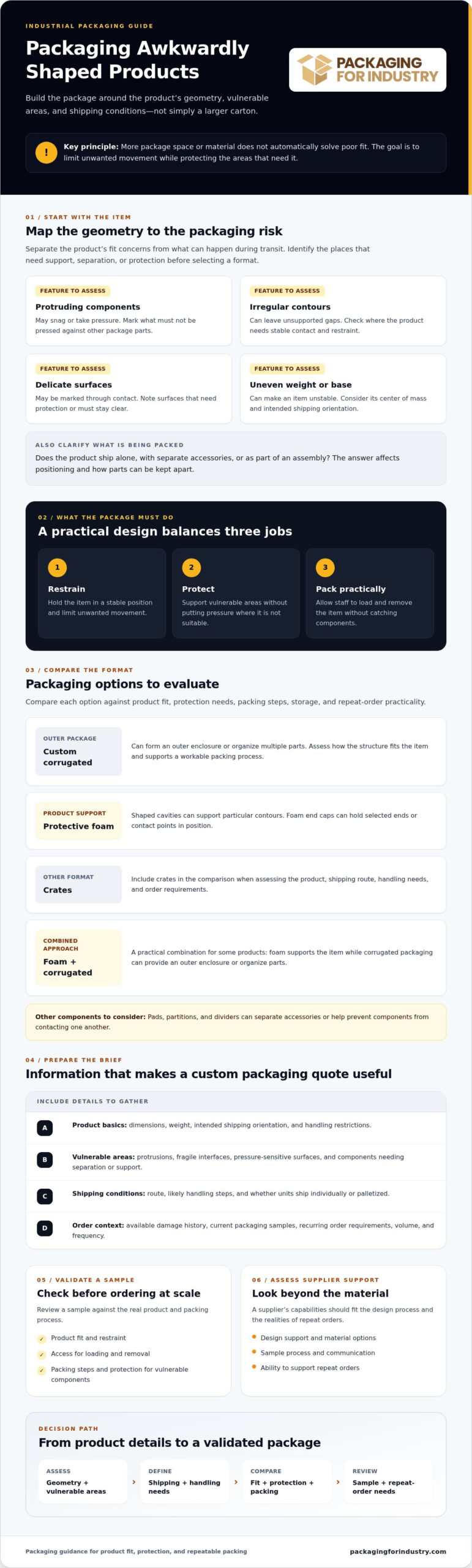
- Map protrusions, uneven weight, delicate surfaces, and dimensions to identify what the package must restrain and protect.
- Compare packaging solutions for awkwardly shaped products by fit, protection needs, packing steps, storage, and repeat-order practicality.
- Use a sample review to check product fit, restraint, access, packing steps, and protection for vulnerable components before ordering at scale.
- Prepare product details and shipping needs to help a supplier develop a more useful custom packaging quote.
- Assess a supplier’s design support, material options, sample process, communication, and ability to support repeat orders.
Why Awkwardly Shaped Products Need a Packaging Plan Built Around Their Geometry
An awkwardly shaped product is difficult to place, restrain, or protect in a standard package because of its geometry. A long assembly with a narrow stem, a component with projecting fittings, or equipment with an uneven base may not sit securely in a stock carton. Simply choosing a larger box can leave more room for movement without solving the underlying fit problem. The package should hold the item in a stable position without putting pressure on vulnerable areas.
Separate fit concerns from transit risks. Fit is about how the item sits inside the package and whether staff can load and remove it without catching on components. Transit risks arise after packing: the item may shift during handling, experience pressure from stacking, or move repeatedly along its shipping route. Packaging engineering brings product design, materials, and handling requirements together to address both. The right packaging solutions for awkwardly shaped products depend on the item, shipping method, handling conditions, and order volume.
Which product features make packaging difficult?
Start by identifying the product’s geometry and the areas that need protection. Protruding components can snag or take pressure. Irregular contours can leave unsupported gaps, while delicate surfaces may be marked by contact with packaging—a challenge frequently faced by fabricators like Fat Boy Design USA when shipping contoured custom motorcycle components. An uneven center of mass can make an item unstable in a carton or crate. Identify any surfaces or components that must not bear pressure or touch other package parts.
Clarify what is being packed, too. Does the product ship alone, with separate accessories, or as part of an assembly? The answer affects how items can be positioned and kept apart. PFI’s custom packaging design services can help assess product-specific requirements and explore a suitable package configuration.
What information should buyers gather before comparing solutions?
- Product dimensions, weight, intended shipping orientation, and handling restrictions provided by the product team.
- Protrusions, fragile interfaces, pressure-sensitive areas, and components that need separation or support.
- Shipping route, likely handling steps, and whether units ship individually or palletized.
- Available damage history, current packaging samples, and recurring order requirements.
These details help a packaging supplier compare custom and stock options against operating needs, not just the product’s outer measurements. For businesses in Los Angeles and across Southern California, a clear brief also makes it easier to discuss packaging for manufacturing, warehousing, or distribution. If you expect repeat orders, include the volume and frequency so the design can be considered for routine packing and replenishment.
How Custom Packaging Contains and Protects Irregular Products
A well-designed package does three jobs: it restrains the product, protects vulnerable areas, and gives staff a practical way to pack and unpack it. The goal isn’t to fill every gap indiscriminately. Instead, support the item at suitable contact points, limit unwanted movement, and keep packaging materials from pressing against components that can’t bear pressure.
Foam can be shaped to support particular contours, while corrugated structures can form an outer enclosure or organize multiple parts. Pads, partitions, and dividers can separate accessories or prevent components from contacting one another. For some products, combining foam with corrugated packaging is a practical option. The right design depends on the item and its handling needs, rather than assuming one material suits every shipment. This integrated approach reflects the broader field of packaging science, which considers how materials and package systems work together.
When are custom foam inserts or end caps a good fit?
Shaped cavities can support an item’s contours, while foam end caps can hold selected ends or contact points in position. The appropriate foam depends on the product and application. Polyethylene foam, polyurethane foam, and ESD foam serve different project requirements, so confirm material suitability with a packaging designer instead of assuming one type will work for every use. Review protective foam packaging options in relation to the product’s surfaces, components, and packing process.
When should buyers consider corrugated boxes or custom crates?
Custom corrugated box structures, pads, partitions, and dividers can organize a product and its accessories inside an outer carton. A crate, including a foam-lined crate, may be worth considering for a large, heavy, or high-value industrial product when its size or handling needs call for a rigid wood structure. A crate isn’t the right choice for every shipment. The design should account for the product, shipping method, and routine handling.
Packaging For Industry can assess custom packaging options, including combinations of boxes, foam, and crates. A sample or prototype can help your team review fit and packing steps before a broader rollout. If you’re comparing packaging solutions for awkwardly shaped products in Los Angeles or elsewhere in Southern California, request a packaging quote with product details and shipping needs to start a focused design discussion.
Compare Packaging Solutions for Awkwardly Shaped Products
Each packaging format addresses a different part of the containment problem. Foam can support a product’s contours, corrugated packaging can enclose and organize it, and a crate provides a wood packaging structure. These materials can also work together. Compare options against product fit, protection needs, packing steps, storage space, and the ability to repeat the design consistently. No format is automatically best. Reviewing a sample helps confirm whether the proposed setup suits the product and shipping process.
How do buyers compare foam, corrugated packaging, and crates?
| Option | Product fit and protection | Packing, storage, and repeat-order considerations |
|---|---|---|
| Custom foam | Shaped cavities or end supports can accommodate particular contours and contact points. | Check how easily staff can place and remove the item, and whether inserts can be stored and supplied consistently for repeat orders. |
| Corrugated structures | Custom box shapes, pads, partitions, and dividers can contain the product and separate components. | Review assembly steps, how the structure stores before use, and whether the design fits the packing line or work area. |
| Crates | A wood packaging option to consider when product scale, handling, or other project requirements call for a rigid structure. | Confirm how the crate will be handled, where it will be staged, and whether the same design can support recurring shipments. |
| Combined solution | Different materials can provide separate functions, such as foam support inside a corrugated box or a foam-lined crate. | Account for each component’s assembly, storage, and replenishment needs, then review the complete packing sequence. |
When does a combined packaging solution make sense?
Use more than one material when the product needs distinct functions. For example, a foam insert may support an irregular assembly while a corrugated box provides the outer enclosure. A foam-lined crate may suit a project that needs shaped support within a wood structure. These are options to assess, not requirements for every shipment. Ask the packaging designer to explain the role of each component and whether the complete package is practical for staff to assemble, handle, and store.
For packaging solutions for awkwardly shaped products, compare the complete system instead of selecting materials in isolation. Packaging For Industry can assess custom designs and combine materials such as boxes, foam, and crates where appropriate. For project-specific pricing, request a packaging quote with product details, shipping method, and expected order volume.
Specify and Validate a Packaging Solution Before Ordering at Scale
A clear brief gives a packaging designer the information needed to turn product geometry and shipping conditions into a workable design. It also helps purchasing and operations teams evaluate the same requirements before committing to a repeat order. For packaging solutions for awkwardly shaped products, use a defined process: document the item and its journey, review the proposed design, evaluate a sample, then confirm the production scope and ordering plan.
What belongs in a custom packaging brief?
Bring together product details and operating context rather than specifying a material in isolation. Include dimensions, weight, product images or drawings, vulnerable areas, and required shipping orientation. Describe the shipping method and likely handling steps, and state whether units ship individually or palletized. Add known damage concerns and explain how staff currently pack the item.
Include purchasing and warehouse details, too. Note expected packaging volume and order frequency, storage limitations, and any components the package must contain. If the product ships with accessories, identify whether they need separation or their own support. These details help a supplier assess both the package design and its fit within the pack-out workflow.
How should buyers review prototypes or samples?
Evaluate the sample with the people who pack, handle, and receive the product. Follow the intended pack-out process and check whether the item fits consistently, stays positioned, and can be removed without difficulty. Inspect contact points and confirm that vulnerable components remain clear of pressure or contact with other package parts.
Then review the workflow. Can staff access the product and separate its components as needed? Are assembly steps clear? Does the package fit the available storage and handling setup? Record specific revision requests instead of general comments, and ask the packaging supplier to confirm which sample changes and production scope are included before approving an order. Packaging For Industry’s custom design process can include CAD/CAM support, prototypes, samples, and packaging reviews, depending on the project.
Once the sample and requirements are approved, confirm the final design, recurring volume, and replenishment needs with the supplier. This gives purchasing a defined basis for comparing options and helps operations prepare for repeat packing. Manufacturers and warehouses in Los Angeles and across Southern California can use the same brief to discuss package fit alongside local supply requirements.
Choose an Industrial Packaging Supplier for Awkwardly Shaped Products
A supplier for irregular products should do more than recommend a box size. Assess whether the team can review product requirements, coordinate design and samples, source suitable materials, and support repeat orders. This matters across industries with different products and handling needs, including aerospace, electronics, medical device manufacturing, food and beverage, and construction. Clear communication helps purchasing and operations understand what information is needed and what to confirm before production.
What should manufacturers and operations teams ask a supplier?
Ask who will review the product and coordinate design, samples, and production. Confirm which materials can be supplied together, such as a corrugated enclosure with foam support or a crate with cushioning. Discuss lead times, expected order frequency, storage needs, stocking options, and service coverage for your location. Confirm project-specific terms directly rather than assuming every material or delivery follows the same schedule.
These questions help teams assess the full supply relationship, not just the initial package concept. The design must suit both the product and the people who pack it, while the supply plan should reflect recurring demand. Share expected volumes early so the supplier can consider repeat-order requirements during design review.
How can PFI support custom and recurring packaging needs?
Packaging For Industry supplies custom and stock materials for industrial buyers, including corrugated boxes, protective foam, crates, and cushioning. Its custom packaging design capabilities can include CAD/CAM support, packaging reviews, prototypes, and samples. Confirm the available scope for your project. Buyers can discuss custom corrugated boxes and custom foam inserts as components of a product-specific solution.
PFI serves businesses across Southern California and supports nationwide needs. Local next-day delivery is offered across Southern California, but availability should be confirmed for the requested items and location. For ongoing demand, ask about stocking programs or just-in-time inventory management and whether either approach fits your usage pattern.
To start a useful discussion, prepare product dimensions and weight, images or drawings, vulnerable areas, shipping and handling details, current packaging samples, expected order volume, and known damage concerns. This gives the supplier a practical basis for reviewing the project and preparing a quote.
Build a Packaging Plan You Can Repeat
Match the package to the product, shipping conditions, and packing process, then validate the design before placing a repeat order. Compare packaging costs alongside material use, packing steps, and recurring supply needs to identify practical ways to reduce expense without overlooking product protection.
Packaging For Industry offers corrugated boxes, foam packaging, crates, and related industrial materials. Custom packaging design can include CAD/CAM support, prototypes, and samples, depending on the project. For ongoing demand, stocking programs and just-in-time inventory management can support supply planning. Share product details, shipping requirements, current packaging, and expected order volume to help prepare a useful custom packaging quote.
A clear brief gives your supplier a practical starting point for a packaging plan that fits your product and supports your operation.
Frequently Asked Questions
What is the best packaging for an irregularly shaped product?
The best option is the one that fits the product, protects vulnerable areas, and works with its shipping and handling conditions. Custom foam can support specific contours, while corrugated structures can enclose the product and separate components. A crate may suit a product whose size or handling needs call for a wood structure. The right packaging solutions for awkwardly shaped products depend on the item, and a sample review can help assess the design before ordering.
How do you package a product that does not fit a standard box?
Document the product’s dimensions, weight, orientation, protrusions, and areas that must not bear pressure. A packaging designer can use those details to assess custom corrugated structures, foam supports, crates, or a combination. The design should account for the shipping method and actual pack-out steps, not just the product’s outer measurements. Review a sample to check fit, restraint, access, and whether staff can pack and remove the item as intended.
Can custom foam inserts protect awkwardly shaped products?
Custom foam inserts can be designed with shaped cavities or support points that correspond to a product’s contours. Depending on the design and application, they may help hold an item in position and separate vulnerable components. Foam type matters, too. Polyethylene, polyurethane, and ESD foam address different requirements, so confirm material suitability with the packaging designer. Evaluate a sample with the actual product before deciding whether the insert meets your handling needs.
Should I use a custom box or a crate for an unusually shaped product?
Choose based on product size, shipping method, handling conditions, and how the package will be managed in your operation. A custom corrugated box can provide a configurable enclosure, with pads or dividers to organize components. A crate may be appropriate when project requirements call for a wood structure. Neither option is automatically best. Compare the packing process and storage requirements, and review the sample before approving the design.
What information should I provide for a custom packaging quote?
Provide product dimensions and weight, images or drawings, orientation requirements, and details about fragile or pressure-sensitive areas. Include the shipping method, whether items travel individually or palletized, current packaging samples, and any known damage concerns. Expected order volume, frequency, storage limits, and pack-out steps help a packaging supplier assess the full requirement. Los Angeles buyers can also note the delivery location and timing needs for project-specific review.
Can packaging be designed for recurring production orders?
Yes. A packaging design can be evaluated for repeat use alongside expected order volumes, production schedules, and storage capacity. Packaging For Industry supports recurring supply needs through stocking programs and just-in-time inventory management. Discuss usage patterns, replenishment planning, and lead times with the supplier so the proposed design and supply approach align with your operation. Confirm the program details and product availability for your specific requirements.
Can a packaging solution combine foam, corrugated boxes, and crates?
Yes. Different materials can serve separate functions in one packaging system. Foam may support or separate a product, corrugated packaging can provide an outer enclosure, and a crate may be considered when the project calls for a wood structure. Packaging For Industry can combine boxes, foam, and crates in custom industrial packaging solutions. Review the complete pack-out to check that the components work together for handling and repeat orders.