
What if the “safe” catalog box you’re using for your spectrometer is actually the primary cause of its next calibration failure? It’s a frustrating reality for many logistics managers: you pay a premium for over-engineered supplies, yet instruments still arrive at the customer site with hairline fractures or misaligned sensors. You likely already know that generic corrugated isn’t designed to handle the resonant frequencies of delicate electronics. This article explores high-performance packaging solutions for sensitive scientific instruments that move beyond basic cushioning. We’ll show you how to eliminate shipping damage through integrated material systems while simultaneously reducing your procurement costs.
We’ll provide a roadmap for achieving a zero-damage shipping record by addressing the latest 2026 IATA regulations for lithium-ion components and the shift toward Kraft-based dunnage in ISTA 6-Amazon standards. You’ll also learn how a local Southern California supplier can slash lead times for custom ESD foam inserts and heavy-duty crates. By focusing on the intersection of engineering and economics, you can finally move away from catalog guesswork and secure a reliable, cost-effective supply chain for your most valuable assets.
Key Takeaways
- Identify and mitigate the primary transit threats of shock, vibration, and electrostatic discharge to protect the internal calibration of delicate sensors.
- Evaluate specialized packaging solutions for sensitive scientific instruments, including the selection of polyethylene or polyurethane foam inserts and heavy-duty corrugated boxes.
- Utilize CAD/CAM engineering and free prototyping to create precision-cut foam assemblies that eliminate product movement during transport.
- Lower packaging costs by optimizing box dimensions to remove unnecessary dimensional weight surcharges from national carriers.
- Improve supply reliability for recurring manufacturing needs with local next-day delivery throughout Southern California, specifically in Los Angeles, Orange County, and San Diego.
The Critical Risks of Shipping Sensitive Scientific Instruments
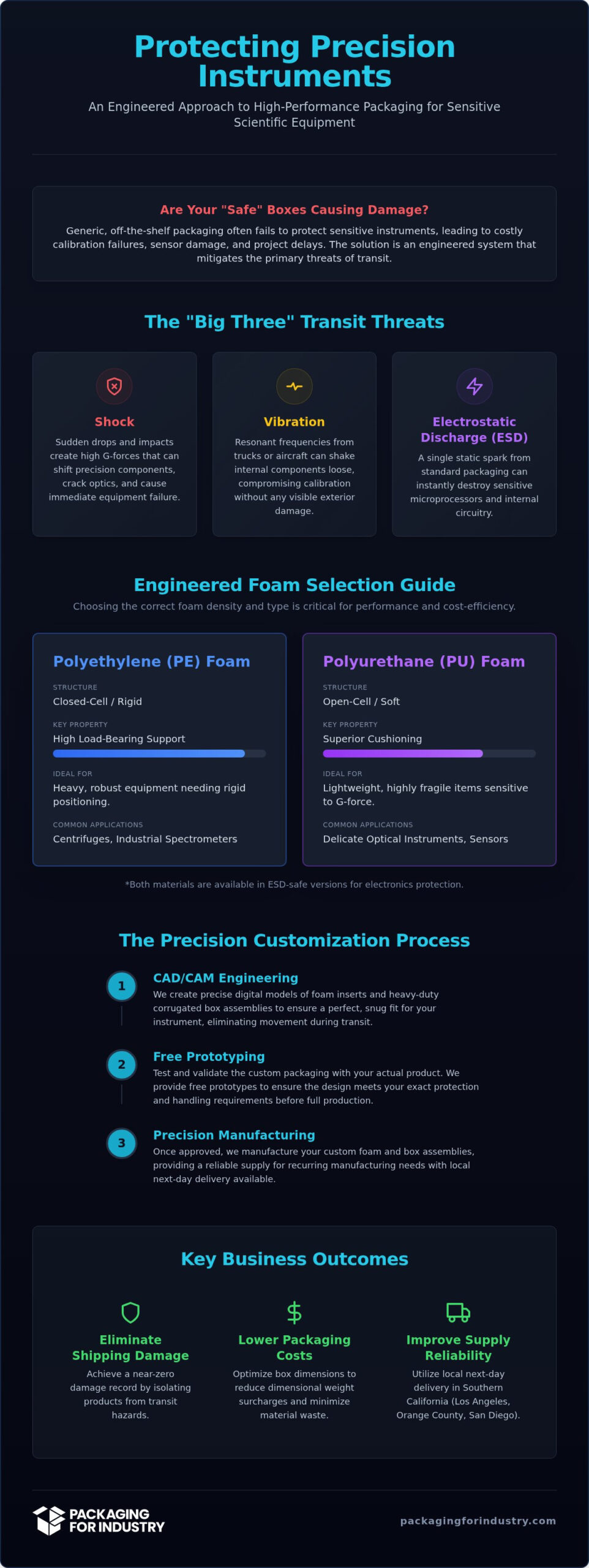
Shipping high-value laboratory equipment involves more than just choosing a sturdy box. You’re dealing with the “Big Three” transit threats: shock, vibration, and electrostatic discharge (ESD). These factors don’t just cause visible cracks. They can compromise the internal calibration of scientific sensors without leaving a single mark on the exterior packaging. When a shipment experiences excessive G-force during a drop or sudden stop, the precision components inside can shift. This leads to costly recalibration or total equipment failure. This damage directly impacts your manufacturing ROI through replacement costs and delayed project timelines. Effective packaging solutions for sensitive scientific instruments must also account for climate control. Moisture barrier bags and desiccants are often necessary to prevent corrosion on delicate circuitry during long-haul transit or warehouse storage.
Shock and Vibration Mitigation
Every scientific instrument has specific resonance frequencies where vibration causes the most internal damage. If the vibrations from a truck or aircraft match these frequencies, components can shake themselves loose. High-quality Package cushioning is the first line of defense. We use custom foam inserts designed to absorb and dissipate energy during drop events. Unlike generic bubble wrap, engineered foam provides a “snug fit” that prevents internal shifting. This precision engineering ensures the instrument remains stationary within the corrugated boxes, effectively isolating it from external physical stress. By calculating the fragility of the device, we select materials that offer the exact deceleration needed to keep G-forces within safe limits.
Electrostatic Discharge (ESD) Protection
Standard plastic films and generic foam are notorious for generating triboelectric charges. For instruments with sensitive microprocessors, a single static spark can destroy internal circuitry instantly. It’s vital to understand the difference between anti-static and static-shielding materials. Anti-static materials prevent the buildup of static, while shielding materials actually block external electrical fields. Depending on the sensitivity of your gear, you might require ESD-safe foam packaging or specialized corrugated assemblies. Implementing these packaging solutions for sensitive scientific instruments ensures that your electronic components arrive in the same functional state they left the cleanroom. Using the right combination of conductive and dissipative materials allows you to reduce shipping damage and avoid the high costs of field failures.
Comparing Protective Materials for Scientific Equipment
Selecting the right materials is a calculated balance between protection levels and logistical efficiency. While generic bubble wrap might suffice for consumer goods, packaging solutions for sensitive scientific instruments require engineered polymers and reinforced outer shells. The weight, fragility, and destination of the instrument dictate whether you need a lightweight corrugated solution or a heavy-duty timber crate. Using the wrong material density often leads to “bottoming out” during a drop, where the cushioning fails to stop the instrument before it hits the outer wall.
Foam Material Selection Guide
The choice between polyethylene and polyurethane foam depends on the static loading requirements of your device. Polyethylene (PE) is a closed-cell material that offers high load-bearing support. It’s ideal for heavy equipment like centrifuges or industrial spectrometers that require rigid positioning within the container. In contrast, polyurethane (PU) is an open-cell, softer foam. It provides superior cushioning for lightweight, highly fragile optical instruments that can’t withstand high G-force impacts. For electronic components, both materials are available in ESD-safe versions. You can review specific material densities and performance specs for these packaging solutions for sensitive scientific instruments on our PFI foam packaging page.
Corrugated and Wood Outer Packaging
Outer packaging must resist stacking pressures and puncture risks in a high-volume warehouse environment. For domestic freight, heavy-duty corrugated boxes in double-wall or triple-wall configurations offer an excellent strength-to-weight ratio. These help lower shipping costs by reducing dimensional weight while providing significant protection. However, for high-value exports or oversized lab gear, custom wood crates are often necessary. Crates provide the structural integrity required for international transit and can be designed with integrated pallets for easy forklift access. When palletizing these loads, integrating corner and edge protection prevents strap tension from crushing the outer container. If you’re currently dealing with transit damage, you can request a custom packaging quote to compare engineered material options for your specific gear.
For instruments with irregular shapes, air-filled partitions or suspension packaging may be the most efficient choice. These systems suspend the instrument in the center of the box using tensioned film, keeping it away from all six sides of the container. This approach is highly effective for lightweight electronics that require maximum shock isolation. By choosing the right material combination, you ensure a reliable supply chain and eliminate the professional stress of recurring product damage.
Engineering Custom Foam and Box Assemblies
Precision engineering is what separates a damaged sensor from a successful delivery. We don’t rely on generic fillers or standard box sizes that leave your equipment vulnerable. Instead, our packaging solutions for sensitive scientific instruments are built around the exact geometry of your product. By integrating CAD/CAM technology into the design phase, we create a protective system where every component serves a specific functional purpose. This methodical approach ensures that your instruments remain stationary and protected against the specific G-force thresholds they’ll encounter during transit.
The Prototyping and Design Process
Our engineering team utilizes your instrument’s CAD files to design precision-cut foam cavities. This eliminates the guesswork often associated with manual measurements. We focus on creating exact fitments that distribute pressure evenly across the device’s chassis, avoiding sensitive adjustment knobs or glass interfaces. A critical part of our service is providing free prototyping. This allows you to verify the fit and performance before committing to a bulk order. We test these prototypes against rigorous vibration and drop standards to ensure they meet the latest 2026 ISTA 6 specifications. You can learn more about our engineering workflow on our custom design packaging page.
Specialized Crating for Scientific Logistics
When your equipment requires more than a corrugated shell, we engineer custom foam-lined wooden crates. These are essential for high-value exports and oversized lab gear that must withstand the rigors of international shipping. Our crates are built using heat-treated wood to comply with ISPM-15 international standards, ensuring your shipment isn’t delayed at customs. We often integrate multiple materials, such as combining high-density polyethylene foam for base support with softer polyurethane for top cushioning. This creates a holistic system of protection and logistical optimization.
If you’re ready to lower packaging costs and eliminate shipping damage, the first step is a technical assessment of your current methods. You can request a packaging quote to see how our bespoke engineering can improve your supply reliability. Whether you need a corrugated box quote for domestic freight or a complex multi-material assembly, we provide the technical expertise to secure your most sensitive assets.
Reducing Packaging Costs and Shipping Damage
Engineering high-performance packaging solutions for sensitive scientific instruments is often viewed as a premium expense. In reality, it’s a cost-containment strategy. When you compare packaging pricing between custom engineered systems and generic catalog suppliers, the fiscal benefits of precision become clear. Generic boxes usually require excessive dunnage to fill empty space, which increases material costs. More importantly, oversized boxes trigger dimensional weight (DIM) surcharges from carriers like UPS and FedEx. By using custom-sized corrugated boxes that fit your instrument’s exact footprint, you eliminate the cost of shipping air and lower packaging costs across your entire distribution network.
Optimizing Procurement with VMI
Warehouse space is a finite resource that shouldn’t be wasted on stacks of empty boxes. Implementing Vendor Managed Inventory (VMI) allows you to transition to a leaner operational model. We monitor your packaging usage and provide just-in-time delivery to your facility. This approach improves your cash flow by reducing the capital tied up in inventory. It also eliminates the need for emergency rush orders when production ramps up unexpectedly. For manufacturers in Southern California, our VMI program ensures that custom foam inserts and heavy-duty boxes are always available for recurring production runs without the burden of on-site storage.
Damage Reduction as a Profit Driver
The most expensive package is the one that fails. To effectively reduce shipping damage, you must calculate the total cost of a failure. This figure goes far beyond the material cost of the box. It includes the labor for inspecting the returned unit, the cost of specialized recalibration, and the potential loss of a high-value customer. We’ve seen how precision-engineered foam assemblies can drastically reduce lab equipment returns compared to generic bubble wrap. These savings go directly to your bottom line. Our team performs comprehensive packaging reviews to identify these vulnerabilities. We focus on areas where over-engineering is costing you money and where under-engineering is causing product loss. This data-driven approach ensures your packaging solutions for sensitive scientific instruments are as fiscally responsible as they are protective.
Custom Packaging Solutions in Southern California
Localized supply chains are essential for high-stakes industries like aerospace and medical device manufacturing. When you’re shipping calibrated gear, you can’t afford the delays or handling risks of long-haul transit from national catalog suppliers. PFI provides specialized packaging solutions for sensitive scientific instruments with a focus on the Southern California industrial landscape. Being a local partner means we understand your specific lead times and warehouse needs. We offer local packaging delivery throughout Orange County, Los Angeles, and the Inland Empire, ensuring your production lines never stall due to a lack of supplies.
Serving the SoCal Tech and Science Corridors
We provide custom boxes in Anaheim, Brea, and Irvine to support the region’s dense concentration of technology firms. For biotech companies in San Diego and Los Angeles, we offer specialized protective foam and heavy-duty corrugated solutions designed for sterile and high-value equipment. This local presence allows for on-site consultations and rapid prototyping that national competitors simply can’t match. You can compare packaging pricing for bulk orders and see the immediate benefit of reduced freight costs. While we maintain fast nationwide shipping for customers across the country, our local infrastructure is optimized for the specific demands of the Southern California science and tech corridors, including next-day delivery in Riverside and San Diego.
The PFI Advantage for Industrial Buyers
Choosing PFI means you’re working with experienced packaging salespeople who understand the technical requirements of industrial logistics. We don’t use generic call centers; you get direct access to experts who can help you lower packaging costs and improve supply reliability. Our team has deep expertise in mil-spec packaging and the protection of high-value industrial components. We ensure your packaging solutions for sensitive scientific instruments meet every regulatory and safety standard, from ESD protection to heavy-duty crating. This comprehensive oversight ensures that your most delicate assets are protected from the design phase to the final delivery. Our goal is to serve as a proactive problem-solver for your facility, providing custom sizes available for any instrument configuration.
Whether you’re looking to reduce shipping damage or transition to a vendor-managed inventory system, we have the engineering and logistical capabilities to support your goals. We provide packaging for manufacturers, warehouses, and distribution centers that value precision and fiscal responsibility. By choosing a local Southern California packaging supplier near me, you gain a steady partner dedicated to your operational success. Our expertise in industrial logistics allows us to optimize your entire system of protection while helping you maintain a competitive bottom line.
Contact us today for a custom packaging quote
Securing Your Supply Chain with Precision Packaging
Maintaining a zero-damage shipping record starts with moving away from one-size-fits-all catalog boxes that don’t account for specific resonance frequencies. Integrating custom ESD foam with heavy-duty corrugated or wooden crates ensures your most delicate electronics survive the rigors of global transit. These tailored packaging solutions for sensitive scientific instruments provide a clear path to lower procurement costs. Precision engineering protects your bottom line.
As B2B specialists in aerospace and medical packaging, we provide free prototyping to ensure a perfect fit. For firms in Orange County, Los Angeles, and San Diego, our local next-day delivery keeps your operations running. We eliminate the burden of excessive inventory.
You can finally eliminate the stress of shipping damage and focus on your core manufacturing goals. We’re ready to help you build a more resilient and cost-effective logistics strategy today.
Frequently Asked Questions
How do I choose between polyethylene and polyurethane foam for instruments?
Polyethylene is a closed-cell foam used for heavy scientific instruments that require high load-bearing support and rigid positioning. Polyurethane is an open-cell, softer material designed for lightweight, highly fragile items like optical lenses. Choosing the right density prevents the instrument from “bottoming out” during transit. We evaluate the static loading of your device to determine which polymer provides the necessary vibration dampening and shock absorption for your specific application.
What are the best packaging solutions for sensitive scientific instruments?
The most effective packaging solutions for sensitive scientific instruments are integrated systems that combine multiple protective materials. This typically includes precision-cut foam inserts housed within heavy-duty double-wall or triple-wall corrugated boxes. For high-value exports, custom-engineered wooden crates provide the structural integrity needed for international freight. These solutions are designed to mitigate shock, vibration, and electrostatic discharge, ensuring that delicate internal sensors remain perfectly calibrated throughout the shipping process.
Can I get a custom packaging quote for low-volume instrument shipping?
We provide a custom packaging quote for manufacturers and industrial distributors with recurring shipping needs. While our primary focus is on bulk quantities and repeat orders, we help businesses engineer solutions for low-volume, high-value instrument shipments. Our process includes CAD/CAM design and prototyping to ensure your custom sizes are optimized for protection. This approach helps you lower packaging costs by eliminating the need for expensive replacements and repairs.
What is the difference between anti-static and ESD foam?
Anti-static foam, often colored pink, is treated to prevent the buildup of static electricity on the foam surface itself. ESD or static-shielding foam, typically black, is designed to actually block external electrical fields from reaching the sensitive circuitry inside. For most scientific instruments with microprocessors, using the correct ESD-safe material is critical. We offer both polyethylene and polyurethane variants in anti-static and conductive grades to meet specific aerospace and medical device requirements.
How does custom packaging reduce shipping damage for lab equipment?
Custom packaging reduces shipping damage by creating a “snug fit” that eliminates internal product movement. We use CAD/CAM engineering to design foam cavities that distribute pressure evenly across the instrument’s chassis, protecting sensitive knobs and glass interfaces. By calculating the fragility and resonant frequencies of your lab equipment, we select materials that keep G-forces within safe limits. This methodical approach identifies vulnerabilities that generic boxes ignore, resulting in a reliable zero-damage shipping record.
Do you provide local packaging delivery in Orange County and Los Angeles?
We provide local packaging delivery across Southern California, including Orange County, Los Angeles, San Diego, and the Inland Empire. Our fleet offers next-day delivery for businesses in cities like Anaheim, Irvine, and Santa Fe Springs. This local presence allows us to support manufacturing hubs with just-in-time inventory and VMI programs. By choosing a local supplier, you reduce lead times and eliminate the logistical stress associated with national catalog distributors.
Why is custom-engineered packaging better than standard catalog boxes?
Custom-engineered packaging provides a level of precision that off-the-shelf boxes from large catalog suppliers simply cannot match. Standard boxes often require excessive void fill, which increases your material spend and triggers dimensional weight surcharges from major carriers. PFI focuses on the intersection of engineering and economics, providing a custom fit that eliminates shipping air. This approach lowers your total cost of ownership while providing significantly better protection than generic industrial supplies.
What information do I need to provide for a custom foam prototype?
To create an accurate custom foam prototype, you should provide CAD files or physical dimensions of your instrument. We also need to know the unit weight, the fragility level or G-force rating, and the intended shipping method. This data allows our engineers to select the correct foam density and design a cavity that secures the product perfectly. Providing information about sensitive external components, such as lenses or adjustment dials, ensures we design the necessary clearance into the assembly.