
The convenience of a national catalog often hides a significant drain on your bottom line. While Uline is a standard choice for many, local manufacturers are realizing that paying high freight surcharges for bulky, off-the-shelf materials is no longer sustainable. If you’re looking for a packaging supplier better than Uline for custom foam Orange County manufacturers can rely on, the answer lies in precision engineering rather than stock sizes. With foam prices increasing by 8.75 percent since 2025, every inch of wasted space or damaged product directly impacts your margins.
You likely understand the frustration of receiving a shipment of fragile parts only to find that generic cushioning failed to do its job. It’s a common struggle to balance warehouse space with the need for bulk catalog orders that don’t quite fit your specific components. This article will show you how moving toward custom-engineered foam solutions can simultaneously reduce your shipping damage and lower your total procurement costs. We’ll explore the advantages of local Southern California delivery, the impact of new SB 54 regulations on your packaging choices, and how free CAD/CAM prototyping can eliminate the risk of a design failure before you ever place a full order.
Key Takeaways
- Learn why choosing a local packaging supplier better than Uline for custom foam Orange County eliminates hidden freight surcharges and excessive minimum order requirements.
- Discover how custom-engineered CAD/CAM designs provide precision protection for fragile parts that generic catalog foam cannot match.
- Explore the logistical advantages of Anaheim-based manufacturing, including next-day delivery and reduced lead times for Southern California operations.
- Understand how to leverage Vendor Managed Inventory (VMI) to reclaim warehouse space and optimize your total cost of ownership.
- Gain a clear checklist for evaluating a supplier’s ability to meet rigorous aerospace, defense, and medical industry packaging standards.
The Uline Trap: Why Catalog Foam Fails Orange County Manufacturers
Defaulting to a massive national catalog is an easy decision during the initial procurement phase. It’s a pragmatic choice for basic supplies, but it often becomes a “trap” for companies shipping high-value or fragile components. National distributors prioritize high-volume turnover and standardized SKUs. They aren’t in the business of precision engineering. When your product value exceeds the protection capabilities of a stock box, you need a packaging supplier better than Uline for custom foam Orange County manufacturers can trust for technical accuracy.
The “one-size-fits-all” model creates a dangerous gap between the material you buy and the protection your product actually requires. Every inch of empty space or poorly fitting cushioning is a point of failure. With foam product pricing increasing by 8.75 percent since 2025, continuing to use inefficient, oversized catalog foam isn’t just a logistics risk; it’s a direct hit to your fiscal responsibility.
Catalog Limitations vs. Industrial Requirements
Stock foam sheets and planks are commodities designed for general use. If your product has complex geometry, your team likely spends expensive labor hours cutting, trimming, or gluing these standard materials to make them fit. This hidden labor cost quickly erodes any perceived savings from catalog pricing. Furthermore, catalog distributors rarely stock specialized materials like anti-static (ESD) or Mil-Spec foams required for Southern California’s aerospace and electronics sectors. Relying on “good enough” fitment leads to recurring transit damage. If a sensitive component has room to migrate during shipping, the packaging has already failed.
The True Cost of National Distribution
Shipping bulky foam across state lines is increasingly cost-prohibitive. In 2026, major carriers have implemented aggressive surcharges for oversized, lightweight shipments. When you order from a national distributor, you’re effectively paying premium freight rates to ship air. This “Freight Shock” significantly inflates your procurement budget without adding any value to the protective qualities of the packaging.
- Lead-Time Volatility: Out-of-state shipping introduces variables like weather delays and hub congestion that can stall your production line.
- Warehouse Inefficiency: Catalog orders often require bulk purchasing to justify shipping costs, which wastes valuable floor space in Orange County facilities.
- Environmental Impact: Shipping large volumes of air across the country contradicts the sustainability goals set by California’s SB 54 regulations.
A local partner in Anaheim solves these logistical challenges. By sourcing your custom foam packaging in Anaheim, you eliminate out-of-state surcharges and gain the agility of next-day delivery. This shift moves your packaging from a commodity expense to a strategic asset.
Custom Engineering vs. Stock Foam: A Technical Comparison
Selecting a packaging supplier better than Uline for custom foam Orange County manufacturers can rely on requires looking past the price-per-sheet. You must evaluate the technical performance of the material itself. Stock foam is a commodity, but industrial protection is a science. While catalog distributors offer generic grades, specialized manufacturing demands specific cell structures and chemical properties to ensure product integrity during transit. Transitioning from stock planks to engineered inserts is the most effective way to eliminate the “good enough” fitment that leads to damage.
The choice between materials often dictates the success of a logistics strategy. Polyethylene (PE) is a closed-cell foam that provides high-load bearing and moisture resistance, making it the standard for heavy aerospace assemblies. Polyurethane (PU) offers a softer, open-cell structure that excels at protecting delicate medical instruments from high-frequency vibration. Expanded Polystyrene (EPS) provides rigid, lightweight support for larger industrial equipment. When these materials are combined with precision CNC routing, the result is a custom fit that stock planks cannot replicate.
Material Selection for Specific Industries
Different sectors in Southern California have unique compliance needs. Aerospace manufacturers require high-density foams that meet strict weight-to-protection ratios to keep shipping costs manageable. Medical device firms need non-abrasive, cleanroom-compatible cushioning that doesn’t shed particles or outgas. For the electronics sector, anti-static and ESD foams are non-negotiable. These specialized materials dissipate static charges that could otherwise destroy sensitive circuitry. Catalog suppliers rarely provide the technical documentation or consistent ESD ratings needed for these high-stakes applications.
The Engineering Advantage: Prototyping and Testing
Precision starts with CAD/CAM design. Instead of manual modifications, CNC routing ensures every insert is identical to the millimeter. This accuracy allows for integrated solutions where foam inserts are perfectly keyed to corrugated boxes, creating a single, cohesive unit. This level of custom design packaging removes the guesswork from your supply chain.
Moving beyond guesswork involves drop testing and vibration analysis. An engineered insert is designed to absorb specific G-forces based on the weight and fragility of your part. Free prototyping allows you to verify fitment and performance before committing to a production run, which significantly reduces your total cost of ownership. If you’re ready to see how an engineered solution compares to your current catalog orders, you can request a technical quote today to begin the design process.
Regional Logistics: The Orange County Advantage
Operating within the Southern California logistics corridor requires a strategy that prioritizes speed and space. When you choose a packaging supplier better than Uline for custom foam Orange County manufacturers gain a partner located in their own backyard. National distributors operate on a model of massive, centralized warehouses that are often hundreds of miles away. This creates a reliance on third-party carriers and subjects your procurement to transit delays. Buying directly from an Anaheim-based manufacturer eliminates the middleman markup and provides a direct line to the production floor.
Next-day delivery isn’t just a convenience; it’s a safeguard against production line stops. For facilities in Anaheim, Irvine, and Costa Mesa, the ability to receive custom foam inserts within 24 hours of an order ensures that high-stakes shipping schedules remain on track. If an emergency arises or a design needs a sudden adjustment, a local team can respond in hours rather than days. This proximity allows you to operate with a level of agility that a catalog-based system simply can’t match.
Servicing the Southern California Industrial Hub
The Irvine Spectrum and Anaheim Canyon are centers of precision manufacturing that don’t have time for logistics volatility. Sourcing your materials locally significantly reduces the carbon footprint of your supply chain by cutting down on long-haul trucking. Our Orange County packaging solutions are designed to support these hubs with regional expertise and localized support. This regional focus ensures your packaging is tailored to the specific environmental and transit conditions of the West Coast.
Solving the Warehouse Space Crisis
Warehouse space in Orange County is among the most expensive in the nation. Storing bulky pallets of catalog foam is an inefficient use of high-value square footage that could otherwise be used for production. By utilizing a local partner, you can transition to a Just-In-Time (JIT) model where you only house what you need for immediate use.
Transitioning to a local JIT model provides several operational advantages:
- Reduced inventory carrying costs
- Elimination of ‘dead’ warehouse space
- Improved cash flow through smaller, more frequent orders
- Faster response to engineering changes
PFI’s stocking programs are engineered to keep your inventory levels low while maintaining high availability for your most critical components. Vendor Managed Inventory (VMI) is a strategic tool for cash flow optimization that shifts the responsibility of inventory levels to the supplier while ensuring immediate availability. This approach frees up capital and floor space, allowing you to scale your operations without expanding your physical footprint.
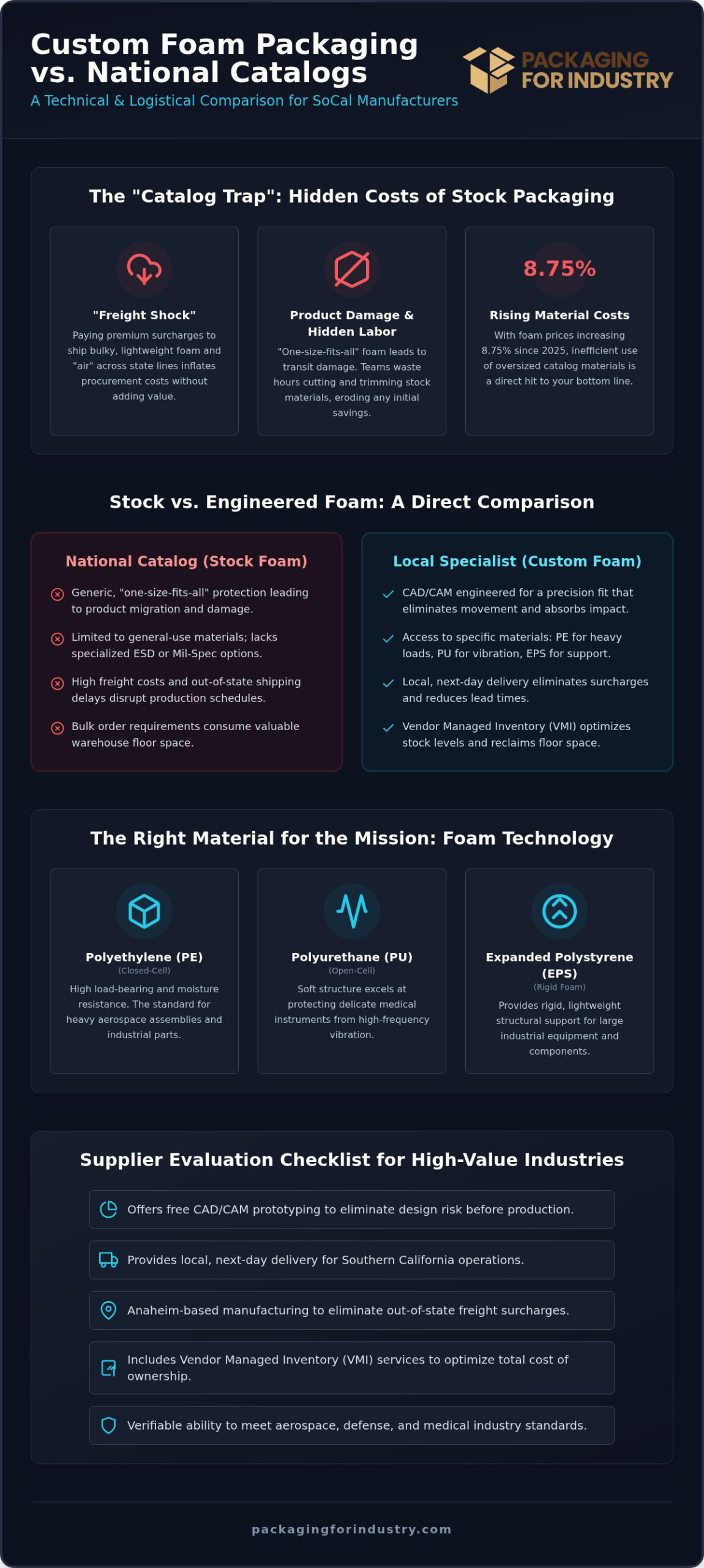
Checklist: Evaluating a Custom Foam Supplier for Your Business
Moving away from a catalog-centric procurement model is a strategic shift that requires careful vetting of your next partner. While a distributor excels at providing high-volume stock items, a packaging supplier better than Uline for custom foam Orange County manufacturers must offer specialized engineering support. You aren’t just buying material; you’re investing in a protective system. This checklist helps you audit potential suppliers to ensure they can handle the technical demands of your production line while maintaining fiscal responsibility.
- Step 1: Assess In-House Engineering: Verify they use CAD/CAM software and CNC routing for precision. If a supplier can’t provide a technical drawing of your insert, they aren’t a custom manufacturer.
- Step 2: Industry Expertise: Confirm they have a history with Mil-Spec, medical, or aerospace standards. Documentation and material certifications are non-negotiable in high-stakes sectors.
- Step 3: Multi-Material Capability: Look for a supplier that integrates foam with corrugated boxes or crates for a turnkey solution.
- Step 4: Logistics Audit: Ensure they offer local next-day delivery and stocking programs to support your production schedule.
- Step 5: TCO Analysis: Evaluate long-term savings from reduced damage and labor rather than just the initial price-per-unit.
Critical Questions for Your Procurement Team
Procurement teams should look beyond the surface level of a product listing. Ask if the supplier offers free prototyping to ensure a perfect fit before production begins. This step de-risks the transition from catalog to custom. Inquire about their ability to scale from low-volume custom runs to high-volume manufacturing without losing precision. Most importantly, verify their track record with aerospace packaging requirements. Precision CNC routing allows for complex geometries that cradle your parts, preventing the surface abrasions often caused by poorly fitting stock sheets.
The ‘Total Cost’ Formula
Evaluating a packaging supplier better than Uline for custom foam Orange County relies on understanding the intersection of engineering and economics. True savings are found in the elimination of operational friction. Calculate the impact of reduced damage rates on your bottom line; off-the-shelf foam often leads to recurring transit failures that cost far more than the packaging itself. Factor in labor savings from kitting and pre-assembled foam inserts. When your team doesn’t have to manually modify foam, your throughput increases immediately.
Finally, consider how Vendor Managed Inventory (VMI) reduces the administrative cost of recurring purchase orders. By automating the replenishment of your custom foam, you free your team to focus on higher-value tasks. This system ensures your inventory levels remain optimized without manual intervention, which stabilizes your cash flow and prevents production delays in your Southern California facility.
Conclusion: Why PFI is the Preferred Orange County Supplier
The transition from a catalog-based procurement model to an engineered approach represents a shift from commodity spending to strategic protection. While distributors provide a broad range of stock items, they lack the specialized engineering required to protect high-value industrial components. Packaging For Industry (PFI) provides a localized, technical alternative. As a packaging supplier better than Uline for custom foam Orange County manufacturers can rely on, PFI focuses on the intersection of engineering and economics to drive down your total cost of ownership. By moving away from “one-size-fits-all” solutions, you eliminate the hidden expenses of freight surcharges and recurring transit damage.
The PFI Difference in Southern California
Our Anaheim-based manufacturing facility ensures that Southern California businesses aren’t subject to the freight surcharges and transit volatility of out-of-state shipping. This proximity allows for a partner-focused approach that goes beyond the initial sale. We provide comprehensive CAD/CAM support and free prototyping to ensure your packaging performs exactly as designed before a single production unit is cut. By exploring our full range of protective foam packaging, you can identify specialized materials like ESD or high-density polyethylene that catalog suppliers simply don’t offer in custom configurations. This local expertise translates to faster response times and a more resilient supply chain.
Taking the Next Step
Initiating a packaging review is the most effective way to identify immediate cost savings in your supply chain. Our engineering team provides a free packaging assessment to analyze your current damage rates, labor costs, and material efficiency. We don’t just sell foam; we design systems that integrate with your existing workflow. See how our just-in-time inventory management keeps your production lines moving without cluttering your warehouse with bulky stock orders. This model allows you to reclaim expensive floor space while maintaining 100 percent availability for your most critical shipping needs. This proactive approach to logistics ensures your operation remains lean, efficient, and fully compliant with evolving California packaging regulations.
If you’re ready to eliminate the freight shock and transit damage associated with catalog cushioning, our team is prepared to engineer a solution tailored to your specific parts. High-stakes manufacturing requires precision, and PFI delivers that precision directly to your Orange County facility.
Streamline Your Logistics with Engineered Protection
Transitioning from a catalog-based model to a localized, engineered solution allows your business to reclaim warehouse space and eliminate the “freight shock” associated with national distributors. By utilizing free CAD/CAM prototyping, you ensure a precise fit that generic foam simply cannot provide. This level of technical oversight and fiscal responsibility is why PFI is a packaging supplier better than Uline for custom foam Orange County manufacturers can trust for high-stakes logistics.
Our Anaheim-based team brings specialized aerospace and medical expertise to every project, ensuring your components are protected by materials that meet rigorous industry standards. With local next-day OC delivery, you gain the agility to respond to production changes without the risk of lead-time volatility or transit delays. We’re focused on helping you achieve zero-damage shipping while lowering your total cost of ownership.
We look forward to partnering with you to solve your most complex industrial packaging challenges and improving your bottom line through superior engineering.
Frequently Asked Questions
Is custom foam more expensive than buying stock foam from Uline?
Total cost of ownership often favors custom solutions over catalog items. While stock foam has a lower per-unit price, it requires expensive manual labor to modify and carries a higher risk of transit damage. Custom inserts eliminate these hidden costs by providing a precision fit that reduces both labor hours and product replacement expenses. This makes custom engineering a more fiscally responsible choice for high-value components.
What is the typical lead time for custom-cut foam inserts in Orange County?
Local manufacturing in Anaheim allows for rapid production cycles compared to national distributors. While design and CAD/CAM prototyping require an initial lead time of a few business days, once the design is finalized, local next-day delivery is available for Orange County facilities. This proximity ensures your production line stays moving without the volatility of out-of-state shipping schedules or hub-related delays common with national carriers.
Can you provide anti-static foam for sensitive electronic components?
Specialized anti-static and ESD foams are standard materials for high-stakes electronics shipping. These foams dissipate static charges that can destroy sensitive circuitry during transit. Unlike generic catalog options, these materials are engineered to meet specific resistance standards required by Orange County’s technology and medical device manufacturers. We provide the technical documentation necessary to verify compliance with your industry’s static-shielding requirements.
Do you offer free prototypes for custom foam packaging designs?
Free prototyping and CAD/CAM design services are included to ensure your components fit perfectly. This process removes the guesswork from your procurement cycle and allows for physical testing before a full production run. Testing a physical prototype ensures the foam density and geometry are optimized for your product’s specific protection requirements, preventing expensive design failures once your parts reach the shipping phase.
How much can I save on freight by switching to a local Southern California supplier?
Switching to a local supplier eliminates the aggressive freight surcharges applied to bulky, lightweight foam shipments. National distributors often ship from out-of-state hubs, which forces you to pay premium rates for “shipping air” across the country. Local delivery in Southern California bypasses these hub-related delays and excessive fuel surcharges, directly improving your margins by reducing the total landed cost of your packaging.
What industries in Orange County do you typically provide custom foam for?
Most custom foam projects serve the aerospace, defense, medical device, and electronics sectors. These industries demand the precision and material certifications that a packaging supplier better than Uline for custom foam Orange County provides. Our Anaheim facility is strategically positioned to support these high-precision manufacturing hubs with specialized cushioning solutions that meet Mil-Spec and cleanroom standards required by regional industrial leaders.
Can you engineer foam inserts that fit into my existing corrugated boxes?
Foam inserts are routinely engineered to fit existing corrugated boxes or crates. This integrated approach allows you to upgrade your internal protection while maintaining your current outer packaging inventory. Precision CNC routing ensures the foam keys into the box perfectly, creating a single, cohesive unit that prevents internal migration. This ensures your parts remain stationary during the most rigorous transit conditions.
What is the difference between polyethylene and polyurethane foam for shipping?
Polyethylene is a rigid, closed-cell foam designed for heavy components and moisture resistance. Polyurethane is a softer, open-cell foam used for cushioning lightweight, delicate items. Selecting the correct material depends on your product’s weight and fragility. Engineering-minded suppliers analyze these factors through vibration and drop testing to determine which foam type provides the necessary G-force protection for your specific application.