
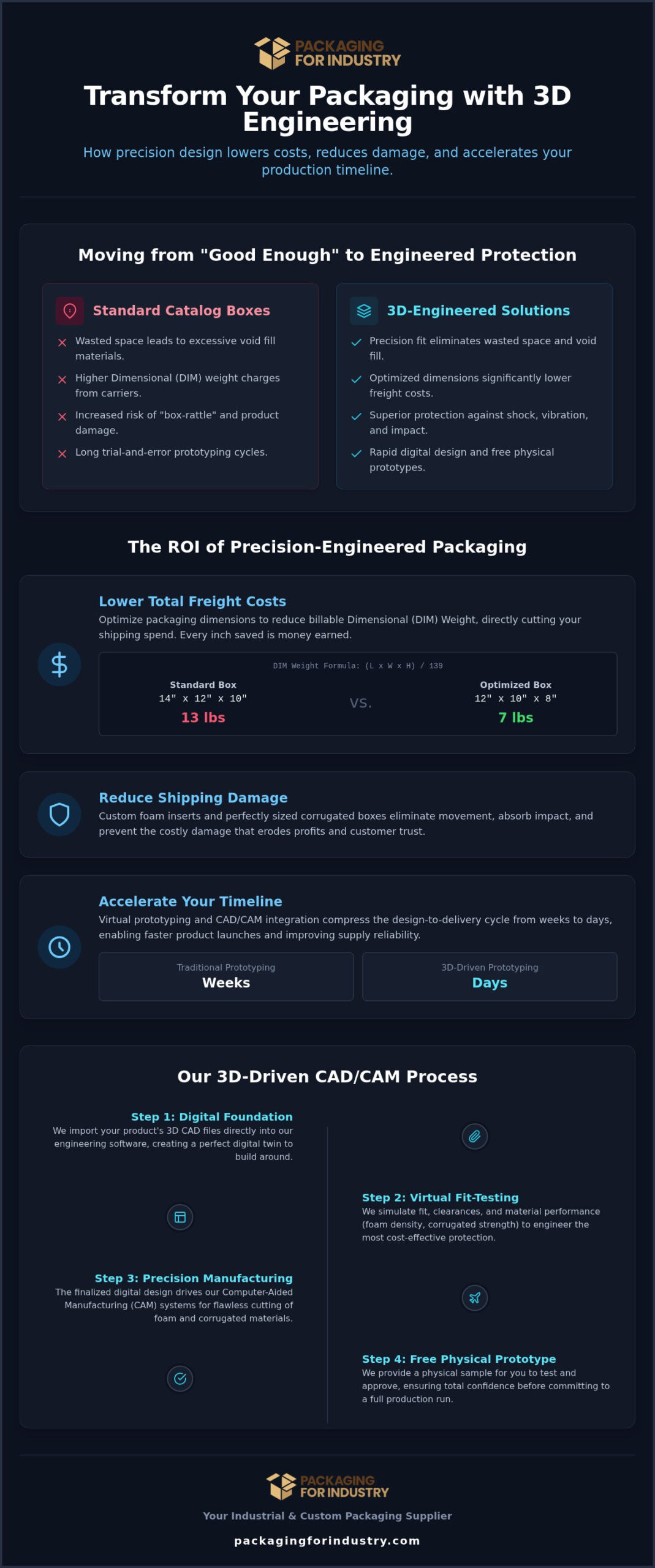
The standard catalog box you’ve been using for years isn’t just a simple container; it’s likely the single biggest contributor to your rising freight spend and product damage rates. With UPS and FedEx enforcing a strict 139 dimensional weight divisor in 2026, every inch of empty space in your packaging costs you real money. Partnering with a packaging supplier with 3D modeling capabilities allows you to move beyond “good enough” solutions. Instead of guessing which stock size might work, you can engineer a precision fit that eliminates the need for excessive void fill and prevents the shifting that leads to shipping damage.
You’re likely frustrated by long lead times for physical prototypes and the sting of unexpected carrier surcharges. We understand that operational efficiency depends on getting the design right the first time. This guide explains how 3D modeling reduces shipping damage, lowers your total freight costs through size optimization, and accelerates your production timeline. You’ll see how precision CAD/CAM support transforms packaging from a commodity expense into a strategic advantage for your warehouse or distribution center.
Key Takeaways
- Transition from standard “catalog” boxes to engineered protection systems to eliminate structural failures and product damage during transit.
- Learn how a packaging supplier with 3D modeling capabilities uses CAD/CAM support to create precision-fit custom foam inserts and corrugated boxes.
- Optimize your packaging dimensions to lower dimensional (DIM) weight charges and significantly reduce your total annual freight spend.
- Leverage free prototyping and local next-day delivery in Southern California to accelerate your production cycles and improve supply reliability.
Why Modern Manufacturers Need a Packaging Supplier with 3D Modeling Capabilities
Industrial packaging has evolved from a simple commodity purchase into a precise engineering requirement. Relying on standard catalog boxes often results in excessive void fill and increased shipping damage; it also triggers higher freight costs due to inefficient dimensional weights. A custom packaging supplier using 3D modeling creates a mathematical representation of your product to ensure a perfect fit before a single sheet of corrugated is cut. This technology allows a packaging supplier with 3D modeling capabilities to focus on structural integrity rather than just aesthetics. It moves your operation from buying generic containers to implementing engineered protection systems that lower packaging costs and improve supply reliability.
The 2026 shipping landscape makes this precision mandatory. With UPS and FedEx using a 139 DIM weight divisor and requiring dimensions to be rounded up to the nearest inch, even a half-inch of over-packaging can bill you for several extra pounds. By utilizing 3D-driven design, you can compress the prototype loop from weeks to days, moving from a digital file to a physical sample with speed. This rapid turnaround is essential for manufacturers who need to meet tight production deadlines without risking the safety of their high-value goods.
Eliminating Guesswork in Industrial Shipping
Manual measurements are often insufficient for complex industrial components with irregular geometries. If a technician miscalculates a clearance by a fraction of an inch, the resulting foam insert may fail to secure the part, leading to impact damage. Virtual fit-testing allows us to simulate how a product sits within its protective foam packaging or custom crate. This process eliminates “box-rattle” and ensures that every component remains static during transit. It’s a proactive way to reduce shipping damage for sensitive electronics or medical equipment that cannot tolerate vibration or shifting.
Compliance and Mil-Spec Requirements
For sectors like aerospace and defense, compliance isn’t optional. We utilize CAD/CAM support to ensure every design meets strict military packaging standards. Digital twins of your packaging allow for detailed quality control audits and provide a reliable record for procurement teams. Whether you’re shipping high-value aerospace gear or heavy-duty construction parts, a packaging supplier with 3D modeling capabilities provides the documentation and precision required for international transit and government contracts. When you’re ready to optimize your shipping designs, you can request a packaging quote to compare packaging pricing against your current stock solutions.
The CAD/CAM Advantage: How 3D Design Transforms Custom Packaging
Traditional packaging design often relies on physical measurements that leave room for human error. By contrast, a packaging supplier with 3D modeling capabilities integrates Computer-Aided Design (CAD) and Computer-Aided Manufacturing (CAM) to create a seamless digital-to-physical workflow. We take your product’s 3D CAD files and import them directly into our engineering software. This allows us to visualize every angle and clearance before any material is cut. It’s a precise method that ensures your high-value hardware is secured within a protective system tailored specifically to its geometry.
Material selection is no longer a guessing game. 3D modeling accounts for foam density, corrugated wall strength, and weight distribution. We use these digital simulations to select the most cost-effective materials that still provide maximum protection. Once the design is finalized, our CAM systems drive the precision cutting of foam and corrugated sheets. To ensure total confidence, PFI offers free prototyping. You can test a physical sample for product fit before committing to a full production run. If you’re looking to optimize your current designs, you can request a packaging quote to see how precision engineering impacts your bottom line.
Precision Engineering for Custom Foam Inserts
Creating effective custom foam inserts requires more than just a rough cutout. Our engineers use 3D modeling to match the exact contours of your hardware, whether it’s a delicate medical device or a heavy industrial part. We evaluate the performance of polyethylene for its rigid durability against the cushioning properties of polyurethane. For electronics and semiconductors, we integrate anti-static (ESD) foam into the 3D design to prevent electrostatic discharge. This multi-material approach ensures every component is shielded from both physical impact and environmental hazards.
Structural Integrity for Custom Crates and Heavy-Duty Boxes
For large-scale machinery, 3D modeling identifies critical load-bearing points within wooden crates. We design internal bracing and support structures that prevent shifting during international transit. This same engineering logic applies to heavy-duty corrugated boxes. By modeling double-wall and triple-wall configurations, we can predict how a box will perform under the stress of palletized transport. Virtual stress testing allows us to reinforce high-impact zones without adding unnecessary weight; this helps you maintain structural integrity while controlling freight costs. Partnering with a packaging supplier with 3D modeling capabilities ensures that your heavy-duty solutions are built for real-world logistical hazards.
Cost-Reduction Analysis: The ROI of 3D-Engineered Solutions
Procurement managers often focus on the unit price of a box, but the true cost of packaging is revealed in your freight invoices and damage claims. A packaging supplier with 3D modeling capabilities changes the financial equation by shifting the focus to Total Cost of Ownership (TCO). While a “cheap” stock box might save pennies on the front end, it frequently results in dollars lost through inefficient space utilization and structural failure. Transitioning to an optimized, custom-engineered solution ensures that you aren’t paying for material you don’t need or space you don’t use.
The ROI of 3D-driven design is found in the precision of the fit. By eliminating the “trial and error” phase of prototyping, you avoid the costs of multiple design iterations and tooling fees. More importantly, it reduces the risk of transit damage. Replacing a single high-value industrial component can cost thousands in material and labor; preventing that damage through engineered protection provides an immediate and measurable return on investment. If you want to lower packaging costs, you must look beyond the price of the corrugated sheet.
Reducing Freight Costs and UPS/FedEx Surcharges
Shipping carriers like UPS and FedEx utilize a 139 dimensional (DIM) weight divisor for domestic shipments. This means you’re billed for the greater of the actual weight or the cubic volume of the package. Because carriers round each dimension up to the nearest whole inch before calculating, even a fraction of an inch of excess space can push your package into a higher weight bracket. For example, a box that measures 16.1″ x 12.1″ x 10.1″ is billed as 17″ x 13″ x 11″ for DIM weight purposes. A packaging supplier with 3D modeling capabilities eliminates this “air” by designing to the exact product footprint. This precision helps you:
- Avoid Additional Handling Surcharges (AHS) for non-conforming dimensions.
- Maximize pallet density to reduce the total number of shipments needed.
- Eliminate the billable weight of unnecessary void fill materials.
Operational Efficiency and Waste Reduction
Engineered packaging simplifies your warehouse operations. When a box and its protective foam packaging are designed as a single system, the kitting and assembly process becomes intuitive. Your team doesn’t have to spend time wrapping parts in layers of bubble wrap or filling gaps with packing peanuts. This speed directly lowers your labor costs per unit shipped. Additionally, using less material without sacrificing protection reduces your environmental footprint and lowers disposal costs for your end customers. It’s a pragmatic approach to sustainability that prioritizes fiscal responsibility.
Selecting the Right Industrial Packaging Partner in Southern California
Choosing a custom packaging supplier requires more than a simple price comparison. For industrial businesses in Southern California, the ability to integrate your engineering data with their manufacturing process is vital. A packaging supplier with 3D modeling capabilities acts as an extension of your design team. They ensure that the digital representation of your product translates perfectly into a physical protective system. This partnership is particularly critical for companies in the aerospace, medical, and electronics sectors where tolerances are tight and the cost of failure is high.
Technical Proficiency and Digital Compatibility
The first criterion for selection is digital compatibility. You need a partner who can handle standard CAD file formats like STEP, IGES, or Parasolid without data loss. It’s also important to verify that the supplier maintains in-house CAD/CAM capabilities. Outsourced design often leads to communication gaps and extended lead times. By working with a local Anaheim packaging supplier that designs and manufactures under one roof, you ensure that the person modeling your foam insert understands the exact limitations of the die-cutting machine. This technical alignment is what prevents prototype creep and keeps your project on schedule.
Logistics: Local Delivery and Stocking Programs
Proximity matters for more than just shipping costs. For manufacturers in the Inland Empire, Los Angeles, and Orange County, local delivery means you can operate with leaner inventory levels. PFI integrates 3D design with Vendor Managed Inventory (VMI) to ensure your custom boxes and foam are always in stock. We use our 3D models to forecast material usage accurately, allowing us to support Just-in-Time (JIT) production lines. This local presence reduces supply chain risk; you aren’t waiting on a shipping container from overseas to keep your fulfillment center running.
While we specialize as a Southern California packaging supplier, our reach extends nationwide. We support distributed manufacturing by providing consistent packaging designs that can be shipped across the country. Whether you need local next-day delivery in San Diego or a bulk shipment to a facility in the Midwest, your packaging remains standardized and reliable. Choosing a packaging supplier with 3D modeling capabilities ensures that your local logistics are backed by global-standard engineering.
PFI: Your Anaheim Partner for 3D-Driven Packaging Solutions
Packaging For Industry (PFI) operates as a specialized Anaheim packaging supplier, bridging the gap between digital engineering and physical logistics. Our “Design-to-Delivery” process starts by ingesting your product CAD files and ends with precise, multi-material kits delivered directly to your dock. By integrating protective foam packaging with heavy-duty corrugated and custom wood crates, we provide a single-source solution for complex industrial needs. As a packaging supplier with 3D modeling capabilities, we ensure every component of your packaging system works in harmony to protect your assets while minimizing material waste.
Custom Solutions for Manufacturers and Warehouses
Manufacturers in the high-tech and defense sectors require more than just standard boxes. PFI provides specialized aerospace packaging solutions that meet rigorous structural and compliance standards. With custom sizes available for any industrial application, we offer bulk packaging pricing for recurring orders of custom-size corrugated boxes, allowing you to maintain stable costs while scaling production. Our local fleet provides reliable local packaging delivery across Orange County, Riverside, and San Diego; this ensures your fulfillment center never stalls due to a lack of supplies. We position ourselves as a dependable local packaging supplier that understands the urgency of industrial lead times.
Comprehensive Support for Operations Managers
We understand that managing packaging inventory can be a significant drain on operational resources. PFI simplifies this by offering free packaging reviews to identify cost-saving opportunities in your current workflow. We analyze your material usage, freight dimensions, and damage rates to propose optimized 3D-driven alternatives that lower your total cost of ownership. PFI integrates 3D modeling with Vendor Managed Inventory (VMI) to eliminate stockouts by ensuring that every custom-engineered SKU is automatically replenished based on real-world usage data.
Our goal is to serve as your long-term industrial packaging supplier, providing the technical expertise of a seasoned consultant with the reliability of a local distributor. Whether you need to reduce shipping damage for sensitive medical devices or lower freight costs for heavy construction equipment, our engineering team is ready to assist. You can request a packaging quote today to begin the 3D modeling process for your next project.
Optimize Your Industrial Logistics Through Precision Engineering
Transitioning from standard catalog boxes to engineered solutions protects your bottom line. By eliminating manual measurement guesswork, you reduce shipping damage and avoid dimensional weight surcharges. A packaging supplier with 3D modeling capabilities provides the technical foundation needed to ensure every custom foam insert fits perfectly. It’s a pragmatic shift from buying generic containers to implementing high-performance protection systems.
PFI combines this engineering expertise with local Southern California logistics. We keep your production lines moving. Our team offers free prototyping and samples to validate every design before you commit to a full production run. With specialized aerospace and mil-spec expertise, we help you meet strict compliance standards while providing local next-day delivery across Orange County and the Inland Empire. It’s time to stop paying for empty space.
We’re ready to help you lower your total packaging costs and improve your delivery reliability.
Frequently Asked Questions
What file types do I need to provide for 3D packaging modeling?
When searching for an industrial packaging supplier near me to handle technical CAD integration, you should provide standard file formats like STEP, IGES, or Parasolid. These formats allow our engineering team to import your product geometry directly into our design software without data loss. If digital files aren’t available, we can work from physical measurements or samples; however, digital data ensures the highest level of precision for custom foam inserts and complex corrugated assemblies.
Is there an extra charge for 3D modeling and prototyping at PFI?
PFI provides free prototyping and samples as part of our commitment to ensuring a perfect product fit before full production. We don’t believe in charging for the engineering required to get the job done right. This service allows you to test the structural integrity of your custom boxes or foam packaging without upfront design fees, reducing your overall project risk and ensuring operational success before you commit to a bulk packaging supplier contract.
How long does it take to get a custom packaging prototype?
We focus on compressing the design loop to keep your production on schedule. While exact timelines depend on the complexity of the project, our in-house CAD/CAM capabilities allow us to move from a digital model to a physical sample in just a few days. This speed is a significant advantage for manufacturers in Southern California who need to validate designs quickly before starting a high-volume production run or requesting a custom corrugated box quote.
Can 3D modeling help reduce my UPS and FedEx shipping surcharges?
Yes, 3D modeling is a critical tool for reducing dimensional (DIM) weight charges. By engineering a precision fit, a packaging supplier with 3D modeling capabilities eliminates the excess “air” that carriers round up to the nearest inch. This optimization directly lowers your billable weight and helps you avoid Additional Handling Surcharges (AHS) caused by inefficient box dimensions or non-conforming packaging geometries that often trigger expensive carrier penalties.
Do you provide 3D modeling for custom foam inserts and wooden crates?
We specialize in modeling complex protective systems that combine multiple materials. Our engineers use 3D design to create precision-cut polyethylene or polyurethane foam inserts that match your product contours exactly. For heavy machinery, we model load-bearing points in wooden crates to ensure structural stability. This integrated approach ensures that your high-value equipment remains static and secure during both domestic and international transit, regardless of the shipment’s complexity.
Can you handle large-volume orders after the design phase is complete?
As a premier packaging distributor near me, PFI is equipped to scale from the design phase to high-volume manufacturing. Once your 3D prototype is approved, we transition into wholesale production to meet your recurring supply needs. We also offer managed stocking programs and Vendor Managed Inventory (VMI) to ensure your custom-sized boxes and foam supplies are replenished automatically, preventing stockouts and maintaining a steady flow for your production lines.
What industries benefit most from 3D-engineered packaging?
Aerospace, defense, medical device manufacturing, and electronics benefit most because they ship high-value, sensitive equipment. These industries require exact tolerances and often must meet strict mil-spec or compliance standards. Any business shipping irregular industrial components or heavy machinery also sees a high ROI from 3D modeling due to the reduction in shipping damage and the optimization of expensive freight costs that can impact the total cost of ownership.
Do you offer local delivery for custom packaging in Southern California?
If you are looking for a bulk packaging supplier with local delivery, PFI offers next-day service across Orange County, Los Angeles, and the Inland Empire. Finding a reliable packaging supplier near me allows you to operate with leaner inventory levels and avoid the long lead times of out-of-state vendors. Our local fleet ensures that your fulfillment operations stay on schedule with custom corrugated boxes and protective foam delivered exactly when needed.