
When a high-value industrial component arrives at a client site with transit damage, the cost isn’t just the replacement part; it’s the lost trust and the stalled production line. You understand that generic, off-the-shelf packaging often fails to meet the rigorous demands of the aerospace and defense sectors. Relying on national catalog suppliers frequently leads to frustrating lead times that disrupt your operational schedule. This article shows you how to specify and source the precision die-cut foam inserts Orange County manufacturers use to achieve zero-damage shipping.
You’ll learn how to navigate the technical requirements of polyethylene foam while managing the economic shifts of the 2026 resin market. We will also explore how local CAD/CAM prototyping and just-in-time delivery can reduce your warehouse footprint and help your facility stay compliant with California’s SB 54 packaging regulations. By the end of this guide, you’ll have a clear roadmap for partnering with a local fabricator who offers the engineering expertise and bulk production capacity your Southern California operations require.
Key Takeaways
- Polyethylene foam provides the essential vibration dampening required for sensitive aerospace and medical components. You’ll learn why this material remains the industrial standard for high-value protection.
- Choosing the correct fabrication method is vital for production efficiency. We compare the high-speed production of die-cut foam inserts Orange County manufacturers rely on for recurring orders against CNC routing for complex prototyping.
- Matching foam density to product weight ensures maximum durability without over-engineering your packaging. We’ll show you how to specify the exact lb/ft³ requirements to optimize your material costs.
- Working with an Anaheim-based fabricator helps you bypass national supply chain delays. This local proximity supports next-day delivery and rapid prototyping cycles that national catalog suppliers can’t match.
- Designing foam inserts and corrugated boxes as a single integrated unit improves overall package integrity. Discover how simultaneous engineering reduces damage rates and lowers your total logistical spend.
The Role of Polyethylene Foam Fabrication in Orange County’s Industrial Corridor
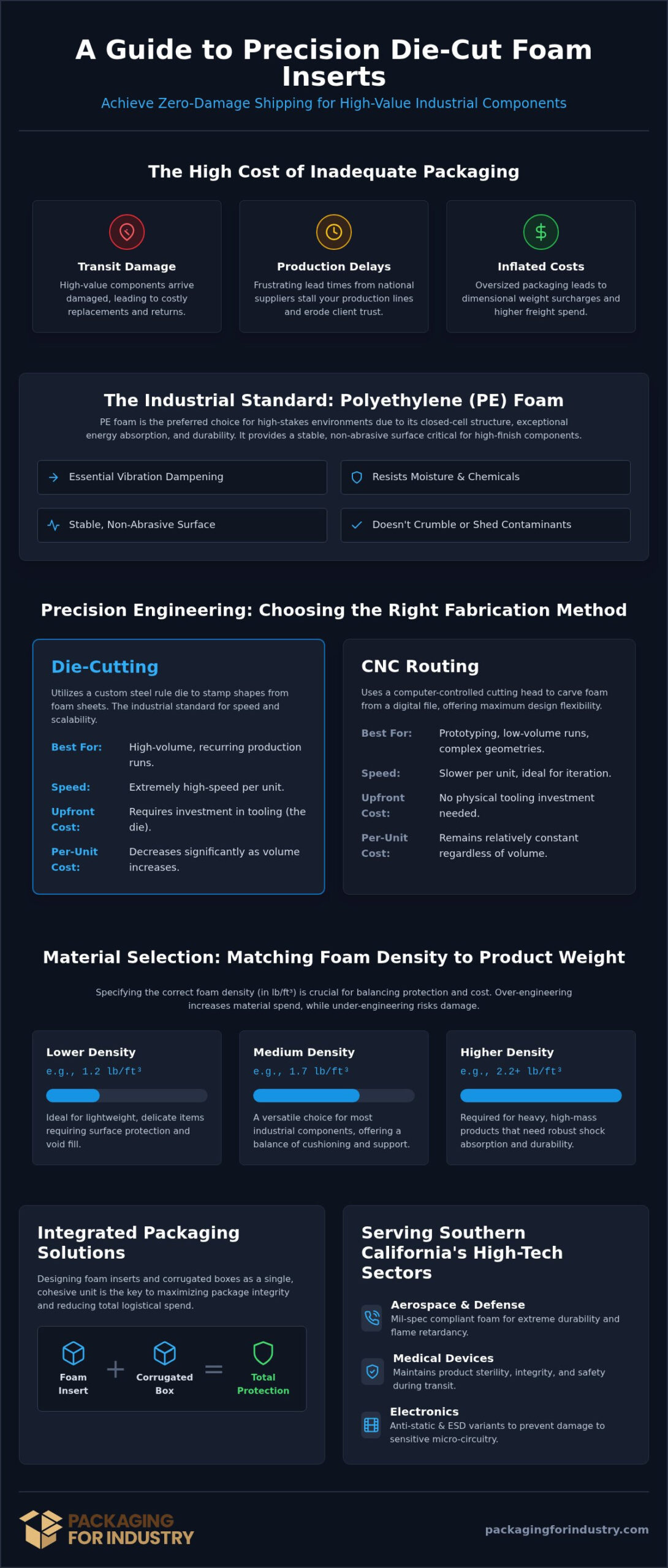
Orange County’s industrial corridor, stretching from Anaheim through Irvine, demands a level of protection that standard packaging cannot provide. Expanded polyethylene (EPE) is the preferred choice for these high-stakes environments due to its closed-cell structure and exceptional energy absorption. PE foam remains the industrial standard because it won’t crumble or shed. It provides a stable, non-abrasive surface that’s critical for high-finish components. Unlike open-cell alternatives, PE foam resists moisture and chemical exposure, making it essential for the delicate supply chains found in Southern California.
For many manufacturers, the transition from generic “pluck foam” to engineered die-cut foam inserts Orange County specialists produce marks a significant shift in quality control. Pluck foam is often unstable and prone to shedding, which can contaminate sensitive medical or aerospace components. Precision die-cutting creates a clean, repeatable fit that secures parts exactly as designed. This eliminates the “slop” in packaging that leads to impact damage during rough handling or long-distance transit.
Targeting High-Tech Sectors in Anaheim and Irvine
Aerospace contractors in the region require materials that meet strict military specifications for durability and flame retardancy. In these applications, the foam must perform under extreme pressure and vibration without degrading. Similarly, medical device manufacturers in Irvine rely on PE foam to maintain product sterility and integrity. For electronics, we provide specialized anti-static and ESD variants that prevent static discharge from damaging micro-circuitry. This level of specialization ensures that sensitive gear remains functional upon arrival, regardless of the shipping environment.
The Economic Impact of Precision Fit
Precision engineering isn’t just about safety; it’s a fiscal strategy. Carriers like FedEx and UPS calculate shipping costs based on “dimensional weight,” which penalizes oversized boxes. By utilizing custom design packaging, you can minimize the outer dimensions of your shipment while maximizing internal protection. This optimization directly reduces freight surcharges. A local partnership with a fabricator who understands die-cut foam inserts Orange County logistics can eliminate the “hidden costs” of long-distance sourcing. When you source locally, you reduce the risk of your own protective materials being damaged in transit before they even reach your production line. This streamlined approach lowers the total cost of ownership by preventing product returns and enhancing your reputation for reliability.
Precision Engineering: Die-Cutting vs. CNC Fabrication for Custom Inserts
Choosing the right fabrication method is a balance of volume, complexity, and budget. For high-volume production, die-cutting is the industrial standard. This process utilizes custom steel rule dies to punch shapes out of foam sheets with incredible speed. It’s the most efficient way to produce the die-cut foam inserts Orange County businesses need for recurring product lines. While die-cutting requires an upfront investment in tooling, the per-unit cost drops significantly as volume increases, making it the most fiscally responsible choice for large-scale manufacturing.
CNC routing offers a different set of advantages. It uses a computer-controlled cutting head to carve foam based on a digital file. This method is ideal for complex geometries that a physical die cannot easily replicate. Since there’s no physical tool to build, CNC is the preferred choice for low-volume runs and initial prototyping. It allows for rapid adjustments to the design without the cost of re-tooling. This flexibility is essential when you’re still refining a product’s dimensions or features.
When to Choose Die-Cutting for Industrial Foam
Scalability is the primary driver for die-cutting. Once the steel rule die is manufactured, we can maintain identical tolerances across thousands of units. This consistency is vital for automated assembly lines where every insert must fit the outer corrugated box perfectly. If your project involves a recurring order of several hundred units, die-cutting typically provides the best return on investment. The precision of the die ensures that every cavity is identical, which eliminates the variability that can lead to product movement during transit.
CAD/CAM support bridges the gap between your product’s design and its physical protection. By using your product’s digital twin, we ensure the foam cavity accounts for every connector, screen, and fragile edge. We offer free prototyping to verify this fit before you commit to a full production run. This step is crucial for identifying potential interference points early. You can speak with our engineering team to start your initial design review and ensure your components are perfectly secured.
Advanced Fabrication Capabilities
Beyond simple cutouts, modern fabrication allows for multi-layer foam assemblies. We can laminate different densities of foam packaging products together to create graduated protection. For example, a soft top layer can prevent surface scratches while a high-density base absorbs heavy impacts. We also specialize in foam-lined corrugated boxes. This integrated solution provides the ultimate shipping security by bonding the foam directly to the box walls, preventing the insert from shifting during rough handling. This approach simplifies your packing process and ensures total accountability for the component’s safety.
Material Selection Guide: Specifying Polyethylene Density and Properties
Selecting the right material is the first step in engineering a reliable shipping solution. While polyurethane (PU) foam is common for lightweight consumer goods, it’s often insufficient for industrial applications. Polyethylene (PE) is a closed-cell foam, meaning its cells are sealed and independent. This structure makes PE superior for heavy-duty protection because it doesn’t absorb moisture and provides higher tensile strength. It’s the resilient choice for die-cut foam inserts Orange County engineers specify when shipping high-value components that must survive multiple drops or rough handling.
Unlike open-cell foams that can bottom out under heavy loads, PE foam offers predictable compression sets. This predictability allows us to design thinner inserts that provide better protection, which ultimately saves you money on outer box dimensions and shipping weights. We offer several specialty additives to meet specific environmental needs, including fire-retardant options and UV-stabilized variants for outdoor storage. You can explore our full range of foam packaging options to find the material that fits your specific environmental constraints.
Understanding Foam Density and Compression
We measure foam strength by density, typically expressed in pounds per cubic foot (lb/ft³). Matching this density to your product’s weight is essential for optimal deceleration during an impact. A 1.7 lb density is the industrial standard for most cushioning needs, providing a balance of softness and support. For heavy machinery or aerospace components, we utilize high-density planks of 2.2 lb or higher. These denser materials prevent heavy parts from migrating through the foam during transit. Conversely, for very lightweight electronics, a low-density foam ensures the material is soft enough to actually compress and absorb energy rather than transferring the shock to the device.
ESD and Cleanroom Requirements
Semiconductor and electronics manufacturers in the region face unique challenges regarding static discharge. Standard polyethylene can generate significant static, which can destroy sensitive micro-circuitry. We solve this by providing anti-static (pink) or conductive (black) polyethylene variants. These materials are chemically treated to dissipate static charges safely. If your production line requires cleanroom compatibility, we offer specialized foams that minimize particulate shedding. These materials ensure that your die-cut foam inserts Orange County deliveries won’t contaminate sterile environments. Our fabrication process adheres strictly to military and industrial safety standards, ensuring that every insert meets the specific compliance requirements of your industry.
Procurement and Logistics: Sourcing Die-Cut Foam in Southern California
Orange County industrial real estate remains a significant overhead cost for manufacturers. With average asking rents reaching approximately $19.39 per square foot in mid-2026, every square foot of warehouse space must be optimized for production rather than storage. Bulky die-cut foam inserts Orange County facilities require often consume excessive floor space when ordered in bulk from national suppliers. Our local presence in Anaheim allows us to implement Vendor Managed Inventory (VMI) programs that solve this specific logistical bottleneck.
We take full responsibility for monitoring your stock levels and delivering precision inserts exactly when your production line needs them. This just-in-time (JIT) approach eliminates the need for you to maintain massive safety stocks. By bypassing the national supply chain delays associated with catalog distributors, you ensure that your high-value components never sit idle waiting for protective packaging. Local sourcing also mitigates the impact of volatile polyethylene resin pricing by allowing for more frequent, smaller-batch orders that reflect current market conditions.
Orange County Service Areas and Next-Day Delivery
Our fleet provides consistent coverage across the region’s primary industrial hubs. We offer next-day delivery for stock items and recurring custom orders to facilities in Anaheim, Irvine, Costa Mesa, and Huntington Beach. This proximity is a strategic advantage for firms in the Orange County service area. It allows for face-to-face design consultations and immediate physical prototyping that remote suppliers simply cannot facilitate. When a design change occurs on your production line, we can iterate and deliver a new prototype in a fraction of the time required by out-of-state fabricators.
Streamlining the Purchasing Process
Getting a precision fit starts with accurate data. We accept CAD files to match your product’s digital twin, but we can also work from physical samples or detailed dimensions to create your initial prototype. One of the most effective ways to reduce procurement friction is to consolidate your suppliers. When you source your custom foam and outer corrugated boxes from a single local partner, you ensure that the tolerances between the two materials are perfectly synchronized. This integrated approach prevents the common issue of foam inserts being too loose or too tight for their outer containers.
Our Vendor Managed Inventory services are designed to integrate seamlessly with your existing ERP or procurement workflows. This partnership goes beyond a simple transaction; it’s a long-term strategy for logistical optimization and fiscal responsibility.
Integrated Packaging Solutions: Why PFI is Your Dedicated Polyethylene Fabricator
Many fabricators provide foam components in isolation, leaving you to source the outer container from a different vendor. This fragmented approach often results in mismatched tolerances that compromise product safety during transit. PFI operates as a comprehensive engineering partner, designing the die-cut foam inserts Orange County manufacturers require alongside custom corrugated boxes. By engineering both elements simultaneously, we ensure the foam provides structural support to the box walls. This synergy prevents stacking failures in the warehouse and ensures that your components are cushioned against the specific G-force impacts they may encounter.
Our team performs a detailed cost-reduction analysis on every project. We identify opportunities to reduce material volume and “dimensional weight” without sacrificing safety. This optimization is verified through our free prototyping service. We provide physical samples for your team to test with your actual components, ensuring the fit is perfect before you commit to a high-volume production run. This level of precision is essential for high-value sectors like aerospace, defense, and medical device manufacturing, where even a minor fitment error can lead to catastrophic product failure.
The PFI Custom Process
The process begins with a consultative design phase where we identify specific transit hazards, such as rotational drops or high-frequency vibration. We then utilize CAD/CAM support to create a precision fitment that accounts for every delicate edge and connector on your part. Once the design is finalized, our Anaheim facility handles the bulk production using high-speed die-cutting equipment. We don’t rely on third-party carriers for regional distribution; our dedicated Southern California fleet manages the final delivery to your dock. This end-to-end oversight ensures total accountability and maintains the integrity of your packaging from the design table to the production line.
Request a Custom Foam Quote Today
Stability in your supply chain starts with a reliable local partner. Our Anaheim engineering team is ready to review your current packaging specs and identify potential areas for material or logistical optimization. We offer significant volume pricing advantages for recurring industrial orders, allowing you to leverage the economics of scale while maintaining just-in-time flexibility. Whether you need specialized ESD protection or heavy-duty aerospace kitting, we provide the technical expertise to secure your most sensitive assets.
Strategic Protection for Southern California’s Industrial Corridor
Securing high-value components requires more than just high-quality material; it demands a logistical strategy that balances protection with economic efficiency. By transitioning from generic cushioning to the precision die-cut foam inserts Orange County engineers trust, you eliminate the variability that leads to transit damage. Our Anaheim facility provides the technical CAD support and free prototyping necessary to ensure your packaging matches your product’s digital twin perfectly. This proactive approach identifies potential interference points before you commit to a bulk production run.
Local partnership allows you to bypass national supply chain volatility and reduce your warehouse footprint through next-day delivery and Vendor Managed Inventory programs. Integrating foam fabrication with custom corrugated box design creates a total protection system that lowers your total cost of ownership. We provide the expertise in aerospace and medical standards required to navigate the complex industrial landscape of Southern California. We’re ready to help you streamline your procurement and safeguard your sensitive assets.
Your production line deserves the reliability of a partner that understands the intersection of engineering and economics. Let’s build a protection strategy that supports your long-term operational goals.
Frequently Asked Questions
What is the difference between die-cutting and CNC routing for foam?
Die-cutting utilizes custom steel rule dies to punch shapes from foam sheets at high speeds. It’s the most cost-effective method for high-volume, recurring industrial orders. CNC routing uses a computer-controlled head to carve foam based on a digital file. This method is ideal for complex geometries and low-volume prototyping because it doesn’t require physical tooling. While CNC offers design flexibility, die-cutting provides superior per-unit economics for bulk production runs.
Can you provide anti-static or ESD polyethylene foam for electronics?
Yes, we provide specialized anti-static (pink) and conductive (black) polyethylene variants. These materials are essential for semiconductor and electronics manufacturing in the Irvine and Anaheim tech hubs. They prevent static discharge from damaging sensitive micro-circuitry during transit. When you specify the die-cut foam inserts Orange County electronics manufacturers require, we ensure the material properties align perfectly with your specific ESD protection and cleanroom standards.
Does PFI offer free prototyping for custom foam inserts in Orange County?
PFI offers free prototyping and CAD/CAM support for custom foam projects. This service allows you to verify the fit and energy absorption of the insert before you commit to a full production run. Our Anaheim-based engineering team works directly with your physical product samples or digital CAD files. This proactive step identifies potential interference points early, reducing the risk of transit damage and costly design revisions later in the process.
What information do I need to provide for a custom foam quote?
To provide an accurate quote, we typically require your product’s dimensions, weight, and fragility level. Providing CAD files is the most efficient method, but we also accept physical samples or detailed drawings. You should also specify the expected order volume and any environmental requirements, such as anti-static properties or mil-spec compliance. This data allows our engineers to calculate the optimal foam density and outer box dimensions for your specific application.
What is the standard lead time for a custom die-cut foam order?
Standard lead times vary based on design complexity, but our local presence significantly reduces typical turnaround times. Once the initial prototype is approved, recurring orders are often eligible for next-day delivery through our dedicated Southern California fleet. For new custom projects requiring steel rule dies, the tooling process usually adds a few business days. We prioritize efficiency to help you maintain a just-in-time production schedule and minimize warehouse delays.
Do you provide the corrugated boxes to go with the custom foam inserts?
We specialize in integrated packaging solutions where the foam and corrugated box are designed together. This simultaneous engineering ensures the foam insert provides structural support to the box walls, preventing stacking failures and maximizing protection. Consolidating your supply chain by sourcing both components from PFI simplifies procurement and ensures perfect fitment. This integrated approach reduces the slop that often leads to product damage in fragmented, multi-vendor packaging systems.
What are the benefits of using a local Orange County foam fabricator?
Working with an Anaheim-based fabricator provides faster prototyping cycles and lower shipping costs. You bypass the long-distance delays and freight surcharges associated with national catalog suppliers. Local proximity also allows for on-site design consultations and physical fitment tests. Additionally, we offer Vendor Managed Inventory (VMI) programs that help you reclaim valuable warehouse space by delivering the die-cut foam inserts Orange County facilities need exactly when their production lines require them.
Can you manufacture foam inserts that meet military specifications (mil-spec)?
Yes, PFI specializes in meeting strict military and defense packaging standards. We utilize polyethylene materials that comply with various mil-spec requirements for durability, energy absorption, and chemical resistance. Our engineering team understands the rigorous testing and documentation required for aerospace and defense contracts. We ensure that your custom inserts provide the reliable performance necessary to protect mission-critical equipment during global transport and long-term storage in harsh or unpredictable environments.