
Did you know that up to 40% of the stretch film used in your warehouse might be literal waste? For many operations in Los Angeles and the Inland Empire, the traditional price-per-roll metric is hiding a massive drain on profitability. A comprehensive pre-stretched vs conventional stretch film cost analysis reveals that the cheapest roll to buy is often the most expensive one to use. If your team struggles with inconsistent load tension or high film breakage at hand-wrapping stations, you’re likely paying for material that never actually secures your freight.
It’s frustrating to watch shipping costs climb while freight damage persists due to poor load stability. You need a wrapping strategy that balances material performance with operational speed. This guide explores how transitioning to high-performance pre-stretched film can reduce your material consumption by 40% and significantly improve worker ergonomics. We’ll examine the technical yield of 2026 film standards and provide a roadmap for lowering your total cost-per-pallet wrapped. By the end, you’ll understand how to optimize your Southern California logistics hub for both durability and fiscal efficiency. This shift isn’t just about changing rolls; it’s about engineering a more reliable supply chain.
Key Takeaways
- Learn how high-performance pre-stretched film reduces material waste by 40% compared to traditional hand-wrapping methods.
- Discover why a pre-stretched vs conventional stretch film cost analysis is the only way to accurately calculate your true cost-per-pallet wrapped.
- Find out how to match specific film gauges and mechanical properties to your unique load profiles to prevent costly freight damage.
- Explore how lighter, factory-elongated rolls improve labor ROI and warehouse ergonomics by simplifying the wrapping process for your team.
- Learn how to optimize your Southern California supply chain using Vendor Managed Inventory (VMI) to ensure just-in-time delivery and reduced storage needs.
The Economics of Pallet Stabilization: Conventional vs. Pre-Stretched
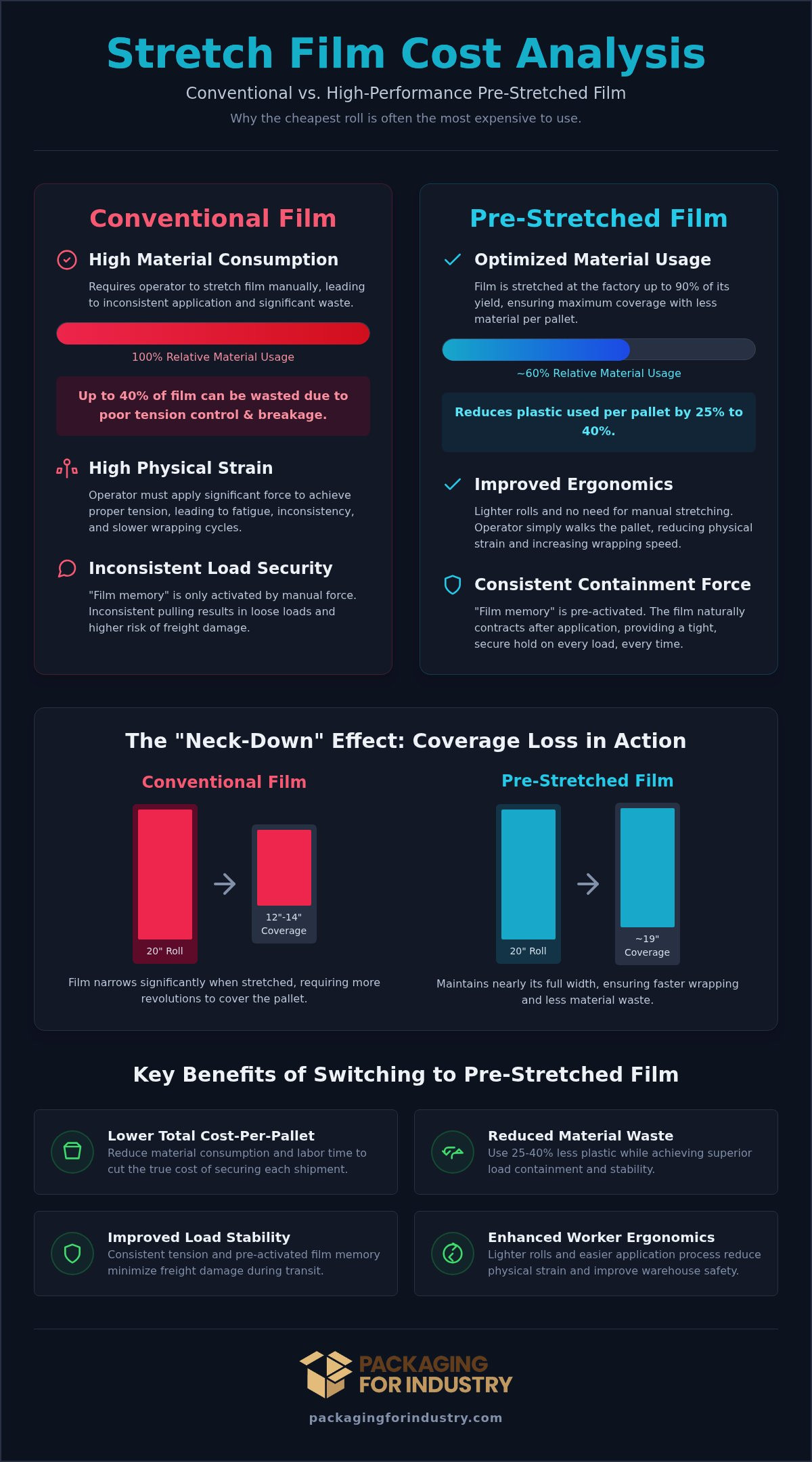
In the warehouse, efficiency is often measured by the speed of throughput, but the materials used to secure that throughput dictate the bottom line. Stretch wrap is a fundamental component of pallet stabilization, yet many procurement departments fall into the “price per roll” trap. Conventional stretch film refers to standard cast or blown materials that require the operator to provide manual tension during application. In contrast, pre-stretched film is factory-elongated, often up to 90% of its potential limit, before it’s wound onto the core. This distinction is the starting point for any rigorous pre-stretched vs conventional stretch film cost analysis. Relying on the upfront cost of a roll ignores the physical reality of how much plastic actually stays on the pallet.
True industrial performance is measured by cost-per-load, not cost-per-unit purchased. Because conventional film requires physical force to achieve the necessary tension, it often results in inconsistent application. Workers tire, leading to loose loads or, conversely, excessive film use to compensate for a lack of tension. By switching to pre-stretched film, Southern California logistics hubs can often reduce the total weight of plastic used per pallet by 25% to 40%. This shift prioritizes the yield of the material over the nominal price on the purchase order.
The Mechanics of Film Memory
Conventional film is essentially a rubber band that hasn’t been stretched yet. The operator must pull the film to its yield point to engage its “memory,” which is the physical property that allows the film to contract and hold the load tight. If the operator doesn’t pull hard enough, the load remains unstable. If they pull too hard, the film breaks, causing downtime. Pre-stretched film arrives with that memory already activated. It naturally seeks to contract after application, providing consistent containment force without the physical strain or the risk of frequent snapping.
Neck-Down and Coverage Loss
When you pull a standard piece of conventional film, it undergoes a process called neck-down. The film narrows significantly as it’s stretched. This means a 20-inch roll might only cover 12 or 14 inches of the pallet’s height per revolution. This forces the operator to make more passes to ensure total coverage. Pre-stretched film is already elongated, so it experiences minimal neck-down during application. It maintains nearly its full width, allowing for fewer revolutions and better overlap. This leads to faster wrapping cycles and less material waste, directly impacting the total cost-per-pallet wrapped.
Mechanical Performance: Cast, Blown, and Pre-Stretch Variants
Selecting the right film requires more than just looking at the price tag. The mechanical differences between cast and blown films dictate how well your pallets survive the rigors of long-haul freight. When performing a pre-stretched vs conventional stretch film cost analysis, you must weigh the clarity and quiet application of cast film against the superior puncture resistance of blown film. Both manufacturing styles can be factory-elongated to create pre-stretch rolls. This allows you to leverage specific material strengths without the physical burden of manual tensioning.
Modern pre-stretched rolls often incorporate reinforced edges. This structural enhancement prevents edge tears, which are the primary cause of film breakage in warehouse environments. If a roll is dropped or bumped in a busy Anaheim distribution center, a standard roll might become unusable. A reinforced pre-stretch roll remains functional, reducing waste and protecting your operational flow. You can compare packaging pricing for these high-performance variants to see how they fit your specific load profiles.
Cast Film: Clarity and Quiet Application
Cast film is the industry standard for high-volume fulfillment centers. Its manufacturing process involves extruding resin through a flat die onto cooled rollers, resulting in a crystal-clear finish. This clarity is essential for medical device manufacturers and consumer electronics distributors who rely on barcode scanning through multiple layers of film. It’s also significantly quieter during unwind than blown film. While it offers excellent stretchability, it generally has lower puncture resistance. This makes it less suitable for loads with sharp corners or protruding components.
Blown Film: Maximum Load Retention
For heavy industrial components and aerospace parts, blown film remains the preferred choice. The resin is blown into a vertical bubble and air-cooled, creating a material with high tack and exceptional holding power. This “sticky” nature ensures that the film adheres to itself even under extreme vibration. In Southern California’s manufacturing hubs, blown film is often used for uneven or heavy loads that require maximum containment. While standard blown film is noisy and physically demanding to apply manually, pre-stretched blown variants offer the same structural integrity with a fraction of the operator effort.
The Cost Analysis: Material Savings and Labor ROI
A detailed pre-stretched vs conventional stretch film cost analysis demonstrates that material volume is only one part of the equation. While a roll of conventional film might look cheaper on a purchase order, its actual yield is significantly lower in a warehouse environment. In practical application, one roll of high-performance pre-stretched film frequently replaces two or more rolls of conventional material. This efficiency stems from the factory-elongation process, which ensures every foot of film on the roll is already at its maximum usable length. You’re no longer paying for the “potential” to stretch the plastic; you’re paying for actual, applied surface area. By switching to pre-stretched film, your facility can reduce material waste by 40% while ensuring more consistent load containment.
Waste reduction is another critical factor for procurement teams. Conventional film often leaves unused material at the bottom of the core because the tension required to pull it becomes too high for the operator to manage comfortably. Pre-stretched film flows off the core with minimal resistance, ensuring you use 100% of the roll. For operations looking to lower packaging costs, these small efficiencies add up across thousands of pallets shipped from Southern California hubs.
Calculating Cost-Per-Load
To optimize your procurement, you need a clear framework for tracking expenses. Cost-per-load is the total material and labor expense required to secure one pallet for transit. Calculating this involves weighing the film used on a sample pallet and multiplying it by your material cost, then adding the labor time spent wrapping. Don’t overlook the cost of “re-wraps.” When conventional film snaps due to over-tensioning, the operator must stop, strip the pallet, and start over. This doubles the cost of that specific load instantly and disrupts the flow of your packing line.
Labor and Ergonomic ROI
The physical toll on warehouse staff is a major hidden expense in competitive markets like Anaheim and the Inland Empire. Wrapping with conventional film forces operators to walk backward while exerting significant upper-body force to create tension. This awkward movement leads to rapid fatigue and increases the likelihood of worker compensation claims. Pre-stretched film allows for a “forward walking” application. Because the film is already elongated, the operator simply guides it around the pallet. Lighter rolls and reduced physical demand improve warehouse morale and staff retention, which are essential for maintaining a stable workforce in today’s logistics landscape.
Application Guide: Selecting Film for Your Load Type
The success of your palletization strategy depends on matching material properties to your specific load profile. An accurate pre-stretched vs conventional stretch film cost analysis must account for the physical characteristics of the freight being moved. In Southern California, logistics managers typically categorize loads into three profiles: A, B, and C. Type A loads represent uniform boxed goods with no protrusions, while Type C loads are irregular, heavy, or have sharp edges that threaten film integrity.
Environmental factors in the Inland Empire and Orange County also play a role. Temperature fluctuations in non-climate-controlled warehouses can affect the memory of the plastic. Conventional film may lose some of its containment force as it softens in the heat. High-performance pre-stretched film, having been elongated under factory conditions, tends to maintain its tension more reliably during thermal cycles. For extremely heavy or unstable Type C loads, conventional heavy-gauge blown film remains the standard because it provides the maximum possible containment force for high-density industrial goods.
Integrating corner and edge protection is a pragmatic way to prevent film failure. These components provide a buffer between sharp edges and the film, allowing you to use thinner, more cost-effective pre-stretch variants without risking a tear. This combination ensures that your material costs stay low while your load stability remains high.
Uniform vs. Irregular Loads
For Type A loads consisting of standard heavy-duty corrugated boxes, pre-stretched film is almost always the superior choice. It provides enough tension to secure the boxes without the risk of crushing the corners. For irregular loads with protrusions, you must prioritize puncture resistance. If you’re switching to pre-stretch for these loads, choosing a variant with reinforced edges is essential to prevent a single puncture from causing a total wrap failure.
Freight and Transit Considerations
Freight leaving Southern California often faces significant vibration during long-haul transit. LTL shipping environments are particularly harsh, as pallets are frequently moved and reloaded. Ensuring load stability for sensitive aerospace components or electronics requires a film that won’t shift or relax during transit. Pre-stretched film’s consistent tension provides a reliable shield against the constant movement of the road, reducing the likelihood of damage claims.
Strategic Procurement: Optimizing Your Stretch Film Supply
A comprehensive pre-stretched vs conventional stretch film cost analysis is incomplete without considering the impact on your warehouse footprint and supply chain reliability. Moving beyond the roll itself, strategic procurement focuses on how your film arrives and how much space it consumes before it ever secures a pallet. High-yield pre-stretched rolls offer a distinct advantage in inventory control. Because one pallet of pre-stretched film can wrap significantly more loads than a pallet of conventional film, you effectively double your storage capacity for packaging supplies. This allows your facility to operate with a leaner inventory without risking a stockout during peak periods.
Reliability is the cornerstone of industrial logistics. Implementing Vendor Managed Inventory (VMI) for your stretch film needs removes the burden of tracking stock levels from your operations team. PFI acts as a proactive partner, monitoring your consumption and ensuring that high-performance film is always available when your wrapping stations are active. This level of oversight is particularly valuable for high-volume manufacturers in Orange County and Los Angeles who can’t afford the downtime associated with material shortages.
Inventory Control and Space Management
Space is a premium commodity in Southern California warehouses. By switching to higher-yield pre-stretch rolls, you reduce the number of pallets you need to store on-site. This frees up valuable floor space for finished goods or additional production lines. When combined with Just-In-Time (JIT) management, your supply chain becomes a tool for efficiency rather than a storage challenge. PFI’s proximity to Anaheim and the Inland Empire ensures local next-day delivery. This allows you to maintain a lean inventory profile while keeping your shipping department running at full capacity.
The PFI Partnership: Beyond the Roll
Successful packaging is rarely about a single product. It’s about how different materials work together to protect your bottom line. We provide custom engineered solutions that integrate film with foam, corrugated boxes, and edge protection to create a unified system of security. Our team conducts custom packaging reviews to identify specific areas where you can reduce waste and improve load integrity. This holistic approach ensures that your logistics costs remain low while your reliability stays high. To see the tangible impact on your operations, you can request a stretch film cost-reduction analysis from our industrial experts today.
Optimizing Your Pallet Stabilization Strategy for 2026
Transitioning from conventional film to high-performance pre-stretch is a strategic decision that impacts material yield, labor ROI, and warehouse safety. A thorough pre-stretched vs conventional stretch film cost analysis reveals that the initial buy-price is secondary to the total cost-per-pallet wrapped. By focusing on film memory and reducing neck-down, your operation can achieve superior load stability with significantly less plastic waste. PFI provides the technical expertise and local inventory needed to execute this transition seamlessly across your facility.
As specialists in industrial manufacturing and aerospace packaging, we offer a pragmatic, cost-saving alternative to large catalog suppliers. Our local next-day delivery across Orange County, Los Angeles, and the Inland Empire ensures your facility maintains peak throughput without the burden of excessive on-site inventory. We don’t just sell film; we engineer logistical systems that protect your bottom line and your freight. It’s time to move beyond generic supplies and adopt a solution-oriented approach to your packaging requirements.
We’re ready to help you eliminate professional stress by solving your most persistent wrapping challenges. Let’s secure your supply chain today.
Frequently Asked Questions
Is pre-stretched film as strong as conventional stretch wrap?
Pre-stretched film provides equivalent or superior containment force compared to conventional wrap when applied correctly. Because the film is elongated during manufacturing, it’s already at its peak performance level. It resists further stretching after application, which creates a consistent, firm grip on the load. While it may feel thinner, its activated memory ensures that the pallet remains secure without the risk of the film loosening during transit.
How much can I save by switching to pre-stretched hand film?
Most industrial facilities reduce material consumption by 25% to 40% when they transition to pre-stretched film. A comprehensive pre-stretched vs conventional stretch film cost analysis shows that using fewer rolls per pallet significantly lowers the total expense. You also save on labor costs because the film is easier to apply, which speeds up the wrapping process and reduces the physical fatigue that often leads to inconsistent wrapping.
Does pre-stretched film work with automated pallet wrappers?
Machine-grade pre-stretched films are specifically designed for semi-automated and fully automated wrapping systems. These films are an excellent choice for older machines that lack a pre-stretch carriage. By using film that’s already elongated, you achieve consistent tension without putting excessive strain on the machine’s motor. This results in more predictable material usage and fewer maintenance interruptions caused by film breakage during high-speed wrapping cycles.
What is the difference between cast and blown pre-stretched film?
Cast pre-stretched film is known for its high clarity and quiet unwind, which is essential for reading barcodes and labels on wrapped pallets. Blown pre-stretched film is more opaque but offers superior puncture resistance and higher tack. Choosing between them depends on your load. Cast is ideal for uniform boxed goods, while blown is better for heavy or irregular loads that might have sharp edges or protrusions.
Can I use pre-stretched film for heavy industrial loads?
You can secure heavy industrial loads with pre-stretched film by selecting a reinforced variant or a higher-performance blown material. These films provide the necessary holding power to prevent heavy components from shifting. For the best results with machinery or metal parts, we recommend combining the film with corner and edge protection. This setup allows the film to maintain maximum tension without tearing on sharp corners during long-haul shipping.
What industries benefit most from pre-stretched film cost analysis?
High-volume manufacturers, aerospace suppliers, and electronics distributors benefit most from a pre-stretched vs conventional stretch film cost analysis. Any operation wrapping more than 10 pallets per day will see a significant impact on their bottom line. Logistics hubs in the Inland Empire and Orange County use these analyses to justify switching from bulky conventional rolls to high-yield pre-stretch rolls to improve both fiscal efficiency and worker safety.
Does PFI offer local delivery for stretch film in Orange County?
PFI provides local next-day delivery for stretch film and other packaging supplies to businesses in Anaheim, Irvine, and throughout Orange County. We also serve Los Angeles and the Inland Empire with our own fleet. Our local presence supports Vendor Managed Inventory (VMI) programs, allowing you to keep a lean stock on-site while ensuring you never face a shortage during peak production or shipping periods.
How does film memory affect pallet stability during shipping?
Film memory is the plastic’s ability to “snap back” and stay tight after it’s applied to a pallet. Conventional film relies on the operator to create this tension, which is often inconsistent. Pre-stretched film has its memory activated at the factory. Once it’s wrapped around your freight, it naturally contracts to create a constant containment force. This prevents the load from shifting or becoming loose during the vibrations of truck transport.