
Switching to sustainable materials doesn’t mean you have to accept higher damage rates or inflated shipping budgets. Many warehouse managers in Southern California feel the mounting pressure to implement recyclable protective packaging for e-commerce shipments, yet they hesitate because of the perceived fragility of paper-based alternatives. It’s a valid concern when your products must survive the high-velocity parcel environment of modern logistics. You shouldn’t have to choose between environmental responsibility and the physical safety of your cargo.
We’ve found that engineered sustainability actually enhances transit reliability when implemented correctly. This guide provides a pragmatic roadmap for transitioning to eco-friendly solutions that protect your bottom line. We’ll explore how custom-engineered corrugated boxes and paper-based cushioning systems provide superior impact resistance for industrial goods. You’ll also learn how to lower packaging costs through bulk procurement and localized delivery strategies that keep your operations running efficiently from Orange County to the Inland Empire.
Key Takeaways
- Understand how heavy-duty double and triple-wall corrugated boxes provide the structural integrity needed for industrial shipping.
- Discover how to transition to recyclable protective packaging for e-commerce shipments without increasing damage rates or compromising product safety.
- Learn the technical differences between paper-based cushioning and plastic foam, specifically regarding G-force shock absorption and block-and-brace techniques.
- Identify strategies to lower packaging costs through bulk procurement and localized delivery systems in Southern California.
- Follow a five-step framework to audit your current waste and design a sustainable logistics system tailored to your specific industry needs.
The Shift Toward Recyclable Protective Packaging in Industrial E-commerce
In the industrial sector, recyclable protective packaging for e-commerce shipments is defined by its ability to be processed through standard municipal or commercial paper streams without sacrificing structural integrity. While retail brands often focus on aesthetic appeal, industrial suppliers must prioritize the physical protection of heavy, high-value components. The transition from Expanded Polystyrene (EPS) and single-use plastics to paper-based systems is no longer optional. Corporate sustainability mandates and evolving state regulations are forcing a move toward Sustainable packaging solutions that don’t end up in a landfill. For businesses in Southern California, this shift requires a partner who understands that a 50-pound aerospace valve cannot be protected by the same materials used for a consumer electronics accessory.
Even in professional B2B relationships, the “unboxing experience” serves as a critical touchpoint. When a technician or warehouse manager receives a shipment, the packaging quality reflects the vendor’s competence. Clean, well-engineered, and easily disposable paper-based protection suggests a methodical operation. Conversely, struggling with messy foam peanuts or non-recyclable plastics creates immediate operational friction for your customer.
Beyond the Poly Mailer: Industrial Needs
Standard retail solutions like bubble mailers or thin-gauge poly bags frequently fail when subjected to the rigors of industrial transit. Industrial e-commerce shipments often involve heavy, sharp, or delicate components that require specialized corner and edge protection and high-burst-strength containers. In sectors like aerospace and medical device manufacturing, the cost of a single damaged part far outweighs the savings of cheap packaging. You need a system that maintains its shape under the weight of stacked pallets. We focus on engineering heavy-duty corrugated boxes, including double and triple-wall RSC designs, that provide the necessary rigidity while remaining fully recyclable.
Sustainability as a Cost-Reduction Strategy
Switching to recyclable protective packaging for e-commerce shipments is a strategic move to lower packaging costs. When you use precision-designed paper cushioning instead of bulky foam, you often reduce the overall dimensions of the shipping container. This directly impacts your bottom line by minimizing dimensional weight (DIM) surcharges from carriers. Additionally, your customers benefit from reduced waste management fees. They don’t have to pay for the disposal of non-recyclable plastics, which simplifies their operations and makes your business a more attractive partner. Using standardized, recyclable materials also streamlines the returns process, as customers can easily reuse the original packaging for outbound transit without searching for specialized disposal methods.
Core Materials for Recyclable E-commerce Protection
Industrial e-commerce demands more than just a standard box. It requires a system of materials designed to withstand the compressive forces of palletized transit and the rigors of parcel delivery. When selecting recyclable protective packaging for e-commerce shipments, manufacturers often begin with heavy-duty corrugated containers. Double-wall and triple-wall Regular Slotted Containers (RSC) provide the stacking strength necessary for heavy machinery parts. Unlike standard retail boxes, these industrial-grade options offer high burst strength that prevents side-wall failure during long-distance shipping.
While paper is the primary focus, some businesses also evaluate recycled polymers. It’s useful to consult FDA guidelines on recycled plastics to understand the safety standards required for specific material applications, even when your primary focus is paper-based sustainability. To secure palletized loads, we utilize recyclable corner and edge protection. These rigid paperboard components reinforce the corners of a load, which allows for tighter stretch film application without crushing the product. This ensures stability during the “last mile” of e-commerce delivery.
Biodegradable void fill, often made from starch-based materials, provides an effective alternative to traditional plastic peanuts. These materials dissolve in water and leave no toxic residue. In an industrial warehouse setting, this simplifies cleanup and reduces the environmental footprint of every package sent. When compared to traditional plastic peanuts, which are notorious for static cling and disposal difficulties, the operational benefits are clear.
Custom Corrugated Solutions
Standard sizes don’t always fit specialized industrial components. Die-cut corrugated boxes are engineered for precision, allowing for internal flaps and folds that lock a part in place without excessive tape. For shipments that might face humidity or outdoor exposure during transit, weather-resistant corrugated options use specialized adhesives to maintain structural integrity. You can explore our full range of corrugated boxes to find the right fit for your heavy-duty needs.
Paper-Based Cushioning and Inserts
Replacing polyethylene foam doesn’t require a compromise on shock absorption. Honeycomb paper inserts provide a high-strength alternative to foam end caps; they use a hexagonal cell structure to distribute vertical pressure across a wider surface area. For cylindrical components or high-precision blueprints, tubes and cores made from recycled fiber offer rigid protection against bending and crushing. These materials are 100% recyclable in standard paper streams, which eliminates the disposal headaches associated with traditional plastic inserts. If you’re ready to optimize your material selection, you can request a packaging quote to see how these sustainable options fit your current budget.
Evaluating Performance: Impact Protection and Damage Reduction
Transitioning to recyclable protective packaging for e-commerce shipments often triggers a primary concern for operations managers; they worry paper-based materials cannot match the shock absorption of plastic foam. The answer lies in the physics of deceleration. While polyethylene foam relies on cellular compression, engineered paper cushioning utilizes structural collapse and air displacement to manage G-force impact. For industrial components, this means designing a system that slows down the movement of the product during a drop, keeping the forces well below the fragility limit of the item.
Effective performance requires more than just filling a box with paper. We implement “Block and Brace” techniques to immobilize heavy parts. By using rigid paperboard components to create a fixed internal structure, we eliminate the shifting that causes most transit damage. This approach is increasingly critical as businesses respond to consumer demand for sustainable options, which has trickled up from retail to influence industrial procurement standards across the supply chain.
The Science of Shock Absorption
Material density is the deciding factor when protecting sensitive electronics. High-density paper inserts can be layered to mitigate specific transit vibrations that would otherwise lead to solder joint failure or mechanical fatigue. To prevent structural failure of the outer container, we integrate cardboard corner protectors. These reinforcements distribute vertical stacking pressure, ensuring that even if a pallet is double-stacked in a cross-docking terminal, the internal recyclable protective packaging for e-commerce shipments remains uncompromised.
Custom Engineering for High-Value Goods
For aerospace and medical sectors, off-the-shelf solutions are rarely sufficient. We utilize CAD/CAM support to develop bespoke recyclable inserts that mirror the exact geometry of your part. In one recent application for an aerospace client, we replaced complex foam assemblies with a single-piece die-cut corrugated insert. This change maintained zero damage rates while simultaneously reducing assembly time on the warehouse floor. Our custom design packaging process includes physical prototyping, allowing you to verify the fit and protection level before committing to a high-volume production run. This methodical testing phase ensures that your move to sustainable materials is backed by data rather than guesswork.
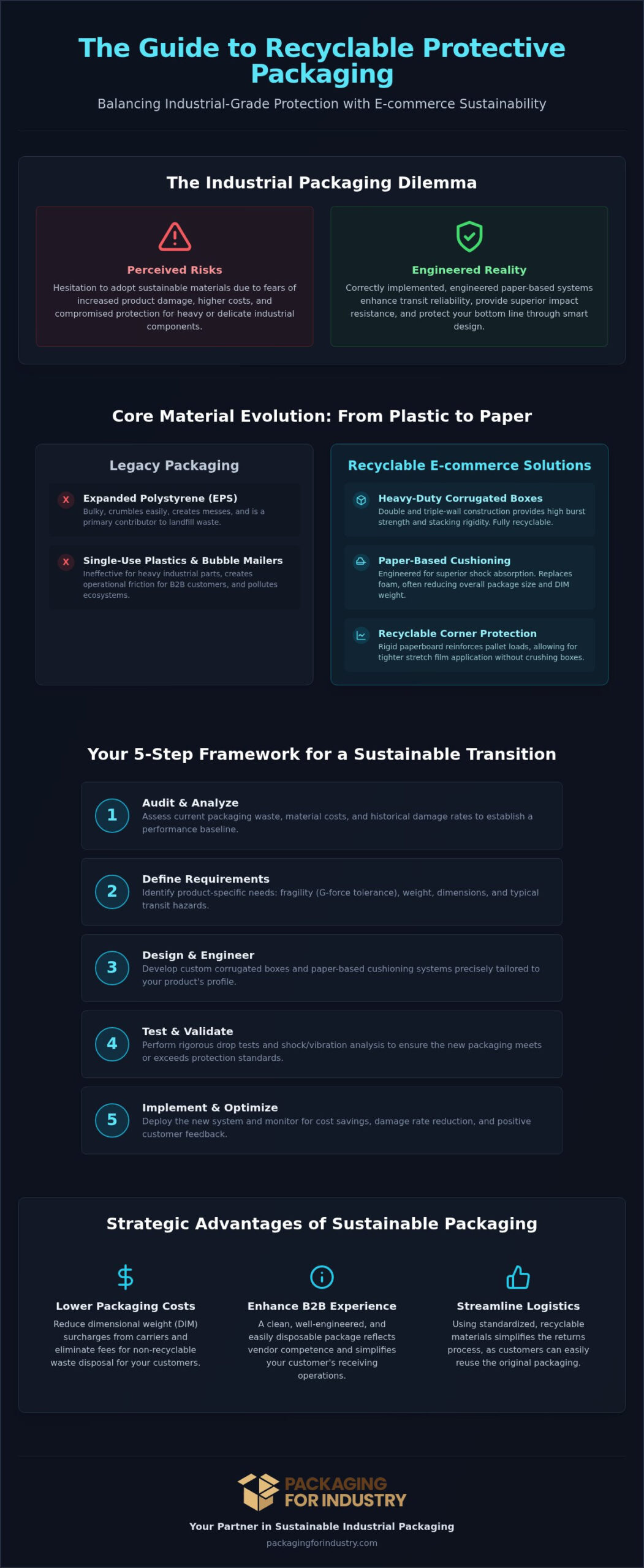
Designing Your Recyclable Shipping System: A 5-Step Framework
Implementing recyclable protective packaging for e-commerce shipments is a technical transition that requires a structured engineering approach. You shouldn’t simply swap plastic for paper without validating that the new system can handle the specific stresses of your supply chain. A haphazard transition often leads to increased damage rates and operational friction. We use a five-step framework to ensure your move to sustainable materials is both fiscally responsible and logistically sound.
- Step 1: Audit current waste and damage. Track your current packaging spend against product damage costs to establish a performance baseline.
- Step 2: Identify high-risk components. Determine which heavy or delicate parts require specialized block-and-brace protection versus standard void fill.
- Step 3: Prototype with sustainable materials. Use CAD/CAM design to create custom corrugated inserts that mirror the geometry of your products.
- Step 4: Conduct rigorous testing. Perform drop tests and vibration simulations to verify that paper-based cushioning meets your protection standards.
- Step 5: Implement a VMI program. Partner with a local supplier to maintain consistent stock levels and ensure your packaging supply keeps pace with demand.
Auditing and Benchmarking
Success starts with accurate data. You need to track your total packaging spend alongside the cost of replacement parts and expedited shipping for damaged goods. This audit often reveals “over-packaging” where you’re wasting both space and money on unnecessary materials. By identifying these inefficiencies, you can set realistic sustainability goals for the fiscal year that actually improve your bottom line. It’s about finding the intersection of material strength and economic efficiency.
Implementation and Logistics
Once you’ve designed your system, the focus shifts to warehouse throughput. Speed is critical in e-commerce; therefore, we recommend integrating kitting and assembly services to streamline the packing process. Transitioning your team to new materials requires clear workflows to ensure consistent protection levels across every shift. To maintain reliability, many Southern California manufacturers utilize our VMI services. This allows us to manage your inventory levels from our local facilities, providing just-in-time delivery to your warehouse in Orange County or Los Angeles. This proactive oversight prevents stockouts during seasonal spikes and allows you to optimize your recyclable protective packaging for e-commerce shipments without tying up excessive capital in warehouse space.
Sustainable Logistics in Southern California: The PFI Advantage
Choosing the right materials is only half the battle. The logistical efficiency of your supply chain determines the true environmental and economic impact of your sustainability initiatives. When you partner with a local supplier for recyclable protective packaging for e-commerce shipments, you significantly reduce the carbon footprint associated with transporting bulky packaging materials across the country. PFI specializes in high-volume, industrial-grade solutions that prioritize both physical protection and logistical flow, ensuring your operations remain lean and responsive.
Local Support for Orange County and LA
We provide dedicated support to manufacturers and warehouses in Anaheim, Irvine, and Los Angeles. Our proximity allows us to offer next-day delivery for e-commerce spikes, ensuring your production lines never stall due to a packaging shortage. For businesses in the Inland Empire, we implement just-in-time (JIT) delivery programs. These programs are designed to free up valuable warehouse floor space by delivering materials only when they’re needed. You’ll have direct access to our industrial packaging consultants who can troubleshoot specific transit damage issues on-site, providing a level of service that large catalog suppliers can’t match.
Scaling with Nationwide Support
While our roots are in Southern California, we leverage an extensive network of distribution partners to support multi-location fulfillment operations. This allows you to standardize your recyclable protective packaging for e-commerce shipments across your entire national supply chain. Standardizing your materials maintains brand consistency and protection levels regardless of where the product is shipped. If you’re looking to optimize your current spend, we recommend a packaging cost-reduction analysis. This technical review identifies opportunities to consolidate SKUs and transition to more efficient, sustainable materials without risking product integrity.
Our team operates as a seasoned industrial consultant, focusing on the intersection of engineering and economics. We don’t just sell boxes; we provide a comprehensive system of protection and logistical optimization. By managing your inventory through our Vendor Managed Inventory (VMI) expertise, we take the professional stress out of procurement. This proactive approach ensures that your bulk recyclable packaging solutions are always available when demand surges. If you’re ready to transition to a more reliable, eco-friendly system, you can request a quote for bulk quantities and custom sizes tailored to your specific industrial needs.
Optimizing Your Industrial Supply Chain for Sustainability
Transitioning to recyclable protective packaging for e-commerce shipments is a strategic investment in both operational efficiency and corporate responsibility. By utilizing custom CAD prototyping, you can ensure that heavy-duty corrugated and paper-based cushioning meet aerospace-grade protection standards without the environmental impact of traditional foam. This shift doesn’t just satisfy regulatory pressures; it streamlines your unboxing experience and strengthens your relationship with professional B2B customers who value waste reduction.
Success depends on a steady supply and technical precision. PFI provides the local expertise needed to navigate this shift, offering next-day delivery in Southern California and vendor-managed inventory to prevent stockouts during seasonal spikes. You can achieve zero increase in damage rates while lowering your overall shipping costs through smarter material engineering and localized logistics. Our team is here to ensure your transition is seamless and fiscally sound.
We’re ready to help you build a more resilient and sustainable logistics operation that protects your products and your bottom line.
Frequently Asked Questions
Is recyclable protective packaging as strong as traditional foam?
Recyclable materials provide equivalent protection when engineered for specific G-force shock absorption requirements. While polyethylene foam relies on cellular compression, paper-based alternatives like honeycomb and molded pulp utilize structural collapse to manage impact energy. This engineering approach ensures that sensitive industrial components remain safe during high-velocity parcel transit. We use CAD/CAM design to match the protection levels of traditional foam while maintaining 100% recyclability in standard paper streams.
How much more does sustainable e-commerce packaging cost?
Sustainable options are increasingly cost-competitive when you evaluate the total cost of ownership. While specialized materials may have a higher unit price, they often reduce dimensional weight surcharges by allowing for smaller container sizes. You should compare packaging pricing based on total logistical efficiency rather than just material costs. Additionally, using recyclable protective packaging for e-commerce shipments eliminates the high disposal fees your customers face with non-recyclable plastics.
Can I use recyclable materials for heavy industrial parts?
Heavy-duty corrugated materials are specifically designed to handle the weight and sharp edges of industrial parts. Double-wall and triple-wall RSC boxes provide the stacking strength and puncture resistance necessary for high-value machinery. When combined with rigid paperboard corner boards and block-and-brace techniques, these recyclable systems secure heavy loads effectively. This approach prevents the structural failure often seen with standard retail boxes during long-distance palletized transit.
Does PFI offer custom-sized recyclable boxes?
We provide a full range of custom sizes available to meet the exact dimensions of your industrial goods. Standard sizes don’t always fit specialized components, leading to wasted space and material. Our design team uses physical prototyping to ensure a perfect fit for products in the aerospace, medical, and electronics sectors. This precision engineering helps lower packaging costs by optimizing material usage and reducing the risk of transit damage.
What is the best way to prevent damage in sustainable shipping?
The most effective way to prevent damage is through immobilization using block-and-brace techniques. By engineering internal corrugated inserts that lock your product in place, you eliminate the internal movement that leads to impact damage. We recommend using recyclable protective packaging for e-commerce shipments that has been rigorously tested through drop and vibration simulations. This data-driven approach ensures your sustainable materials perform reliably under real-world shipping conditions.
Does PFI provide local delivery for e-commerce packaging in Southern California?
We offer local next-day delivery throughout Orange County, Los Angeles, and the Inland Empire. Our fleet supports manufacturers in cities like Anaheim and Irvine with reliable, just-in-time delivery. It’s a more efficient way to manage your supply chain while ensuring you have the necessary materials for e-commerce spikes. Local partnership also reduces the carbon footprint of your operations by shortening the transit distance for bulky packaging materials.
How do I request a quote for bulk recyclable packaging?
You can request a packaging quote directly through our online portal or by contacting our industrial consultants. We specialize in bulk quantities and custom-engineered solutions tailored to the needs of manufacturers and distributors. We’ll perform a comprehensive analysis of your current spend and damage rates to provide a fiscally responsible transition plan. Our focus is helping you improve supply reliability while effectively managing the costs of specialized sustainable materials.