
A single rejected shipment due to non-compliant packaging can stall a multi-million dollar defense contract and compromise mission readiness. For contractors operating within San Diego’s defense corridors, there’s no margin for error in equipment protection. You need specialized foam inserts for military transit cases San Diego that don’t just cushion but actually meet rigorous MIL-STD-2073-1E requirements. At Packaging For Industry (PFI), we know that protecting high-value electronics and autonomous assets requires more than off-the-shelf solutions, especially when a single failure leads to rejected shipments or costly contract delays.
It’s frustrating to deal with long lead times from catalog suppliers or damage caused by multi-modal transport vibrations. You’ve likely seen how generic foam fails under the stress of rapid deployment or fails to meet specific Commercial Item Descriptions like A-A-59136. This guide teaches you how to specify high-performance foam inserts that meet strict military standards and protect high-value assets during transit. We’ll examine technical differences between polyethylene and polyurethane, explain the benefits of CAD/CAM precision, and show how a local supplier with vendor-managed inventory (VMI) can eliminate shortages and ensure your compliance with defense contracts.
Key Takeaways
- Identify why standard cushioning fails in multi-modal transport and how to select specialized materials that withstand the rigors of San Diego’s defense logistics.
- Learn to navigate the specific requirements of MIL-STD-2073-1E to ensure your packaging remains fully compliant with federal defense contracts.
- Evaluate whether CNC routing or die-cutting is the superior fabrication method for your custom foam inserts for military transit cases San Diego.
- Discover how CAD-driven design and free prototyping can eliminate fitment errors and lower packaging costs before full production begins.
- Understand the logistical advantages of local vendor-managed inventory programs for maintaining a steady supply of mission-critical packaging near North Island and Miramar.
The Critical Role of Custom Foam Inserts for San Diego Defense Logistics
San Diego serves as a primary hub for global defense, where the industry drives roughly 20% of the local Gross Regional Product. For contractors supporting operations near Miramar, North Island, and Camp Pendleton, the stakes of equipment transit are exceptionally high. High-value electronics, autonomous systems, and specialized weaponry must endure the rigors of multi-modal transport, moving from aircraft to ship to truck. Standard off-the-shelf foam often lacks the density and precision required to survive these shifts in velocity and handling. Utilizing high-performance foam inserts for military transit cases San Diego ensures that sensitive assets remain operational upon arrival, directly impacting mission readiness and preventing the logistical nightmares associated with damaged gear.
San Diego’s Unique Industrial Logistics Landscape
Moving sensitive gear between inland facilities like Miramar and coastal naval bases presents specific environmental challenges. Southern California’s coastal climate introduces moisture and salt air, which can degrade inferior packaging materials over time. Ruggedized transit solutions must exceed the capabilities of consumer-grade “pick-and-pluck” foam, which often lacks the structural integrity for repeated use in humid or high-salinity environments. Professional engineering ensures that Package cushioning materials are selected specifically for these conditions. This is why following modern standards like A-A-59136 is critical. It ensures the foam maintains its protective properties and structural memory even after multiple trips through San Diego’s dense defense logistics corridors.
The Hidden Costs of Improper Cushioning
The true cost of transit damage isn’t just the price of a replacement part; it’s the operational delay that follows. Vibration and shock during transport can lead to micro-fractures in sensitive electronics that aren’t immediately visible during initial inspection. Custom-engineered foam provides a superior ROI by preventing these “latent failures” and ensuring strict adherence to MIL-STD-2073-1E packaging requirements. By investing in precision-cut protection, San Diego defense contractors can avoid high-volume replacement costs and lower packaging costs over the lifecycle of a contract. You can learn about our custom design packaging services to see how we mitigate these risks through CAD-driven engineering and precise material selection, ensuring every asset is mission-ready the moment it reaches its destination.
Material Engineering: Selecting the Right Foam for Military Cases
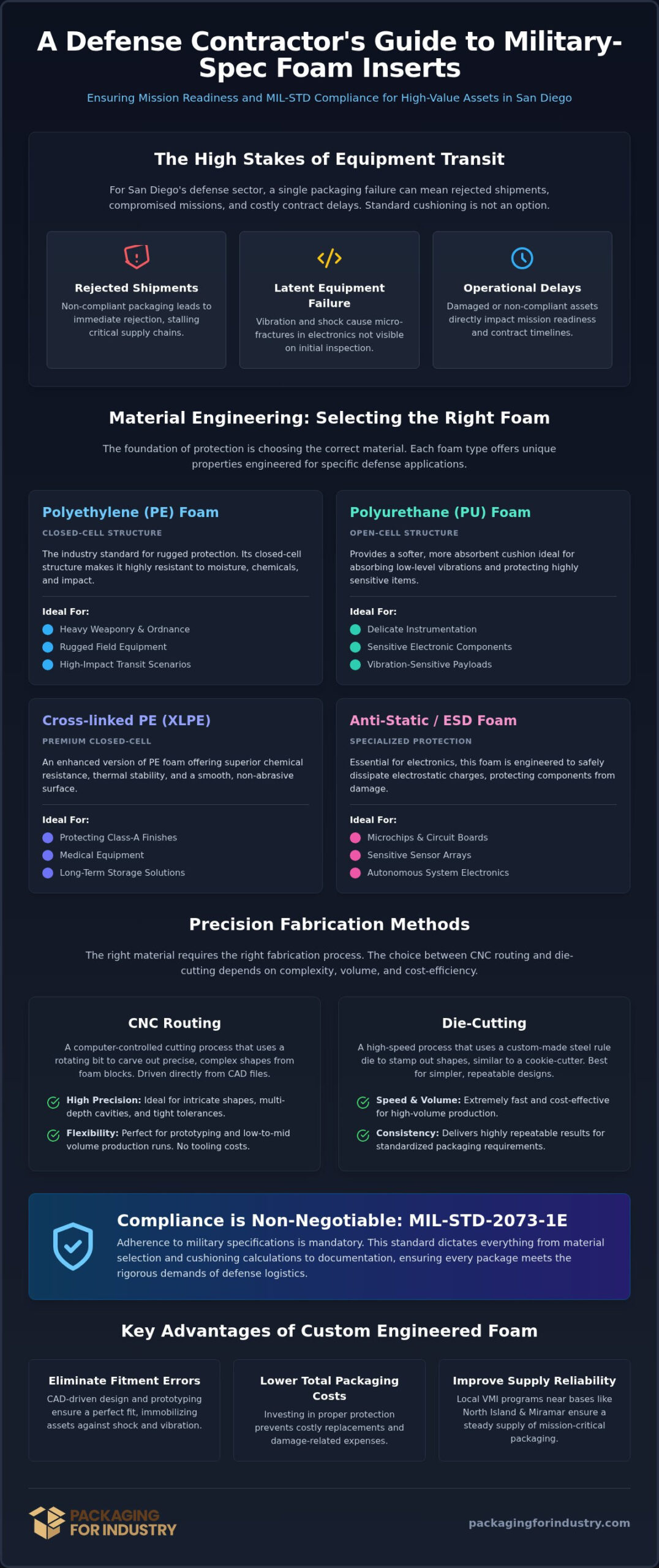
Selecting the proper material is the foundation of effective packaging engineering. For defense contractors specifying foam inserts for military transit cases San Diego, the choice between open-cell and closed-cell structures depends on the asset’s weight and fragility. Closed-cell Polyethylene (PE) foam serves as the industry standard for rugged protection. It’s highly resistant to moisture and chemicals, making it ideal for heavy weaponry or field equipment. Conversely, open-cell Polyurethane (PU) foam provides a softer cushion for delicate instrumentation, absorbing lower-level vibrations that could damage sensitive internal components.
Cross-linked Polyethylene (XLPE) offers superior chemical resistance and a non-abrasive surface, which is vital for protecting Class-A finishes during long-term storage or deployment. For San Diego’s growing electronics and semiconductor sectors, Anti-Static (Pink) or Electrostatic Discharge (ESD) foam is essential. These materials prevent static buildup that can destroy microchips or sensitive sensor arrays during transit. You can browse our protective foam packaging options to compare specific material properties for your project.
Density and ILD: The Science of Shock Absorption
Engineering high-performance foam inserts for military transit cases San Diego requires calculating density and Indentation Load Deflection (ILD). Density, measured in pounds per cubic foot, determines the foam’s load-bearing capacity and long-term durability. ILD measures how much pressure is needed to compress the foam by a specific percentage. If the foam is too dense, it won’t compress enough to absorb shock; if it’s too soft, the equipment will bottom out against the case wall. PFI engineers analyze the G-factor of your product, which is the maximum deceleration it can withstand, to match it with the precise ILD required for zero-damage transit.
Specialized Additives for Harsh Environments
Military applications often demand specialized additives to meet safety and performance protocols. Flame retardant specifications are frequently required for aerospace applications to mitigate fire risks in transit. Additionally, choosing between conductive and dissipative foam is critical for ESD protection. Conductive foam allows charges to flow quickly to a ground, while dissipative foam slows the charge movement to protect ultra-sensitive devices. If you’re unsure which material meets your specific contract’s requirements, you can request a packaging quote to consult with our engineering team on a custom solution.
CNC Routing vs. Die-Cutting: Precision Fabrication for Hard Cases
Selecting the right fabrication method is a decision driven by both engineering requirements and economic scale. For high-performance foam inserts for military transit cases San Diego, the choice between CNC routing and die-cutting depends on the equipment’s geometry and the total volume of the production run. Each method offers specific benefits that impact the final per-unit cost and the level of protection provided to the asset.
CNC routing is the preferred method for high-end transit cases requiring varying depths or intricate 3D geometries. This process uses computer-controlled cutting heads to carve precise cavities directly into foam planks. Since it’s a digital process, there’s no need for physical tooling. This makes it a highly efficient choice for low-to-medium volume military production runs where custom fitment for delicate optics or sensors is non-negotiable. It allows for multi-stage protection by combining different foam densities within a single insert, ensuring that heavy bases and fragile lenses receive appropriate support.
Die-cutting is a mechanical process that uses a steel rule die to stamp shapes out of foam sheets. It’s a cost-effective solution for high-volume orders of uniform foam pads or simple inserts. While die-cutting requires an upfront investment in tooling, the per-unit price drops significantly as the order volume increases. It’s often the best choice for basic kitting projects or protective layers that don’t require complex, multi-depth cavities.
The Advantages of CNC-Routed Inserts
CNC routing provides high precision tolerances that ensure a snug, movement-free fit for every component. This precision is vital for maintaining the calibration of sensitive instrumentation. Digital fabrication also allows for the easy integration of finger-pulls and specialized accessory pockets without the need for manual secondary operations. This level of detail is critical when protecting mission-critical assets that must be accessed quickly and safely in high-pressure field environments.
Shadowing and FOD Prevention for Aerospace
In San Diego aerospace hangars, tool control is a fundamental safety requirement. Shadow foam trays utilize dual-color foam layers to provide immediate visual confirmation of missing equipment. If the bright bottom layer is visible, the technician knows a tool hasn’t been returned. This simple yet effective system prevents Foreign Object Debris (FOD), which can cause catastrophic damage to aircraft engines. You can explore our aerospace packaging solutions to see how these multi-layer assemblies improve organization and safety across defense and commercial aviation sectors.
Ensuring Compliance: Mil-Spec Standards and Documentation
Compliance with federal standards is the primary barrier to entry for many defense projects. When specifying foam inserts for military transit cases San Diego, contractors must adhere to MIL-STD-2073-1E, Change 4. This standard establishes the baseline for documenting and executing military packaging. It’s vital to account for these requirements early in the design phase to avoid rejected shipments. Beyond the foam inserts, we provide comprehensive documentation support, ensuring your materials meet specific Commercial Item Descriptions like A-A-59136. This level of oversight prevents administrative delays that can stall critical production timelines. Failure to provide a proper paper trail can lead to contract non-compliance, which risks your standing as a preferred vendor.
Meeting Strict Defense Contract Requirements
Every defense contract requires a verifiable history for all packaging materials. We provide a Certificate of Conformance (CoC) with every order, confirming that your polyethylene or polyurethane meets the required performance specifications. If a supplier can’t provide a clear paper trail, your entire shipment is at risk during inspection. When you request a packaging quote, our team reviews your specific Mil-Spec callouts to ensure the selected cushioning matches the contract’s protective requirements. This includes verifying flame retardancy and ESD properties for sensitive aerospace gear. You can view our military packaging capabilities to see how we maintain these rigorous standards for contractors throughout Southern California.
Logistics and Delivery to San Diego Defense Hubs
Logistics efficiency is just as important as material compliance. While we focus on San Diego defense hubs like Miramar and North Island, our regional footprint extends across Los Angeles, Orange County, and the Inland Empire. We utilize our own fleet for local next-day delivery, which helps you lower packaging costs by eliminating the high freight fees associated with shipping large volumes of foam inserts for military transit cases San Diego. Our vendor-managed inventory (VMI) and just-in-time (JIT) programs ensure your production lines stay active without requiring excessive on-site storage. This regional support ensures that prime contractors have a reliable partner capable of responding to urgent deployment schedules across the entire Southern California defense corridor.
Streamlining Procurement with PFI’s Custom Foam Solutions
PFI approaches packaging through an engineering lens, ensuring that procurement becomes a streamlined part of your production cycle. Our process begins with CAD/CAM support, where we translate your equipment’s dimensions into a digital model. This digital precision allows us to create multi-functional foam inserts for military transit cases San Diego that provide exact fitment for every accessory and component. By integrating these inserts with custom heavy-duty corrugated boxes or wood crates, we provide a single-source solution that simplifies your vendor list and ensures total system compatibility.
Free prototyping is a standard part of our consultative approach. We don’t believe in guessing when it’s a matter of high-value military assets. Before moving to full-scale production, we provide a physical sample for fit-testing. This step eliminates the risk of costly errors and ensures the final product meets your expectations for both protection and organization. Whether you need a single custom case or a bulk order for a new deployment, this prototyping phase guarantees that your instrumentation is secure from the moment it’s packed.
The PFI VMI Advantage for San Diego Manufacturers
Industrial space in San Diego’s defense corridors is at a premium. Storing large volumes of protective foam can quickly eat into your operational footprint. Our Vendor Managed Inventory (VMI) programs solve this by allowing us to stock your custom packaging in our facility. We monitor your usage levels and deliver replacements just-in-time, effectively freeing up warehouse space in high-rent zones. This proactive approach eliminates packaging shortages and ensures you’re never waiting on a box to ship a finished part.
Request a Quote for Your Military Transit Case Project
Starting a project with us is straightforward. To provide an accurate quote, we typically need your equipment’s dimensions, weight, and any specific Mil-Spec requirements. Our team can also work from your existing CAD files to accelerate the design phase. Local Southern California businesses benefit from our next-day delivery options and on-site consultations. You can request a custom packaging quote today to begin the engineering process and secure the protection your assets require.
Secure Your Mission-Critical Assets with Precision Engineering
Securing high-value defense assets requires a strategic approach to packaging that balances material science with strict regulatory compliance. We’ve explored how selecting the right density and fabrication method ensures your equipment survives the rigors of multi-modal transport. Utilizing precision-cut foam inserts for military transit cases San Diego isn’t just about cushioning; it’s about maintaining mission readiness through rigorous adherence to MIL-STD-2073 standards.
Our engineering team provides the CAD/CAM support and free prototyping necessary to guarantee a 100% fit for your delicate electronics or weaponry. By sourcing locally, you benefit from next-day delivery to San Diego hubs and vendor-managed inventory programs that eliminate supply chain bottlenecks. Partnering with a specialist ensures your logistics stay efficient while your protection stays absolute.
We look forward to helping you optimize your defense logistics and ensure every shipment arrives in perfect operational condition.
Frequently Asked Questions
What is the best foam for military transit cases?
The optimal material depends on the weight and fragility of your equipment. Closed-cell polyethylene (PE) is the industry standard for heavy-duty protection due to its durability and chemical resistance. For delicate instrumentation, open-cell polyurethane (PU) offers superior shock absorption. We also provide cross-linked polyethylene (XLPE) for assets requiring class-A surface protection. Our engineering team helps you select the optimal density based on your specific product G-factor.
Do you provide custom foam inserts for Pelican or SKB cases in San Diego?
We provide precision-engineered foam inserts for all major hard case brands, including Pelican and SKB. Our CNC routing process ensures a perfect fit for these cases, regardless of their internal dimensions. With custom sizes available for any case model, this is a critical service for contractors seeking foam inserts for military transit cases San Diego, as it replaces standard pick-and-pluck foam with a professional solution that won’t degrade under heavy field use.
Can you help meet Mil-Spec packaging requirements for my defense contract?
We specialize in navigating complex defense packaging requirements. Our team ensures compliance with MIL-STD-2073-1E, Change 4, and provides necessary material certifications for your contract. We maintain a deep inventory of foams that meet Commercial Item Descriptions like A-A-59136. This expertise helps you avoid rejected shipments and ensures your packaging documentation meets the strict audit standards of prime defense contractors and government agencies.
What is the minimum order quantity for custom foam inserts?
As an industrial supplier, we focus on serving manufacturers and defense contractors with bulk packaging needs. Minimum order quantities vary depending on the fabrication method and material type selected. While CNC routing allows for smaller production runs due to the lack of tooling costs, die-cutting is typically reserved for higher volume requirements. You can compare packaging pricing for your specific volume by contacting our sales team for a quote.
Do you offer anti-static or ESD-safe foam for electronics?
We offer a full range of anti-static and ESD-safe foam options specifically designed for sensitive electronics and semiconductor components. These materials prevent electrostatic discharge that can damage microchips during transit. Our ESD foams are available in various densities and can be custom-routed to create secure, dissipative environments for your hardware. This is a vital requirement for many aerospace and technology firms operating in San Diego.
How long does the prototyping process take for custom foam?
The prototyping process typically moves quickly once we receive your CAD files or physical dimensions. Our engineering team utilizes CAD/CAM support to design your insert and produce a physical sample for fit-testing. This stage is crucial for ensuring 100% accuracy before we move into full-scale production. Local Southern California businesses often experience faster turnaround times due to our proximity and dedicated local support for San Diego hubs.
Do you deliver to military bases like Miramar or Camp Pendleton?
We provide local next-day delivery options to major defense hubs and industrial zones throughout Southern California. Our logistics network regularly serves facilities in Miramar, Carlsbad, El Cajon, and Camp Pendleton. Sourcing locally allows you to lower packaging costs by reducing freight expenses associated with shipping large volumes of foam inserts for military transit cases San Diego. We also offer vendor-managed inventory to ensure you always have compliant packaging.
Can you provide both the foam and the outer corrugated boxes?
We provide integrated packaging solutions that include both the custom foam inserts and the outer protective containers. This includes heavy-duty corrugated boxes, RSC boxes, and custom wood crates. By sourcing your entire packaging system from a single supplier, you ensure that the foam and outer container work together to provide maximum protection. This holistic approach streamlines your procurement process and ensures all components meet your specific contract requirements.