
If your high-value sensors survive a rigorous manufacturing process only to fail during the final mile of transit, your engineering excellence is effectively neutralized. In the competitive Orange County medical device corridor, you’re likely managing the dual pressure of 2026 FDA QMSR compliance and the skyrocketing costs of local warehouse space. If you’ve been searching for a reliable industrial packaging supplier near me that understands these specific operational pains, we provide the localized expertise required to keep your throughput moving without the risk of transit damage.
We understand that protective packaging solutions for medical devices Santa Ana manufacturers rely on must be as precise as the instruments they hold. This guide explains how to achieve zero-damage shipping rates and optimize your supply chain with engineered secondary packaging and local Vendor Managed Inventory (VMI) programs. We’ll examine the technical shift toward custom-cut foam, heavy-duty corrugated materials, and the logistical strategies that help you reclaim floor space while remaining audit-ready for the latest ISO 11607 standards.
Key Takeaways
- Understand the critical role of engineered secondary packaging in protecting primary sterile barriers and high-value instrumentation during transit.
- Evaluate the performance differences between PE, PU, and ESD foam inserts to ensure optimal stabilization for sensitive surgical and diagnostic electronics.
- Stay compliant with the 2026 FDA QMSR and ISO 11607 standards by sourcing documented, audit-ready protective packaging solutions for medical devices Santa Ana OEMs.
- Solve local warehouse space constraints and reduce lead times through Vendor Managed Inventory (VMI) and just-in-time delivery of custom corrugated boxes.
- Reduce operational overhead by choosing a local Southern California partner that offers a cost-effective alternative to national catalog suppliers.
The Critical Role of Secondary Protective Packaging for Santa Ana OEMs
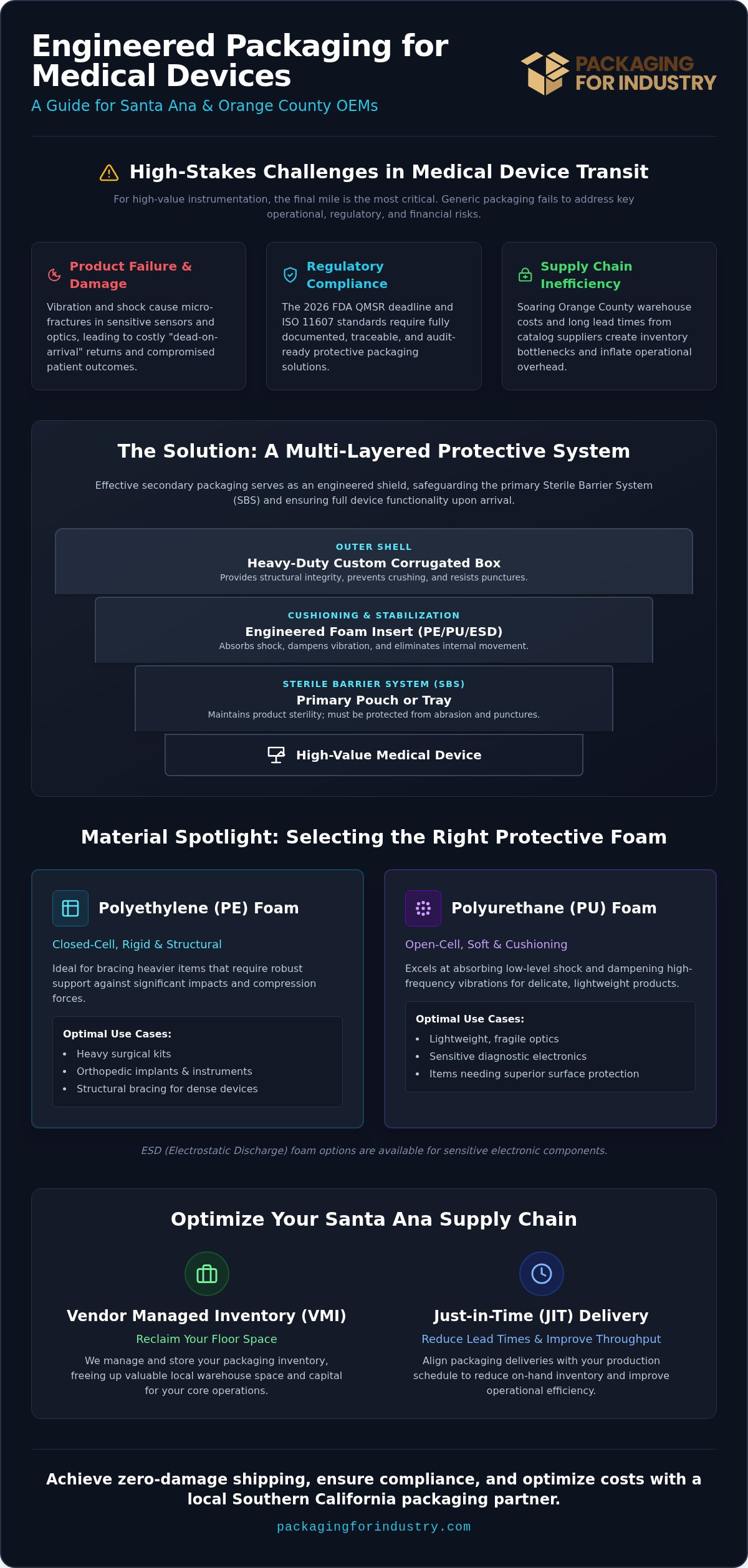
In the medical manufacturing sector, secondary packaging serves as the engineered protection surrounding the primary sterile barrier. While the primary pouch or tray maintains sterility, the secondary layer ensures the device remains functional after enduring the rigors of the supply chain. For Santa Ana med-tech firms, this distinction is critical. High-value instrumentation, such as surgical sensors and diagnostic optics, is prone to micro-fractures caused by high-frequency vibrations during transport. If your outer packaging fails to dampen these forces, you may deliver a sterile product that is technically non-functional, leading to costly returns and compromised patient outcomes.
Effective protective packaging solutions for medical devices Santa Ana OEMs use must bridge the gap between engineering and logistics. Relying on stock shipping containers often overlooks the specific resonance frequencies of sensitive medical hardware. Without specialized dampening, even a minor drop during transit can misalign internal components, rendering a device useless before it ever reaches a clinician’s hands.
Protecting the Sterile Barrier System (SBS)
The primary goal of secondary packaging is to safeguard the Sterile Barrier System (SBS). During palletized shipment, internal movement is the primary cause of pouch punctures and tray abrasions. Custom-fit corrugated boxes eliminate this shifting effect by providing a precise friction fit for the primary container. Standard off-the-shelf boxes frequently fail medical-grade vibration tests because they leave too much void space, which allows the product to gain momentum during impact. By utilizing heavy-duty containers designed according to established medical device packaging standards, manufacturers can maintain the integrity of the SBS from the cleanroom to the operating room.
Navigating Santa Ana’s High-Stakes Logistics
Santa Ana is a central hub for Southern California’s life sciences industry, situated near John Wayne Airport and major freight terminals. This proximity offers logistical speed, but it also introduces high-intensity handling environments. The last mile of delivery to local clinics or hospitals often involves multiple touchpoints where boxes are dropped or stacked incorrectly. Inadequate outer packaging results in more than just a damaged box; it causes clinical delays that disrupt surgical schedules. For a local manufacturing packaging supplier, the focus must be on reducing shipping damage through structural integrity. When a shipment arrives damaged, the financial loss includes the cost of the device, the expense of expedited replacement, and the potential damage to your brand’s reputation for reliability.
Engineered Foam and Corrugated Solutions for Sensitive Devices
Precision engineering is the standard for protective packaging solutions for medical devices Santa Ana OEMs require. Choosing the right material isn’t a matter of preference; it’s a calculation of G-force protection and material compatibility. Polyethylene (PE) foam is a closed-cell, rigid material ideal for heavier surgical kits and orthopedic implants that require structural bracing. Conversely, Polyurethane (PU) foam is an open-cell, softer material that provides superior cushioning for lightweight, fragile optics. As you compare packaging pricing for these materials, it’s essential to factor in the long-term savings gained by eliminating field failures. These material choices align with the FDA Quality System Regulation, which mandates that manufacturers ensure their packaging design protects the device through all phases of distribution.
We provide free prototyping and CAD/CAM support to ensure a precision fit before full-scale production begins. This process allows you to test the interaction between the foam and the device, identifying potential pressure points that could lead to damage. By integrating die-cut foam with heavy-duty corrugated outer shells, we create a multi-material system that handles both vibration dampening and structural impact. You can request a custom packaging quote to see how these engineered materials compare for your specific device requirements.
Die-Cut Foam Inserts and End Caps
Designing for impact requires a deep understanding of foam density. High-density foam absorbs high-energy shocks for heavy components, while low-density options protect delicate surfaces from abrasion. Custom foam assemblies are particularly effective for multi-component surgical kits, keeping each tool isolated and secure. For instance, protecting a $50,000 diagnostic tool with custom-engineered inserts ensures the internal calibration remains intact even if the box is dropped on a concrete warehouse floor. This level of precision eliminates the need for generic bubble wrap and reduces the overall footprint of your shipping container.
Heavy-Duty Corrugated and Triple-Wall Boxes
Standard boxes often fail when tasked with supporting heavy medical machinery or robotic surgical systems. In these cases, we utilize double-wall or triple-wall corrugated materials to provide the necessary stacking strength and puncture resistance. If you’re shipping internationally, weather-resistant corrugated options protect against humidity and moisture during sea or air freight. You can learn more about our custom corrugated options to determine which board grade best suits your equipment’s weight and destination. This structural foundation is what allows the internal foam components to perform their job effectively.
Compliance and Standards for Medical Device Transit
The regulatory landscape for medical device shipping reached a significant milestone on February 2, 2026, with the full implementation of the FDA’s Quality Management System Regulation (QMSR). This regulation harmonizes U.S. standards with international requirements, placing a heavier emphasis on how secondary packaging supports the sterile barrier. For manufacturers sourcing protective packaging solutions for medical devices Santa Ana OEMs must now ensure that their secondary containers are fully documented to facilitate compliance with ISO 11607-1:2019. It is no longer sufficient to simply prevent physical breakage; you must demonstrate that your packaging maintains the integrity of the Sterile Barrier System (SBS) through rigorous transit simulations, including vibration, drop, and atmospheric pressure testing.
Traceability is the backbone of a compliant supply chain. Every batch of custom corrugated boxes or foam inserts requires documentation that verifies material consistency. This ensures that the packaging used in your validated shipping studies is identical to the packaging arriving at your loading dock. By maintaining these strict standards, you reduce the risk of audit failures and ensure that your devices remain functional and sterile from the point of manufacture to the clinical environment. We provide the technical specifications and material certifications necessary to satisfy both internal quality audits and external regulatory inspections.
Meeting ISTA 3A and 3B Standards
Passing ISTA 3A or 3B transit tests requires precision engineering rather than just extra cushioning. Custom CAD/CAM design allows for repeatable packaging performance, ensuring that every foam insert provides the exact level of shock absorption required by your device’s specifications. This consistency is vital for maintaining a validated state. By utilizing engineered designs, Santa Ana manufacturers can pass rigorous vibration and drop simulations on the first attempt, avoiding the delays and costs associated with redesigning packaging after a failed test. High-quality materials prevent the performance drift that often leads to unexpected transit damage.
Material Purity and Cleanroom Compatibility
Secondary packaging must not compromise the manufacturing environment. We offer low-particulate foams and liners specifically selected for their cleanroom compatibility, ensuring that no contaminants are introduced during the final assembly and boxing stages. For devices containing sensitive electronics or semiconductor components, it is essential to explore our protective foam packaging capabilities including ESD and anti-static materials. These specialized solutions prevent latent electrical failures caused by static discharge during handling. Integrating these materials into your secondary packaging design provides a comprehensive shield for both the physical and electronic integrity of your medical equipment.
Optimizing Santa Ana Supply Chains with VMI and JIT
Santa Ana manufacturers operate in one of the most expensive industrial real estate markets in the nation. Utilizing floor space for bulk storage of empty corrugated boxes and large foam blocks is an operational inefficiency that drains your bottom line. To stay competitive in the Orange County medical device corridor, you need a logistics strategy that prioritizes production capacity over inventory overhead. Our Vendor Managed Inventory (VMI) programs are designed to help you lower packaging costs by eliminating the high price of on-site storage. By shifting the burden of inventory management to your supplier, you ensure that protective packaging solutions for medical devices Santa Ana teams require are always available without cluttering the manufacturing floor.
The primary advantage of a local partnership is the elimination of lead-time surprises. When you rely on national catalog suppliers, a sudden spike in production can leave you waiting days for specialized packaging, stalling your shipping department. A local JIT delivery system synchronizes your packaging supply with your actual production runs. We monitor your usage patterns and maintain a safety stock of your custom die-cut foam and heavy-duty boxes in our facility, delivering them exactly when your production schedule demands. This proactive approach transforms packaging from a potential bottleneck into a seamless component of your workflow.
Vendor Managed Inventory for Med-Tech
Our VMI programs are tailored for the high-precision needs of the medical sector. We conduct regular inventory reviews, either weekly or monthly, depending on your volume, to ensure your stock levels never dip below critical thresholds. This system allows you to reclaim valuable square footage for new cleanrooms or assembly lines instead of storing stacks of pallets. By outsourcing the monitoring and replenishment of your packaging, your procurement team can focus on high-value components rather than tracking box counts. Streamline your operations with our VMI programs to gain total visibility into your packaging spend while reducing on-site storage costs.
Kitting and Assembly Services
Efficiency on the shipping floor is often lost during the final assembly process. We offer pre-assembled packaging kits that arrive at your facility ready for immediate use. By combining your custom foam inserts, corrugated boxes, and required labels into a single SKU, we simplify your internal logistics and improve packing consistency. This kitting service reduces labor costs and ensures that every device is packed exactly according to your validated engineering specifications. When your team doesn’t have to hunt for multiple components to ship a single unit, throughput increases and the risk of human error during the packing process is significantly lowered.
Why Santa Ana OEMs Partner with Packaging For Industry (PFI)
When selecting protective packaging solutions for medical devices Santa Ana OEMs often find that large-scale catalog suppliers lack the technical depth required for high-stakes instrumentation. While generic bulk distributors excel at providing standard tape or stock mailers, they aren’t equipped to engineer a custom die-cut foam assembly that must survive a validated vibration test. We position ourselves as a cost-effective alternative to these major national suppliers by providing direct access to packaging engineers and a local delivery fleet. This ensures you receive precision-engineered protection without the administrative bloat or premium pricing of a middleman. Our focus is on solving the physical and fiscal challenges of your supply chain, not just filling a catalog order.
Our expertise exists at the intersection of medical technology and aerospace logistics. Because Santa Ana serves as a hub for both sectors, we understand the shared requirements for high-reliability packaging. Whether you need ESD-safe foam for a surgical robot or heavy-duty triple-wall corrugated for a diagnostic imaging component, we provide comprehensive support from the initial CAD design to the final bulk delivery. This end-to-end accountability eliminates the stress of managing multiple vendors and ensures your packaging remains compliant with 2026 industry standards. We act as a seasoned industrial consultant, identifying vulnerabilities in your current shipping methods before they result in a clinical delay or an audit failure.
A Local Partner for the Orange County Tech Corridor
Having your packaging manufacturer in your backyard provides a level of agility that national suppliers cannot match. Proximity allows for rapid response times when production schedules shift or urgent prototypes are needed for a looming product launch. We offer next-day delivery across Southern California, ensuring your shipping floor never runs dry even during peak demand cycles. This personalized service means you have a dedicated partner who understands the specific logistical challenges of the Orange County corridor. Request a custom packaging quote today to see how a local partnership can improve your operational reliability and lower your total cost of ownership.
Your Next Steps for Packaging Optimization
Improving your supply chain starts with a pragmatic evaluation of your current packaging performance. We recommend the following steps to ensure your medical devices are protected and your costs are controlled:
- Conduct a Packaging Audit: We help you identify hidden damage risks and areas where material waste is driving up your shipping costs.
- Prototype New Designs: Before a major launch, we provide CAD/CAM support to create and test custom foam inserts that match your device’s exact geometry.
- Analyze Cost Reductions: We compare your current packaging spend against our custom-engineered alternatives to find meaningful savings through material optimization and VMI.
- Verify Compliance: Ensure your secondary packaging documentation is ready for 2026 FDA QMSR audits and ISO requirements.
Contact us today to schedule a site visit or a technical consultation. Our goal is to function as your outsourced packaging department, providing the stability and expertise you need to scale your manufacturing operations with confidence. We’re ready to help you eliminate transit damage and reclaim your warehouse floor space.
Secure Your Supply Chain for 2026 and Beyond
Transitioning your strategy from generic catalog supplies to engineered systems is a critical step for Santa Ana OEMs. By integrating custom die-cut foam with heavy-duty corrugated materials, you eliminate the vibration risks that lead to clinical delays. Our expertise in ESD and high-density protective foams ensures your sensitive electronics remain functional upon arrival. This technical precision is what separates a successful product launch from a costly logistical bottleneck.
Implementing local VMI and JIT programs allows you to reclaim valuable warehouse space and reduce lead-time surprises. We provide free CAD/CAM prototyping and design reviews to ensure your protective packaging solutions for medical devices Santa Ana is both cost-effective and audit-ready for the latest FDA standards. With next-day delivery across Orange County, you can maintain a lean supply chain without compromising on material quality. We understand the high stakes of the medical corridor and are here to act as your steady, dependable partner in logistical optimization.
Your operational challenges are solvable with the right engineering approach. We look forward to helping you achieve zero-damage shipping rates and a more efficient warehouse floor.
Frequently Asked Questions
What is the difference between primary and secondary medical packaging?
Primary packaging is the sterile barrier system, such as a pouch or tray, that directly contacts the medical device. Secondary packaging refers to the engineered outer protection, including custom boxes and foam inserts, that shields the primary barrier from transit damage. While the primary layer ensures sterility, the secondary layer is what prevents physical impact and vibration from compromising the device’s functionality during distribution.
Do you offer ESD foam for medical electronics in Santa Ana?
Yes, we provide specialized anti-static and ESD-safe foam packaging for sensitive diagnostic and surgical electronics. These materials are essential for preventing latent electrical failures caused by static discharge during handling and transport. We stock a variety of ESD-compliant foams that can be custom-cut to fit your specific electronic components or high-value instrumentation boards.
How can a VMI program reduce my medical device packaging costs?
A Vendor Managed Inventory (VMI) program lowers costs by eliminating the need for large on-site storage and reducing the administrative burden of inventory tracking. By delivering packaging just-in-time, we help you reclaim expensive Santa Ana floor space for manufacturing instead of box storage. This localized approach improves your cash flow by ensuring you only store and pay for the inventory you need for immediate production.
Can PFI help my company pass ISTA transit testing?
We specialize in engineering protective packaging solutions for medical devices Santa Ana OEMs use to pass rigorous ISTA 3A and 3B testing. Our CAD/CAM design process creates repeatable, high-performance packaging that withstands vibration, drop, and atmospheric pressure simulations. By using precision-cut foam and heavy-duty corrugated materials, we ensure your shipping system meets the strict transit requirements necessary for regulatory approval.
What are the lead times for custom die-cut foam inserts?
Lead times for custom foam inserts are significantly shorter when working with a local Santa Ana partner compared to national catalog suppliers. Because we manage design and production locally, we can often provide prototypes and final production runs with rapid turnaround times. This agility is vital for medical device manufacturers who need to meet tight product launch windows or sudden spikes in market demand.
Do you provide free prototyping for Santa Ana medical device manufacturers?
Yes, we offer free prototyping and CAD/CAM design reviews for local medical device OEMs. This service allows your engineering team to verify the precision fit and protective qualities of a design before committing to a full-scale production run. It’s a pragmatic way to ensure your protective packaging solutions for medical devices Santa Ana are optimized for both safety and cost-efficiency.
Are your corrugated boxes compliant with international export standards?
Our corrugated boxes and crates are designed to meet international shipping and export standards, including ISPM-15 requirements for wood components. We offer heavy-duty double-wall and triple-wall corrugated options that provide the stacking strength and puncture resistance needed for global air and sea freight. This ensures your medical equipment remains secure and compliant throughout the entire international supply chain.
How does the 2026 FDA QMSR affect my secondary packaging choices?
The 2026 FDA Quality Management System Regulation (QMSR) harmonizes U.S. standards with ISO 13485:2016, placing greater emphasis on risk management and documentation. This means your secondary packaging must be part of a traceable, validated quality system that proves the device’s integrity is maintained during transit. We provide the material certifications and technical documentation required to satisfy these updated audit and compliance standards.