
A single misplaced wrench in a turbine assembly doesn’t just stall production; it can lead to a catastrophic failure that costs millions and compromises safety. You already know that in the high-stakes Southern California aerospace sector, tool accountability is the backbone of operational integrity. Maintaining a 5S Lean environment on a busy shop floor is a constant challenge when specialized equipment isn’t properly shadowed. Implementing precision-engineered custom foam for tool control in aerospace manufacturing SoCal facilities is the most effective way to eliminate these risks while driving bottom-line efficiency. It turns a disorganized toolbox into a visual inventory system where a missing item is spotted in seconds.
We understand that your goal is to achieve zero missing tools during inspection and reduce the rising costs of tool replacement. This guide will show you how to eliminate FOD risks, streamline your 5S compliance, and optimize your production floor layout for faster cycles. We will examine the technical advantages of closed-cell polyethylene inserts, the necessity of AS9100-compliant tool shadowing, and how local prototyping from an Anaheim-based partner can accelerate your manufacturing timelines across Orange County and Los Angeles. By the end of this article, you’ll have a clear roadmap for integrating professional tool control into your facility’s logistics strategy.
Key Takeaways
- Understand how a systematic approach to tool control eliminates the high cost of Foreign Object Damage (FOD) and ensures total shop floor accountability.
- Learn why Cross-Linked Polyethylene (XLPE) is the industry standard for durability and chemical resistance in demanding aerospace environments.
- Discover how to source high-precision custom foam for tool control in aerospace manufacturing SoCal facilities to meet rigorous AS9100 standards and 5S requirements.
- Identify the practical steps to audit your inventory and design tool layouts using professional shadowing techniques for maximum production efficiency.
- Leverage free prototyping and local next-day delivery from an Anaheim-based partner to reduce implementation risk and lower your total procurement costs.
The Critical Role of Tool Control in SoCal Aerospace Manufacturing
Tool control isn’t just about tidiness; it’s a rigorous, systematic approach to organizing and accounting for every piece of equipment on the production floor. In the high-density aerospace hubs of Long Beach, Torrance, and Irvine, tool control is a foundational element of operational safety. Manufacturers in these regions face intense pressure to maintain global standards while managing complex assembly lines. Utilizing custom foam for tool control in aerospace manufacturing SoCal facilities provides a level of precision that traditional shadow boards or pegboards cannot match. Unlike generic storage, these custom inserts create a dedicated, non-reactive cavity for every tool. This ensures that nothing is misplaced and everything is protected from impact or chemical exposure. Precision engineering requires precision organization, and custom foam provides the physical infrastructure needed to maintain a high-velocity workspace.
FOD Prevention: A Non-Negotiable Standard
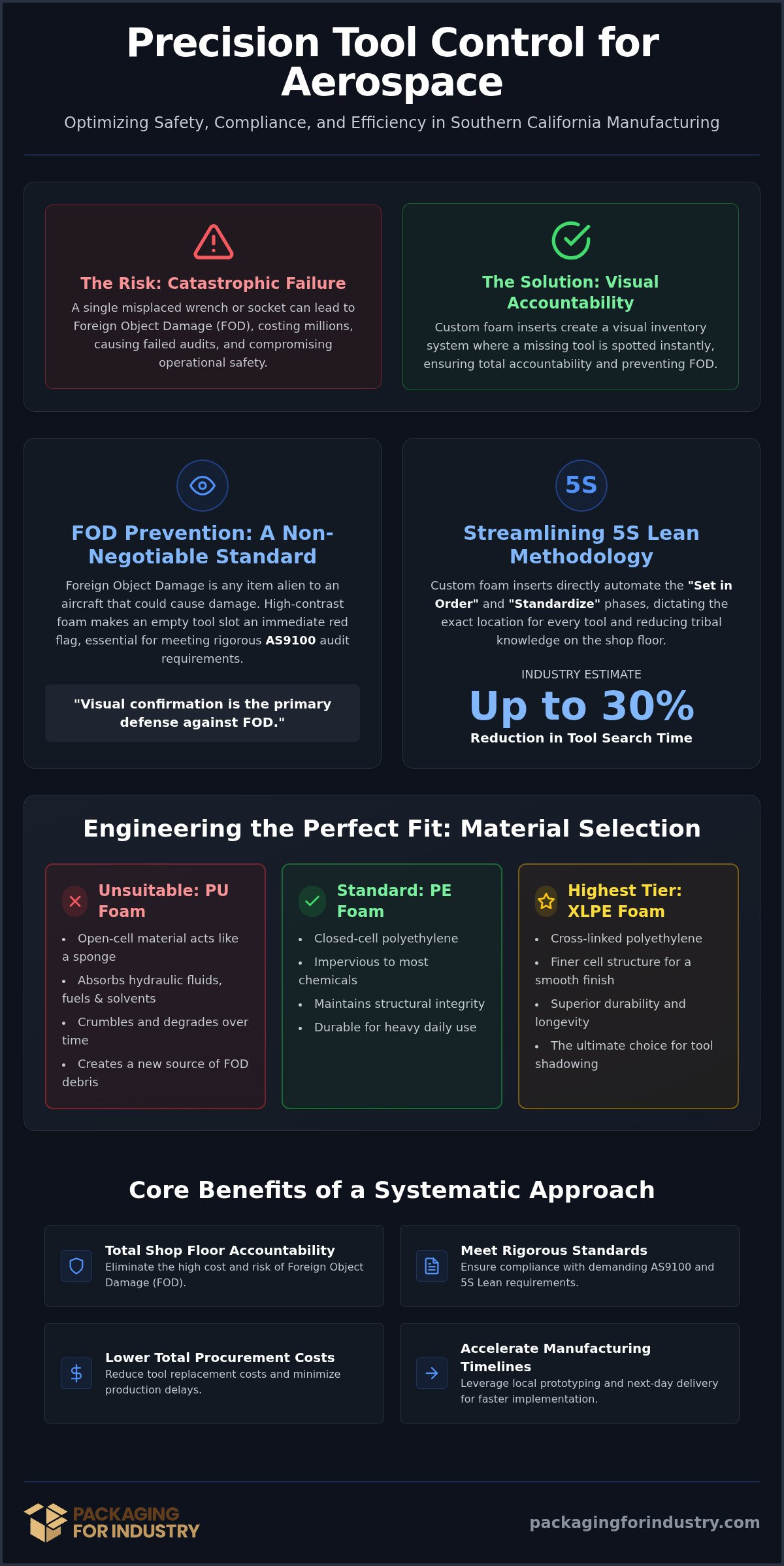
Foreign Object Damage (FOD) is defined as any substance or item alien to an aircraft or system that could potentially cause damage, and its presence can lead to failed audits or catastrophic mechanical failure during flight. A single missing socket or fastener left inside an airframe represents a massive liability. Visual accountability is the primary defense against this risk. When a tool chest uses high-contrast foam packaging, an empty slot becomes an immediate red flag. This instant visual confirmation is essential for meeting AS9100 requirements, where tool accountability is a strictly audited metric. Beyond safety, FOD prevention is a matter of fiscal responsibility. The cost of grounding an aircraft or performing an emergency teardown to find a lost tool far exceeds the investment in a professional tool control system.
5S Lean Methodology in the SoCal Workspace
The 5S workplace organization method, comprised of Sort, Set in order, Shine, Standardize, and Sustain, serves as the framework for modern aerospace management. Custom foam inserts directly automate the “Set in order” and “Standardize” phases by dictating the exact location and orientation of every asset. This eliminates the “tribal knowledge” often required to find specialized equipment on a busy shop floor. Implementing custom foam for tool control in aerospace manufacturing SoCal facilities allows for a reduction in tool search time by up to 30%, according to various industry reports. For manufacturing operations in Southern California, this efficiency translates into faster production cycles and lower labor costs. By standardizing the layout across multiple shifts, you ensure that every technician can maintain the same high standard of organization. It creates a self-policing environment where the shop floor remains optimized without constant supervisor intervention.
Engineering the Perfect Fit: Material Selection for Aerospace Foam Inserts
Selecting the right material is a critical engineering decision that impacts both the longevity of the insert and the safety of the aircraft. While polyurethane (PU) foam is often used for basic cushioning, it’s generally unsuitable for the rigors of an aerospace hangar. PU is an open-cell material that acts like a sponge, absorbing hydraulic fluids, jet fuels, and harsh solvents. Over time, this causes the foam to crumble and degrade, which creates a new source of debris. For high-performance custom foam for tool control in aerospace manufacturing SoCal operations, closed-cell polyethylene (PE) is the industry standard. It’s impervious to most chemicals and maintains its structural integrity under heavy daily use.
Cross-linked polyethylene (XLPE) represents the highest tier of material for tool shadowing. Its fine cell structure provides a smoother finish and superior durability compared to standard PE. It’s particularly effective at resisting the compression set that occurs when heavy tools sit in the same spot for years. Because XLPE doesn’t shed or produce dust, it keeps your tool chests compliant with the strictest cleanroom and FOD prevention protocols. Choosing the right material ensures that your organization system doesn’t become a maintenance liability itself.
Polyethylene (PE) Foam: Durability and Precision
The closed-cell nature of PE foam is what makes it a primary component in the 5S system to reduce waste. Since it doesn’t support bacterial growth or moisture retention, it protects your high-value specialized equipment from corrosion. Density is another vital factor to consider. Heavier tools require higher density foam, typically 2.0 lb or higher, to prevent them from bottoming out. Lighter, delicate instruments can use lower densities for a more secure grip. Two-color shadowing is achieved by laminating a bright colored base layer to a dark top layer. When a tool is removed, the bright color is exposed, making an empty spot impossible to ignore during a shift-change audit.
Specialized ESD Foam for Avionics
Avionics and electronics manufacturing require an additional layer of protection against electrostatic discharge (ESD). Sensitive circuit boards can be permanently damaged by static charges that build up on standard plastics. We provide specialized anti-static and static-dissipative custom foam packaging designed to bleed off these charges safely. These materials are essential for any facility handling flight computers, sensors, or communication hardware. If you’re looking to upgrade your electronics assembly area, you can request a packaging quote to see how ESD-safe custom foam for tool control in aerospace manufacturing SoCal can protect your high-value assets while maintaining total organization.
Precision Manufacturing: CNC Routing vs. Die-Cutting for Tool Shadowing
Precision in the aerospace sector requires more than just high-quality materials; it demands advanced fabrication techniques. At PFI, we use CAD/CAM engineering to ensure every insert meets the rigorous tolerances expected in mil-spec packaging environments. By creating digital tool profiles, we eliminate the guesswork of manual measurements. This digital-first approach ensures that whether you’re organizing a single mobile workstation or a massive assembly line, the fitment is exact. Prototyping further reduces risk by allowing your team to verify the layout before full-scale production, ensuring that high-value equipment is secured exactly as intended.
CNC Routing for Complex Aerospace Toolsets
CNC routing offers unparalleled flexibility for specialized kitting projects. In aerospace, where tools often have irregular shapes and varied heights, the ability of a CNC router to cut multiple depths within a single foam sheet is indispensable. This method produces clean, burr-free edges that won’t degrade over time, a critical requirement for maintaining a FOD-free zone. It’s the optimal choice for low-to-medium volume runs of complex toolsets, as it requires no physical dies and allows for rapid design iterations. This precision is a cornerstone of NASA’s FOD prevention program, where the physical layout must match the digital inventory exactly to ensure total shop floor accountability.
Die-Cutting for High-Volume Standardization
For high-volume standardization across multiple SoCal facilities, die-cutting remains the most efficient manufacturing path. This process uses steel rule dies to punch out cavities with high repeatability, ensuring that every drawer in your facility is identical. While it requires an initial investment in tooling, the significant reduction in cost-per-unit makes it the preferred choice for large-scale 5S rollouts. Our custom design packaging services integrate these high-volume runs into your broader logistics strategy, providing a uniform organizational standard from Orange County to San Diego. This scalability allows you to implement professional custom foam for tool control in aerospace manufacturing SoCal across your entire operation without compromising on precision or durability.
Implementing a 5S Tool Control Program in Your SoCal Facility
Successful 5S integration begins with a physical audit of your shop floor. Transitioning from disorganized tool chests to a high-performance visual management system requires more than just buying inserts; it requires a process. When integrating custom foam for tool control in aerospace manufacturing SoCal operations, the goal is to create a self-correcting environment where every technician is an auditor. By following a structured implementation plan, you can eliminate the “travel waste” that occurs when workers leave their stations to locate specialized equipment.
- Step 1: Audit and Categorize. Document every tool in the manufacturing cell. Identify high-value calibrated instruments and small components that pose the highest FOD risk.
- Step 2: Shadowing Design. Group tools by frequency of use. Professional shadowing techniques ensure that the most critical items are the most visible.
- Step 3: Digital Profiling. Collaborate with our engineers to create digital profiles of your inventory. This ensures that every cavity is a perfect match for the specific tool model.
- Step 4: Prototyping. Test a single drawer or kit in real-world shop floor conditions before committing to a facility-wide rollout.
- Step 5: Standardization. Once the design is verified, roll out the inserts across all work cells to ensure total accountability across every shift.
Optimizing Layout for Ergonomics and Speed
Efficiency on the aerospace floor is often measured in seconds. We apply the “Golden Zone” principle during the design phase, placing your most frequently used tools in the easiest-to-reach spots within the drawer. This reduces repetitive strain and speeds up production cycles. To further accelerate identification, we offer laser engraving for part numbers or tool sizes directly onto the foam surface. This level of detail ensures that even new hires can maintain 5S standards without extensive training. High-quality custom foam for tool control in aerospace manufacturing SoCal environments doesn’t just store tools; it directs the workflow.
Local Logistics: The SoCal Advantage
Working with an Anaheim-based supplier eliminates the logistical friction inherent in out-of-state catalog orders. Proximity allows our team to provide hands-on support during the audit and design phases, which is something a national distributor cannot offer. We provide next-day delivery capabilities for facilities in Orange County, Carson, and Torrance. This local speed is vital for companies utilizing Just-in-Time inventory management to keep their overhead low. By sourcing locally, you reduce lead times and ensure that your shop floor upgrades happen on your schedule, not the carrier’s.
Why PFI is the Preferred Partner for Aerospace Tool Control in SoCal
PFI operates as a seasoned industrial consultant and a proactive problem-solver for the region’s most demanding sectors. Our aerospace and aviation packaging solutions extend beyond simple inserts to include advanced kitting and organization systems that streamline complex assembly processes. We understand that defense contractors throughout the Inland Empire and San Diego require mil-spec packaging durability to maintain compliance with federal safety standards. When you implement custom foam for tool control in aerospace manufacturing SoCal facilities with PFI, you’re investing in a system designed for long-term reliability. Our free prototyping service allows you to verify every detail before a full rollout, ensuring that your organization system drives fiscal responsibility and peak production speed.
Vendor Managed Inventory (VMI) for Tool Control
Maintaining a high-functioning 5S environment requires consistent supply reliability and the elimination of warehouse clutter. Through our Vendor Managed Inventory (VMI) program, we handle the end-to-end management of your foam components so your team can focus on assembly. We monitor your actual usage rates and provide automatic replenishment, which is a key part of our strategy to help you lower packaging costs by reducing emergency orders and administrative overhead. This steady and dependable supply chain ensures that your technicians always have the organizational tools they need without the burden of managing excess stock on-site.
Request a Packaging Quote for Your Aerospace Facility
Whether you need a single specialized drawer or a facility-wide rollout, we have custom sizes available to fit any tool chest or mobile workstation. Our Anaheim-based team is ready to conduct a full packaging review to identify opportunities for improved efficiency and damage reduction across your shop floor. You can request a packaging quote today to compare packaging pricing and see how our local support in Irvine, Santa Ana, and San Diego can optimize your aerospace manufacturing floor. We provide the technical expertise and logistical flow necessary to protect your high-value assets while maintaining a world-class 5S standard.
Optimize Your Shop Floor with Precision Tool Control
Achieving total tool accountability requires a transition from generic storage to engineered solutions. By selecting high-density cross-linked polyethylene and utilizing CAD/CAM design, you eliminate the catastrophic risks of FOD while streamlining 5S compliance. Precision organization isn’t just a safety requirement; it’s a driver of production efficiency that reduces tool replacement costs and wasted labor time.
Our Anaheim-based team provides the technical expertise needed to modernize your facility. We offer expert CAD/CAM support for precision aerospace tolerances and free prototyping on all custom foam designs to ensure a perfect fit before you commit to a full rollout. With local next-day delivery across Southern California, we help you maintain a high-velocity workspace without the delays of out-of-state shipping. Implementing custom foam for tool control in aerospace manufacturing SoCal operations is a proactive step toward operational excellence and fiscal responsibility.
We look forward to helping you build a safer and more efficient manufacturing floor.
Frequently Asked Questions
How much does custom foam for tool control cost in Southern California?
Pricing is determined by the specific material density, the complexity of the tool cavities, and the total production volume. While raw polyethylene sheets have standard market pricing, custom-engineered inserts are quoted based on the engineering time and fabrication method required. You can compare packaging pricing by requesting a quote to see how custom sizing and local production can lower your total tool control costs.
What is the best foam material for aerospace tool inserts?
Closed-cell, cross-linked polyethylene (XLPE) is the industry standard for aerospace manufacturing due to its durability and non-reactive properties. This material is preferred because it doesn’t shed particles, resists compression set, and is impervious to most aerospace fluids. For avionics, we also provide static-dissipative ESD foam to protect sensitive electronic components from electrostatic discharge during assembly and storage.
Can I get a prototype before ordering a full set of tool foam?
Yes, we provide free prototyping on all custom foam designs to ensure a precision fit for your specialized equipment. This allows you to test the tool shadowing in real-world shop floor conditions before moving to a facility-wide rollout. Prototyping reduces buyer risk and ensures that every torque wrench and caliper sits flush within its designated cavity, preventing any movement during transport.
How long does it take to design and manufacture custom foam inserts?
Design and manufacturing timelines typically range from a few days to two weeks depending on the complexity of the toolset. Because we are based in Anaheim, we provide faster turnaround times than out-of-state catalog suppliers. Our CAD/CAM support allows us to move from a digital tool profile to a physical insert with high efficiency, supporting your tight production schedules.
Does tool control foam help with AS9100 and 5S compliance?
Implementing custom foam for tool control in aerospace manufacturing SoCal facilities is a primary method for meeting AS9100 tool accountability requirements. The visual shadowing effect ensures that missing tools are identified instantly during shift changes. This supports the “Set in Order” and “Standardize” phases of the 5S methodology, creating a self-policing environment that actively prevents Foreign Object Damage (FOD).
What is the difference between CNC routed and die-cut foam?
CNC routing uses a computer-controlled bit to cut varied depths and intricate shapes, making it ideal for low-to-medium volume specialized kits. Die-cutting uses a steel rule die to punch out cavities in a single motion, which is more cost-effective for high-volume standardization. We help you choose the right method based on your facility’s scale, tool complexity, and total budget requirements.
Can custom foam inserts withstand aerospace chemicals and hydraulic fluids?
Our high-density polyethylene foam is specifically engineered to resist degradation from jet fuels, hydraulic fluids, and common cleaning solvents. Unlike open-cell polyurethane, which absorbs liquids and crumbles over time, closed-cell foam remains structurally sound in hangar environments. This durability ensures that your tool control system doesn’t become a source of debris itself, maintaining the integrity of your cleanroom operations.
Do you offer local delivery for aerospace manufacturing hubs in LA and OC?
We offer local next-day delivery for aerospace manufacturing hubs throughout Los Angeles and Orange County. Our Anaheim headquarters is strategically located to serve facilities in Torrance, Long Beach, Irvine, and Carson. This proximity allows us to integrate with your Just-in-Time inventory needs and provide on-site support for tool audits and fitment reviews, ensuring your shop floor remains optimized.