
A packaging delivery plan can fail before a shipment even leaves the supplier. Packaging supply chain planning for buyers involves more than order timing: demand changes, material availability, sourcing decisions, and handoffs among purchasing, operations, and warehousing all affect whether the right supplies arrive when production needs them.
Lead times and supplier reliability matter, but a workable plan also needs clear ownership of inventory updates, timely communication about launches or specification changes, and agreement on how to respond when demand shifts. This guide explains how packaging trends and uncertainty shape purchasing decisions, how material availability affects sourcing and inventory, and where supply chain handoffs can create delivery risks. It also shows how manufacturers, warehouses, and distribution operations in Orange County, Los Angeles, and San Diego can connect these factors to practical delivery planning. The goal is to balance cost, availability, and operational needs without relying on last-minute fixes.
Key Takeaways
- Align forecasts, inventory levels, and replenishment triggers to help packaging arrive when production needs it.
- Map material dependencies and packaging specifications before availability changes disrupt purchasing or delivery plans.
- Evaluate packaging changes for their effects on protection, handling, storage, and downstream shipping requirements.
- Clarify who owns inventory updates and communicates changes at each handoff, from purchasing through distribution.
- Use packaging inventory programs and suitable materials to support steadier supply and more efficient operations.
How Does Packaging Sourcing Affect Delivery Times?
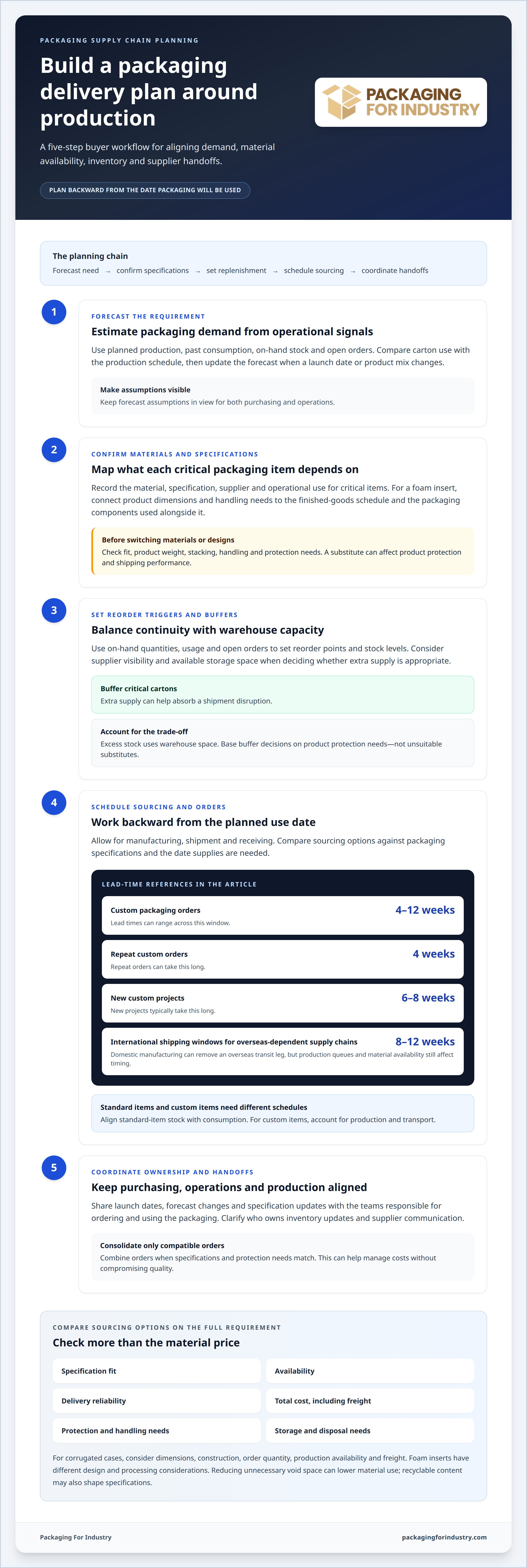
For buyers, packaging supply chain planning connects forecast demand with order timing and replenishment. Coordinate procurement with production dates, material availability, and the time required to receive and stage supplies.
Demand Forecasting and Inventory Management
Demand forecasting estimates packaging needs based on planned production, past consumption, on-hand stock, and open orders. An outdated forecast can leave a packing line short or create excess warehouse inventory. For example, a manufacturer can compare carton use with its production schedule and adjust orders when a launch date or product mix changes. Keep forecast assumptions visible to purchasing and operations teams.
Replenishment Planning and Inventory Buffers
Replenishment planning sets reorder triggers and stock levels, while an inventory buffer provides extra supply for demand changes. Use on-hand quantities, usage, and open orders to set reorder points, then account for storage capacity and supplier visibility. A buffer of critical cartons can help absorb a shipment disruption, but excess stock consumes warehouse space. Base buffer decisions on product protection needs rather than unsuitable substitutes.
Domestic Manufacturing and Stock Planning
Domestic manufacturing can remove an overseas transit leg, but production queues and material availability still affect timing. Packaging supply chains dependent on overseas production can face international shipping windows of 8-12 weeks. Compare sourcing options with the packaging specifications and planned use date. For standard items, align stock with consumption; for custom items, account for production and transport in the schedule.
Coordinating Procurement and Production Schedules
Packaging supply chain planning for buyers also links purchasing dates with production needs. Schedule orders backward from the date packaging will be used, allowing for manufacturing, shipment, and receiving. Custom packaging lead times can range from 4 to 12 weeks. Repeat custom packaging orders can take 4 weeks, while new projects typically take 6-8 weeks. Share launch dates and forecast changes with purchasing and production. Consolidate orders only when specifications and protection needs match, helping manage costs without compromising quality.
How Does Material Availability Shape Packaging Plans?
Material availability can constrain packaging choices, order timing, and production continuity. In the United States, material pricing depends on type, grade, dimensions, specifications, order quantity, availability, and freight. Compare equivalent packaging and delivery terms rather than unlike items.
Material Availability and Packaging Specifications
Material availability means being able to source suitable packaging in the required quantity and to the required specification. A substitute that changes fit or cushioning can affect product protection and shipping performance. For example, if a specified corrugated grade is constrained, review product weight, stacking, and handling needs before switching to a different case design. Treat specifications as operational requirements, not purchasing shorthand.
Mapping Material Dependencies
A dependency map links each packaging item to its material, specification, supplier, and operational use. Start with a critical item, such as a foam insert for an electronics assembly, and record the product dimensions and handling requirements it serves. Connect the insert to the finished-goods schedule and the packaging components used alongside it. This helps identify which production or shipping activity a shortage could affect.
Material Sourcing and Procurement
Packaging sourcing involves finding and evaluating suppliers and materials; procurement covers the broader process of buying and managing those supplies. Compare specification fit, availability, delivery reliability, total cost, and supplier communication. Involve operations and purchasing when requirements change so sourcing decisions reflect actual packing-line use. Consolidating compatible orders can simplify receiving, but only when the materials meet each product’s protection and handling requirements.
Material Prices and Cost Drivers
Packaging material costs reflect more than raw materials. When comparing corrugated cases, account for dimensions, construction, order quantity, production availability, and freight. Foam inserts have different design and processing considerations. Sustainability choices also affect material selection: reducing unnecessary void space can lower material use, while recyclable content may shape specifications. Compare options against protection, handling, and disposal needs, not price alone.
What Industries Does PFI Serve?
Packaging For Industry serves manufacturers, warehouses, distributors, fulfillment centers, aerospace companies, food businesses, medical companies, electronics companies, construction suppliers, and other industrial businesses. Each operation has different products, order patterns, and shipping conditions. A manufacturer may need packaging staged beside a production line, while a distributor may need consistent case and pallet configurations for outbound shipments.
Manufacturing teams coordinate packaging with product assembly, storage, and dispatch. A change in product dimensions can affect cushioning, case fit, and how finished goods stack before shipment. PFI’s custom packaging design services support projects that need packaging tailored to a product or workflow. The aim is to make handling repeatable without adding avoidable steps.
Warehouses and fulfillment centers face a different challenge: packaging must suit picking, packing, storage, and carrier handoff. Bulky supplies can consume valuable floor space, while poorly matched protective packaging can increase damage during handling. Distributors also need dependable packaging availability across multiple orders and destinations. Aligning specifications with actual warehouse and shipping processes helps teams plan space and work more efficiently.
Aerospace and electronics operations may handle products that need carefully designed protective packaging. Foam packaging can help position and cushion components during storage and transit, with design shaped around the item and its handling needs. PFI serves aerospace companies with packaging solutions tailored to their operations. Its aerospace packaging support connects packaging needs with product protection and shipping requirements.
Food and medical businesses coordinate packaging with their products, internal handling processes, and customer requirements. Construction suppliers may need packaging suited to bulky or heavy goods moving through warehouses and distribution. Requirements vary by product and shipment, so one format will not suit every operation. PFI also serves other industrial businesses seeking packaging that fits their workflow, helps reduce shipping damage, and supports reliable supply planning.
What Packaging Supply Chain Trends Should a Team Watch?
Packaging logistics depends on close coordination between sourcing, storage, and shipment requirements. Trace each packaging component from receiving to pallet loading to spot delays and avoidable handling.
Packaging Logistics and Process Evaluation
Evaluate packaging logistics by tracing materials through receiving, storage, packing, and outbound shipping. A corrugated case stored far from a packing line, for example, adds handling, while inconsistent pallet patterns can complicate loading. Review where teams stage supplies, how they replenish work areas, and how they prepare finished shipments. A process map can reveal duplicated handling, crowded storage, or unclear ownership of exceptions.
Measure the effect of a packaging change across the entire route, not just at the packing station. A smaller case may use less material but affect pallet efficiency or protection in transit. Include warehouse staff and shipping teams in the review because they manage those downstream effects. Clear standards for product consistency and delivery reliability also make process reviews more useful.
Packaging Supplier Sourcing and Evaluation
Supplier sourcing should balance specification fit, total cost, capacity, delivery reliability, communication, and sustainability. A packaging supplier that meets a drawing but cannot meet required order timing may still disrupt production. Compare options against the same requirements, including quantities, labeling, and delivery expectations. For a critical component, identify alternate sourcing options and define who responds if supply changes.
Resilience comes from practical contingencies, not simply adding suppliers. Map the packaging items that could stop a production or shipping task, then assign someone to monitor each risk. A shortage of corner board, for example, could affect pallet stability even when cartons remain available. Supplier updates about demand peaks, new launches, and specification revisions give planning teams time to adjust.
Evaluating Packaging Changes
Assess a proposed packaging change against product protection, handling, storage, and shipment needs. A thinner protective layer may reduce material use, but testing should include the product’s actual packing and transport conditions. Before adopting a new component, identify whether customer, quality, engineering, or supplier approval is needed. Record the revised specification and communicate it to each team handling orders, inventory, or packing.
Demand Patterns and Forecast Uncertainty
Demand patterns show how packaging use varies across products, customers, and production schedules. A steady reorder item behaves differently from a carton used for a seasonal promotion. Forecast uncertainty increases when sales plans, product mix, or launch timing changes. A promotion, for example, may move the need for printed cartons earlier while routine shipping continues to use standard cases. These signals affect order quantities, delivery dates, and warehouse placement.
Separate baseline demand from known events before placing packaging orders. A manufacturer can use production schedules for routine cartons, then treat a planned product launch as a separate demand signal. If the launch date changes, purchasing can revise the affected order without disrupting unrelated packaging. This distinction helps teams see which requirements are firm and which depend on changing sales or production assumptions.
Placement matters as much as quantity. Keeping high-use packaging near the relevant packing station can reduce internal movement, while reserve stock stays in warehouse storage. In a fulfillment operation, a sudden increase in orders for one product can leave its carton in the wrong location. Connect item-level demand to the work area that uses it, then account for replenishment time between storage and use.
Late updates to forecasts can cause delays. For example, engineering may change a product dimension after a carton order is placed. The revised specification can affect the order, receiving plan, and packing schedule. Assign an owner to manage changes and route updates to purchasing, production, and warehouse teams. This handoff helps identify affected orders before existing packaging reaches the packing line.
Use scenario reviews to turn uncertainty into defined actions. A launch plan can account for expected demand, a slower rollout, and a faster-than-planned response. For each scenario, record which packaging orders change, where stock should sit, and who communicates adjustments. Review assumptions when product mix or production timing shifts. This gives the team a practical basis for ordering while limiting excess stock and preventable schedule interruptions.
Packaging Supply Chain Stages and Handoffs
Packaging supply chains span product planning, sourcing, production, warehousing, picking, and distribution. Each stage passes along specifications, quantities, timing, and condition requirements. A manufacturer may have cartons in stock but still miss a production run if packing instructions conflict with the schedule. Assign an owner to each handoff and define which changes require an update.
Planning establishes what packaging each product requires and when it must be ready. Sourcing turns those requirements into orders, while production and supplier schedules determine when materials can arrive. For custom packaging, artwork approval can consume 30-40% of a project’s lead time. Late revisions can therefore affect the next handoff, even before material production begins. Keep approvals, specifications, and order status visible to the teams relying on them.
At receiving, warehouse staff need to match deliveries to the correct item, quantity, and specification. A discrepancy between a purchase order and the cartons received can leave the packing area short, even when a shipment has arrived. Define who records inventory status, reports damage or shortages, and alerts production. Clear ownership of exceptions helps teams respond before a missing component interrupts packing.
During picking and packing, supplies must reach the right workstation in usable condition. A manufacturer may stage cartons near an assembly line while keeping reserve stock in warehouse storage. Once products are packed, pallet configuration, load stability, and shipment labels shape the distribution handoff. If pallet patterns or labeling instructions change, update packing and shipping teams before dispatch.
Distribution closes the loop, but delivery problems can expose gaps in earlier handoffs. A damaged shipment may point to a mismatch between packaging specifications, pallet packing, and transport handling. Record the issue against the relevant product, packaging item, and process stage. The practical takeaway is to assign an owner to every handoff, document changes where teams use them, and route exceptions to someone who can act. This keeps manufacturers, warehouses, and distribution teams working from the same plan.
Why Choose Packaging For Industry (PFI)?
Packaging For Industry (PFI) helps manufacturers, warehouses, distributors, and fulfillment teams connect packaging decisions with production and shipping needs. When supply timing shifts or packaging use varies, buyers can assess whether materials and inventory approaches suit their workflow. The aim is to support dependable operations while controlling unnecessary handling and product damage.
Foam Packaging cushions products or provides a shaped protective fit during storage and transport. Stretch Film secures palletized loads for handling and distribution. The choice depends on the task: foam protects individual products, while stretch film helps stabilize unit loads. Consider each material’s role alongside packing and shipping requirements to keep decisions grounded in operational needs.
Inventory planning is another part of the picture. Vendor Managed Inventory (VMI) for Packaging and Just-In-Time (JIT) Inventory Management for Packaging help businesses structure their packaging supply. VMI coordinates packaging inventory management, while JIT aligns packaging availability with operational timing. The right fit depends on consumption patterns, storage capacity, order changes, and how packaging moves through the facility. Clear expectations for inventory status and communication connect purchasing with production.
PFI is a practical next step when packaging requirements, supply timing, or inventory coordination need closer alignment. A useful discussion can focus on the packaging items tied to production, the materials that protect products in transit, and where delays or excess stock create operational friction. These details help shape a solution around the actual process rather than treating every packaging item as interchangeable. Buyers can consider whether Foam Packaging, Stretch Film, VMI, or JIT inventory management addresses the need.
To get started, organize the relevant packaging specifications, usage patterns, and receiving or production constraints. This gives the conversation a clear operational focus and helps identify which packaging decisions matter most to delivery planning.
Contact Packaging For Industry (PFI) to discuss your packaging supply planning needs.
Frequently Asked Questions
Can a supplier guarantee the same lead time for every order?
No. Lead times can vary with order specifications, quantity, material availability, production capacity, and shipping conditions. A repeat order for a standard item may follow a different schedule from a custom design or revised specification. Buyers can improve planning by separating routine orders from new projects and sharing changes early. Treat each schedule as specific to its order, and update production plans when quantities or requirements change.
How can supplier relationships improve visibility?
Consistent communication gives both sides a clearer view of demand changes, open orders, and potential supply constraints. A buyer can share an upcoming product launch while the supplier reports a change affecting a packaging component. Agree on who shares updates and how to raise exceptions so purchasing and operations work from current information. This visibility helps teams respond before discovering a mismatch at receiving.
How can teams reduce packaging supply surprises?
Set clear exception triggers, such as a short delivery, a specification change, or usage that exceeds the current plan. Assign an owner to route each issue to purchasing, production, and warehouse staff. If incoming cartons differ from the approved item record, for example, hold them from the packing line until the discrepancy is resolved. Clear escalation paths prevent unreviewed substitutes from causing further disruption.
How do fulfillment requirements affect packaging decisions?
Fulfillment requirements shape how packages are picked, packed, labeled, and prepared for carrier handoff. A multi-item order may need internal separation, while a single large product may require packaging suited to its dimensions and handling. Warehouse teams also need packaging that fits their packing stations and storage layout. Reviewing actual order types and packing workflows helps buyers choose formats that support accurate fulfillment without adding unnecessary steps.
How should a team evaluate a potential packaging change?
Compare a proposed option with the current package through a defined trial using consistent criteria. Record whether it protects the product, fits the packing process, stores efficiently, and remains intact after normal handling. Include the people who pack and receive it, since they can spot fit or usability issues that purchasing may miss. Document the approved version and communicate the change before replacing existing stock.
What Are the Best Practices for Purchasing Packaging Supplies?
Use consistent specifications when requesting and comparing packaging quotes so options match in dimensions, materials, protection, and order quantity. Keep item descriptions and approved revisions aligned across purchase orders, receiving records, and warehouse systems. Before consolidating purchases, confirm that items serve compatible needs and can be stored appropriately. Review recurring orders against actual use, then adjust quantities or timing when product mix or production plans change.
What Is Packaging Procurement?
Packaging procurement involves identifying supply needs, purchasing packaging, and managing orders and deliveries. It can include corrugated boxes, protective materials, tape, labels, and pallet wrap. A purchasing team might define a need, compare matching offers, place a purchase order, and coordinate receipt with the warehouse. Accurate item records and clear order details help prevent receiving errors and keep packaging aligned with production needs.
What is packaging supply chain planning for buyers?
Packaging supply chain planning for buyers coordinates packaging requirements with purchasing, inventory, production, and shipping needs. It helps teams understand which materials support each product and how changes affect operations. A revised product configuration, for example, may require updates to the package record, warehouse stock, and packing instructions. Clear responsibility for those updates keeps approved packaging aligned with day-to-day fulfillment.