
A single scratch on a mirror-finished stainless steel conveyor can turn a profitable sale into a total loss before the equipment even reaches the customer’s floor. For local manufacturers, the stakes of transit are rising as machinery becomes more automated, precise, and expensive. Finding a specialized packaging supplier for food processing equipment manufacturers SoCal is no longer a luxury; it’s a critical operational requirement. You likely already know that standard corrugated solutions and off-the-shelf crates often fall short when protecting precision-engineered machinery against the rigors of long-haul freight or international shipping.
This guide will demonstrate how specialized industrial packaging protects your high-value assets while reducing shipping costs and eliminating lead time delays. We’ll examine how custom-engineered wood crates, heavy-duty double-wall corrugated, and precision foam inserts work together to ensure zero-damage arrivals. You’ll also learn how local vendor-managed inventory (VMI) and just-in-time delivery models can streamline your supply chain and lower your total cost of packaging. From ISPM 15 compliance for exports to California-specific PFAS regulations, we provide the technical expertise needed to keep your operations moving efficiently.
Key Takeaways
- Learn how custom-engineered wood crates and precision foam inserts eliminate transit damage to high-value stainless steel surfaces.
- Discover why partnering with a local packaging supplier for food processing equipment manufacturers SoCal reduces lead times and lowers total landed costs.
- Identify how Vendor Managed Inventory (VMI) and just-in-time delivery models stabilize your supply chain without cluttering your warehouse floor.
- Understand the process of using free prototyping to ensure a perfect fit for complex machinery before you commit to a full production run.
- Determine how to compare packaging pricing to find a professional, cost-saving alternative to large catalog suppliers like Uline.
The Strategic Role of Packaging in Food Processing Equipment Manufacturing
High-value food processing machinery requires a level of protection that goes far beyond the capabilities of standard shipping supplies. While Food packaging primarily focuses on consumer safety and shelf life, the industrial packaging used to transport the machinery itself must prioritize structural integrity and impact resistance. Standard boxes often fail because they aren’t engineered to support the extreme weight or irregular dimensions of industrial mixers, conveyors, and ovens. When these components fail during transit, the result is more than just a damaged product; it’s a disruption to your customer’s production schedule and a blow to your professional reputation.
Selecting a specialized packaging supplier for food processing equipment manufacturers SoCal is a strategic decision that affects your company’s bottom line. Professional industrial packaging acts as an insurance policy for your equipment. It bridges the gap between manufacturing excellence and successful delivery. Our approach balances the need for maximum protection with the fiscal necessity to lower packaging costs. By using high-performance materials and precise engineering, we ensure that your equipment arrives in showroom condition without overspending on unnecessary weight or volume.
Challenges in Shipping Heavy Food Machinery
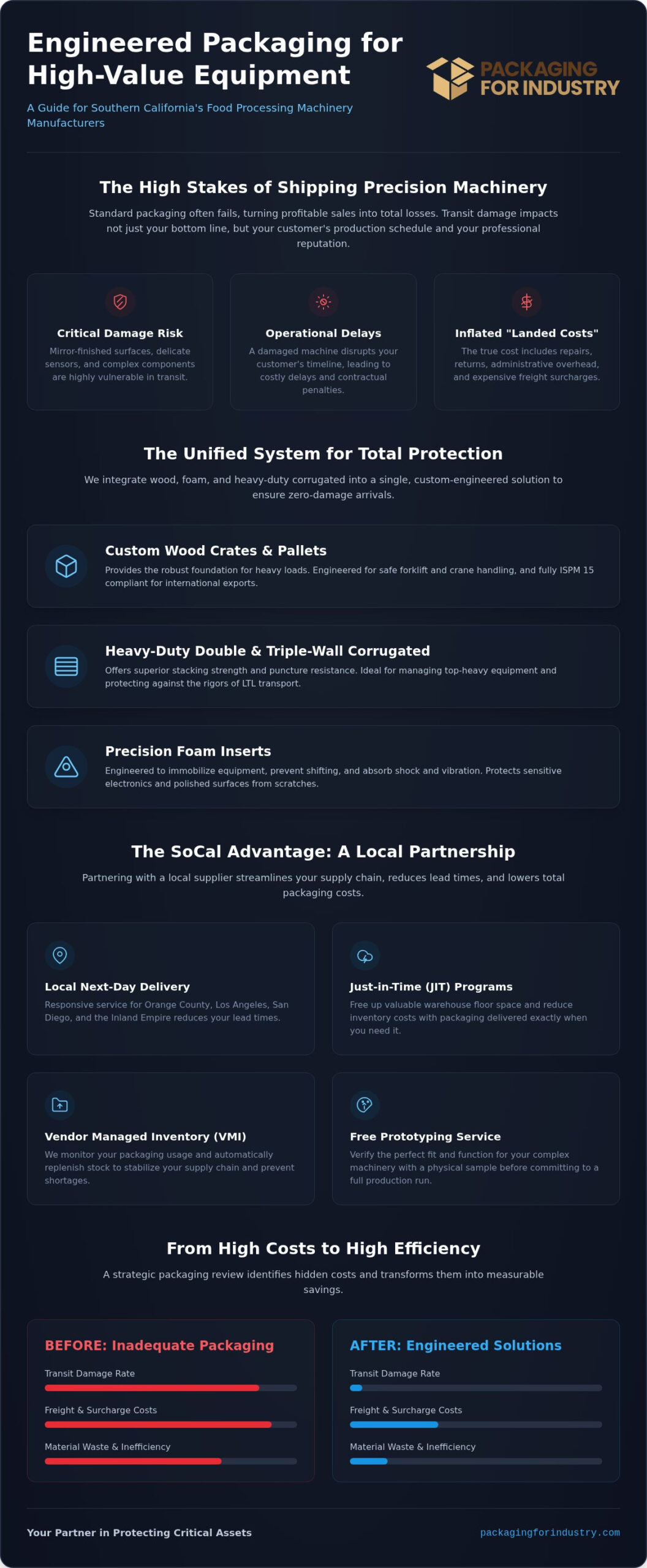
Food processing equipment is notoriously difficult to secure. These machines are often top-heavy, contain sensitive electronic sensors, and feature polished stainless steel surfaces that are easily scratched. To manage these high-weight loads, we utilize heavy-duty double and triple-wall corrugated solutions. These materials provide the stacking strength needed for warehouse environments and the puncture resistance required for flatbed or LTL transport. We also address irregular dimensions by creating custom inserts that prevent the machinery from shifting, which is the primary cause of internal component failure during long-haul shipping.
The Cost of Inadequate Protection
The true cost of transit damage is rarely limited to the price of a repair. It includes the “landed cost” of the equipment, encompassing the original manufacturing labor, freight fees, and the administrative overhead of processing a return. Inadequate protection also leads to significant financial leaks through freight surcharges. Carriers like UPS and FedEx apply heavy penalties for inefficiently sized packages or poorly secured pallets. By conducting a thorough review of your current methods, we help you optimize dimensions and material usage. This process allows manufacturers to reduce shipping damage while simultaneously achieving measurable packaging cost savings through better freight efficiency and reduced material waste.
Engineering Custom Protection: Crates, Foam, and Corrugated
Effective protection for industrial machinery requires a multi-material engineering approach. As a leading packaging supplier for food processing equipment manufacturers SoCal, we don’t rely on a single material to safeguard high-value assets. Instead, we integrate wood, foam, and corrugated into a unified system. This holistic strategy ensures that every component, from the heavy structural frame to the most delicate digital sensor, receives the specific level of protection it requires for safe transit.
Our process begins with custom design packaging services that include free prototyping. We build a physical sample to verify the fit and function before you commit to a full production run. This step is vital for equipment with irregular footprints or sensitive control panels. While the outer crate provides structural defense, we also consider the internal environment. For example, any components that might have incidental contact with food zones must align with FDA regulations for food contact materials to prevent contamination during the unboxing and installation process.
Custom Wood Crates and Pallets for Heavy Loads
Heavy machinery requires robust foundations. Our custom wood crates and pallets are built to handle high-weight loads while facilitating safe movement by forklifts and cranes. For manufacturers exporting equipment, we ensure full compliance with ISPM 15 standards. As of 2026, APHIS has resumed full enforcement of these wood packaging standards, including mandatory marking requirements. We use heat-treated wood to prevent customs delays or shipment rejections at international borders. For sensitive electronics housed within larger machines, we often specify foam-lined crates to dampen vibrations that can loosen connections during transit.
Precision Protective Foam Packaging
We utilize die-cut foam inserts to secure valves, sensors, and smaller kitted parts. Choosing the right material density is critical; polyethylene foam offers the durability needed for heavy equipment, while polyurethane provides softer cushioning for lighter components. If your machinery includes integrated control panels, we provide anti-static or ESD foam to prevent electrostatic discharge damage. You can request a packaging quote to see how these engineered foam solutions fit your specific production workflow.
Heavy-Duty Corrugated Solutions
In many cases, heavy-duty double-wall or triple-wall corrugated boxes provide a cost-effective alternative to full wood crating for machine sub-assemblies. We manufacture custom RSC boxes tailored to your machine’s exact footprint, which eliminates wasted space and reduces freight surcharges. By using internal partitions and dividers, we can kit machine parts together safely. This ensures that every bolt, bracket, and spare part arrives organized and protected, reducing the time your team spends on inventory and assembly at the destination.
The SoCal Advantage: Local Logistics and Inventory Management
Local proximity is a strategic asset for manufacturers of large-scale food equipment. Transporting oversized crates or heavy-duty corrugated supplies across state lines adds unnecessary freight costs and lead time delays. By partnering with a local packaging supplier for food processing equipment manufacturers SoCal, you gain the agility needed to respond to sudden production shifts. Our facility in Anaheim supports local next-day delivery throughout the region, ensuring that your shipping floor never grinds to a halt due to a lack of supplies.
Managing a warehouse footprint in Southern California is expensive. Every square foot dedicated to storing empty crates or stacks of triple-wall boxes is a square foot not being used for high-value machinery assembly. We allow you to reclaim that space by managing your inventory at our site. While our focus is local, we also maintain nationwide shipping capabilities to support multi-location manufacturers who require consistent packaging standards across their entire operation.
Vendor Managed Inventory (VMI) for Production Lines
Maintaining a consistent supply of custom-sized boxes is complex. Our Vendor Managed Inventory program eliminates the risk of stockouts by putting the responsibility of inventory tracking on our team. We conduct scheduled inventory reviews on a weekly, biweekly, or monthly basis to match your specific production volume. This model improves your cash flow because you only pay for the packaging as it’s delivered, reducing the capital tied up in on-site inventory. Proper handling during storage also ensures that materials remain compliant with FDA regulations for food contact substances, which is critical for equipment destined for sanitary environments.
Just-In-Time (JIT) Delivery in Southern California
Reliability is the primary differentiator between a local partner and a national catalog supplier. While large distributors often struggle with custom lead times, our JIT logistics model is built specifically for the SoCal industrial landscape. We provide rapid response times to key hubs, including Anaheim, Irvine, and Santa Fe Springs. This proactive approach eliminates the need for emergency rush orders and the high fees associated with them. You get the stability of a seasoned industrial consultant and the speed of a local delivery fleet, creating a seamless flow from our warehouse to your shipping dock.
Specifying Your Equipment Packaging Requirements
Procurement and operations managers shouldn’t treat machinery protection as a commodity purchase. For high-value food processing gear, the specification process must be a technical audit. A reliable packaging supplier for food processing equipment manufacturers SoCal will guide your team through identifying critical vulnerabilities before a single crate is built. This involves more than just measuring the outer dimensions. You must account for the weight distribution, the center of gravity, and the specific fragility of internal electronic sensors or glass components. If your equipment can’t withstand forces exceeding a certain G-rating, the packaging must be engineered to absorb the excess energy during transit. This is especially true for government-contracted machinery that requires rigorous mil-spec packaging compliance to ensure safety during demanding transport cycles.
Accurate data is the foundation of effective protection. When providing dimensions for custom foam or crates, include the location of any protruding valves, control panels, or delicate stainless steel surfaces. Clear documentation and precise engineering drawings ensure that every pallet and crate is built to the exact tolerances required for both safety and legal compliance. By defining these parameters early, you prevent the costly “trial and error” approach that often leads to transit damage or expensive freight rejections.
Defining Material Specifications
Choosing the right materials for pallet stabilization is a balance of efficiency and security. You’ll need to decide between hand and machine stretch film based on your production volume and the weight of the load. Machine film provides more consistent tension, which is vital for maintaining the integrity of heavy equipment on the move. We also recommend integrating heavy-duty corner boards to prevent high-tension strapping from biting into polished stainless steel surfaces or crushing the edges of RSC boxes. For tracking and identification, selecting the correct thermal transfer ribbon is essential to ensure that labels remain legible through varying temperatures and humidity levels in the shipping environment.
Prototyping and Testing
Complex machinery requires a physical fit test. We use CAD/CAM support to engineer custom solutions, but physical prototypes remain essential for verifying the fit of irregular machinery. This step allows us to identify potential abrasion points or structural weaknesses before the full production rollout. Our approach to packaging kitting ensures that multiple components are secured within a single unit, reducing the risk of lost parts and simplifying assembly at the destination. Ongoing packaging reviews are also a key part of our service. By analyzing past shipments, we can solve recurring damage issues and refine our designs to further lower your total cost of ownership. This proactive approach ensures that your packaging evolves alongside your machinery designs, maintaining maximum protection as your product lines grow.
Why PFI is the Preferred Packaging Partner for SoCal Manufacturers
Choosing a packaging supplier for food processing equipment manufacturers SoCal requires a partner that understands the intersection of engineering and economics. PFI differentiates itself by acting as a seasoned industrial consultant rather than a simple distributor. We provide the technical expertise needed to safeguard complex machinery while maintaining the fiscal responsibility required by your purchasing department. With custom sizes available for even the most irregular machine footprints, we ensure every piece of equipment is secured without the risk of over-packaging or wasted material.
National catalog vendors often serve as a default choice for many warehouses, but they typically lack the custom-tailored response needed for high-value machinery. When you compare packaging pricing between PFI and high-volume catalog vendors, the value of our specialized engineering becomes clear through reduced damage claims and lower freight costs. We don’t just sell components; we integrate packaging kitting and custom protection into your existing production flow to streamline your entire shipping operation.
Our direct access to industrial packaging experts who understand the factory floor sets us apart. We don’t just ship products; we solve complex logistical challenges. By working closely with your operations team, we identify bottlenecks in your packing process and provide solutions that improve both speed and reliability. This steady, dependable partnership is designed to eliminate professional stress by ensuring your high-value assets are always protected by the most efficient materials available.
The PFI Difference: Engineering + Economics
Our primary objective is to help you lower packaging costs without compromising the safety of your equipment. We achieve this through material optimization and freight efficiency. By engineering a box or crate to the exact dimensions of your machine, we eliminate the unnecessary volume that leads to expensive freight surcharges. This pragmatic approach provides peace of mind for operations managers who are focused on the bottom line. Packaging For Industry is dedicated to keeping your production moving with a reliable, proactive, and technically superior supply chain.
Getting Started with a Packaging Review
The first step toward optimizing your shipping process is a comprehensive packaging review. During this initial assessment, our experts analyze your current methods, identify damage risks, and look for cost-saving opportunities. We evaluate everything from your pallet stabilization techniques to the density of your protective foam inserts. This data-driven process allows us to provide an accurate and competitive quote that reflects the real-world needs of your manufacturing environment. Once the assessment is complete, we provide a clear path forward that includes free prototyping to ensure a perfect fit for your most complex machinery.
Optimizing Your Food Equipment Supply Chain
Protecting high-value machinery requires an engineered approach that combines heavy-duty materials with precise design. You’ve seen how custom wood crates, precision foam, and triple-wall corrugated work together to eliminate transit damage. Choosing the right packaging supplier for food processing equipment manufacturers SoCal is a strategic investment in your brand’s reputation and your bottom line. By leveraging local expertise, you can reduce logistics overhead and focus on building world-class machinery.
PFI provides the specialized support your production floor needs to remain efficient. Our local Southern California next-day delivery and free prototyping for custom designs ensure your equipment is always ready for shipment. With specialized VMI programs, we manage your inventory so you can reclaim valuable warehouse space. It’s time to transition from a reactive shipping model to a proactive, engineered solution that provides total peace of mind and fiscal stability.
We’re ready to help you stabilize your supply chain and protect your most valuable assets. Let’s work together to ensure every machine reaches its destination in showroom condition.
Frequently Asked Questions
What are the benefits of custom corrugated boxes for food processing equipment?
Custom corrugated boxes provide superior protection by eliminating wasted space that leads to product shifting and damage. For high-value food processing equipment, we engineer heavy-duty double and triple-wall boxes tailored to specific machinery footprints. This precision reduces freight surcharges from carriers like UPS and FedEx while ensuring structural integrity during stacking. These solutions from a professional packaging supplier for food processing equipment manufacturers SoCal allow you to optimize shipping costs and product safety simultaneously.
How can a VMI program reduce my packaging lead times?
A Vendor Managed Inventory (VMI) program eliminates lead time surprises by placing the responsibility of stock tracking on our team. We perform scheduled inventory reviews at your facility on a weekly, biweekly, or monthly basis. By monitoring actual usage, we ensure that custom boxes, foam, and crates are replenished before they run out. This proactive approach prevents production halts caused by packaging shortages and removes the stress of managing long lead-time custom items.
Do you provide local next-day delivery in Orange County and Los Angeles?
Yes, we provide local next-day delivery throughout Orange County, Los Angeles, and the Inland Empire from our headquarters in Anaheim. Our local fleet is dedicated to serving industrial hubs in Irvine, Santa Fe Springs, and Huntington Beach. This proximity allows us to support just-in-time production schedules and respond rapidly to urgent needs. Local delivery reduces your freight expenses and ensures that your operations stay on schedule without the delays associated with national carriers.
Can you engineer custom foam inserts for fragile machinery components?
Our engineering team specializes in designing custom foam inserts to protect delicate sensors, valves, and control panels. We utilize CAD/CAM support to create precision prototypes from various materials, including polyethylene, polyurethane, and anti-static ESD foam. These inserts are specifically engineered to absorb G-force impacts and prevent abrasion on polished stainless steel surfaces. This level of protection is essential for ensuring that complex food processing machinery arrives at its destination in perfect working order.
What is the difference between double-wall and triple-wall corrugated boxes?
The primary difference lies in the number of fluted layers and their corresponding stacking strength. Double-wall boxes consist of two layers of fluting and three liners, providing excellent protection for heavy industrial parts. Triple-wall boxes add a third fluted layer, offering extreme structural integrity and puncture resistance comparable to wood crates. We recommend triple-wall corrugated for the heaviest machinery components to ensure safe transit while maintaining a significantly lower weight than traditional timber packaging.
Do you offer free prototyping for custom packaging designs?
Yes, we provide free prototyping for custom packaging designs to ensure a perfect fit before you commit to a full production run. Our team develops physical samples of crates, foam assemblies, and corrugated boxes for your team to test with actual machinery. This verification process identifies potential issues such as abrasion points or center-of-gravity shifts. Prototyping is a critical step in our mission to be a reliable packaging supplier for food processing equipment manufacturers SoCal.
How do I request a quote for bulk industrial packaging supplies?
You can request a packaging quote directly through our website by providing your equipment dimensions and shipping requirements. Our specialists will conduct an initial assessment to identify the most cost-effective materials for your bulk needs. We focus on recurring orders and high-volume industrial supplies, including stretch film, pallets, and custom corrugated. Once we understand your usage history and production schedule, we provide competitive pricing that serves as a cost-saving alternative to large catalog suppliers.
Do your wood crates meet international export standards (ISPM-15)?
All of our custom wood crates and pallets intended for international shipping meet the ISPM 15 standards for heat-treated wood packaging. We ensure that every crate is properly debarked and marked with the official IPPC stamp to prevent customs delays or shipment rejections. As of 2026, the USDA’s APHIS is strictly enforcing these regulations, making compliance more critical than ever. Our export crates provide the durability and certification needed for global machinery distribution without regulatory risk.