
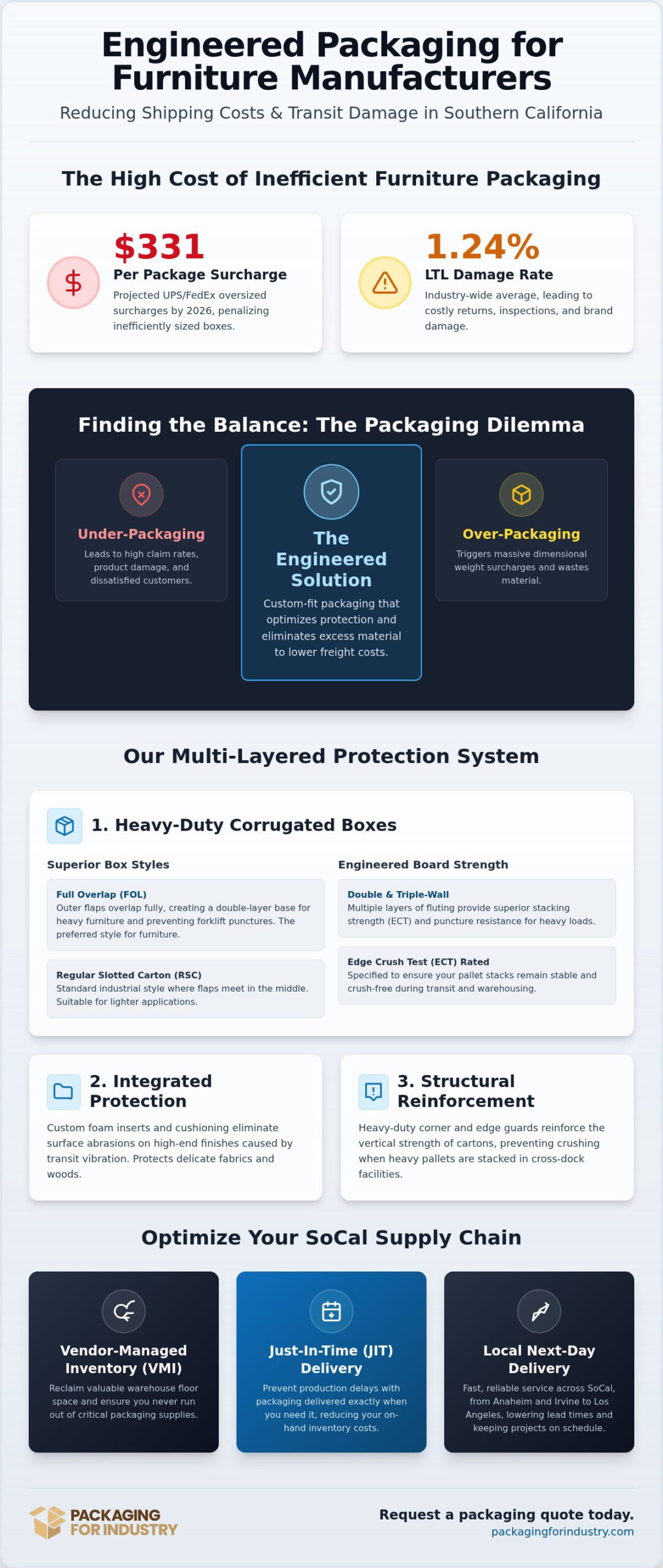
With UPS and FedEx oversized surcharges reaching as high as $331 per package in 2026, your current box design might be your largest unaddressed expense. Shipping high-end furniture through LTL or parcel networks in Southern California has never been more complex or costly. You’re likely dealing with the frustration of 1.24% industry-wide LTL damage rates while watching your margins disappear into “Additional Handling” fees and rising containerboard prices. Finding reliable custom packaging for furniture manufacturers SoCal is no longer just about buying boxes; it’s about securing your bottom line through better engineering.
This guide demonstrates how to reduce transit damage and optimize your furniture shipping costs with engineered solutions tailored for the local market. We’ll examine how to leverage local next-day delivery, free prototyping, and advanced materials like heavy-duty double-wall corrugated and corner boards to slash your landed costs. By the end, you’ll understand how to streamline your procurement and implement custom-fit protection that actually reduces your overall shipping dimensions.
Key Takeaways
- Learn why multi-layered protection systems are essential for navigating the high-risk LTL freight corridors in Southern California.
- Discover how custom packaging for furniture manufacturers SoCal utilizes heavy-duty corrugated styles like FOL to provide superior base support for heavy loads.
- Understand the engineering behind integrated foam cushioning and corner guards to eliminate surface abrasions on high-end finishes.
- Explore how Vendor Managed Inventory (VMI) and just-in-time delivery can reclaim valuable floor space in your warehouse while preventing production delays.
- See how local next-day delivery from Anaheim to hubs like Irvine and Los Angeles helps manufacturers lower packaging costs and reduce lead times.
The High Cost of Furniture Damage in Southern California Logistics
Industrial packaging for the furniture sector isn’t just a container; it’s a multi-layered system designed to mitigate specific transit forces. For manufacturers operating out of Anaheim or the Inland Empire, shipping through the Southern California freight corridor presents unique challenges. High-volume LTL (Less-Than-Truckload) environments involve multiple sorting hubs and frequent forklift touches. This increased handling makes structural integrity a business-critical requirement rather than a luxury. Professionals seeking custom packaging for furniture manufacturers SoCal often realize that stock boxes from major catalog suppliers aren’t built for these specific rigors.
The financial impact of shipping failure extends far beyond the cost of a broken chair. With LTL damage rates averaging 1.24% industry-wide, manufacturers face a compounding cycle of expenses. You’re looking at the cost of return logistics, the labor required for inspection, and the long-term damage to your brand reputation among retailers. By applying professional corrugated box design principles, you can move away from reactive “damage control” and toward a proactive, engineered protection strategy that secures your margins.
Common Furniture Transit Risks
Furniture faces three primary threats during the journey from the factory floor to the customer. First, constant vibration on the I-5 and I-10 corridors causes surface scuffing on finished woods and delicate fabrics. Second, edge and corner crushing occurs when heavy pallets are stacked improperly in cross-dock facilities. We recommend using heavy-duty corner and edge protection to reinforce the vertical strength of your cartons. Finally, environmental factors in warehouse storage can weaken corrugated fibers. If your board grade doesn’t account for humidity shifts, the stack height capacity of your boxes will fail over time.
The “Over-Packaging” vs. “Under-Packaging” Dilemma
Most manufacturers struggle to find the balance between protection and price. Under-packaging leads to high claim rates, but over-packaging triggers massive dimensional weight surcharges. With 2026 UPS and FedEx rates increasing effectively by 7% to 12% for bulky items, every inch of excess air in a box costs money. Custom packaging reduces freight costs by optimizing box dimensions to fit the product precisely while maintaining required protection levels. This approach allows you to lower packaging costs by eliminating the “dead space” that carriers now penalize with heavy surcharges. Switching from oversized stock boxes to a custom-engineered fit is often the fastest way to reclaim lost profit on high-volume production lines.
Selecting Heavy-Duty Corrugated Box Styles for Furniture
Choosing the right custom packaging for furniture manufacturers SoCal requires a precise understanding of how board grade interacts with product weight and transit duration. While standard boxes might suffice for lightweight consumer goods, furniture requires high-performance custom corrugated boxes engineered for structural integrity. The foundation of this protection starts with selecting the appropriate box style, typically a choice between Regular Slotted Cartons (RSC) and Full Overlap (FOL) designs. While the RSC is the most common industrial style, furniture manufacturers often prefer the FOL because its outer flaps extend the full width of the box. This creates a double layer of corrugated board on both the top and bottom, providing essential reinforcement for heavy furniture bases and protecting against forklift punctures.
For heavier items like oak dining tables or upholstered sofas, double-wall and triple-wall corrugated boards are the industry standard. Double-wall board uses two layers of fluting to provide superior stacking strength and puncture resistance. If you are shipping industrial-grade modular components or oversized wardrobes, triple-wall corrugated offers a level of durability comparable to wood crates but at a much lower weight and cost. These heavy-duty materials ensure your products withstand the high-energy environment of Southern California logistics hubs.
Board Strength and Weight Capacities
Specifying the correct Edge Crush Test (ECT) rating is vital for safe pallet stacking. A higher ECT rating indicates better top-to-bottom compression strength, which prevents the bottom boxes in a stack from collapsing under the weight of those above. This is especially critical when you consider the high cost of furniture damage that can occur during emergency braking or shifting loads in a trailer. For international export, we often recommend weather-resistant corrugated liners. These specialized materials maintain their structural bonds even in high-humidity shipping containers, ensuring your high-value wood finishes remain protected from moisture-induced box failure.
Custom Box Features for Manufacturers
Beyond the board grade, custom functional features can significantly improve warehouse efficiency and the customer experience. Integrated hand-holes and access panels allow for safer manual handling of bulky items in tight warehouse spaces. For exceptionally long or tall pieces like wardrobes, multi-piece telescoping boxes provide an adjustable fit that simplifies the packing process. You can also utilize printed corrugated to display clear handling instructions or branding, which reduces the likelihood of improper stacking by third-party carriers. If you are ready to optimize your current box specifications, you can request a packaging quote to speak with a design specialist about your specific furniture line.
Integrated Protection: Custom Foam and Corner Guards
While heavy-duty corrugated board provides the necessary outer shell, it rarely offers sufficient protection for high-end furniture finishes on its own. For manufacturers in the Inland Empire or Orange County, the interior engineering of a carton is what determines if a piece arrives in showroom condition. Effective custom packaging for furniture manufacturers SoCal relies on an integrated system where interior components manage the physics of transit. By combining board, foam, and edge reinforcements, you create a comprehensive barrier against the vibrations and impacts common in the Southern California freight corridor.
The science of protective foam packaging focuses on shock absorption and surface preservation. Unlike generic bubble wraps, engineered foam inserts are designed to decelerate a product during a drop or sudden shift in a trailer. PFI engineers these materials into integrated kits, ensuring that every component—from the base pallet to the top cap—works in unison. This holistic approach eliminates the “hidden costs” of damage claims that occur when interior protection is treated as an afterthought.
Foam Material Selection for Furniture
Selecting the right foam density is a balance between protection and cost-efficiency. We typically utilize three primary types of foam for industrial furniture applications:
- Polyethylene (PE) Foam: A closed-cell material ideal for heavy bracing and blocking. It maintains its shape under significant weight, making it the standard for supporting heavy table legs or bed frames.
- Polyurethane (PU) Foam: A softer, open-cell foam used for delicate surface protection. Its high flexibility allows it to wrap around contoured edges, preventing micro-scratches on high-gloss finishes or fine veneers.
- Anti-Static Foam: Essential for modern office furniture or smart home pieces that feature integrated electronics and charging ports.
Reinforcing the Load with Corner Boards
The most vulnerable points of any furniture shipment are the corners and edges. Utilizing heavy-duty corner and edge protection is critical for stabilizing palletized loads. These cardboard reinforcements prevent heavy-duty nylon straps from cutting into the corrugated boxes during the tensioning process. Beyond surface protection, corner boards significantly improve the stacking strength of your pallets, which is vital for high-density warehouse storage in expensive SoCal real estate. Furthermore, corner boards allow for tighter stretch film application without crushing the product, ensuring the entire pallet remains a single, cohesive unit throughout the LTL network. This level of stabilization is often the difference between a successful delivery and a costly return.
Optimizing Procurement: VMI and Just-In-Time Delivery
Southern California real estate is some of the most expensive industrial space in the country. For a furniture manufacturer, dedicating thousands of square feet to empty, bulky corrugated boxes is a logistical drain. This storage burden often forces a choice between high inventory costs or the risk of production-stopping stockouts. Professional custom packaging for furniture manufacturers SoCal requires a procurement strategy that prioritizes floor space efficiency. By implementing Vendor Managed Inventory (VMI), you shift the storage and tracking responsibility to your supplier, ensuring you only have the packaging you need for current production cycles.
This approach integrates seamlessly with Just-In-Time (JIT) delivery models. Instead of managing complex reorder points for dozens of custom box sizes and foam inserts, your procurement team can focus on higher-value operations. Scheduled inventory reviews eliminate the administrative friction of manual ordering, protecting your facility from the hidden costs of emergency rush fees. It transforms your packaging from a storage headache into a streamlined utility.
The PFI VMI Process for Manufacturers
Our VMI program follows a structured three-step methodology designed for high-volume furniture production. First, we conduct a comprehensive usage assessment and lead-time analysis to understand your peak cycles. Second, we design a stocking program specifically for your custom items at our Anaheim headquarters. Finally, PFI specialists perform weekly or monthly inventory reviews on your floor. We count the stock, identify upcoming needs, and trigger replenishments automatically. This proactive oversight ensures that your line never waits for a box.
Financial and Operational Benefits
The primary advantage of a VMI program is the immediate improvement in cash flow. You reduce the capital tied up in slow-moving packaging inventory and pay for supplies closer to the time of use. Operationally, this eliminates the production downtime caused by late-arriving supplies or catalog supplier inconsistencies. For those managing custom packaging for furniture manufacturers SoCal, the ability to scale production without increasing warehouse footprint is a major competitive edge. By reclaiming floor space previously used for box storage, you can expand your manufacturing capacity or streamline your assembly kitting areas.
Why SoCal Manufacturers Choose Packaging For Industry
Southern California’s manufacturing landscape requires a supplier that balances logistical speed with engineering precision. Packaging For Industry (PFI) is headquartered in Anaheim, which facilitates local next-day delivery to major industrial hubs in Irvine and Los Angeles. For those sourcing custom packaging for furniture manufacturers SoCal, this proximity is a critical factor in reducing freight expenses and lead times. Unlike national catalog suppliers that ship from distant regional hubs, our local fleet ensures your production line remains responsive to shifting market demands.
We go beyond simple material supply by offering specialized packaging kitting and assembly services. Our team can deliver pre-assembled kits that include the heavy-duty corrugated box, custom foam inserts, and corner boards ready for immediate use. This capability saves significant labor on your warehouse floor, allowing your staff to focus on furniture assembly rather than repetitive packaging preparation. It is a pragmatic solution for high-volume makers looking to optimize their total operational flow and lower packaging costs.
Reliability in furniture shipping depends on a perfect fit. We provide free prototyping and CAD design to ensure every piece of your furniture line is secured within its protective system. This engineering-first approach eliminates the guesswork common with one-size-fits-all catalog options. By testing the fit before a full production rollout, you ensure that the integrated materials perform exactly as intended, protecting your high-value wood finishes from the vibrations of the SoCal freight corridors.
Local Support Across Southern California
Our service network extends across the Inland Empire, Orange County, and San Diego. Being a local partner means we can implement quick design changes when you launch new product lines or modular components. You receive personalized service from an industrial packaging specialist who understands the specific logistics of the Southern California region. This stability is essential for maintaining long-term supply reliability and ensuring your custom packaging for furniture manufacturers SoCal remains cost-effective as your business scales.
Request Your Custom Furniture Packaging Quote
To compare packaging pricing effectively, provide our team with your product dimensions, weight, and current transit damage rates. We use this data to identify where engineering improvements can reduce your overall landed costs and eliminate oversized surcharges. Custom prototypes are developed within a predictable timeframe to facilitate rapid testing and approval. Request a Quote today to lower your furniture packaging costs and secure your Southern California supply chain with an experienced industrial partner.
Secure Your Furniture Supply Chain for 2026
Southern California manufacturers face a shifting logistics environment where carrier surcharges and material costs require constant vigilance. Moving beyond standard catalog boxes to a system of engineered protection is no longer optional for maintaining profitability. You’ve seen how integrating heavy-duty corrugated board with custom foam and corner guards creates a shield against the rigors of LTL transit. By leveraging Vendor Managed Inventory, you can reclaim valuable floor space and eliminate the stress of production stockouts.
Packaging For Industry provides the local expertise needed to navigate these challenges. From our Anaheim headquarters, we offer local next-day delivery and free custom packaging prototyping to ensure your products fit perfectly before you commit to a full rollout. Our specialization in industrial manufacturing solutions allows us to act as a proactive partner in your operational success. Transitioning to custom packaging for furniture manufacturers SoCal is the most direct path to lowering your landed costs and securing your brand reputation.
We’re ready to help you optimize your logistics and protect your margins with solutions built for the local market.
Frequently Asked Questions
What are the best box styles for shipping heavy wooden furniture?
Full Overlap (FOL) cartons and multi-piece telescoping boxes are the most reliable styles for heavy wooden items. The FOL style features flaps that completely cover the top and bottom, providing extra structural reinforcement. Telescoping boxes are ideal for varying heights, such as different table models. We recommend double-wall or triple-wall corrugated board to prevent punctures from heavy furniture legs. These designs ensure maximum stacking strength in the warehouse.
How can I reduce the cost of custom foam inserts for my furniture line?
How can I reduce the cost of custom foam inserts for my furniture line?
Yes, PFI provides local next-day delivery from our Anaheim headquarters to all of Orange County. This includes cities like Irvine, Brea, and Costa Mesa. Local delivery reduces lead times and freight costs compared to national suppliers. It ensures your custom packaging for furniture manufacturers SoCal arrives exactly when your production line needs it. This proximity allows for more agile supply chain management and faster design iterations.
Can custom packaging help me avoid UPS and FedEx oversized surcharges?
Yes, custom-fit packaging eliminates the dead space that triggers dimensional weight surcharges. Carriers penalize oversized boxes that contain mostly air. By engineering the box to the exact dimensions of the furniture, you reduce the length and girth measurements. This optimization is the most effective way to lower packaging costs related to parcel shipping fees. It often results in smaller footprints that fit more units per pallet during LTL transit.
What is the minimum order quantity for custom printed furniture boxes?
MOQs vary based on the specific dimensions and board grade of the project. We focus on industrial bulk quantities for manufacturers and distributors. Custom sizes available for high-volume runs typically offer the best price-per-unit. Request a packaging quote to get specific minimums for your furniture line’s printed corrugated needs. Our goal is to provide scalable solutions that match your production output without creating excess inventory or storage headaches.
How does a Vendor Managed Inventory (VMI) program work for packaging?
PFI specialists conduct regular on-site inventory reviews at your facility to monitor stock levels. We track usage patterns and automatically trigger replenishments from our Anaheim warehouse. This system prevents production shortages and eliminates the administrative burden of manual procurement. It allows you to maximize floor space for manufacturing rather than storing empty boxes. You only pay for what you need, which significantly improves your monthly cash flow and operational efficiency.
Do you provide heat-treated pallets for international furniture export?
Yes, we supply ISPM-15 compliant heat-treated pallets and crates for international shipping. These are necessary to meet customs requirements for wood packaging materials. Using certified pallets ensures your furniture exports aren’t delayed at the border. We can integrate these pallets with custom corrugated and foam for a complete export-ready solution. This provides a single point of accountability for your entire international shipping system, from the factory floor to the final destination.
How do I get a prototype for a new furniture piece?
You can start by providing your product dimensions and weight to our design team. We offer free custom packaging prototyping to ensure a perfect fit before mass production. Our CAD designers create a sample that you can test for both protection and assembly speed. This process ensures that your final custom packaging for furniture manufacturers SoCal meets all industrial shipping standards. We refine the design based on your feedback before rollout.