
In the industrial supply chain, a plain brown box is often a missed opportunity for both operational efficiency and professional credibility. While many view custom printing as a luxury reserved for consumer brands, the most effective corrugated box branding ideas for businesses are actually functional tools that reduce costly handling errors. For manufacturers in Los Angeles and Orange County, clear branding acts as a visual shorthand that speeds up inventory identification and ensures your high-value components are handled with the necessary care.
You’ve likely experienced the frustration of shipping damage caused by poor handling or the logistical bottleneck of unidentified parts sitting on a warehouse pallet. It’s a common challenge that impacts your reputation and your profit margins. This guide explores how to leverage custom branding to improve your B2B professional image while simultaneously streamlining your warehouse logistics. We’ll cover cost-effective labeling strategies, material choices that meet California’s latest compliance standards, and ways to reduce shipping errors through smarter packaging design.
Key Takeaways
- Learn how industrial branding improves first impressions with Tier 1 aerospace and medical clients by projecting professional authority and reliability.
- Explore functional corrugated box branding ideas for businesses that prioritize inventory identification and handling instructions to reduce warehouse errors.
- Understand the economic differences between flexographic and digital printing to select the most cost-effective method for your specific production volume.
- Discover industry-specific marking requirements for high-value aerospace and medical components to ensure both protection and regulatory compliance.
- Learn how local Southern California sourcing and Vendor Managed Inventory (VMI) can eliminate lead time delays and prevent packaging stockouts.
The Strategic Role of Branding in Industrial Corrugated Packaging
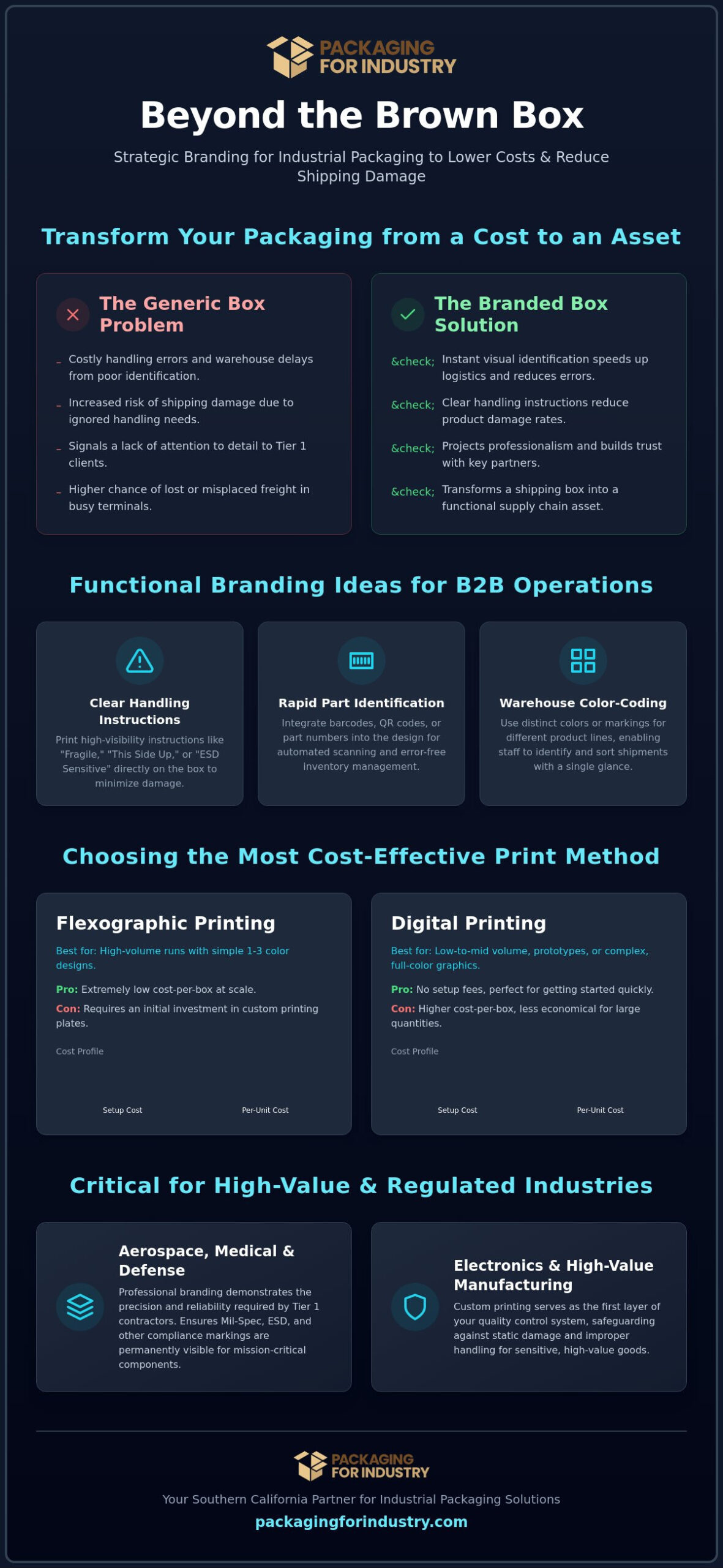
Industrial branding is far more than an aesthetic choice; it’s a strategic layer of information applied directly to your shipping containers. For manufacturers across Southern California, industrial branding is the purposeful integration of logos, handling instructions, and part identification to optimize the movement of goods through the supply chain. This approach transforms a standard shipping vessel into a logistical asset that protects your bottom line.
In the B2B sector, first impressions are measured by reliability and precision. When delivering components to Tier 1 aerospace or medical facilities, your packaging serves as the first physical touchpoint of your quality control system. A generic, unmarked box can inadvertently signal a lack of attention to detail. In contrast, implementing corrugated box branding ideas for businesses demonstrates a level of professional maturity that builds immediate trust with procurement officers and operations managers. Beyond optics, branding serves as a critical safety feature. Utilizing high-visibility print for “Fragile,” “ESD Sensitive,” or “This Side Up” instructions ensures that handlers prioritize your cargo appropriately, effectively reducing product damage rates during transit.
The economics of branding are rooted in efficiency and throughput. A well-branded box reduces the likelihood of lost shipments by making your freight instantly recognizable in a crowded terminal. By adhering to fundamental Corrugated box design principles, you can ensure that your branding doesn’t compromise the structural integrity of the container while still achieving maximum visual impact.
Professionalism in the B2B Supply Chain
Transitioning from generic brown boxes to a recognizable corporate identity is a vital step in building brand equity with distributors and end-users. In the manufacturing sector, industrial branding is a blend of marketing visibility and logistical utility that streamlines the receiving process. By utilizing custom design packaging, your business projects the image of a stable, long-term partner capable of meeting the rigorous standards of the Los Angeles industrial market.
Logistics Optimization Through Visual Identification
Branding is a powerful tool for warehouse management. Color-coding boxes for different product lines allows your team to speed up picking and packing operations with a single glance. Integrating QR codes or barcodes directly into the box design facilitates automated scanning, which is essential for high-volume distribution centers in the Inland Empire or Orange County. These visual cues significantly reduce “misplaced freight” issues, ensuring that the right parts reach the right destination without the need for manual inspection of every container.
Functional Corrugated Box Branding Ideas for Businesses
Effective branding in an industrial environment prioritizes utility over decoration. While retail packaging focuses on shelf appeal, functional corrugated box branding ideas for businesses focus on reducing errors and improving throughput. For a distribution center in Los Angeles, a well-branded box serves as a silent supervisor, guiding handlers on how to move, stack, and store your products without the need for constant oversight. By treating your packaging as a piece of industrial equipment, you can implement design choices that maximize impact while minimizing production costs.
Minimalist logo placement is one of the most efficient ways to professionalize your shipments without inflating your budget. By focusing on high-contrast colors like black or dark blue on standard kraft board, you ensure visibility even in dimly lit warehouse environments. It is also essential to professionalize required compliance markings. Instead of relying on generic stickers that can peel off, printing ISPM 15 heat-treat stamps, ESD sensitivity symbols, or specific Mil-Spec markings directly onto the corrugated surface ensures permanent compliance. This approach adheres to Corrugated industry standards for durability and legibility, providing peace of mind during transit.
Logo Placement Strategies for Maximum Visibility
The “Two-Panel” rule is a pragmatic standard for industrial shipping. By printing your brand assets on two adjacent panels, you ensure the box is identifiable regardless of how it is stacked on a pallet or rack. Avoid using small, intricate details that might get lost on the porous texture of corrugated material. Instead, use bold, sans-serif fonts and large-scale logos that remain legible from a distance. If you aren’t ready for full custom printing, utilizing custom-branded tape on stock boxes is a cost-effective way to secure your shipments while maintaining a professional corporate identity.
Beyond the Logo: Information-Rich Branding
Industrial packaging should provide technical value to the end-user. Printing re-order information, technical support contact details, or QR codes directly on the interior flaps ensures that procurement teams have the data they need exactly when they need it. This reduces friction in the supply chain and encourages repeat business. You can also use branding to distinguish between different grades of material, such as using a specific color-coded stripe to identify heavy-duty triple-wall containers versus standard RSCs. If you need help determining which layout works best for your operations, you can request a custom packaging quote to see a prototype of your design. This level of detail prevents costly picking errors and ensures that high-value components are always housed in the correct protective environment.
Technical Specifications: Balancing Print Quality with Box Durability
Executing effective corrugated box branding ideas for businesses requires a deep understanding of how ink applications interact with structural engineering. In an industrial setting, the primary function of a shipping container is protection. If a branding design requires heavy ink saturation, it can inadvertently introduce moisture into the corrugated medium, potentially softening the flutes and reducing the box’s stacking strength. Achieving a professional look without compromising the Edge Crush Test (ECT) rating is a technical challenge that requires precise calibration of printing equipment and material selection.
Material choice significantly dictates the visual outcome of your branding. Standard kraft (brown) board is the cost-effective choice for most industrial applications, though it requires bold, high-contrast inks to remain legible. White-faced corrugated board provides a cleaner canvas that makes colors pop, which is often preferred for high-value electronics or medical supplies. However, white board may show scuffs and warehouse dust more easily than kraft. For heavy-duty applications involving double-wall or triple-wall containers, the printing process must be carefully managed to avoid crushing the fluting during the impression stage, as any structural deformation directly leads to a higher risk of product damage during transit.
Flexographic vs. Digital Printing for Manufacturers
Flexographic printing remains the industry standard for high-volume industrial orders. While it requires an initial investment in custom printing plates, the per-unit cost drops significantly as volume increases, making it the most fiscally responsible choice for repeat production runs. Digital printing is the preferred alternative for short-run prototypes or specialized aerospace components with low SKU volumes. It eliminates setup fees for plates and allows for highly detailed graphics, though it typically carries a higher per-box price point. Choosing between these methods depends on your annual volume and the level of detail required for your logistical markings.
Board Grade and Finish Considerations
Printing on Custom Corrugated Boxes with specialized finishes can further enhance durability. In a rugged warehouse environment, a matte finish is generally superior to gloss. Matte surfaces hide finger oils and minor abrasions that occur during palletization and transit, keeping your brand looking professional until it reaches the end-user. If your operations require outdoor storage or exposure to high humidity, specialized coatings can be applied over the print to prevent ink bleed and maintain board stiffness. This technical oversight ensures that your branding remains a functional asset throughout the entire supply chain.
Industry-Specific Branding Requirements: Aerospace, Medical, and Defense
Industrial branding must adapt to the regulatory and operational rigors of specific sectors where “branding” is a functional requirement for safety and traceability. For these fields, corrugated box branding ideas for businesses prioritize high-contrast marking and compliance symbols over mere decoration. For manufacturers in Los Angeles and San Diego, providing components for high-value turbine or fuselage assemblies requires a marking system that integrates corporate identity with mandatory technical data. This ensures that every container remains a traceable logistical asset from the factory floor to the final assembly line.
In the medical device and electronics sectors, your packaging’s visual appearance is a direct reflection of the precision and sterility of the product inside. Medical device packaging should utilize clean, minimalist branding that projects reliability to hospital procurement teams. For electronics, branding serves a critical safety function by color-coding for ESD (Electrostatic Discharge) protection. Using standardized symbols on pink anti-static or black conductive materials alerts handlers to the sensitive nature of the cargo, effectively reducing the risk of mishandling during transit.
Aerospace and Defense Marking Standards
For defense contractors, branding is often governed by strict directives such as MIL-STD-2073-1, the standard practice for military packaging. You must incorporate your corporate logo alongside high-contrast part numbers, serial codes, and batch data to ensure rapid identification in military depots. This dual-purpose branding approach professionalizes your shipments while meeting the rigorous documentation standards of Aerospace Packaging Solutions. When dealing with large-scale crates or custom wood and corrugated hybrids, use oversized flexographic printing to ensure that handling instructions remain legible throughout the entire supply chain.
Medical and Electronics Professionalism
Ensuring your branding remains intact during international transit and customs inspections is vital for maintaining supply reliability. High-quality inks and specialized coatings prevent the degradation of barcodes and logos when exposed to the humidity and mechanical stress of long-haul shipping. If your current packaging doesn’t meet these specialized standards, you can request a custom packaging quote to develop a solution that balances industry compliance with professional corporate visibility. These targeted branding strategies reduce the risk of rejected shipments and improve your standing as a preferred Tier 1 supplier.
Optimizing Your Branding Strategy with a Southern California Partner
For manufacturers in Los Angeles and Orange County, the logistical advantage of a local packaging partner cannot be overstated. When implementing corrugated box branding ideas for businesses, proximity translates directly into reduced lead times and lower freight costs. A local supplier understands the specific pressures of the Southern California supply chain, from the high-velocity requirements of the Inland Empire distribution hubs to the precision standards of the San Diego aerospace corridor. By sourcing your custom branded containers from a regional facility, you eliminate the risks associated with long-distance shipping delays and ensure your production lines remain operational.
Efficiency in branding also extends to how you manage your physical stock. Packaging For Industry (PFI) offers Vendor Managed Inventory (VMI) to help you maintain a lean operation without the risk of stockouts. Instead of dedicating valuable warehouse floor space to bulk quantities of branded boxes, we store your inventory in our Anaheim facility and deliver it on a just-in-time basis. This service acts as a buffer against market volatility and ensures that your branded packaging is always available when your finished goods are ready for transit. Combining these logistical strengths with a comprehensive Packaging Cost Savings Analysis allows you to identify exactly where custom branding can reduce total operational expenses.
The PFI Advantage: From Design to Next-Day Delivery
Working with local engineers allows for a more collaborative design process. Our team utilizes CAD/CAM prototyping to create physical samples of your branded boxes before you commit to a full production run. This phase is critical for ensuring that your corrugated box branding ideas for businesses align perfectly with the structural needs of the product. By integrating custom branding with other protective elements, such as custom foam inserts or corner protection, you create a unified packaging system that professionalizes your brand while maximizing product safety. This holistic approach ensures that your B2B image remains consistent across all touchpoints in the supply chain.
Next Steps: Requesting Your Custom Branding Quote
Transitioning to custom branded packaging is a straightforward process when you have the right technical specifications prepared. To get started, you’ll need to provide your high-resolution artwork and specific board grade requirements, such as double-wall or triple-wall needs. Our team will then guide you through the selection of printing methods and finishes that best suit your volume and industry standards. Once the design is finalized, you can rely on our local fleet for reliable delivery across Southern California. If you’re ready to professionalize your industrial shipments and streamline your warehouse logistics, you can request a custom packaging quote today to receive a prototype and pricing for your specific application.
Modernize Your Supply Chain with Custom Industrial Branding
Industrial branding is a functional asset that optimizes your supply chain and reinforces your professional image with high-value clients. By selecting the right printing methods and material grades, you protect your product’s structural integrity while ensuring mandatory markings remain legible throughout transit. Implementing strategic corrugated box branding ideas for businesses allows your operations to move faster and with fewer errors. It’s a pragmatic investment that pays dividends in both logistical throughput and B2B credibility.
Partnering with a local Southern California supplier ensures your packaging strategy is supported by specialized engineering for the aerospace and medical sectors. We provide free prototyping and CAD/CAM support to verify fit and finish before bulk production begins. Our local next-day delivery and Vendor Managed Inventory (VMI) programs allow you to maintain a lean warehouse without the risk of stockouts. We are ready to help you reduce shipping damage while simultaneously lowering your total packaging costs through smarter design.
Request a Custom Branded Box Quote for Your Business and let’s optimize your logistics today. We look forward to building a reliable partnership that supports your long-term operational goals.
Frequently Asked Questions
How much does it cost to add a logo to my shipping boxes?
The total cost depends on your order volume, the number of colors in your design, and the chosen printing method. Flexographic printing requires an initial investment in printing plates but offers lower per-unit costs for high-volume runs. Digital printing is often more economical for short runs since it eliminates setup fees, though the per-box price is typically higher.
What is the minimum order quantity (MOQ) for custom branded corrugated boxes?
Minimum order quantities vary based on the production method and box dimensions. Digital printing allows for smaller runs, which is ideal for specialized aerospace or medical prototypes. High-volume flexographic orders typically require larger quantities to offset the initial setup and plate costs, making them better suited for standardized manufacturing needs.
Will printing on the box affect its strength or durability during shipping?
Heavy ink saturation can potentially impact the compression strength of a corrugated container by introducing moisture into the fluting. We manage this by using high-quality inks and precise application techniques that maintain the board’s Edge Crush Test (ECT) rating. This technical oversight ensures your branding doesn’t compromise the structural integrity of the box during transit.
Can I get custom branded boxes with next-day delivery in Southern California?
We provide local next-day delivery for established inventory across Los Angeles and Orange County. While the initial custom design and plate creation take time, our Vendor Managed Inventory (VMI) program allows us to store your branded boxes in our Anaheim facility. Once stocked, we deliver your packaging on-demand to support your production schedule.
What is the difference between flexographic and digital printing for boxes?
Flexographic printing uses rubber or polymer plates to transfer ink and is the most cost-effective solution for high-volume industrial orders. Digital printing works like a large-scale inkjet printer, allowing for high-detail graphics and short production runs without the need for plates. Your choice depends on your specific SKU volume and the complexity of your corrugated box branding ideas for businesses.
Can PFI help with the actual design and layout of my box branding?
Our team provides full CAD/CAM support and specialized engineering to help you finalize your branding layout. We focus on functional designs that integrate logos with mandatory handling instructions and part identification. We also offer free prototyping to ensure the branding and product fit meet your exact specifications before you commit to a full production run.
Are there extra fees for printing plates or setup on custom orders?
Flexographic printing involves a one-time setup fee for the creation of custom printing plates. These plates are a durable investment used for all repeat orders of that specific design. Digital printing does not require plates, which eliminates initial setup fees but results in a higher per-box price point for bulk quantities compared to flexo.
How can branding help reduce my overall shipping and damage costs?
Effective branding reduces costs by clearly displaying handling instructions like “Fragile” or “This Side Up,” which minimizes mishandling by carriers. It also speeds up warehouse identification, reducing picking errors and lost freight in large distribution centers. Professional branding ensures that Tier 1 clients recognize your shipments, which can lower the rate of rejected deliveries and insurance claims.