
For many Southern California operations, ordering from a massive national catalog feels like the safe, default choice. However, in 2026, that perceived convenience is often a hidden tax on your bottom line. You’ve likely seen the 5.9% general rate increases and felt the sting of the 139 DIM weight divisor on your freight bills. It’s frustrating to pay premium shipping for “one-size-fits-most” boxes that don’t actually protect your high-value goods. We understand that managing rising freight charges and limited warehouse space is a constant operational headache.
Switching from Uline to a local packaging partner in California can slash your unit prices by 15% to 40% while eliminating the transit damage that erodes your margins. By moving away from a generic distributor and toward a dedicated industrial packaging supplier, you gain access to custom-engineered protection and logistical flexibility that a catalog simply can’t provide. This guide explores how Southern California businesses are reclaiming their floor space through Vendor Managed Inventory (VMI) and securing next-day local delivery to stabilize their supply chains. We’ll break down the technical and economic advantages of choosing a partner that prioritizes your specific engineering needs over bulk catalog volume.
Key Takeaways
- Learn how to reduce your packaging spend by up to 40% by eliminating the hidden “convenience tax” and high freight charges associated with national catalog suppliers.
- Discover the logistical benefits of switching from Uline to a local packaging partner in California, including next-day SoCal delivery and significantly lower landed costs.
- Understand how custom-engineered corrugated boxes and protective foam inserts can eliminate the damage rates common with “one-size-fits-most” stock solutions.
- See how Vendor Managed Inventory (VMI) programs allow you to reclaim valuable warehouse floor space by shifting from bulk catalog orders to just-in-time delivery.
- Gain a clear roadmap for transitioning your supply chain to a local partner and learn what information is needed to request an accurate packaging quote.
Why California Manufacturers are Switching from Uline to Local Partners
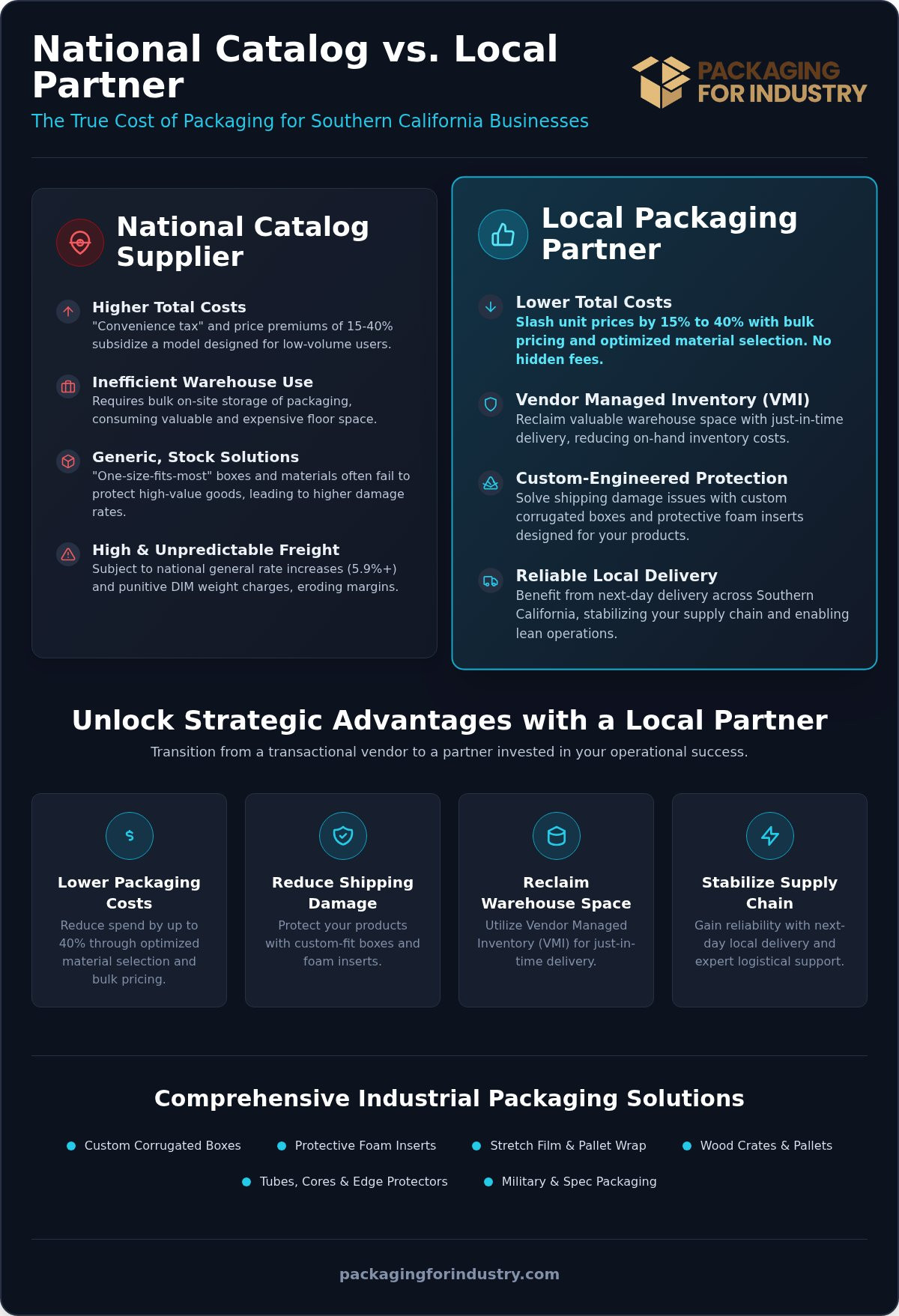
Many Southern California manufacturers rely on national catalog giants because of the perceived ease of ordering. However, this convenience often masks a significant financial drain on industrial operations. Switching from Uline to a local packaging partner in California isn’t just about changing vendors; it’s a strategic move to optimize the total landed cost of your supplies. Catalog prices are typically set to cover the overhead of massive national distribution hubs and the logistical cost of shipping small orders across the country. High-volume industrial users often find themselves subsidizing this infrastructure while receiving generic, stock solutions that don’t fit their specific needs.
In 2026, the shift toward regionalized supply chains has accelerated. Rising freight charges and the implementation of California’s SB 54 have made local expertise more valuable than a generic catalog. Companies in precision-heavy sectors like aerospace, medical device manufacturing, and electronics are leading this transition. These businesses require specialized protective foam packaging and custom corrugated designs that a stock distributor simply cannot provide with the necessary level of engineering oversight.
The True Cost of Convenience
Catalog pricing structures prioritize the “ships today” promise for single-pack customers. For a manufacturer in Anaheim or Irvine, this means paying a premium for a service model designed for low-volume users. When you compare packaging pricing, the hidden markup in catalog items can lead to a 15% to 40% price premium over a local partner. A strategic partner does more than fill orders; they analyze your usage patterns to lower packaging costs through better material selection and bulk pricing. Moving away from a transactional vendor relationship allows you to treat your packaging as an engineered component of your product rather than an afterthought.
California’s Unique Logistical Landscape
Industrial real estate in Southern California is a premium expense. With average rents hovering around $1.22 per square foot in mid-2026, using your warehouse to store months of bulky corrugated boxes is an inefficient use of capital. Local partners mitigate this by offering Vendor Managed Inventory (VMI), which allows businesses to shift to a just-in-time model. Proximity to a local supplier in Orange County or Los Angeles ensures that delivery reliability remains high despite regional traffic or port congestion. This local presence enables next-day delivery, which is essential for maintaining lean operations without the risk of stockouts or the burden of massive on-site inventories.
Comparing Total Cost of Ownership: National Catalog vs. Local Partner
Measuring the success of a procurement strategy solely by unit price is a common mistake. Landed cost, which includes the base price plus freight, handling, and administrative fees, provides the only accurate view of your spending. There are documented economic advantages of local partners that directly impact these variables. When switching from Uline to a local packaging partner in California, you transition from paying for a massive distribution infrastructure to paying for the actual materials and engineering that protect your goods. Local suppliers focus on optimizing your entire operation, whereas catalogs focus on high-margin transactions.
Direct Price Comparison: Boxes and Film
Wholesale pricing for corrugated boxes is built on industrial volume, not small-order convenience. National catalogs typically charge a premium to support the “ships today” model for customers buying five boxes at a time. High-volume manufacturers subsidize this model when they buy in bulk. Similarly, evaluating stretch film by the roll is often misleading. Catalog suppliers may not disclose the exact gauge or weight, whereas local partners focus on yield and load containment. Buying by the pound or performance metric ensures you pay for usable plastic, not just a SKU in a book. This transparency is critical for businesses looking to lower packaging costs without sacrificing load stability.
Hidden Logistics Savings
Shipping bulky items like boxes and foam across multiple state lines is inherently inefficient. Freight charges from national hubs to Southern California are rising steadily. Parcel and LTL carriers have announced effective rate increases between 7% and 12% for 2026 when surcharges are factored in. Local delivery eliminates these long-haul costs and the risk of expensive “emergency order” fees when stock runs low. Consolidating your stock supplies with custom-engineered solutions also reduces administrative strain. You can compare packaging pricing more effectively when you see the total landed cost on a single local invoice. If you want to see the difference in your specific application, you can request a packaging quote to evaluate your current spend against catalog rates.
Custom Engineering vs. Stock Solutions: Solving Shipping Damage
Catalog suppliers pride themselves on vast inventories of stock sizes. However, a stock box rarely provides the precise fit required for high-value industrial equipment. Switching from Uline to a local packaging partner in California allows you to move away from “one-size-fits-most” containers that often lead to 1-3% higher damage rates. When a product doesn’t fit its box perfectly, it relies on excessive void fill, which can shift during transit. This instability is the primary cause of impact damage in LTL and parcel shipping environments. Precision engineering ensures that your product remains stationary, significantly reducing the risk of costly returns and insurance claims.
Beyond physical protection, custom engineering provides financial relief from carrier surcharges. In 2026, major carriers use a 139 dimensional weight divisor and round every fractional inch up to the next whole number. A stock box that’s only two inches too large in each dimension can significantly increase your billable weight, even if the product inside is light. Custom-sized corrugated boxes eliminate this “air tax,” directly lowering your landed costs. PFI offers free prototyping for custom designs, allowing you to test and verify a solution before committing to a full production run.
Protective Foam and Custom Inserts
Stock bubble wrap or packing peanuts are often inadequate for sensitive electronics or medical devices. We design custom foam inserts using polyethylene or polyurethane to cradle products securely. For the California electronics sector, we offer specialized ESD and anti-static foam to prevent electrostatic discharge during handling and transport. These precision-cut inserts don’t just protect better; they reduce waste and assembly time compared to manual void-fill methods, improving your throughput at the packing station.
Heavy-Duty and Mil-Spec Requirements
Industrial goods often exceed the burst strength of standard stock boxes found in a catalog. We manufacture heavy duty corrugated boxes, including double-wall and triple-wall options, to support significant weight and stacking pressure. For aerospace components, we build custom crates and pallets that meet rigorous safety and durability standards. Working with a local expert ensures your packaging complies with military packaging (mil-spec) requirements, which prevents costly rejections at the receiving dock and ensures long-term supply reliability.
Streamlining Operations with Vendor Managed Inventory (VMI) in SoCal
Warehouse space in Southern California remains some of the most expensive industrial real estate in the country. In mid-2026, average asking rents in the region are approximately $1.22 per square foot. When you rely on a national catalog, you are often forced to buy in massive bulk to reach price breaks, which means paying to store empty air for months. Switching from Uline to a local packaging partner in California changes this dynamic. By implementing Vendor Managed Inventory (VMI), you shift the storage burden from your facility to ours, allowing you to use that valuable floor space for production or revenue-generating inventory.
PFI manages the entire lifecycle of your packaging supplies. Our process includes a detailed assessment of your current throughput, followed by a custom stocking plan and automated replenishment. For facilities in Anaheim and Los Angeles, this means just-in-time (JIT) delivery that aligns with your daily production schedule. This local proximity ensures that your supply chain remains resilient even during regional logistical shifts.
Reclaiming Your Warehouse Floor
Storing six months of corrugated boxes or rolls of stretch film ties up significant capital. VMI improves your cash flow by ensuring you only pay for what you need when you need it. It also eliminates the risk of stockouts on critical items like packaging tape or labels. When we manage your inventory levels locally, we catch usage spikes before they become operational emergencies, preventing the high costs associated with expedited shipping from national hubs.
The Transition: How to Switch Without Downtime
Moving from a catalog-based system to a local partnership is a structured process designed to prevent supply chain interruptions. We follow three primary steps to ensure a seamless changeover:
- Usage Audit: We analyze your top 20 packaging items to determine actual monthly consumption and identify where stock sizes are causing waste or excessive DIM weight charges.
- Program Design: We create a stocking schedule based on your lead times and production peaks, ensuring your high-volume items are always available.
- Delivery Implementation: We establish a next-day local delivery cycle to keep your lines running without requiring massive on-site safety stock.
Making the Move: Your Roadmap to Lower Packaging Costs with PFI
Transitioning away from a national catalog is a strategic decision that prioritizes operational precision over generic convenience. Packaging For Industry (PFI) serves as a dedicated resource for businesses that have outgrown the limitations of stock SKUs and high freight surcharges. Switching from Uline to a local packaging partner in California allows your team to stop managing a catalog and start managing a supply chain. By moving to a localized model, you gain a partner invested in your bottom line rather than a vendor focused on transaction volume. This shift is the first step toward achieving the 15% to 40% cost savings common when businesses move to an engineered supply model.
Our Southern California Service Advantage
Unlike national distributors that serve every consumer segment, PFI is 100% industrial-focused. We understand the technical requirements of manufacturing, aerospace, and warehouse operations. This focus means you have direct access to packaging engineers who can solve complex protection challenges, not just customer service representatives reading from a script. Our local delivery network covers Orange County, Los Angeles, and the Inland Empire, ensuring that your corrugated boxes and stretch film arrive on our own trucks. This proximity eliminates the uncertainty of third-party carriers and the damage often associated with long-haul transit.
Start Your Cost-Saving Analysis Today
To compare packaging pricing effectively, you need to look beyond the unit price on a website. A true cost-reduction analysis accounts for freight, damage rates, and the square footage consumed by excessive inventory. We recommend starting with a local site visit. Our team can perform a physical review of your current materials to identify where custom-engineered protective foam packaging or right-sized boxes could save you money. When you are ready to request a packaging quote, having your current specifications and monthly usage data on hand will ensure the most accurate comparison. We can work from existing samples or help you design a new solution from scratch using our free prototyping service.
Your move to a local partner shouldn’t be complicated. We provide a clear roadmap that includes usage audits, design refinement, and a structured delivery schedule. This methodical approach ensures that you lower packaging costs while improving the reliability of your entire supply chain. Our Anaheim-based team is ready to help you transition from a catalog-dependent buyer to a lean, efficient operator.
Optimizing Your Industrial Supply Chain for 2026
Transitioning to a localized packaging model is more than a cost-cutting exercise; it’s an investment in operational stability. By moving away from one-size-fits-most catalog options, you eliminate the “air tax” of dimensional weight surcharges and significantly reduce shipping damage through custom-engineered protection. Our local Anaheim facility provides the technical oversight and free prototyping necessary to ensure your products are secured with precision, tailored specifically to your manufacturing requirements.
Switching from Uline to a local packaging partner in California empowers your team to reclaim valuable warehouse floor space and stabilize lead times with local next-day delivery. With potential cost savings between 15% and 40%, you can redirect capital from generic supplies back into your core business processes. We are ready to help you audit your current usage and design a more efficient, responsive supply chain that prioritizes your bottom line over catalog volume.
We look forward to helping you streamline your logistics and improve your supply reliability across Southern California.
Frequently Asked Questions
Is it really cheaper to buy from a local packaging supplier than Uline?
Yes, it’s typically more cost-effective for industrial users. National catalog suppliers set high unit prices to subsidize their massive marketing and small-order shipping infrastructure. When you move to a local partner like PFI, you avoid these premiums. We focus on bulk industrial volume and custom engineering, which allows us to offer 15% to 40% savings on your annual packaging spend while improving product protection.
Can a local partner match the delivery speed of a national catalog?
We provide next-day local delivery across Southern California using our own fleet of trucks. While national catalogs ship quickly, they often rely on third-party parcel carriers that are subject to regional delays and rising surcharges. Our proximity to your facility in Anaheim, Los Angeles, or the Inland Empire allows for more reliable, just-in-time replenishment that aligns with your daily production schedule.
What is the minimum order size for custom corrugated boxes in California?
Minimum order quantities vary based on the specific design and material requirements, such as heavy-duty double-wall or triple-wall corrugated. We focus on serving recurring industrial and manufacturing needs rather than one-time retail purchases. Our team provides free prototyping for custom designs, ensuring your product fits perfectly before we move into a full production run to support your ongoing shipping needs.
How much can I save on shipping by switching to a local partner?
Switching from Uline to a local packaging partner in California provides immediate relief from rising carrier fees. You eliminate long-distance freight costs while reducing dimensional weight surcharges. By right-sizing your corrugated boxes, you stop paying to ship empty space. This strategy, combined with our local delivery, helps many SoCal manufacturers lower their total landed costs by up to 40% compared to traditional catalog ordering.
Does PFI provide custom foam inserts for aerospace and electronics?
We specialize in engineering protective foam packaging using materials like polyethylene and polyurethane. For the California electronics sector, we offer specialized anti-static and ESD foam to prevent electrostatic discharge during transit. Our engineers design these inserts to cradle high-value aerospace components securely, which eliminates the need for excessive manual void fill and significantly reduces the risk of shipping damage for delicate equipment.
What areas in Southern California do you offer next-day delivery to?
Our local delivery network covers Orange County, Los Angeles County, the Inland Empire, and San Diego County. This includes industrial hubs such as Anaheim, Huntington Beach, Irvine, Santa Ana, Long Beach, Riverside, and San Bernardino. Because we operate our own delivery fleet, we provide more consistent lead times than national distributors that rely on third-party logistics providers to reach Southern California facilities.
How does a Vendor Managed Inventory (VMI) program work for packaging?
Our Vendor Managed Inventory program starts with a usage audit to determine your average consumption of corrugated products and shipping supplies. We then establish a replenishment schedule, where our team monitors your stock levels on-site at your facility. This eliminates the need for your team to place manual orders or store six months of inventory. It’s a proactive system that ensures you always have the materials needed.
Can you provide Mil-Spec packaging for defense contracts in SoCal?
Yes, we manufacture military packaging that meets rigorous defense contract specifications. Our team understands the specific requirements for durability, moisture barriers, and long-term storage required for mil-spec applications. We build heavy-duty boxes, custom crates, and specialized foam assemblies designed to withstand the harsh environments typical of military logistics, ensuring your components pass inspection at the receiving dock every time.