
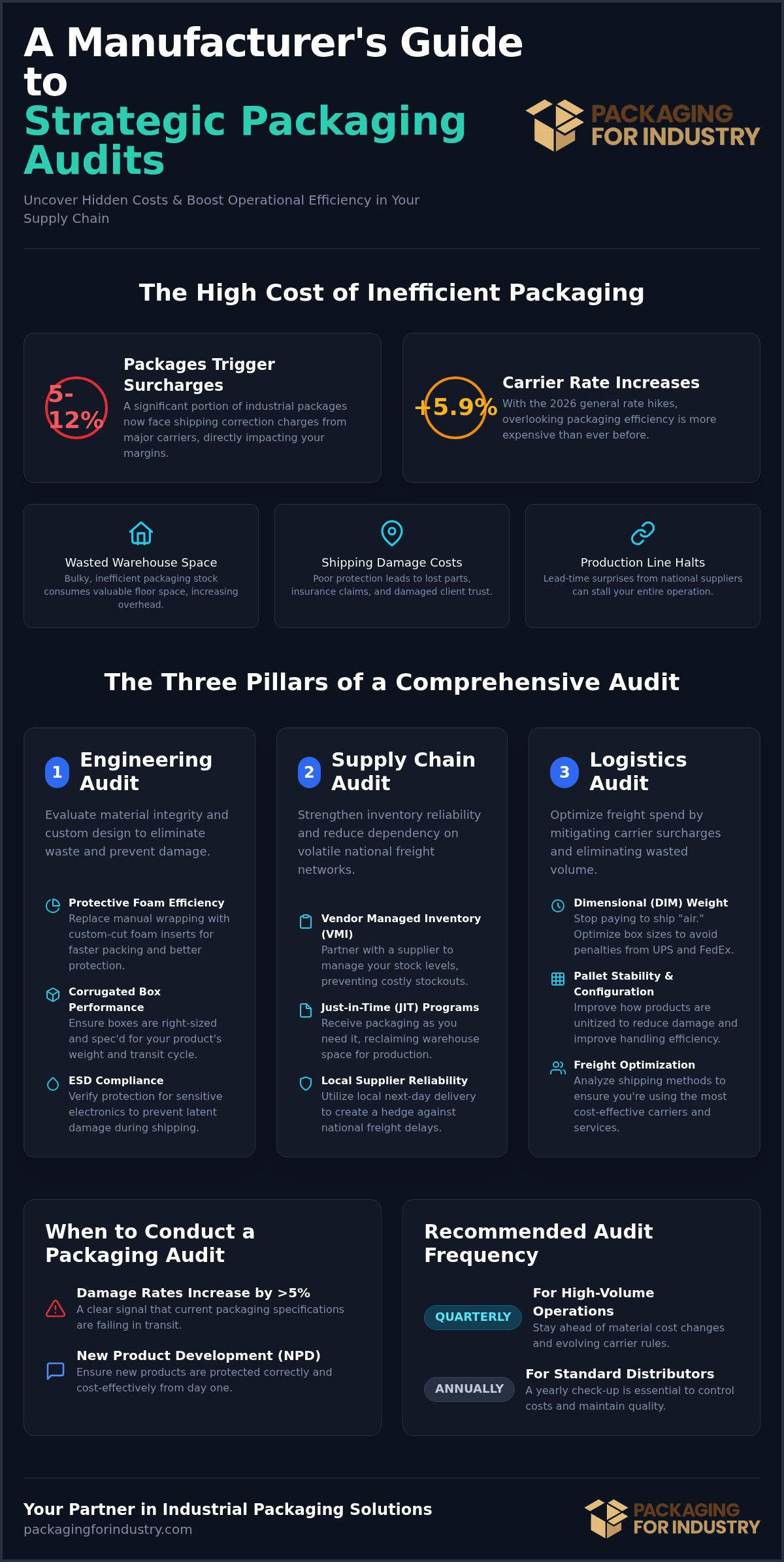
Did you know that between 5% and 12% of all industrial packages now trigger at least one shipping correction charge from major carriers? With the 2026 general rate increases of 5.9% now in full effect, these hidden surcharges are no longer just a minor nuisance. They’re a direct hit to your operational margins. You’ve likely dealt with the frustration of unexpected shipping damage on high-value parts or the high warehouse costs of storing bulky, inefficient packaging stock. It’s even worse when national catalog suppliers hit you with lead-time surprises that stall your production schedule.
Performing a formal packaging audit for manufacturers Southern California is the most effective way to expose these logistical leaks and reclaim your bottom line. You deserve a supply chain that is as precise as your engineering. This guide provides a clear framework to vet your current suppliers, reduce expensive UPS and FedEx surcharges, and build higher reliability into your daily operations. We’ll move beyond generic fixes to look at the intersection of material engineering and logistics economics, ensuring your protection levels match your fiscal goals.
Key Takeaways
- Learn how to audit dimensional (DIM) weight and pallet stability to mitigate 2026 carrier rate increases and avoid aggressive shipping surcharges.
- Discover how Vendor Managed Inventory (VMI) and JIT programs eliminate production halts caused by lead-time surprises from national catalog suppliers.
- Identify opportunities to lower packaging costs by evaluating whether your protective foam packaging is over-engineered or insufficient for your specific transit cycles.
- Use this comprehensive framework to conduct a professional packaging audit for manufacturers Southern California, focusing on reclaiming expensive warehouse space in the Inland Empire and Orange County.
- Understand why a physical site visit from a packaging engineer is a non-negotiable step in consolidating audit findings into an accurate request for a packaging quote.
Why Southern California Manufacturers Need a Packaging Audit in 2026
Southern California’s industrial landscape is facing a unique set of economic pressures. As of 2026, warehouse lease rates in the Inland Empire and Orange County have reached historic peaks. This makes “dead” space more expensive than ever. If your facility is cluttered with pallets of bulky, generic packaging stock, you’re essentially paying a premium to store air. A professional packaging audit for manufacturers Southern California identifies these inefficiencies, allowing you to reclaim floor space for production rather than storage.
Operational reliability is another critical driver. For lean manufacturing lines, an inconsistent supply of materials like custom corrugated boxes or stretch film can halt entire shifts. Relying on national catalog suppliers often introduces lead-time surprises that a local partner can eliminate. PFI, based in Anaheim, offers local next-day delivery across the region, providing a stable hedge against the volatility of national freight networks.
The financial stakes are particularly high for aerospace and medical device manufacturers. High-value components require precision protection. Shipping damage doesn’t just result in a lost part; it triggers insurance claims, production delays, and damaged client relationships. By adhering to rigorous package testing standards, you ensure that your materials actually meet the demands of the modern transit cycle.
The Hidden Costs of Catalog Ordering
Many procurement teams default to national catalogs for convenience. However, “off-the-shelf” solutions rarely account for the specific dimensions of your product. This creates a “surcharge trap” where oversized boxes trigger 2026 dimensional (DIM) weight penalties from carriers like UPS and FedEx. Over-packaging increases dimensional volume beyond necessary protection levels, causing manufacturers to pay for shipping air instead of actual product. Switching to custom design packaging can significantly lower packaging costs by optimizing every inch of the shipping container.
Audit Frequency: When to Review Your Supplier
You shouldn’t wait for a crisis to evaluate your industrial packaging solutions. A 5% increase in reported shipping damage is a clear signal that your current specs are failing. It’s also standard practice to conduct a packaging audit for manufacturers Southern California during any New Product Development (NPD) phase. High-volume operations benefit most from quarterly reviews, while smaller distributors should aim for at least an annual assessment to stay ahead of rising material costs and carrier rate hikes.
Engineering Audit: Evaluating Custom Design and Protection
A successful packaging audit for manufacturers Southern California must look beyond the unit price and evaluate the engineering integrity of the materials. Protection that is too light leads to product damage. Protection that is too heavy leads to wasted freight spending. Your supplier should provide comprehensive CAD/CAM support and free prototyping to ensure a precision fit before any production begins. This phase is critical for identifying whether you are over-specifying materials or leaving high-value parts vulnerable to the stresses of the supply chain.
Protective Foam and Cushioning Efficiency
Auditing custom foam inserts often reveals significant material waste and labor inefficiency. If your team is manually wrapping parts in generic foam sheets, you’re losing money on every box. Switching to custom-cut polyethylene or polyurethane foam allows for optimized density and faster packing times. For high-tech sectors like semiconductor manufacturing, the audit must also verify ESD (electrostatic discharge) compliance to protect sensitive circuitry from latent damage during the shipping cycle. Precision cushioning reduces the overall box size, which helps you avoid the dimensional weight surcharges mentioned earlier.
Custom Corrugated and Heavy-Duty Performance
The performance of your corrugated boxes impacts both shipping safety and shop floor productivity. An audit reviews whether standard RSC or custom die-cut designs better serve your assembly speed and storage constraints. For heavy industrial gear, the benchmark often shifts from double-wall to triple-wall corrugated to prevent stacking failures in the warehouse. If your products move internationally, your audit should specify weather-resistant or mil-spec materials to withstand humidity and rough handling. You can leverage custom design packaging services to determine the exact board grade required for your load profile.
Finally, verify the “Drop Test” standards for your custom crates and heavy-duty boxes. Real-world transit stress is unpredictable. A crate that looks sturdy on a warehouse floor might fail under the high-frequency vibration of a long-haul truck or the sudden impact of a forklift. Engineering-led design ensures your crates meet the structural requirements of the heaviest industrial equipment without adding unnecessary weight or volume. If you’re unsure if your current specs are optimized, you can request a packaging quote to compare your current costs against an engineered solution.
Supply Chain Audit: Inventory Reliability and VMI
Manufacturing in Southern California moves at a pace that doesn’t allow for supply chain gaps. If your design is engineered perfectly but your materials don’t arrive on time, your production line stops. A comprehensive packaging audit for manufacturers Southern California must evaluate whether your supplier is a proactive partner or merely a vendor. You need to verify if they hold backup stock for your recurring orders. If they don’t, you’re one logistical hiccup away from an expensive stockout. Reliability is the foundation of any industrial operation.
Lead times are a critical metric in this audit. National catalog suppliers often provide “off-the-shelf” convenience but struggle with custom items, leading to lead times that can stretch into weeks. Local suppliers like PFI offer a distinct advantage by providing local next-day delivery across the region. Your audit should also track communication responsiveness. Measure the time it takes to receive an RFQ response and evaluate their protocol for emergency replenishment. In a high-stakes environment, every hour of silence during a shortage costs your business money.
The VMI Advantage for Lean Manufacturing
Implementing Vendor Managed Inventory (VMI) shifts the burden of stock monitoring from your team to the supplier. By establishing strict min/max levels, you optimize cash flow and free up the expensive warehouse floor space in the Inland Empire or Orange County that we discussed earlier. The primary objective of a JIT program in a high-volume warehouse is to synchronize material delivery with actual production schedules to minimize inventory carrying costs. This approach turns your packaging supply from a storage headache into a streamlined, predictable flow.
Packaging Kitting and Assembly Services
Labor remains one of the most significant costs in any fulfillment or distribution center. Your audit should measure the “time-to-pack” for your most frequent shipping configurations. If your team spends excessive time folding complex corrugated inserts or hunting for different components, you’re losing money on labor. Utilizing packaging kitting services allows you to receive pre-assembled sets, which reduces touchpoints and speeds up the assembly process. During the audit, look for opportunities to implement reusable or returnable packaging systems. For closed-loop distribution networks within Southern California, these systems can offer substantial long-term savings and reduce your overall environmental footprint.
Logistics Audit: Freight Optimization and Surcharge Mitigation
A packaging audit for manufacturers Southern California should prioritize operational ROI over simple compliance. While many audits focus on quality documentation, a logistics-focused review exposes how your packaging dimensions directly inflate your freight spend. Carrier pricing models in 2026 heavily penalize “dead air.” If your corrugated boxes are even an inch larger than necessary, you’re likely paying for weight you aren’t shipping. This audit phase identifies the gap between your actual shipment weight and the dimensional (DIM) weight billed by carriers like UPS and FedEx.
Pallet stability is another critical factor in freight optimization. Load shifting during transit is a primary cause of damage claims and refused shipments. Your audit must evaluate the performance of your current stretch film and palletizing strategy. High-performance film, when applied with the correct containment force, prevents the lateral movement that leads to collapsed stacks. For manufacturers in the Inland Empire or Orange County, securing these loads is vital for navigating the frequent stops and starts of regional trucking routes.
Reducing UPS and FedEx Surcharges
Carrier surcharges for oversized items or additional handling can double the base rate of a shipment. You can mitigate these costs by integrating corner and edge protection into your pallet builds. These materials allow you to increase stacking height and pallet density without compromising structural integrity. By maximizing the vertical space in a trailer or delivery van, you reduce the total number of shipments required. Custom-engineered boxes further assist by ensuring your package dimensions stay below the specific thresholds that trigger aggressive handling fees.
The Southern California Service Footprint
Proximity to your supplier is a logistical asset. Auditing the cost of freight from out-of-state vendors often reveals hidden expenses in the form of longer lead times and higher fuel surcharges. PFI provides local next-day delivery across Anaheim, Irvine, and Los Angeles, which allows you to operate with leaner inventory levels. By utilizing just-in-time inventory, you can combat the high regional storage costs associated with Southern California real estate. This local service model ensures that you aren’t tying up capital in bulk packaging supplies that sit idle in your warehouse for months.
Implementing Your Audit: Requesting a Quote and Site Visit
Once you’ve completed the analytical phases of your audit, the next step is moving toward implementation. You must consolidate your findings into a single Request for Quote (RFQ) that reflects your actual operational needs. It’s vital to compare the total cost of ownership (TCO) rather than just the unit price of a single box. A cheap box that fails during transit or causes a production delay is far more expensive than an engineered solution. The final step in this process is securing a reliable custom packaging quote that accounts for your specific logistics profile.
A physical site visit from a packaging engineer is non-negotiable for any serious packaging audit for manufacturers Southern California. While digital specs are helpful, an engineer needs to see your packing line, your storage constraints, and how your team handles materials. This “boots on the ground” approach ensures that the proposed solutions work in the real world, not just on paper. It allows the engineer to identify bottlenecks or safety risks that a spreadsheet simply cannot capture.
Information Needed for a Precise Packaging Quote
To receive a precise quote, you’ll need to provide specific data points. This includes product dimensions, weight, and the relative fragility of the items. You should also define your shipping methods and transit cycles. Providing annual usage estimates is essential for accessing bulk packaging pricing tiers. If your operation requires military packaging or must meet aerospace compliance standards, these requirements must be clearly documented in the RFQ to ensure all materials meet the necessary certifications.
Transitioning to a New Packaging Partner
Transitioning to a new partner shouldn’t disrupt your workflow. We recommend phased rollouts, typically starting with high-volume corrugated boxes before moving to more complex custom inserts or foam sets. Set clear KPIs for the first 90 days of the agreement, focusing on delivery punctuality, damage reduction, and inventory accuracy. This methodical approach allows you to verify the supplier’s performance without overextending your operational risk. Ready to lower your costs? Request a comprehensive packaging quote from PFI today.
Optimizing Your Industrial Packaging for 2026 and Beyond
A comprehensive packaging audit for manufacturers Southern California transforms your materials from a recurring expense into a strategic logistical asset. By evaluating the intersection of material engineering and economic efficiency, you can eliminate the hidden surcharges and product damage that erode your margins. Moving from generic catalog ordering to custom-engineered solutions allows you to bypass carrier penalties and reclaim valuable floor space in your facility.
PFI provides the technical expertise and local reliability needed to secure your supply chain. We offer free prototyping for all custom designs and specialize in precision protection for aerospace and heavy industrial gear. With local next-day delivery throughout the region, you can implement lean inventory strategies with total confidence. It’s time to stop paying for “dead air” and start optimizing your end-to-end protection.
Take the first step toward a more efficient operation by scheduling your professional site visit today. Our team is ready to help you reduce shipping damage and lower your total cost of ownership.
Frequently Asked Questions
What is included in a professional packaging audit for manufacturers?
A professional packaging audit includes a technical review of current material specifications, design integrity, and supply chain reliability. Engineers evaluate your corrugated board grades, foam densities, and palletizing methods to identify over-engineering or insufficient protection. The process also analyzes logistical factors like dimensional weight surcharges and warehouse space utilization. By consolidating these findings, manufacturers can identify specific opportunities to reduce waste and improve the total cost of ownership across their entire operation.
How can a packaging audit reduce my shipping damage rates?
A packaging audit reduces shipping damage by identifying structural weaknesses in your current design and matching materials to real-world transit stresses. Engineers use CAD/CAM support and physical prototyping to simulate the vibrations and impacts of the supply chain. Whether you need heavy-duty triple-wall boxes or custom-cut ESD foam inserts, the audit ensures your protection levels are precisely calibrated. This proactive approach prevents the high costs associated with insurance claims and damaged client relationships.
Does PFI provide on-site packaging audits in Southern California?
Yes, PFI provides comprehensive on-site packaging audits for manufacturers Southern California across Anaheim, Orange County, Los Angeles, and the Inland Empire. Our engineers visit your facility to observe your packing lines, storage constraints, and handling procedures in person. This physical assessment is vital because it reveals operational bottlenecks and safety risks that digital specifications often miss. By seeing your workflow first-hand, we can design custom stocking programs that fit your specific warehouse footprint.
Can custom packaging actually be cheaper than stock catalog boxes?
Custom packaging is often cheaper than stock catalog boxes when you factor in total landed costs. Standard boxes frequently contain “dead air” that triggers expensive dimensional weight surcharges from carriers like UPS and FedEx. By engineering a box to fit your product’s exact dimensions, you reduce both material waste and shipping volume. Additionally, custom-engineered protection reduces the labor costs associated with manual wrapping and minimizes the financial impact of product damage during transit.
What industries benefit most from an industrial packaging audit?
Industrial packaging audits offer the highest ROI for sectors handling high-value, fragile, or heavy components. This includes:
- Aerospace and defense companies requiring mil-spec compliance.
- Electronics and semiconductor manufacturers needing ESD protection.
- Medical device companies focused on sterile and secure transit.
- Industrial equipment manufacturers shipping heavy machinery.
These industries face complex shipping cycles where precision engineering and material durability are critical for maintaining operational flow and preventing costly production delays.
How does a packaging audit help with UPS or FedEx surcharges?
A packaging audit identifies the specific package dimensions that trigger aggressive carrier surcharges. By optimizing the size of your corrugated containers, you can often bypass the dimensional weight pricing tiers that inflate freight costs. The audit also evaluates pallet builds, using corner and edge protection to increase stacking density. These small adjustments ensure your shipments remain within standard handling categories, allowing you to avoid the additional fees associated with oversized or non-conforming industrial loads.
What is the difference between an internal audit and a supplier audit?
An internal audit focuses on your facility’s packing speed, labor efficiency, and warehouse space management. In contrast, a supplier audit evaluates the reliability, lead times, and engineering capabilities of your current vendor. While an internal review identifies where your team is wasting time, a supplier audit determines if your partner is providing the best value. Combining both perspectives ensures that your packaging strategy supports both your shop floor productivity and your broader fiscal goals.
How often should a Southern California manufacturer conduct a packaging review?
Manufacturers should conduct a formal packaging audit for manufacturers Southern California at least once per year to stay ahead of rising material costs and carrier rate hikes. High-volume operations often benefit from quarterly audits to maintain lean inventory levels through VMI programs. You should also trigger a review immediately following any 5% spike in shipping damage or during the development of a new product line. Regular assessments ensure your supply chain remains resilient against local logistical volatility.