
If your shipping rates jumped by nearly 6% this year while the USPS aligned its DIM weight divisor to a strict 139, is your standard box actually a financial liability? Many manufacturers in Orange County and Los Angeles view packaging as a fixed overhead cost, but this perspective overlooks the compounding expenses of oversized cartons and transit damage. You’re likely feeling the pressure of rising surcharges and the labor intensive nature of complex manual packing.
The ROI of custom protective packaging goes far beyond simple breakage prevention; it’s a strategic financial instrument designed to optimize your entire supply chain. By switching to engineered solutions, you can reduce dimensional weight and eliminate the hidden costs associated with product returns. This guide provides a clear framework to calculate your Total Cost of Ownership (TCO). We’ll show you how to streamline warehouse labor and achieve zero-damage delivery for high-value components, ensuring your San Diego or nationwide distribution remains profitable and efficient.
Key Takeaways
- Shift from a “unit price” mentality to a Total Cost of Ownership (TCO) model to uncover hidden logistical expenses and operational bottlenecks.
- Mitigate the high financial burden of product returns by utilizing engineered foam packaging that provides superior shock absorption compared to generic loose fill.
- Calculate the ROI of custom protective packaging by right-sizing corrugated boxes to eliminate wasted space and avoid rising carrier dimensional weight (DIM) surcharges.
- Improve warehouse throughput and reduce labor costs by implementing custom foam end-caps and packaging kitting solutions that streamline the packing line.
- Leverage free prototyping and local Southern California delivery to ensure high-value components are protected without the risks of long lead times or excessive inventory footprints.
Defining the ROI of Custom Protective Packaging in 2026
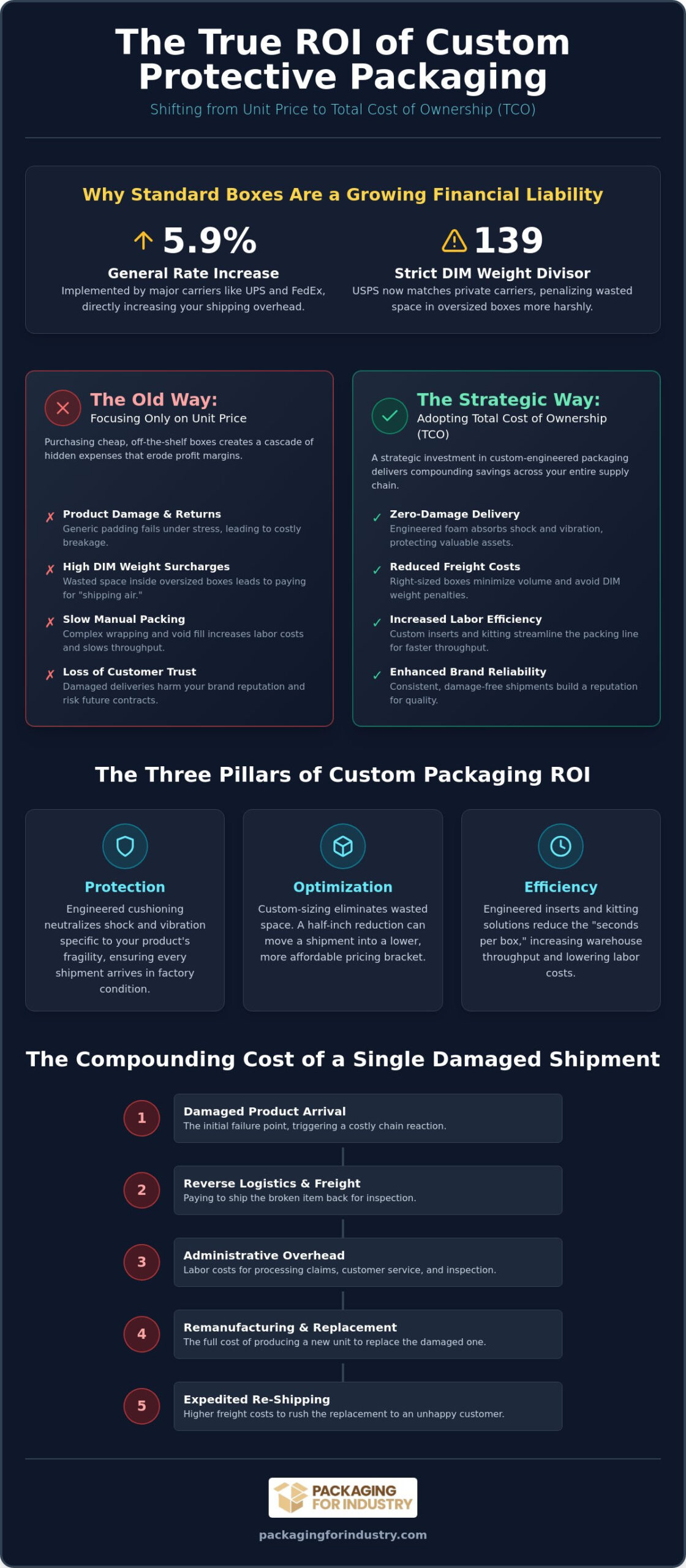
Many industrial procurement teams still evaluate packaging based on the invoice price of a single box. In 2026, this narrow focus is financially dangerous. With UPS and FedEx implementing a 5.9% general rate increase and the USPS lowering its dimensional weight divisor to 139 to match private carriers, shipping “air” has never been more expensive. The ROI of custom protective packaging isn’t just about the unit price of the materials; it’s about how those materials interact with your entire supply chain to protect your bottom line.
Total Cost of Ownership (TCO) vs. Price Per Unit
Purchasing low-cost, off-the-shelf corrugated boxes often results in expensive failures during transit. When a high-value aerospace component arrives damaged, the initial savings on the box disappear instantly. You must account for the cost of re-manufacturing the part, expedited re-shipping, administrative labor for processing claims, and the potential loss of a long-term contract. Total Cost of Ownership in industrial packaging is the sum of all expenses related to a package’s lifecycle, where upfront engineering costs serve as a strategic hedge against catastrophic transit risks and logistical waste. By investing in a packaging cost savings strategy that prioritizes fit and function, you eliminate the “hidden” expenses that generic catalog suppliers often ignore.
The Three Pillars of Packaging ROI
To maximize the ROI of custom protective packaging, your strategy should rest on three functional pillars:
- Protection: Engineering the correct Package cushioning is the most direct way to eliminate the high cost of damaged goods. By neutralizing shock and vibration specific to your product’s fragility, you ensure every shipment arrives in factory condition.
- Optimization: Custom sizing reduces shipping volumes. Since major carriers now round up fractional dimensions to the next whole inch before calculating dimensional weight, even a half-inch reduction in box size can move a shipment into a lower pricing bracket.
- Efficiency: Speeding up the packing line with engineered inserts, such as custom foam packaging, reduces the “seconds per box” on the warehouse floor. This labor efficiency is critical for distributors in high-volume regions like Orange County and Los Angeles.
Indirect ROI also plays a significant role in your financial health. In sectors like medical or automotive manufacturing, consistent, zero-damage delivery builds a brand reputation for reliability that generic packaging cannot match. When your operations team spends less time on complex manual wrapping and more time on throughput, the cumulative savings in labor and warehouse footprint provide a clear path to long-term profitability. Transitioning to a custom-engineered system ensures your logistics are optimized for the strict carrier regulations of 2026 while protecting your most valuable assets.
Mitigating the High Cost of Product Damage
When a shipment fails, the financial impact extends far beyond the price of the item itself. For manufacturers in Southern California, a single damaged delivery triggers a chain reaction of reverse logistics freight, inspection labor, and administrative overhead. You’re not just losing the product; you’re paying to ship it back, paying a technician to evaluate the failure, and potentially losing the trust of a long term client. The ROI of custom protective packaging is realized when these preventable failures are removed from your balance sheet.
Generic loose fill or bubble wrap often fails because it allows for “migration” inside the box. During a long haul from Los Angeles to the East Coast, products shift, creating gaps that leave corners vulnerable to impact. Engineered foam packaging eliminates this risk by securing the item in a fixed position. This precision ensures that shock and vibration are absorbed by the packaging material rather than the component.
Consider a $50,000 aerospace component. A standard corrugated box with generic padding might save a few dollars upfront, but it offers zero protection against the specific G-forces experienced during turbulent transit. By utilizing custom inserts, you create a dedicated “crush zone” that preserves the integrity of high value assets. This level of protection is essential for electronics that require static electricity (ESD) shielding or sensitive medical instruments that cannot tolerate even minor vibrations.
Custom Foam vs. Generic Cushioning
Choosing the right material is a balance of engineering and economics. Polyethylene foam is a closed cell material perfect for heavy items requiring multiple impact protection, while polyurethane is softer and ideal for lighter, more fragile goods. The goal isn’t to over package with the most expensive material available; it’s to use the exact density required for the job. Precision cut aerospace packaging ensures you aren’t paying for excess material while maintaining the highest safety standards for your hardware.
The ‘One-Percent’ Rule in Damage Rates
Small improvements in delivery success lead to significant annual savings. If your operation ships 10,000 units a year, reducing your damage rate by just 1% can save thousands in replacement costs and lost revenue. Beyond the immediate cash savings, a lower damage profile often leads to more favorable insurance premiums and fewer contested claims. A “failed delivery” is a marketing disaster; consistent, perfect arrivals are a competitive advantage that justifies the initial investment. If you are ready to stabilize your shipping outcomes, it may be time to request a packaging quote for a custom engineered solution.
Optimizing Freight Costs and Dimensional Weight (DIM)
Shipping air is one of the most common ways industrial operations erode their margins. In 2026, the financial penalty for inefficient packaging has reached a new peak. Major carriers have aligned their policies; the USPS now uses a DIM weight divisor of 139, matching the standards long held by UPS and FedEx. Because carriers round up every fractional dimension to the next whole inch before calculating this weight, a box that is just slightly too large can trigger significantly higher costs. The ROI of custom protective packaging is often most visible here, where right-sizing your containers directly lowers your daily shipping spend.
Standard catalog boxes are designed for general use, which usually results in excessive void space that requires expensive fillers. By switching to custom corrugated boxes, you eliminate this wasted volume. This transition allows you to move away from the “one size fits many” approach that invites carrier surcharges and increases material waste. When your packaging is engineered to the specific footprint of your product, you stop paying to ship empty space across the country.
Beating UPS and FedEx Surcharges
Small adjustments in box dimensions can move your shipments into lower pricing tiers, avoiding the “Additional Handling” fees that carriers frequently increase. If right-sizing a box saves just $2.00 per shipment, a mid-sized distributor shipping 10,000 units annually realizes a $20,000 direct return on their engineering investment. These savings scale rapidly for high-volume fulfillment centers in Los Angeles and Orange County. By aligning box dimensions precisely with the product profile, you ensure that every cubic inch paid for is productive inventory rather than expensive void space.
Maximizing Pallet Density
Freight optimization isn’t limited to individual parcels; it extends to how you utilize every square inch of a trailer. Custom crates and heavy duty double wall boxes are designed to stack securely, allowing you to maximize vertical space without risking a collapse. To achieve this, many manufacturers utilize corner and edge protection to reinforce pallet integrity, enabling higher stacking heights and more units per shipment.
When you fit more product onto a single pallet, you reduce the total number of trucks required to move your inventory. This density is maintained through the strategic use of high performance stretch film, which provides the necessary load containment for heavy industrial goods. For a San Diego based manufacturer shipping nationwide, improving pallet density by 15% can result in thousands of dollars in annual freight savings, providing a clear and measurable ROI of custom protective packaging through logistical efficiency alone.
Operational Efficiency: Labor and Warehouse Savings
While freight savings are immediate, the long term ROI of custom protective packaging is often found on the warehouse floor. Labor remains one of the highest variable costs in any fulfillment or manufacturing operation. If your team spends several minutes manually wrapping a single component in bubble wrap and tape, you’re losing throughput every hour. Custom engineered solutions replace these tedious manual processes with intuitive, high speed alternatives that keep your line moving.
Integrating packaging kitting into your assembly process ensures that every required component arrives ready for immediate use. This eliminates the time workers spend searching for various materials or assembling complex boxes from scratch. By delivering a pre-configured kit to the line, you maximize the efficiency of your most valuable resource: your people. This streamlined approach isn’t just about speed; it’s about creating a repeatable, error free system that reduces the risk of packing mistakes.
Streamlining the Packing Line
Switching from generic rolls of cushioning to “drop-in” foam end-caps can significantly reduce assembly time. Some industry professionals report that standardized custom inserts can lower labor costs per unit by 30% or more by simplifying the packing process. This standardization also reduces worker training time, as the packaging only fits the product in one specific, secure way. Unlike off-the-shelf catalog items that require trial and error to secure, custom designs are engineered for a perfect fit on the first try. This precision allows your team to focus on quality control rather than struggling with mismatched materials.
Vendor Managed Inventory (VMI) as an ROI Driver
The financial benefit of Vendor Managed Inventory (VMI) is found in the optimization of your warehouse footprint. In high rent areas like Orange County and Los Angeles, every square foot of floor space dedicated to storing bulky packaging is space that isn’t generating revenue. VMI programs allow you to reduce tied up capital by only stocking the inventory needed for your immediate production cycle. This frees up cash flow and floor space for more profitable activities, such as expanding manufacturing capacity.
By leveraging local Southern California logistics and next day delivery, you can implement a just-in-time strategy that eliminates the need for massive on site storage. This proactive approach prevents downtime caused by unexpected packaging stockouts. Your line should never stop because of a missing box or roll of stretch film. Transitioning your packaging management to a seasoned partner turns your warehouse into a lean, profit focused operation that responds quickly to market demands.
Partnering with a Custom Packaging Manufacturer
Selecting a packaging supplier is often viewed as a simple procurement task, but for industrial manufacturers, it’s a strategic decision that dictates long term profitability. While catalog suppliers offer the illusion of convenience through massive inventories, they often hide costs in the form of oversized boxes and generic protection levels. Choosing to work with a specialized manufacturer allows you to move away from these “one size fits many” limitations. The true ROI of custom protective packaging is realized when your supplier acts as an extension of your own engineering team, identifying savings that a standard catalog simply cannot provide.
One of the most critical steps in securing this return is through free prototyping. At PFI, we don’t expect you to commit to a full production run based on a drawing alone. We provide physical samples to ensure a perfect product fit before you invest. This testing phase allows your operations team to verify the ease of assembly and the security of the internal cushioning, effectively proving the ROI before the first shipment even leaves your dock. In high stakes sectors like aerospace and medical device manufacturing, this precision isn’t a luxury; it’s a requirement for financial stability.
The Engineering Advantage
Our custom design packaging services utilize advanced CAD/CAM support to create integrated solutions. We often combine multiple materials, such as heavy duty corrugated, precision cut foam, and wood, into a single system designed for maximum protection and minimum weight. For example, we’ve helped clients move from traditional heavy wood crates to lightweight triple wall corrugated solutions for export. This transition maintains the necessary structural integrity while significantly reducing the tare weight of the shipment, leading to immediate and substantial freight savings on every international order.
Why Choose PFI for Industrial ROI?
Proximity is a major factor in logistical reliability. Because we provide local support to Anaheim, Orange County, and the surrounding regions, we can offer local next day delivery to keep your production lines moving. This proximity reduces the lead time risks associated with national catalog suppliers who may ship from distant hubs. Whether you’re operating in the medical device sector in San Diego or military electronics in Los Angeles, our expertise in specialized sectors ensures your packaging meets all regulatory and safety standards without unnecessary material waste.
Investing in custom engineering turns your packaging from a sunk cost into a financial asset. By optimizing for material use, labor speed, and freight density, you create a more resilient and profitable supply chain. If you’re ready to stop overpaying for generic boxes and start protecting your margins, it’s time to evaluate your current system.
Optimizing your packaging is one of the most effective ways to reclaim lost margins and eliminate professional stress. We’re ready to partner with you to build a more efficient, reliable, and profitable supply chain.
Frequently Asked Questions
How do I calculate the ROI of switching to custom packaging?
You calculate the ROI of custom protective packaging by analyzing your Total Cost of Ownership (TCO). This formula includes the direct reduction in product damage rates, lower freight expenses from right-sized dimensions, and decreased labor hours on the packing line. When these cumulative savings exceed the incremental cost of custom engineering, you’ve achieved a positive return. This data-driven approach allows procurement teams in Anaheim and Los Angeles to justify the shift from generic materials to precision solutions.
Isn’t custom packaging much more expensive than buying from a mass-market catalog?
Custom solutions often have a higher unit price than generic catalog items, but they are more cost-effective when you analyze the entire supply chain. Large catalog suppliers sell standard sizes that often require excessive void fill and larger boxes than necessary. By eliminating wasted materials and reducing dimensional weight, custom engineered systems typically lower your total operational spend. You’re paying for protection and efficiency rather than just a cardboard container.
How can custom boxes reduce my UPS and FedEx shipping costs?
Custom boxes reduce shipping costs by optimizing your dimensional (DIM) weight profile. Since UPS and FedEx round up to the next whole inch, even a slight reduction in box dimensions can move your shipment into a lower pricing tier. Right-sizing ensures you aren’t paying to ship empty space or “air.” This is particularly valuable for Southern California manufacturers shipping nationwide, where every cubic inch saved translates to direct freight savings.
What industries see the highest return on investment from custom foam inserts?
Sectors with high-value or highly sensitive components, such as aerospace, medical devices, and electronics, see the most significant returns. These industries face catastrophic financial losses if a single part arrives damaged. Precision foam inserts, including ESD-safe polyethylene or polyurethane, provide the exact shock absorption needed to eliminate transit failures. For defense contractors in San Diego, this level of reliability is essential for maintaining strict contract compliance and avoiding expensive re-manufacturing.
Does custom packaging really reduce labor costs in the warehouse?
Custom packaging significantly lowers labor costs by streamlining the assembly process. Instead of workers spending minutes manually wrapping items in bubble wrap, they can use “drop-in” foam end-caps or pre-configured kits. This standardization reduces the “seconds per box” on the warehouse floor and minimizes worker training requirements. High-volume fulfillment centers in Orange County find that these efficiency gains often provide a faster return than material savings alone.
What is the typical lead time for custom-engineered packaging prototypes?
Prototype lead times vary depending on complexity, but PFI typically provides initial samples within a few business days. We offer free prototyping and CAD design services to ensure a perfect fit before you commit to a full production run. This rapid turnaround allows your engineering team to test the solution in real-world conditions without delaying your rollout. Our local Southern California presence ensures that design iterations happen quickly and efficiently.
How does Vendor Managed Inventory (VMI) improve my bottom line?
Vendor Managed Inventory (VMI) improves your bottom line by reducing the amount of capital tied up in bulky packaging stock. Instead of using valuable warehouse floor space for months of inventory, PFI manages your levels and delivers just-in-time. This frees up square footage for revenue-generating activities like manufacturing or assembly. It also eliminates the risk of costly production downtime caused by unexpected packaging stockouts or lead-time delays.
Can custom packaging help with international export compliance (ISPM-15)?
Custom packaging solutions include heat-treated wood crates and pallets that meet strict ISPM-15 international export standards. If you’re shipping heavy machinery or sensitive components overseas, compliant custom crating is essential to avoid customs delays or rejected shipments. We engineer these solutions to be both durable and compliant, ensuring your goods move through international ports without administrative friction. This protection is vital for maintaining your global supply chain reliability.