
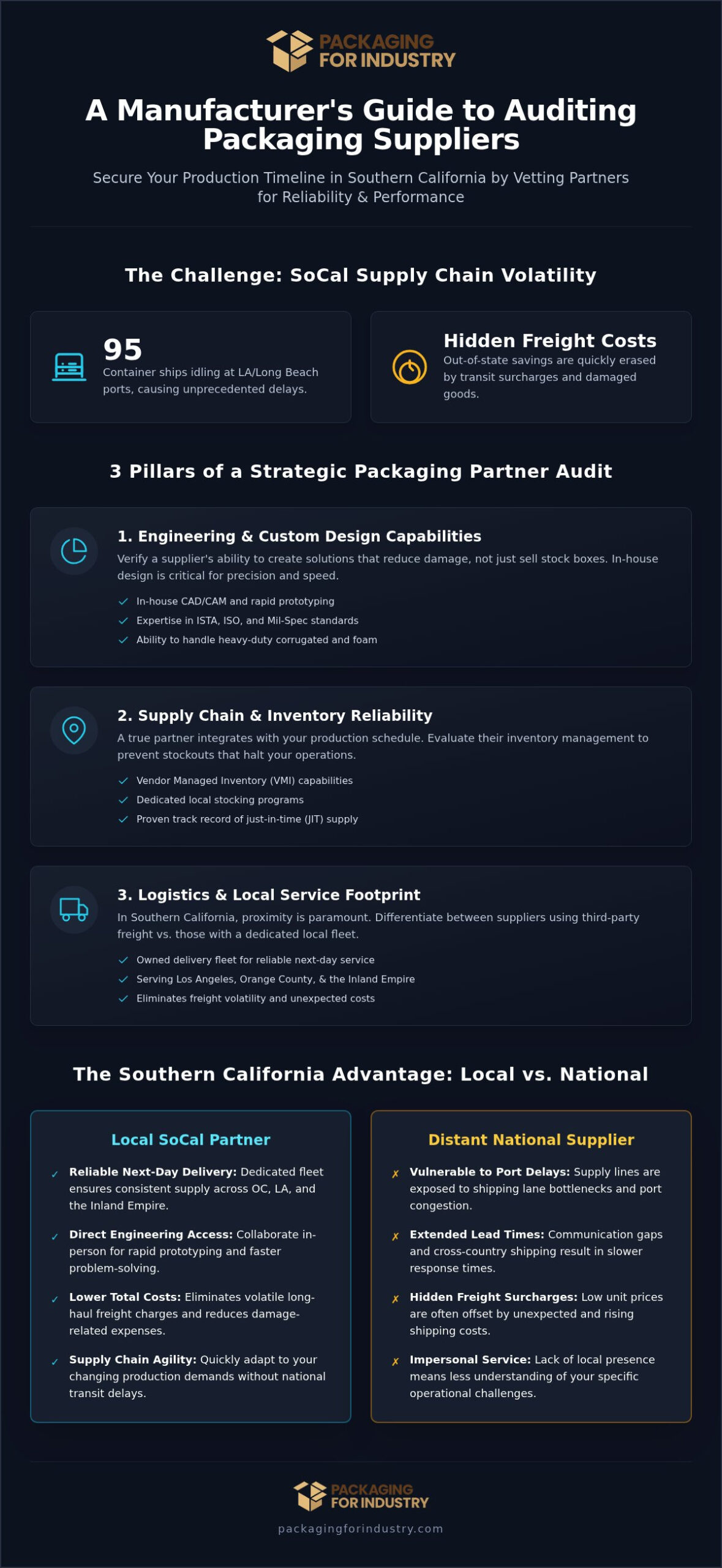
With 95 container ships currently idling at the Los Angeles-Long Beach harbor, relying on a distant packaging supplier is no longer just a logistical hurdle; it’s a direct threat to your production timeline. Utilizing a professional packaging supplier audit checklist Southern California manufacturers can trust is the first step toward reclaiming supply chain reliability. You’ve likely experienced the frustration of stockouts on custom boxes or discovered that out-of-state savings are quickly erased by hidden freight costs. It’s a common challenge for industrial operations in Anaheim and San Diego that need reliable, local support to keep lines running without interruption.
We agree that your packaging partner should be a proactive problem solver, not a source of professional stress. This guide will help you vet partners for engineering precision and logistical agility to keep operations lean. You’ll learn how to evaluate a supplier’s readiness for the new ISO 9001:2026 standards and California SB 54 reporting requirements while ensuring your custom corrugated boxes and protective foam meet the latest ISTA 3E-2026 testing protocols. We’ll also cover how to lower packaging costs, reduce shipping damage, and secure reliable next-day local delivery in Los Angeles and Orange County.
Key Takeaways
- Evaluate a supplier’s in-house CAD/CAM and prototyping capabilities to ensure custom-engineered solutions effectively reduce shipping damage for high-value components.
- Analyze the financial benefits of local logistical proximity, focusing on how a dedicated delivery fleet in Southern California lowers freight costs and improves lead-time reliability.
- Utilize this comprehensive packaging supplier audit checklist Southern California to vet potential partners on their Vendor Managed Inventory (VMI) capabilities and stocking programs.
- Learn to distinguish between third-party freight and local next-day delivery services to guarantee supply chain stability across Los Angeles, Orange County, and the Inland Empire.
- Master the process of requesting a packaging quote and conducting facility site visits to verify a supplier’s ability to handle heavy-duty corrugated and multi-material packaging requirements.
Why an Industrial Packaging Supplier Audit is Critical for SoCal Operations
Manufacturers in Southern California often treat packaging as a secondary concern until a stockout of custom corrugated boxes halts a production line. Utilizing a professional packaging supplier audit checklist Southern California operations can rely on helps identify these vulnerabilities before they impact your bottom line. A formal Quality audit of your provider ensures they operate as a strategic partner rather than just a catalog vendor. This shift allows you to uncover hidden costs like freight surcharges from out-of-state suppliers and the high price of “good enough” materials that fail during transit. Strategic partnerships focus on long-term stability. While a catalog buyer chases the lowest unit price, a strategic partner evaluates your entire supply chain to find efficiencies. This includes analyzing how your products are stacked on pallets or whether your edge protectors are truly necessary for your specific shipping lanes.
The Impact of Packaging on Production Flow
Shortages in the packaging department cause expensive shutdowns that ripple through your entire facility. In lean manufacturing, consistent supply is mandatory. If your protective foam or heavy-duty double-wall boxes don’t arrive on time, finished goods sit on the warehouse floor, tying up capital. Cheap boxes often lead to a higher total cost of ownership because they lack the engineering to reduce shipping damage. A reliable supplier integrates with your production schedule to maintain a steady logistical flow. They understand that a 10% saving on a box is irrelevant if it causes a 20% increase in product returns or a two-day delay in shipping high-value aerospace components.
Local vs. National: The Southern California Advantage
Sourcing from national suppliers introduces significant lead-time risks, especially given the current state of regional logistics. Recent data shows 95 container ships waiting at the Los Angeles-Long Beach harbor with median dwell times of 2 days. A packaging supplier in Anaheim or Los Angeles provides the agility needed to bypass these bottlenecks. Prioritizing local proximity offers specific operational advantages:
- Reliable local delivery: Owning a local fleet ensures next-day delivery across Orange County, San Diego, and the Inland Empire.
- Sustainability: Reducing the distance your stretch film and pallets travel lowers your carbon footprint and aligns with regional environmental goals.
- Engineering access: You get direct access to design teams for rapid prototyping of high-value components.
Auditing for a local service footprint is the most effective way to lower packaging costs by removing the freight volatility inherent in long-distance shipping. When you work with a partner who understands the local geography, you aren’t just buying a product; you’re securing a reliable link in your supply chain.
Audit Checklist: Engineering and Custom Design Capabilities
Engineering is the backbone of damage reduction in the industrial sector. A robust packaging supplier audit checklist Southern California manufacturers use must prioritize a supplier’s ability to design from scratch. Verify if they offer in-house CAD/CAM design and rapid prototyping. This capability allows for immediate adjustments to packaging geometry, ensuring a precise fit for high-value components. Suppliers who outsource design often suffer from extended lead times and communication gaps that result in poor fitment and increased shipping damage. It’s vital to ensure your partner understands industry-specific standards, such as mil-spec requirements for defense contracts or aerospace-grade protection levels.
Top-tier partners engineer multi-material solutions. This involves integrating corrugated boxes with custom foam inserts and wooden crates for a holistic approach. It’s essential to align these designs with supply chain best practices to optimize both protection and pallet density. Testing capabilities are equally important. Ask if they perform drop tests or vibration simulations to verify that their designs meet the latest ISTA 3E-2026 standards before you commit to a bulk order.
Custom Corrugated and Heavy-Duty Solutions
Evaluate the supplier’s range beyond standard RSC boxes. For heavy industrial parts, you need access to double-wall and triple-wall corrugated materials. Audit their capacity for specialized partitions and custom printing that enhances brand presence. A critical audit point is their ability to manufacture bulk bins and Gaylord boxes. These large-scale solutions are vital for moving mass quantities of components through the regional logistics network safely. If you require custom sizes, ensure they can manufacture them without the excessive lead times typical of national catalog vendors.
Protective Foam Engineering
Precision in foam is non-negotiable for electronics and medical devices. Verify that the supplier stocks various foam types including polyethylene, polyurethane, and anti-static ESD foam. Ask about their die-cut precision and assembly capabilities. High-quality custom foam packaging should be engineered to specific G-force ratings to protect against impact during transit. This engineering-first approach is what separates a strategic partner from a simple box reseller. If your current supplier can’t provide a prototype within 48 hours, they might be slowing down your product launches. You can request a packaging quote to see how an engineering-led design process improves your bottom line.
Audit Checklist: Supply Chain and Inventory Reliability
Inventory reliability is the difference between a smooth shift and a complete production halt. When evaluating your packaging supplier audit checklist Southern California providers, you must look beyond their manufacturing equipment. You need to assess their warehouse capacity and financial stability. A supplier without significant on-site storage for your specific stock is a liability. Ask about their stocking programs for long lead-time custom items like mailing tubes or heavy-duty triple-wall corrugated. If they don’t have the floor space to hold your safety stock, your supply chain is vulnerable to the next logistical bottleneck at the local ports. A comprehensive packaging supplier audit checklist Southern California manufacturers use must also include an assessment of emergency order protocols and rush delivery options.
The VMI Advantage for Manufacturers
Implementing a Vendor Managed Inventory program is the most effective way to prevent stockouts of custom boxes and stretch film. VMI shifts the burden of inventory tracking from your purchasing team to the supplier. This offloads packaging storage from your facility, freeing up valuable warehouse floor space for your own production or finished goods. It improves cash flow by ensuring you only pay for what you use through planned replenishment cycles. During your audit, ask for a detailed review of their VMI reporting. You need to know how often they perform physical counts and how they adjust stocking levels based on your seasonal demand spikes. This level of oversight ensures you never run out of critical materials during a high-volume fulfillment period.
Just-In-Time (JIT) Delivery Standards
Reliability in Southern California requires a partner capable of just-in-time inventory management. Audit their track record for on-time delivery across major hubs like Anaheim, Irvine, and Santa Fe Springs. Communication protocols are vital; your production team should have a direct line to their dispatch for emergency order updates. A supplier with a dedicated local fleet can offer rush delivery options that third-party freight carriers simply can’t match. Look for partners who manage recurring needs without requiring manual reordering every week. This automation reduces administrative overhead and ensures your stretch film and pallets are always available when the trucks arrive at your loading dock. To secure your supply chain, you can request a packaging quote that includes a managed inventory plan tailored to your volume.
Evaluating Logistics and Local Service Footprint
A critical line item on any packaging supplier audit checklist Southern California manufacturers use is the ownership of a local delivery fleet. Relying on third-party freight carriers introduces variables that your procurement team can’t control. Local ownership means the supplier dictates the delivery schedule, ensuring next-day reliability for stock industrial supplies without the risk of a carrier “bumping” your pallet for a higher-paying load. This logistical control is vital for maintaining a lean inventory of bulky items like corrugated boxes and stretch film. It’s the difference between a predictable morning arrival and a production shutdown caused by an empty loading dock. When a supplier owns their trucks, they’re accountable for the entire last mile, from their warehouse to your facility.
Southern California Service Zones
The geography of the region requires a partner who understands the specific bottlenecks of the 5, 405, and 91 corridors. Effective logistics support for Anaheim and Irvine hubs allows for rapid replenishment of high-volume manufacturing lines. Navigating the Inland Empire and San Diego distribution corridors requires a strategic warehouse location to minimize transit times and fuel surcharges. Utilizing local delivery is a primary tool for packaging cost savings because it eliminates the massive freight fees associated with shipping air and empty space from out-of-state providers. A local partner can often consolidate deliveries, reducing the number of trucks entering your facility and streamlining your receiving process.
Freight and Surcharge Mitigation
Freight costs often exceed the value of the packaging materials themselves. An experienced supplier understands local UPS and FedEx surcharge zones and how dimensional weight impacts your bottom line. They should proactively suggest optimized box sizing to reduce these regional shipping fees before they erode your margins. During your audit, ask if the supplier conducts regular packaging reviews for damage reduction and freight efficiency. Utilizing custom crates and pallets tailored to your specific product dimensions can significantly lower your total landed cost by improving truckload utilization. This level of logistical expertise ensures your high-value components reach the customer safely while keeping your shipping budget under control. It’s about engineering the logistics as carefully as the packaging itself.
Final Step: Requesting a Custom Packaging Quote and Site Visit
Completing your packaging supplier audit checklist Southern California requires moving beyond paperwork to physical verification. A site visit is the only way to confirm a supplier’s operational health and quality control standards. During a tour, observe the workflow between their CAD/CAM design lab and the production floor. Look for organized inventory management and the maintenance level of their conversion equipment. You’re searching for a partner who treats their facility with the same precision you apply to your own manufacturing line. This visit is also the ideal time to discuss their transition plan for ISO 9001:2026. Comparing total value against per-unit pricing is the final hurdle. A cheaper box that incurs higher freight or fails during transit is never the most economical choice. True savings come from engineering and logistical proximity.
Information Needed for an Accurate Quote
Structuring a custom packaging quote request properly is the key to maximum accuracy. You must provide specific data points to ensure the engineered solution matches your needs:
- Physical Specifications: Detailed dimensions, weight, and fragility levels of the component.
- Operational Requirements: Recurring monthly volumes and any specific storage or VMI needs.
- Compliance Standards: Mention if you require military packaging or aerospace-grade certifications.
Providing this level of detail allows a supplier to engineer for protection and cost-efficiency simultaneously. It’s the most effective way to compare packaging pricing across different providers fairly.
Securing Your Supply Chain with PFI
Securing your supply chain requires a partner who understands the unique pressures of the Southern California market. Packaging For Industry (PFI) combines industrial expertise with local logistical reliability. Our Anaheim headquarters serves as a hub for manufacturers in Irvine, San Diego, and Los Angeles who need next-day delivery and expert prototyping. We don’t just sell boxes; we provide a comprehensive system to lower packaging costs and improve your operational flow. Our team specializes in identifying inefficiencies that others miss, such as over-packaging or poor pallet utilization. You can request a packaging quote today to benchmark your current provider against our industrial standards. Scheduling a physical packaging review is the fastest way to identify immediate savings and eliminate the hidden costs of shipping damage.
Optimize Your Southern California Supply Chain
Implementing a rigorous packaging supplier audit checklist Southern California manufacturers can trust is the fastest way to eliminate operational bottlenecks. You’ve seen how local proximity and engineering expertise directly impact your bottom line by reducing shipping damage and removing hidden freight costs. A partner who offers free custom prototyping and understands the specific requirements of aerospace and industrial sectors provides more than just boxes. They offer a comprehensive system of total protection and logistical flow.
By prioritizing suppliers with their own delivery fleets and robust VMI programs, you secure the reliability needed to maintain lean manufacturing schedules. Local next-day delivery across Orange County, Los Angeles, and San Diego ensures you aren’t at the mercy of port congestion or third-party carrier delays. This proactive approach to logistics helps you manage recurring needs without administrative overhead. Transitioning from a catalog buyer to a strategic partnership creates a stable foundation for long-term growth and fiscal efficiency.
We look forward to helping you streamline your procurement and protect your high-value components with precision-engineered solutions.
Frequently Asked Questions
What are the most common red flags during a packaging supplier audit?
Red flags include a lack of in-house CAD/CAM design capabilities and reliance on third-party freight carriers for local orders. If a supplier can’t provide a prototype within 48 hours, they likely outsource their engineering. Another warning sign is a lack of physical inventory for your custom items. These gaps indicate a vendor who isn’t prepared to support the fast-paced requirements found in a packaging supplier audit checklist Southern California manufacturers use to ensure reliability.
How does local Southern California delivery impact my total packaging costs?
Local delivery dramatically lowers your total landed cost by eliminating expensive out-of-state freight surcharges. When you work with a packaging supplier near me in Anaheim, you benefit from next-day delivery across Orange County and Los Angeles. This proximity allows you to maintain leaner on-site inventory, freeing up valuable warehouse floor space. You aren’t paying to ship empty air across the country, which keeps your bulk packaging pricing competitive and your supply chain agile.
Can a packaging supplier help reduce my UPS or FedEx shipping surcharges?
Yes, a strategic partner reduces shipping fees by optimizing your box dimensions to minimize dimensional weight (DIM) charges. We conduct packaging reviews to identify where oversized stock boxes are triggering expensive UPS or FedEx surcharges. By engineering a custom corrugated box that fits your product precisely, we help you avoid unnecessary “Large Package” fees. This data-driven approach ensures your shipping budget is spent on product movement rather than avoidable carrier penalties.
What is the difference between stock packaging and custom-engineered solutions?
Stock packaging consists of standard sizes found in a catalog, which often leads to over-packaging and high damage rates. Custom-engineered solutions are designed specifically for your product’s weight, fragility, and shipping method. While a corrugated box quote for stock items might look cheaper per unit, custom designs often lower total costs by reducing material waste and shipping damage. Engineering-led solutions provide superior protection for high-value components while optimizing your pallet density.
How does a Vendor Managed Inventory (VMI) program work for industrial boxes?
A Vendor Managed Inventory (VMI) program involves the supplier monitoring your stock levels and replenishing materials based on actual usage. We perform weekly or biweekly physical counts at your facility to ensure you never face a stockout. This system eliminates the need for manual reordering and prevents capital from being tied up in excess inventory. It’s a proactive way to manage your stretch film quote and box supply without the stress of emergency orders.
Is it possible to get custom foam inserts designed for high-value aerospace parts locally?
Local design for aerospace components is a core strength for Southern California suppliers. We provide in-house CAD/CAM support and free prototyping for custom foam inserts in Anaheim. Whether you need polyethylene, polyurethane, or anti-static ESD foam, we engineer the protection level to meet specific G-force ratings. This local access allows for rapid design iterations, ensuring your high-value parts are secured within custom-lined crates or boxes before your production deadline.
What certifications should I look for in a military-spec packaging supplier?
Look for suppliers with proven expertise in military-spec packaging and heat-treated pallets for international export. A reliable partner understands the specific material requirements and labeling standards needed for defense contracts. They should offer weather-resistant corrugated and specialized barrier bags that meet stringent mil-spec codes. During your audit, verify their track record with aerospace and defense contractors to ensure they can handle the rigorous documentation and protection standards required for these high-stakes shipments.
How quickly can I get a prototype for a custom corrugated box design?
You can typically receive a physical prototype for a custom corrugated box design within 48 hours when working with a local engineering team. This speed is critical for manufacturers who need to validate a new design before a full production rollout. Rapid prototyping allows you to test the fit and protection levels immediately, preventing delays in your product launch. You can request a packaging quote to start the design process and see a sample before committing to bulk quantities.