
The lowest price in your favorite packaging catalog might actually be a significantly higher cost than it appears on your balance sheet. It’s easy to see why many procurement managers rely on the speed of national suppliers, but the sticker price rarely accounts for the hidden drain on your operations. When you analyze Uline pricing vs total cost of ownership from a packaging partner, it becomes clear that factors like the 2026 dimensional weight divisor of 139 and rising additional handling surcharges for large parcels can turn an “affordable” box into a liability by the time it reaches your dock.
You likely value the convenience of a ready-made inventory, but you’re also feeling the sting of hidden freight surcharges and the frustration of stockouts on critical custom sizes. We’ll explore why a strategic relationship saves you more than a one-off transaction. You’ll discover how a partner like PFI eliminates wasted warehouse space through Vendor Managed Inventory (VMI) and reduces shipping damage through better engineering. We’ll break down the math behind per-unit costs and show you how to reclaim floor space in expensive markets like Southern California, where industrial lease rates in Orange County now average $1.45 per square foot.
Key Takeaways
- Understand why catalog sticker prices are misleading and how analyzing Uline pricing vs total cost of ownership from a packaging partner reveals hidden expenses like freight surcharges and dimensional weight fees.
- Learn how custom-engineered corrugated boxes eliminate the “shipping air” tax by right-sizing your packaging to avoid UPS and FedEx oversized surcharges.
- Discover how Vendor Managed Inventory (VMI) programs free up valuable warehouse space and eliminate the administrative burden of tracking recurring packaging needs.
- Identify the fiscal advantages of local next-day delivery in Southern California, which replaces expensive national freight timelines with a more reliable, just-in-time supply chain.
- Gain a clear roadmap for transitioning to a strategic partner by auditing your full packaging spend, including unit costs, damage rates, and operational inefficiencies.
The Catalog Trap: Why Uline Sticker Prices Are Only the Beginning
The thick catalog sitting on a procurement manager’s desk represents a specific kind of operational ease. It promises immediate availability and a massive range of SKUs with just a few clicks. However, this convenience often masks a long-term threat to fiscal health. When evaluating Uline pricing vs total cost of ownership from a packaging partner, you must look past the per-unit sticker price. Catalog suppliers prioritize high-margin stock items that are engineered for general use rather than your specific application. This “one size fits most” approach often forces you to pay for excess material and shipping air.
Industrial buyers frequently fall into the trap of repeated small orders. While this keeps inventory low on paper, the cumulative administrative and freight costs are staggering. Every transaction carries an overhead cost. By treating packaging as a series of isolated purchases rather than a strategic system, companies ignore the broader Total Cost of Ownership (TCO) of their supply chain. You’re not just buying a box; you’re funding a massive distribution network that might not be optimized for your bottom line.
The Reality of Catalog Markup
National distributors operate on a retail-style pricing model. Their list prices are set to maximize profit on low-volume, transactional buyers. If you’re a high-volume industrial user, you’re effectively subsidizing the logistics and inventory overhead required to serve those small, one-time customers. A partnership mindset shifts the focus toward optimization. Instead of paying a premium for a supplier’s massive warehouse network, you can leverage a partner that aligns its inventory with your actual production schedule. This transition moves you away from a convenience tax and toward a model where pricing reflects your specific volume and engineering requirements.
Hidden Fees: Freight and Surcharges
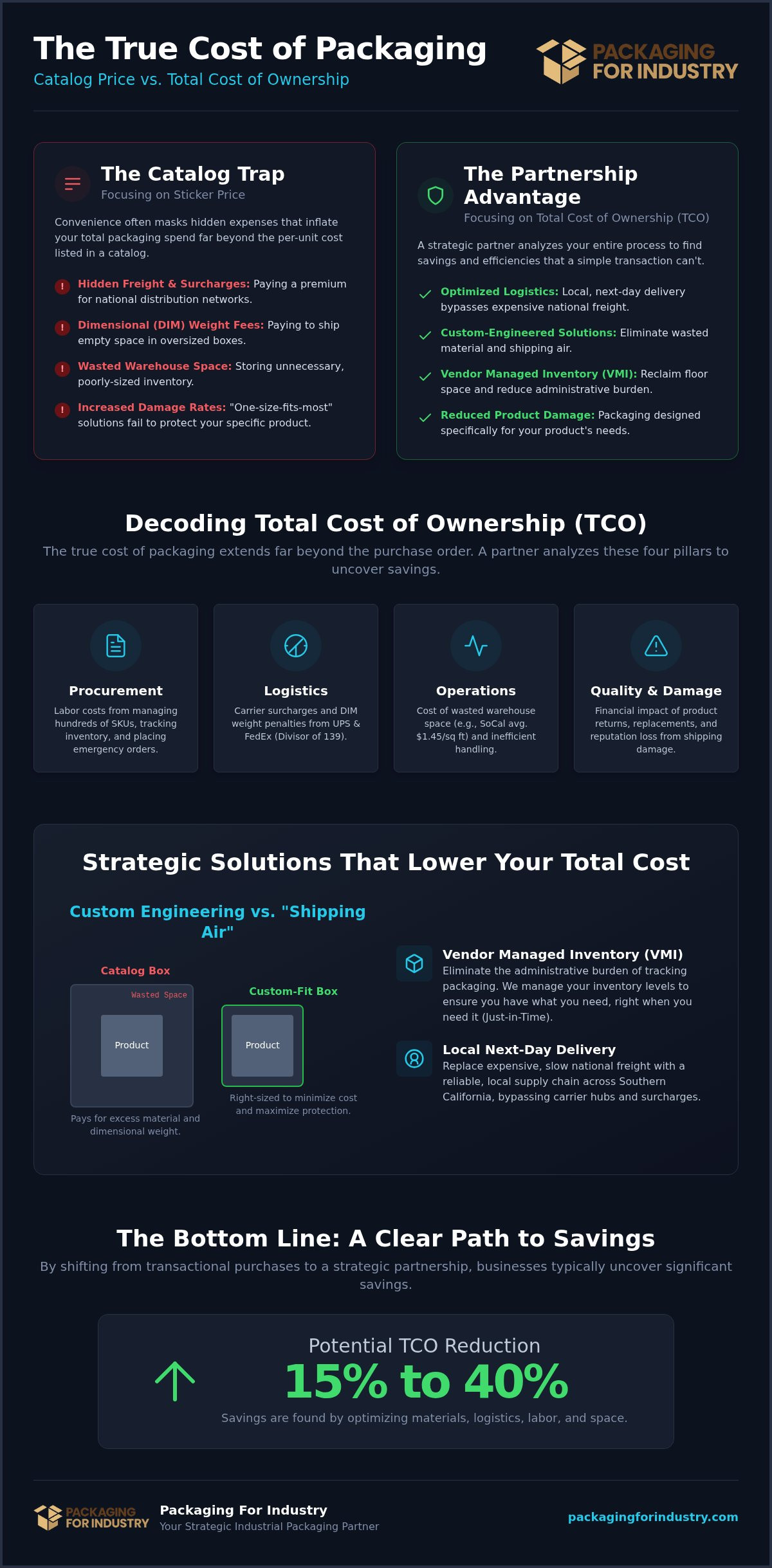
The most significant drain on a packaging budget often happens after the box leaves the supplier. Catalog orders are subject to national freight rates and carrier surcharges that can double the effective cost of a shipment. Dimensional weight (DIM) is a critical factor here. Carriers like UPS and FedEx use a divisor of 139 to calculate billable weight. If a catalog box is slightly larger than necessary, you pay for the empty space inside every time you ship a product.
Many national suppliers offer “free shipping” thresholds, but these costs are usually baked into inflated unit pricing. You avoid these traps by utilizing local packaging delivery in Southern California. Local logistics bypass the massive freight hubs and residential delivery networks that drive up national shipping rates. Sourcing closer to your point of use eliminates the surcharges that make catalog shopping so expensive for industrial applications.
Decoding Total Cost of Ownership (TCO) in Industrial Packaging
A low price on a purchase order is a poor indicator of long-term profitability. While catalog suppliers emphasize the unit cost, a strategic partner evaluates the entire lifecycle of the material. Total Cost of Ownership is the sum of all costs associated with the purchase, delivery, storage, and performance of a packaging material. Comparing Uline pricing vs total cost of ownership from a packaging partner reveals that the true expense of packaging is divided across four key pillars: Procurement, Logistics, Operations, and Quality.
A packaging partner identifies “invisible” waste that a standard website cannot detect. This includes the time your staff spends managing stockouts or the financial impact of using a box that’s slightly too weak for your product’s weight. By auditing these pillars, businesses often uncover cost savings of 15% to 40% simply by optimizing the system rather than chasing the lowest per-unit bid. It’s about looking at the flow of materials through your facility rather than just the transaction at the point of sale.
Procurement and Administrative Labor
Managing a packaging supply chain is labor-intensive. Your team might spend hours tracking hundreds of individual SKUs and issuing emergency purchase orders when stock runs low. These administrative tasks add a significant layer of indirect cost, especially when you consider that 50% to 70% of warehouse operating costs are typically labor. Implementing Vendor Managed Inventory (VMI) removes this burden by shifting the responsibility of stock monitoring to the supplier. This streamlines the quote-to-delivery cycle and ensures your production line never stops due to a missing component. If you’re struggling with the administrative weight of high-volume orders, a customized cost-reduction analysis can clarify where your labor hours are being wasted.
Storage Costs and Warehouse Efficiency
Warehouse space is one of the most expensive assets in modern manufacturing. In 2026, industrial lease rates in Orange County average $1.45 per square foot, while Los Angeles County rates have reached nearly $19.47 per square foot annually. Storing bulky, off-the-shelf corrugated boxes takes up valuable real estate that could be used for revenue-generating production. Utilizing just-in-time inventory management allows you to keep only what you need on-site. This model reduces the risk of obsolete inventory and frees up capital that would otherwise be tied up in excess stock. When you stop paying to store “shipping air,” your operational efficiency improves immediately.
Custom Engineering vs. Off-the-Shelf: Impact on Your Bottom Line
Selecting a box from a catalog often involves choosing the “closest” size, which inevitably leads to the hidden cost of shipping air. When you compare Uline pricing vs total cost of ownership from a packaging partner, the fiscal impact of these oversized containers becomes apparent. Every inch of excess space requires expensive void fill and triggers higher dimensional weight charges. By switching to custom corrugated boxes, manufacturers can eliminate the “Additional Handling” surcharges applied to packages exceeding 48 inches or specific cubic volumes, which are common triggers in 2026 carrier rate structures.
Precision engineering does more than just lower freight bills. In one case study, a manufacturer saved 20% in total shipping volume by replacing generic stock boxes with custom-engineered inserts. This reduction didn’t just lower per-unit shipping costs; it also maximized pallet density, allowing for more product per truckload. Integrating protective foam packaging ensures that these tighter tolerances don’t compromise safety during the rigors of transit.
Engineering for Damage Reduction
The true cost of a damaged shipment extends far beyond the price of the replaced item. You must account for a cascade of expenses that catalog suppliers rarely mention:
- Replacement product manufacturing and material costs.
- Expedited return and reshipment freight charges.
- Warehouse labor required for inspection, restocking, and RMA processing.
- The long-term erosion of brand reputation and customer trust.
Catalog solutions often lack the specificity needed to protect sensitive industrial components. Through custom design packaging, engineers identify specific transit vulnerabilities like vibration or drop-shock. PFI provides free prototyping for these designs, ensuring the solution performs in the real world before you commit to a full production rollout.
Material Optimization
Over-packaging is as fiscally irresponsible as under-packaging. Many buyers default to expensive triple-wall corrugated when a double-wall box reinforced with corner and edge protection would provide superior durability at a lower cost. A strategic partner looks for these opportunities to downgauge materials without sacrificing integrity. By integrating multiple materials like foam, wood, and corrugated into a single engineered solution, you achieve a balance of weight and strength that off-the-shelf options cannot match. This methodical approach to material selection is a cornerstone of reducing your total packaging spend.
Operational Efficiency: VMI and Local Logistics Savings
A website’s “In Stock” badge is a snapshot of a supplier’s warehouse, but it offers no guarantee for your specific production schedule. When your operations rely on a national catalog, you’re vulnerable to carrier delays and hub congestion that can halt your assembly line. A partnership model replaces this uncertainty with actual reliability. PFI’s VMI programs prevent production stops by proactively monitoring usage levels. This proactive management is a critical factor when analyzing Uline pricing vs total cost of ownership from a packaging partner. While a catalog charges you for the convenience of a transaction, a partner invests in the continuity of your business.
The Southern California Advantage
Proximity is a significant driver of logistics efficiency. For manufacturers in Anaheim and Los Angeles, local delivery eliminates the high freight costs and unpredictable timelines of national shipping. You aren’t just saving on transport; you’re reducing the carbon footprint of your supply chain by shortening the distance between the source and your dock. Communication also becomes more direct. Instead of explaining your unique requirements to a rotating cast of call center agents, you work with a dedicated account manager who understands your facility’s layout and production rhythm. This local expertise ensures that your packaging arrives exactly when it’s needed, not when a national carrier’s route happens to allow it.
Simplifying the Production Line
Labor is the largest variable in warehouse operating costs, often accounting for 50% to 70% of the total spend. You can reclaim these labor hours by utilizing packaging kitting services. Rather than having your team pull components from multiple pallet locations, they receive ready-to-use kits delivered directly to their stations. This efficiency extends to your procurement and receiving docks as well. You can consolidate your supply chain by integrating stretch film and pallets into a single local delivery.
This consolidation also improves your cash flow. Instead of tying up capital in massive catalog orders that sit on your floor for months, you pay for packaging as you use it. This just-in-time model is a much more efficient use of your budget and your physical space. When you stop paying to store and manage excess inventory, the gap between Uline pricing vs total cost of ownership from a packaging partner becomes even wider. You gain a leaner operation that responds faster to changes in demand without the risk of obsolete stock.
Making the Switch: How to Transition to a Strategic Packaging Partner
Moving away from a transactional relationship with a national distributor is a strategic business decision that requires a clear roadmap. To accurately evaluate Uline pricing vs total cost of ownership from a packaging partner, you must move beyond the simple comparison of line-item prices. A successful transition follows a structured process that prioritizes long-term operational health over short-term convenience. By re-engineering your procurement logic, you shift from a model of “buying boxes” to one of “optimizing logistics.”
- Step 1: Conduct a full packaging spend audit. Gather data on unit costs, annual freight expenses, and historical damage logs to see the complete picture of your current spend.
- Step 2: Identify problem SKUs. Focus on high-volume items and custom-sized containers that frequently trigger dimensional weight surcharges or require excessive labor to pack.
- Step 3: Request a packaging quote. Use your audit data for a direct comparative analysis that includes engineering recommendations.
- Step 4: Pilot a stocking or VMI program. Start with your most critical items to stabilize your production line and prove the reliability of the partnership before scaling across all categories.
Transitioning from a catalog supplier to a partner like PFI typically yields between 15% and 40% in packaging cost savings. These results are achieved by eliminating the “convenience tax” and logistics waste that characterize off-the-shelf procurement models.
Preparing for Your Packaging Review
Effective reviews rely on precise data. Have your annual usage reports, current freight bills, and RMA logs ready for analysis. This documentation allows a specialist to identify “low-hanging fruit”—inefficiencies like over-engineered boxes or excessive void fill—that offer immediate cost reduction opportunities. We recommend inviting a consultant for an on-site warehouse walkthrough to observe your packing process in real-time. This often reveals labor bottlenecks and material waste that aren’t visible on a standard spreadsheet.
The PFI Commitment
PFI operates as an industrial consultant rather than a faceless catalog. Our focus remains on recurring industrial needs where precision and reliability are mandatory. Whether you operate in the Aerospace, Medical, or Manufacturing sectors, we understand the specific regulatory and durability standards your products must meet. We provide the engineering depth and local logistics support that national distributors cannot replicate. Our goal is to serve as a steady, dependable “fixer” for your supply chain challenges. Ready to lower your packaging costs? Request a quote today.
Optimizing Your Supply Chain for Long-Term Profitability
Catalog convenience serves a purpose for one-time needs. Industrial operations require a more methodical approach to procurement. By analyzing Uline pricing vs total cost of ownership from a packaging partner, you can uncover significant inefficiencies in your current logistics and storage workflows. Moving beyond the sticker price allows you to capture between 15% and 40% in total cost savings through engineered custom corrugated boxes and reduced shipping damage.
A partnership with PFI provides more than just materials. It delivers peace of mind through next-day local delivery across Southern California and specialized engineering support for the aerospace, medical, and manufacturing sectors. You’ll reclaim valuable warehouse space and eliminate the administrative burden of tracking recurring inventory. This transition turns your packaging from a series of expenses into a streamlined system of protection and efficiency.
Your bottom line deserves a packaging system designed for precision and durability.
Frequently Asked Questions
How much can I actually save by switching from a catalog supplier to PFI?
Most industrial clients realize a 15% to 40% reduction in their total packaging spend. This isn’t just about unit price; it’s the result of analyzing Uline pricing vs total cost of ownership from a packaging partner. We eliminate hidden freight surcharges and reduce material waste through better engineering. By optimizing box sizes and material grades, you stop paying for shipping air and excessive void fill.
Does PFI offer next-day delivery like national catalog companies?
Yes, we provide reliable next-day delivery throughout Southern California, including Orange County and Los Angeles. Our local logistics network allows us to bypass the national freight delays and surcharges that often plague catalog orders. Because we’re close to your dock, we can respond faster to production spikes without the high costs of expedited shipping. This proximity is a cornerstone of our just-in-time service model.
Can PFI handle custom corrugated boxes and foam inserts that Uline doesn’t stock?
Custom design is our core specialty. While catalog suppliers focus on high-margin stock items, we engineer custom corrugated boxes and die-cut foam inserts tailored to your specific product dimensions. We combine multiple materials like polyethylene foam and double-wall corrugated into integrated solutions. This ensures superior protection for sensitive industrial components that off-the-shelf packaging simply cannot accommodate. Our engineering team prioritizes your product’s safety and transit efficiency.
What is the minimum order quantity for custom-engineered packaging?
We focus on recurring industrial needs and bulk quantities. Our programs are designed for manufacturers and warehouses that use packaging materials on a weekly or monthly basis. Minimums vary based on the complexity of the custom design and material requirements. We prioritize building long-term stocking programs that ensure you have a consistent supply for your production lines, which is more efficient than one-time retail-style purchases.
How does a Vendor Managed Inventory (VMI) program work for my warehouse?
Our VMI program involves scheduled on-site inventory reviews conducted by a dedicated account manager. We monitor your actual usage levels and replenish stock based on agreed-upon minimum and maximum levels. This proactive approach is a key part of improving Uline pricing vs total cost of ownership from a packaging partner. You only store what you need, which frees up valuable warehouse floor space and improves your overall cash flow.
Can PFI support nationwide shipping if I have locations outside of Southern California?
We offer nationwide support through an extensive network of distribution and manufacturing partners across the United States. While our primary fleet services Southern California, we can manage recurring packaging programs for clients with multiple locations. This ensures consistency in packaging quality and design across your entire supply chain. Our team coordinates the logistics to maintain your stocking levels regardless of where your facilities are located.
Do I need to pay for prototypes and packaging design?
We provide free prototyping and CAD/CAM support for custom designs to ensure a perfect fit before full production begins. This service allows you to test the packaging’s performance against vibration and drop-shock in real-world conditions. By verifying the design early, we eliminate the risk of expensive errors or product damage during the initial rollout. It’s part of our commitment to engineering-led cost reduction and technical precision.
What industries does PFI specialize in for custom packaging solutions?
We specialize in sectors that require high-performance protection, including aerospace and defense, medical device manufacturing, and electronics. Our team understands the rigorous standards of these industries, such as mil-spec requirements and cleanroom packaging needs. We also serve the automotive and industrial equipment sectors, providing heavy-duty solutions for fragile or high-value components. Our expertise is built around the technical utility and durability required for professional industrial applications.