
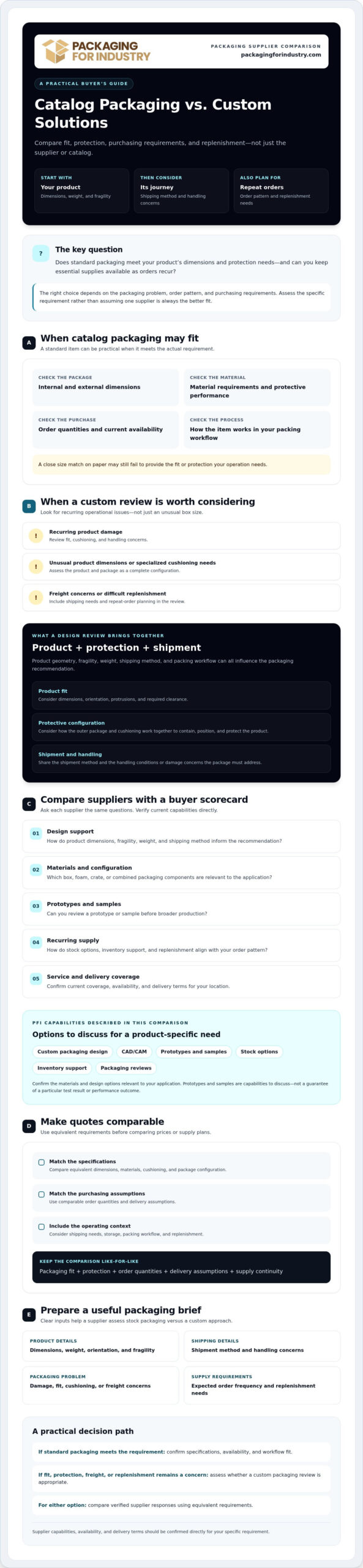
The easiest packaging to order isn’t always the best fit for your product or supply plan. In the standard catalog versus Packaging For Industry (PFI) packaging for custom solutions comparison, the key question isn’t just which supplier has the right box in a catalog. It’s whether standard packaging meets your product’s dimensions and protection needs, and how you’ll keep essential supplies available as orders recur.
Catalog purchasing can be practical for standard requirements. But if products arrive damaged, excess packaging is increasing freight exposure, or replenishment is difficult to coordinate, it may be time to assess a custom approach. Those are real operational concerns, and the right choice depends on your packaging problem, order pattern, and purchasing requirements.
This article compares catalog buying with PFI’s custom packaging design, prototypes and samples, stock options, and inventory support. You’ll learn what to compare in like-for-like quotes, including packaging fit, protection, order quantities, and replenishment needs. That gives you a practical basis for choosing a packaging supplier and evaluating whether a custom solution can support more dependable operations.
Key Takeaways
- Use the Uline vs PFI packaging for custom solutions comparison to assess your specific packaging requirement, not just the supplier’s catalog or name.
- Evaluate the design process by asking how product dimensions, fragility, weight, and shipping method inform packaging recommendations.
- Use a buyer scorecard to compare verified responses on design support, materials, prototypes, recurring supply, and service coverage.
- Compare quotes using equivalent specifications, quantities, and delivery assumptions, then consider how each option fits your shipping and storage needs.
- Explore whether PFI’s corrugated boxes, foam, stretch film, crates, and packaging kitting align with your custom or recurring industrial packaging needs.
Uline vs. PFI Packaging: Start With the Packaging Problem
Are you sourcing a standard packaging item, or trying to solve a specific problem with fit, protection, freight, or replenishment? That’s the first decision in the Uline vs PFI packaging for custom solutions comparison. Custom packaging solutions are designed around a product, shipment, or recurring process rather than selected only from standard dimensions.
The goal isn’t to assume one supplier is better. It’s to determine which option fits your operation. Start with the product’s dimensions and weight, the protection it needs, how it ships, how often you order, and how you replenish supplies. These details help you compare a standard item with a custom design on equivalent requirements. Packaging also serves several functions, including containing and protecting goods, as outlined in this overview of Packaging.
When catalog packaging may meet the requirement
A standard box or other catalog item may be a sensible choice when its dimensions, material, and protective performance suit the product and shipping process. Before ordering, confirm internal and external dimensions, material requirements, order quantities, and current availability with the supplier. Check how the item handles your actual packing workflow, too. A close size match on paper may not provide the fit or protection your operation requires.
When a custom packaging review is worth considering
Recurring damage, unusual product dimensions, specialized cushioning needs, or freight concerns can signal that standard packaging deserves another look. For example, a component that shifts inside a box may need a more deliberate combination of container and cushioning. A custom review can assess how a box, foam, crate, or other packaging elements work together instead of treating each item as a separate purchase.
PFI offers custom packaging design services, including design support, prototypes and samples, and packaging reviews. Those steps can help buyers evaluate fit before broader production. Explore custom packaging design services to see how a review may support a product-specific requirement. For Southern California buyers, also confirm current delivery coverage and terms as part of supplier selection.
Bring useful details to the discussion: product dimensions and weight, how it’s oriented in the package, the shipment method, damage or handling concerns, and expected order frequency. A clear brief helps a packaging supplier assess whether stock packaging is adequate or whether custom packaging solutions may better align with protection, packing efficiency, and replenishment needs.
How Custom Packaging Engineering Changes the Supplier Comparison
A supplier comparison should consider the process behind a packaging recommendation, not only the finished box or material. Ask what information each supplier needs, how it evaluates the product and shipment, and whether it can support design review and fit testing. In the Uline vs PFI packaging for custom solutions comparison, verify each supplier’s current capabilities directly rather than assuming either one does or doesn’t provide a particular service.
Product geometry, fragility, weight, and shipping method all influence design. A part with protrusions may need clearance and shaped cushioning; a heavy component may call for a different container approach than a lightweight one. The design review should also account for how the team packs the item and how it moves through transit and handling.
Custom packaging design brings product fit, cushioning needs, and shipment conditions together to guide the choice of materials and package configuration.
Assessing boxes, foam, and integrated protection
Depending on the requirement, a solution may involve custom corrugated boxes, protective foam, foam inserts, or a crate. Each component has a role: the outer package contains the shipment, while cushioning helps position and protect the product inside. Combining materials can be useful when one component alone doesn’t address the full requirement. PFI offers corrugated box solutions as well as foam packaging; confirm the materials and design options relevant to your application with the supplier.
PFI’s custom design support includes CAD/CAM, prototypes, and samples. These are capabilities to discuss during evaluation, not a promise of a particular test result or performance outcome. Ask how the proposed design relates to your product dimensions, packing process, and shipping conditions, and what information the supplier needs to assess the application.
Validating a design before repeat purchasing
A prototype or sample gives your team an opportunity to assess fit and packing steps before considering a broader rollout. Record product orientation, how employees load and close the package, any damage observations, and the shipment conditions. This creates a useful basis for discussing design adjustments and comparing a custom packaging quote with an equivalent standard option.
For crate applications, include handling and transit requirements in the review. Document the product’s support points and how the load will be secured, then ask the supplier to explain how its proposed design addresses those needs. These details make supplier responses easier to compare and help purchasing and operations teams assess the full packaging process.
Once the requirements are documented, you can request a custom packaging quote based on the product, packing process, and shipment details.
Uline vs. PFI: Compare Custom Packaging Suppliers With a Buyer Scorecard
A side-by-side scorecard turns the Uline vs PFI packaging for custom solutions decision into a review of verifiable requirements. Ask both suppliers the same questions, record their current responses, and compare the details against your operation. Confirm Uline’s current capabilities and terms directly before drawing conclusions. Confirm PFI’s delivery coverage and terms, too.
| Criterion | Buyer question | Uline verified response | PFI verified response |
|---|---|---|---|
| Design support | Can the supplier assess the product, shipment, and current packaging problem? | Record confirmed scope and terms. | Record confirmed scope and terms. |
| Materials | Which relevant packaging materials can be considered together? | Record verified options. | Record verified options. |
| Samples and prototypes | Are samples or prototypes available, and what steps are involved? | Record confirmed process. | Record confirmed process. |
| Recurring supply | How are repeat orders, lead times, and replenishment handled and confirmed? | Record confirmed process and terms. | Record confirmed process and terms. |
| Geographic service | Does delivery coverage and timing fit your shipping locations? | Record current coverage and terms. | Record current coverage and terms. |
Questions to include in a supplier comparison
Ask each packaging supplier to explain how it would evaluate your product and shipment, not just quote a material. Clarify which materials, samples, or prototype steps are relevant to the project. For ongoing needs, request confirmed information on ordering, lead times, and replenishment so purchasing can assess supply continuity rather than relying on assumptions.
Match the scorecard to the operation
Weight the criteria according to how packaging is used. Manufacturers may prioritize repeatability, production continuity, and replenishment of custom items. Warehouses and distributors should consider storage space, order frequency, and the variety of packaging supplies they manage. For aerospace or other sensitive goods, document protection requirements and validate applicable specifications with qualified stakeholders and the supplier.
For Southern California operations, include local delivery coverage and current terms in the comparison. PFI also states nationwide shipping capabilities; confirm service details for the destinations and order pattern your business requires. For recurring packaging needs, ask whether PFI’s vendor managed inventory program aligns with your replenishment process. A completed scorecard makes differences visible and gives procurement, operations, and warehouse teams a shared basis for evaluating suppliers.
Compare Total Packaging Fit, Shipping Impact, and Supply Continuity
A low unit quote doesn’t show the full operating cost of packaging. To compare packaging pricing fairly, use the same specifications, order quantities, and delivery assumptions, then review how each option affects packing work, shipping, storage, and replenishment. This gives the Uline vs PFI packaging for custom solutions decision a practical basis beyond the quoted price.
- Document the current package. Record its dimensions, materials, cushioning, packing steps, and the product it holds. Note where the package fits well and where it creates extra work or unused space.
- Review shipping issues. Track damage observations, product movement, and shipment methods. For parcel shipments, use actual package dimensions and the carrier’s current rules to assess potential dimensional-weight charges or other surcharges. Confirm applicable terms with UPS or FedEx.
- Map order patterns and storage. Review usage by packaging item, order frequency, available warehouse space, and production schedules. Include emergency purchases or stockouts in the assessment.
- Compare equivalent quotes. Ask suppliers to quote the same material, dimensions, quantity, and delivery assumptions. Clarify minimums, lead times, quote validity, and terms for repeat orders, including any bulk packaging pricing.
Review packaging costs beyond the unit quote
Compare more than the cost per box or material. Consider packing labor, product damage, freight impacts, storage requirements, and the purchasing effort tied to urgent orders. A change in package dimensions or protection may affect several of these factors, so use your own shipment and operational data to assess whether a different design could help lower packaging costs. Don’t treat potential savings or damage reduction as guaranteed outcomes.
Ask each supplier to explain quote assumptions and recurring-order terms before comparing totals. PFI’s packaging cost savings approach can be a relevant next step for businesses reviewing packaging performance and expenses.
Evaluate replenishment for recurring packaging needs
Set stocking levels only after reviewing actual usage, lead times, storage space, and production schedules. For repeat-use materials, vendor managed inventory or just-in-time programs may help coordinate replenishment with operational demand. Ask how the program works, what information your team must provide, and how availability and delivery timing are confirmed.
For Southern California operations, include local packaging delivery coverage and current terms in your comparison. Assess supply continuity alongside packaging fit to see whether a supplier’s replenishment process supports production and warehouse planning.
When PFI Is a Strong Fit for Custom Industrial Packaging
PFI is worth evaluating when stock packaging doesn’t resolve a specific fit or protection issue, when multiple materials need to work together, or when recurring orders require a more coordinated supply plan. Its offerings include corrugated boxes, foam packaging, stretch film, crates, and packaging kitting. PFI serves industrial buyers in sectors such as aerospace, electronics, medical device manufacturing, food and beverage, and industrial equipment.
As a Southern California industrial packaging supplier, PFI supports local businesses and ships nationwide. Local next-day delivery across Southern California and nationwide shipping are stated capabilities, but confirm current coverage, availability, and delivery terms for your location and order. For custom design support, review PFI’s custom packaging design services. Recurring-use materials may also be evaluated for stocking, vendor managed inventory, or just-in-time inventory management based on your operational requirements.
What to include in a custom packaging quote request
A clear request helps the supplier evaluate the application and prepare a quote based on useful details. Gather:
- Product dimensions, weight, fragility, and orientation in the package.
- Shipment method and any current damage or packing concerns.
- Estimated order quantities, repeat frequency, storage constraints, and required materials.
- Available product drawings, photos, samples, or details of the current packaging.
Include how the item is packed today and what needs to change. If you’re requesting multiple packaging components, identify where they’ll be used together so the supplier can assess the full requirement. For recurring orders, share usage patterns and replenishment expectations to support a relevant supply discussion.
Move from comparison to a practical next step
A packaging review may be useful if standard options haven’t addressed product fit, protection, or repeat supply needs. Compare supplier responses against your documented requirements, and confirm design scope, materials, sample or prototype steps, order terms, and delivery conditions before making a purchasing decision. The goal is to identify a solution that suits your operation.
Decision checklist: Do you need custom sizes? Must materials work together? Would a sample help your team assess fit? Are recurring orders difficult to coordinate? Use those requirements to guide your supplier conversation.
Choose the Packaging Partner That Fits Your Operation
The Uline vs PFI packaging for custom solutions decision comes down to your product, shipping requirements, and supply pattern. Standard packaging may suit a straightforward need; a custom review may be worth exploring when fit, protection, or replenishment remains a challenge. Compare equivalent specifications and quote assumptions, then weigh packaging performance alongside ordering and storage requirements.
PFI is an option to evaluate for custom industrial packaging needs, with design support that includes prototypes and samples. PFI can also combine packaging materials and offers stocking programs for recurring needs. These capabilities can help your team assess design fit and plan replenishment, but the right approach depends on your documented requirements and confirmed supplier terms.
Bring product dimensions, shipping details, current packaging concerns, and expected order patterns to the next supplier conversation. A clear brief helps you compare responses and identify a practical path toward reliable packaging supply.
With the right information in hand, you can move forward with greater confidence and choose packaging that supports your operation.
Frequently Asked Questions
Is Uline or PFI better for custom packaging?
The better fit depends on your packaging requirements and purchasing pattern. Compare current supplier capabilities, quote assumptions, product fit, protection needs, and replenishment terms rather than relying on a general ranking. The Uline vs PFI packaging for custom solutions decision should be based on verified responses to your specific requirements. For a standard item, compare availability and ordering terms; for a complex or recurring need, ask about design support and supply planning.
Can PFI make custom boxes and foam inserts?
Yes. PFI offers custom packaging design services, corrugated boxes, and foam packaging, including custom box and foam insert solutions. The design process can include CAD/CAM support, prototypes, and samples, which give teams a way to review fit before broader production. Share product dimensions, weight, and protection requirements so PFI can assess the application and confirm suitable materials and project details.
How do I compare custom packaging quotes from Uline and PFI?
Request quotes using the same product dimensions, materials, quantities, and delivery assumptions. Compare more than the unit price: check any minimums, lead times, sample or prototype steps, and recurring-order terms. Ask suppliers to clarify what each quote includes and verify current capabilities directly. If packaging affects freight or damage concerns, include those operational factors in your evaluation rather than treating the lowest initial quote as the only measure.
What information should I provide for a custom packaging quote?
Provide product dimensions, weight, fragility, and orientation, along with the shipping method and any current damage or packing concerns. Include estimated order quantities, repeat frequency, storage constraints, and materials you’re considering. Drawings, photos, samples, or details of the current packaging can help clarify the application. For repeat orders, share usage patterns and production schedules so the supplier can discuss replenishment requirements alongside the packaging design.
Can custom packaging help reduce shipping damage or freight costs?
Custom packaging may help address product movement, inadequate cushioning, or excess package size, but results depend on the product, design, and shipping conditions. Review damage records and actual shipment dimensions, then check current carrier rules for any potential dimensional-weight or surcharge exposure. Ask suppliers to assess the package against your documented needs. Use your shipment and cost data to evaluate possible improvements, not as a basis for assuming guaranteed savings or damage reduction.
Does PFI offer recurring packaging supply programs?
Yes. PFI offers vendor managed inventory and just-in-time inventory management for packaging, along with stocking programs for recurring needs. These options may suit businesses that regularly use custom boxes, foam, stretch film, or other packaging materials. Before setting up a program, review actual usage, lead times, production schedules, and available storage space with the supplier. Confirm replenishment processes and terms based on your operation’s requirements.
Does PFI serve businesses outside Southern California?
Yes. PFI is based in Southern California and supports businesses nationwide through shipping and distribution partners. Local next-day delivery is a stated capability across Southern California, while nationwide shipping is also available; confirm current coverage, delivery timing, and terms for your locations and order. Businesses with multiple sites should share destination details and recurring needs when evaluating whether a supply program can support their operation.