
A pallet that looks wrapped isn’t necessarily secure; this is especially true when jagged edges and protruding components are involved. You likely know the frustration of seeing a carrier reject an unstable shipment or dealing with high freight damage claims because your film zippered on a sharp corner. Securing these complex profiles is a constant challenge for warehouse teams in Southern California hubs like Orange County and Los Angeles. Simply adding more layers isn’t the answer. It’s often a waste of material that fails to address the root cause of instability.
Using the right stretch film for securing irregular shaped loads requires a strategic focus on containment force and puncture resistance. We agree that transit damage is an unacceptable drain on your bottom line and operational efficiency. This guide provides the professional techniques and material selection strategies you need to stabilize complex industrial loads and achieve zero-damage shipments. You’ll learn how to choose between blown and cast films, identify critical wrap points, and standardize your process to lower costs while improving reliability across your entire supply chain.
Key Takeaways
- Blown stretch film is the preferred choice for irregular loads due to its superior puncture resistance against sharp protrusions and jagged edges.
- Mastering the use of stretch film for securing irregular shaped loads involves a two-phase process of load leveling and precise pallet anchoring.
- Containment force is the critical metric for stability; use the “Push Test” to verify that complex loads won’t shift during LTL transit.
- Integrating film with custom foam inserts and corner protection creates a unified containment profile that significantly reduces freight damage claims.
- Standardizing your wrapping process and utilizing Vendor Managed Inventory (VMI) ensures consistent material availability and lower operational costs.
The Logistics Challenge of Securing Irregular Shaped Loads
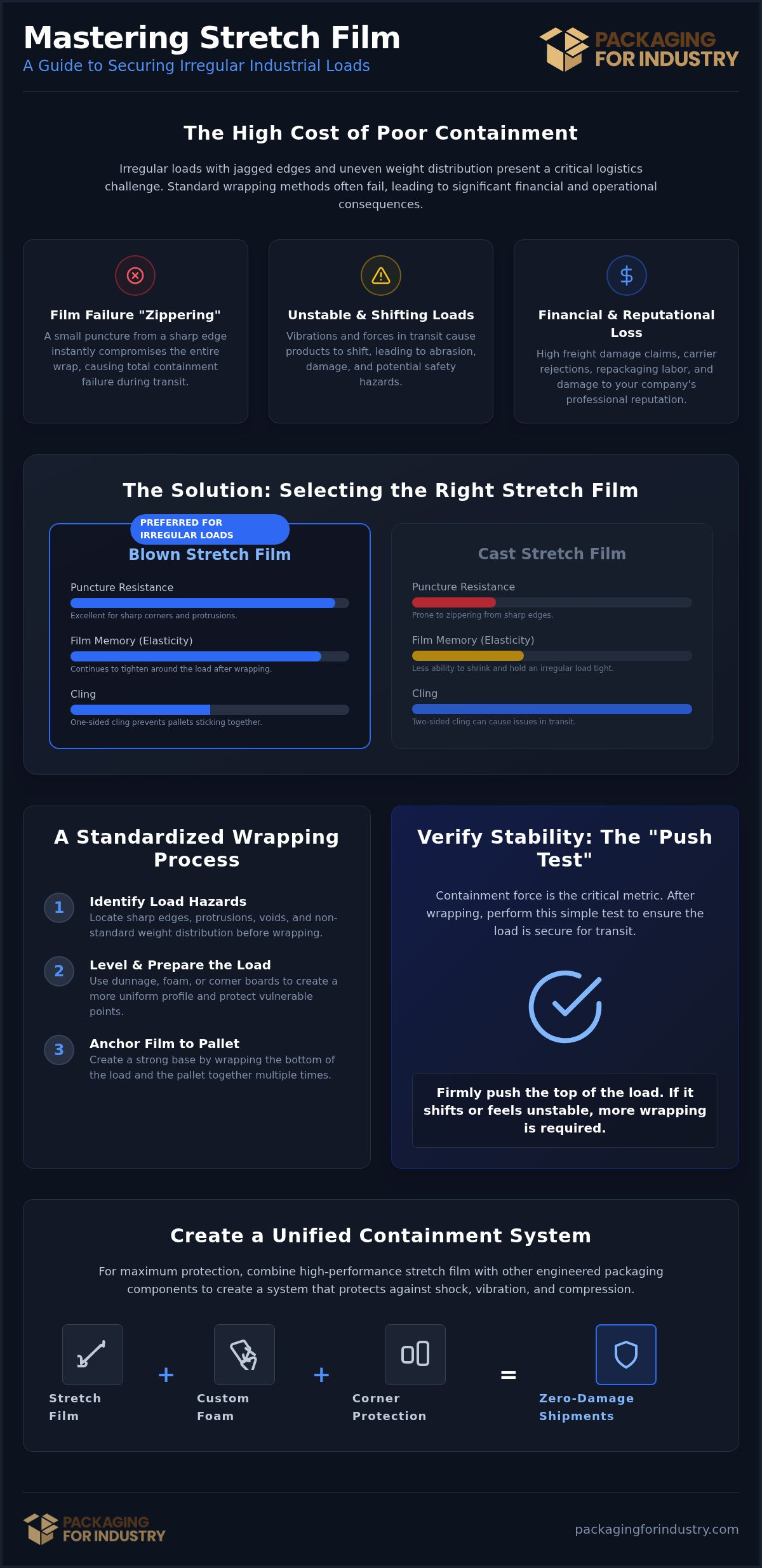
Industrial logistics involves much more than uniform boxes on a pallet. Irregular loads include anything with jagged protrusions, non-standard weight distribution, or significant voids. These items, such as aerospace components, heavy machinery, or custom-fabricated parts, present a unique challenge for standard unitizing methods. Using the wrong Stretch wrap leads to “zippering,” where a small puncture from a sharp edge causes the entire wrap to fail instantly. When you select stretch film for securing irregular shaped loads, you aren’t just wrapping a product; you’re engineering a containment system. Standard cast film, while excellent for uniform pallets, often lacks the puncture resistance required for these high-stress applications.
The physical risks extend beyond simple film failure. Unstable pallets are a “ticking time bomb” for your freight budget. During transit, vibration and centrifugal forces cause products to shift. This movement leads to product-to-product abrasion, which can ruin sensitive finishes or damage delicate components. Choosing a high-performance stretch film for securing irregular shaped loads is a business-critical decision for operations throughout the Inland Empire and Los Angeles. Without the proper material, your shipment is at high risk for carrier rejection before it even leaves the dock.
The Financial Impact of Poor Containment
Freight budgets are under constant pressure. LTL carriers in Southern California hubs, like those in Anaheim and Santa Fe Springs, are increasingly strict about pallet integrity. If a load shifts, they may reject it or apply significant “non-conforming” surcharges. Recouping damage costs from carriers is notoriously difficult and time-consuming. Beyond the immediate claim, you face hidden costs like the labor required for repackaging and the damage to your professional reputation. You can lower packaging costs by getting the containment right the first time, preventing these expensive logistical setbacks.
Identifying Load Hazards: Protrusions and Voids
Identifying hazards is the first step toward optimization. Sharp edges act like knives against thin film, requiring materials with high tear resistance. If your load has a non-standard footprint or an offset center of gravity, the risk of it sliding off the pallet during transit increases significantly. Voids in the load profile also create “soft spots” where film tension is lost, compromising the entire unit. Understanding these variables allows your team to apply material only where it provides the most benefit. If you are ready to audit your current process, you can request a packaging quote for high-performance materials designed for these specific hazards.
Selecting the Right Stretch Film for High-Performance Containment
Choosing the correct material is the most critical step in stabilizing a non-standard pallet. While many warehouses rely on a single type of wrap for every shipment, using the wrong stretch film for securing irregular shaped loads leads to wasted material and damaged goods. You must match the film’s physical properties to the specific hazards of the load, such as sharp corners or uneven weight distribution. High-performance films aren’t just thicker; they’re engineered to provide specific levels of puncture resistance and load-holding force that standard retail-grade wraps cannot match.
Blown vs. Cast Film: The Puncture Resistance Debate
Blown stretch film is the industry standard for securing irregular shaped loads. It’s manufactured using a process that creates a tougher, more resilient film with superior “memory,” meaning it continues to shrink and tighten around the load after application. This one-sided cling is essential because it prevents pallets from sticking together in a crowded trailer. While cast film offers excellent clarity and quiet discharge, it often lacks the tear resistance required for machinery or aerospace components. If a sharp edge punctures cast film, the tear typically propagates across the entire layer. Blown film’s molecular structure helps contain small punctures, preventing a total containment failure.
Determining the Correct Gauge for Heavy Machinery
Gauge selection should be based on the weight and the “sharpness” of the load profile. Standard 80 gauge film is often sufficient for boxed goods, but industrial parts frequently require heavy-duty 120 gauge or higher. However, modern resin technology allows for “down-gauging.” You can often compare stretch film pricing and specs to find high-performance 60 or 70 gauge films that outperform traditional 80 gauge materials. This strategy helps you lower packaging costs without compromising the integrity of your shipment. Matching the gauge to the load ensures you aren’t paying for excess plastic that doesn’t add to the actual containment force.
Achieving maximum containment also depends on “pre-stretch” capabilities. This is the process of stretching the film before it’s applied to the pallet, which activates the film’s elastic memory. If you don’t reach the optimal pre-stretch level, the film will loosen during transit as the load settles. This is backed by research on containment force which indicates that environmental factors and application techniques significantly impact how well a load stays unitized over time. To ensure your team is using the most efficient material for your specific application, you can request a packaging quote for a customized film evaluation.
Step-by-Step: Techniques for Wrapping Odd-Shaped Industrial Parts
Properly applying stretch film for securing irregular shaped loads requires a shift from speed to precision. Warehouse teams in centers like Irvine and Torrance often struggle because they treat complex machinery like a standard cube. To achieve a zero-damage shipment, your team must follow a structured, four-phase application process that focuses on structural integrity rather than just surface coverage. This engineering-first approach ensures that the load remains unitized even under the stresses of long-haul transit.
Load Leveling with Foam and Corner Protection
Before the first layer of film is applied, you must create a “wrappable” profile. Irregular loads often feature deep voids or sharp protrusions that cause film to bridge or puncture. Use custom foam inserts to fill these gaps, providing internal support that prevents the film from collapsing inward. Additionally, place cardboard edge protectors on all sharp corners. This blunts the hazard and allows the film to apply even pressure across the load’s entire surface area. By leveling the load first, you ensure that the containment force is distributed logically, which is essential for maintaining stability during the sudden stops typical of LTL transit.
Phase two is anchoring. Secure the film to the pallet base with at least three full rotations. This creates a physical bond that prevents the load from sliding off the pallet during handling. Once anchored, move into the “X-Pattern” phase. This involves wrapping diagonally across the load to create structural reinforcement. This technique is particularly effective for top-heavy items or parts with an offset center of gravity. Finally, finish the process by securing the film tail. Don’t simply tuck it in; use a pressure-sensitive label or a heat seal to ensure the containment doesn’t unravel in a windy trailer.
Advanced Manual Wrapping Techniques
Manual wrapping requires specific physical adjustments to compensate for the lack of machine-controlled tension. One of the most effective methods is the “Rope” technique. By twisting the film into a cord as you wrap, you create high-strength bands that act like heavy-duty straps. Use these ropes at the load’s most unstable points. Always maintain a 50% overlap between layers to ensure there are no weak spots. Be mindful of “Neckdown,” which is the tendency of the film to narrow as it is stretched. To combat this, apply slightly less tension on flat surfaces and maximize it on the corners where the film is naturally supported. This balanced approach ensures that your stretch film for securing irregular shaped loads provides the maximum possible containment without snapping under pressure.
Measuring Containment Force and Load Stability
Verification is the final, non-negotiable step in the packaging process. You can select the highest quality stretch film for securing irregular shaped loads and apply it with precision, but without measuring the results, you are still guessing. Containment force is the total pressure applied to the load by all layers of film. It is the only metric that truly correlates with a pallet’s ability to survive the rigors of LTL shipping. Unlike wrap force, which measures how hard the film is being pulled as it leaves the roll, containment force measures the actual holding power on the product.
A practical, low-tech way to verify integrity on the warehouse floor is the “Push Test.” After wrapping, an operator attempts to move the top layer of the load. If the product shifts more than two inches relative to the pallet, the containment force is insufficient. For standardized results across multiple shifts, we recommend using a digital containment force gauge. This tool provides a specific poundage reading, allowing you to establish a baseline for every product type. This data is essential for Packaging reviews for damage reduction, as it allows you to justify material usage based on proven stability rather than habit.
The Science of Load Containment
Environmental factors in Southern California logistics hubs like Anaheim or Santa Fe Springs play a significant role in film performance. High heat and humidity can cause film to relax, leading to a loss of containment force over time. It’s common for a pallet to feel secure immediately after wrapping, only to become unstable after sitting in a warm trailer for six hours. Understanding this relaxation period is vital. We help our clients identify “Weak Zones”, which are areas where the film bridges over a void rather than touching the product, to ensure tension remains consistent across the entire profile.
Troubleshooting Common Failures
Even with the best materials, failures occur if the mechanics of the wrap are unbalanced. “Zippering” remains a frequent issue when tension is too high on a sharp protrusion. If you notice small tears propagating, you likely need to increase the film gauge or adjust the pre-stretch settings. Another critical failure point is “Pallet Slide.” This happens when the load is secure but hasn’t been properly anchored to the wooden pallet. If the connection fails, the entire unit can slide off the base during a sudden stop. Finally, be wary of “Crush.” If you apply too much tension to delicate components or RSC boxes, you risk damaging the product from the outside in.
Optimize Your Logistics with PFI Custom Engineering
Securing a complex industrial load is rarely a single-product task. It’s a coordinated effort between structural support and high-performance materials. At PFI, we don’t just sell rolls of plastic; we engineer a total containment system. By integrating custom corrugated boxes with specialized foam and the right stretch film for securing irregular shaped loads, we eliminate the gaps that lead to transit failure. This holistic approach ensures that every component is immobilized before it even reaches the wrapping station, providing peace of mind for your logistics team.
Integrated Solutions for Aerospace and Manufacturing
High-value sectors require specialized oversight. For instance, securing a large turbine part involves more than just a pallet. We design custom foam kitting to cradle the component within a heavy-duty box, then wrap the entire unit to create a unified profile. This strategy is central to our custom packaging for aerospace clients. Our kitting services simplify the process for your warehouse team, turning a complex logistics puzzle into a repeatable, standardized workflow. This precision prevents the zippering and shifting issues discussed in previous sections.
Lowering Your Packaging Costs with PFI
Many businesses overspend by relying on generic catalog suppliers that offer one-size-fits-all options. We help you lower packaging costs by optimizing the specific materials your operation requires. Our Vendor Managed Inventory (VMI) program prevents shortages and ensures you always have the correct film and stabilization supplies on hand. This improves cash flow through just-in-time replenishment, allowing you to focus on production rather than inventory management.
We provide local next-day delivery for manufacturers in Anaheim, Irvine, and across the Inland Empire. Our nationwide shipping capabilities ensure that your satellite facilities receive the same level of precision and reliability. If your current wrapping process results in high damage claims or excessive material waste, a custom packaging review is the first step toward a more efficient operation. We identify cost-reduction opportunities that catalog suppliers often overlook, focusing on the intersection of engineering and economics.
Securing Your Industrial Supply Chain with Precision
Stabilizing complex industrial pallets requires moving beyond standard wrapping habits. By transitioning to high-performance blown film and implementing rigorous containment force testing, your warehouse team can eliminate the professional stress of freight damage claims. We’ve established that securing these loads isn’t just about the plastic; it’s about the engineering behind the entire containment profile. Integrating custom foam inserts with high-performance film creates a unified structure that withstands the rigors of LTL transit and protects your bottom line.
PFI specializes in these high-stakes applications, particularly for the aerospace and industrial manufacturing sectors in Southern California. We provide custom engineering services designed to eliminate transit damage and offer local next-day delivery in Anaheim, Irvine, and Torrance. Utilizing the right stretch film for securing irregular shaped loads is a critical investment in your operational reliability and long-term fiscal health. Our experts are ready to audit your current process, identify immediate cost-reduction opportunities, and implement Vendor Managed Inventory programs that ensure you never face a supply shortage. This proactive approach turns your packaging from a simple expense into a strategic advantage.
Take the guesswork out of your logistics and build a more dependable supply chain today.
Frequently Asked Questions
What is the best stretch film for sharp, irregular loads?
Blown stretch film is the professional’s choice for securing irregular shaped loads because of its superior puncture resistance and elastic memory. Unlike cast film, blown film is manufactured to withstand jagged protrusions without zippering. Its molecular structure allows it to “breathe” with the load during transit, maintaining high containment force even in fluctuating temperatures. This durability ensures that sharp machinery parts or aerospace components remain unitized throughout the entire Southern California logistics network.
Can I use cast stretch film for heavy machinery?
Cast stretch film is generally not recommended for heavy machinery with sharp edges. While cast film offers excellent clarity and a quiet discharge, it lacks the toughness required to resist punctures from industrial protrusions. If a sharp corner pierces cast film, the tear often propagates across the entire pallet, leading to a total containment failure. For heavy machinery, we recommend high-performance blown film to ensure maximum load stability and reduce the risk of carrier rejections.
How many layers of stretch film are needed for an irregular pallet?
The number of layers depends on the weight and geometry of the load, but we typically recommend at least three layers with a 50% overlap. For irregular profiles, you should apply extra rotations at the pallet base and any sharp transition points. Simply adding more film isn’t always the answer; it’s about achieving the correct containment force. We recommend using a digital gauge to verify that your specific wrap pattern provides the necessary holding power for transit.
What is ‘load leveling’ in industrial packaging?
Load leveling is the process of using secondary materials to create a uniform profile before wrapping. This involves placing custom foam inserts into deep voids or using heavy-duty corner boards to blunt sharp protrusions. Leveling prevents the film from “bridging” over gaps, which causes low-tension zones that compromise stability. By creating a wrappable surface, you allow the stretch film for securing irregular shaped loads to apply even pressure across the entire pallet, significantly lowering packaging costs and damage rates.
How do I prevent stretch film from tearing on sharp corners?
To prevent tearing, you must blunt the sharp edges using corner and edge protection materials before wrapping. Cardboard or plastic corner boards provide a smooth surface for the film to glide over, preventing the “zippering” effect that ruins a wrap. Additionally, using a higher-gauge blown film provides the physical thickness needed to resist punctures. This combination is essential for manufacturers in industries like aerospace and medical device production where product protection is non-negotiable.
Why is my stretch film sliding off the pallet during shipping?
Pallet slide usually happens because the load isn’t properly anchored to the wooden base. You must secure the film to the pallet by wrapping several times around the bottom board. If the film only grips the product, the entire unit can shift off the pallet during sudden stops or sharp turns. We recommend a minimum of three bottom wraps to create a physical bond between the load and the pallet, ensuring your shipment stays secure during LTL transit.
Does PFI offer local delivery for stretch film in Orange County?
Yes, Packaging For Industry provides local next-day delivery throughout Orange County, including Anaheim, Irvine, and Huntington Beach. We also serve Los Angeles County and the Inland Empire with our own fleet of trucks. This local focus allows us to support your just-in-time production schedules and prevent emergency stockouts. Whether you need bulk quantities of blown film or custom-engineered foam inserts, we ensure your warehouse stays stocked with the materials required to secure complex industrial loads.
How can a VMI program help manage my stretch film inventory?
A Vendor Managed Inventory (VMI) program eliminates the guesswork from your procurement process. PFI performs scheduled inventory reviews at your facility to monitor film usage and replenish stock before a shortage occurs. This is particularly valuable for custom-engineered films or long lead-time items that can’t be easily replaced. By managing your stocking levels, we help you improve cash flow, reduce warehouse clutter, and ensure your production line never stops due to a lack of packaging supplies.