
VCI paper alone doesn’t make a machined-part shipment corrosion-safe. The right choice depends on the metals, part geometry, machining process, and conditions during storage and transit. For buyers sourcing VCI paper for machined parts Los Angeles, start by matching the paper’s documented compatibility to the parts, then plan how they’ll be cushioned and packed for shipment.
Corrosion protection is important when finished parts may spend time in storage or travel through changing conditions. But VCI paper is one part of a packaging plan, not a substitute for cushioning or a suitable outer package. Parts also need protection from contact, movement, and handling during transit.
This guide covers the main criteria for specifying VCI paper, including metal compatibility, part shape, and shipment requirements. It also explains how to coordinate corrosion protection with foam, corrugated boxes, and wooden crates. Packaging For Industry supports Los Angeles County manufacturers with custom packaging design and complementary protective packaging, with next-day local delivery available for these products and services. The goal is a practical packaging setup that protects parts in transit and keeps recurring supply needs organized.
Key Takeaways
- Specify VCI paper for machined parts Los Angeles based on the exact metals involved. Compatibility can vary by grade, especially with mixed-metal assemblies.
- Record part dimensions, surface finish, and machining conditions so the wrapping method fits the parts instead of relying on a one-size-fits-all approach.
- Compare VCI paper, VCI film, and cushioning by their different roles, then build a configuration suited to handling and shipment.
- Include part drawings, order quantities, shipping method, and packaging configuration in quote requests to make purchasing decisions clearer.
- Plan the outer package around part fit and transit protection. Custom packaging design and coordinated protective materials can support a more complete shipment plan.
VCI Paper for Machined Parts in Los Angeles: What It Protects, and What It Does Not
Machined parts can develop corrosion while in storage or in transit, putting finished surfaces and delivery schedules at risk. When evaluating VCI paper for machined parts Los Angeles, distinguish what the material is designed to protect against from the physical protection the rest of the package must provide.
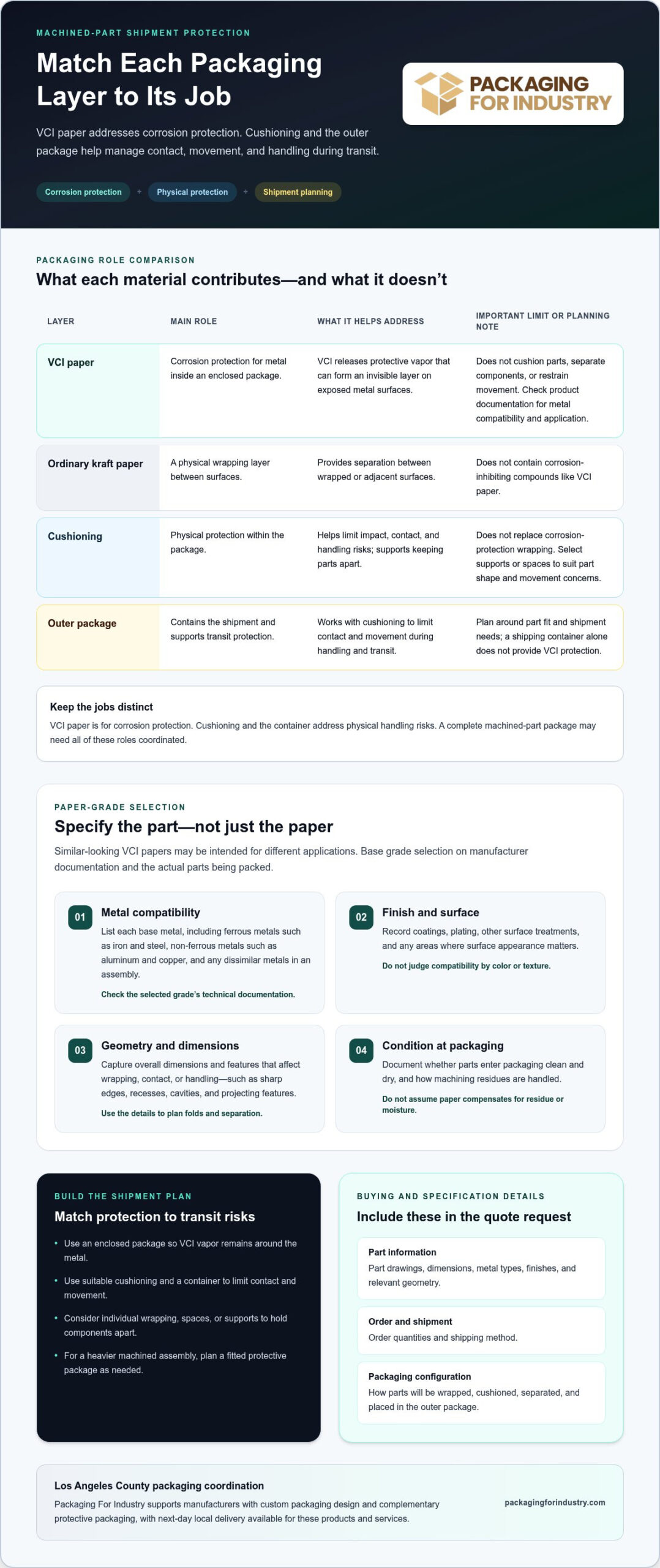
VCI paper is paper treated with volatile corrosion inhibitors that release protective vapor around metal inside an enclosed package. Ordinary kraft wrapping paper provides a physical layer between surfaces, but it doesn’t contain those corrosion-inhibiting compounds. VCI paper adds a corrosion-protection function; it isn’t a substitute for cushioning or a shipping container.
How VCI paper protects machined metal surfaces
In an enclosed package, inhibitors in the paper vaporize and move through the air around the parts. They can form an invisible protective layer on exposed metal surfaces, helping interrupt the reactions that cause corrosion. This overview explains Volatile corrosion inhibitor (VCI) technology.
Performance depends on the selected paper and how it’s used. Grades can differ, so don’t assume every option protects the same metals or performs identically. Check the paper’s technical documentation for intended metal compatibility and application. The package also needs to enclose the parts so the vapor remains around the metal. Don’t assume a fixed protection period without product-specific guidance.
VCI protection differs from oil, grease, or liquid coatings. Those methods apply a substance directly to a surface, while VCI paper works through inhibitor vapor within the package. That distinction can matter for machined components when a coating may affect handling or the next production step. The appropriate approach depends on the part and packaging process.
Why machined parts need more than corrosion protection
Corrosion is only one transit risk. A wrapped shaft can still strike another component if parts shift in a box. A machined edge may scrape a neighboring surface, and a heavy component can move against the container during handling. VCI paper doesn’t prevent impact, separate parts, or restrain movement by itself.
Plan physical protection separately. Use suitable cushioning and an outer container to limit contact and movement. Individually wrapped components may need spaces or supports that hold them apart, while a heavier machined assembly may need a fitted protective package. Protective cushioning materials can complement corrosion-protection wrapping by addressing impact and handling concerns.
Keep each material’s role clear: VCI paper addresses corrosion protection, while cushioning and the shipping container address physical handling risks. Specifying these separately helps you build a complete package for machined parts instead of expecting one wrapping material to solve every transit problem.
Match VCI Paper to Metal Type, Part Geometry, and Machining Conditions
Start with the part, not the paper roll. For VCI paper for machined parts Los Angeles, document which metals need protection, how the components are shaped, and their condition when packaging begins. These details give purchasing and production teams clear criteria for evaluating paper grades and planning the wrapping method.
Choose VCI paper based on documented metal compatibility, not paper appearance alone. Similar-looking papers can be intended for different applications. Use the manufacturer’s product documentation to guide grade selection. For background on VCI paper use across metal types, see Cortec VCI Paper.
Confirm compatibility with the machined part’s metal
Identify the base metal for every component. Ferrous metals, such as iron and steel, differ from non-ferrous metals such as aluminum and copper. Don’t assume a grade intended for one category will suit another. If an assembly contains dissimilar metals, include each metal in the compatibility review and follow the selected paper’s technical documentation.
Record coatings, plating, or other surface treatments too, so the packaging requirement reflects the finished part as well as its base material. Don’t choose by color, texture, or other visual cues. Compatibility is product-specific and can’t be reliably determined from appearance.
Account for shape, finish, and post-machining handling
Dimensions and geometry affect how paper can cover and separate parts. A flat machined plate is straightforward to wrap, while a component with sharp edges, recesses, cavities, or projecting features may need a different fold pattern or additional separation. Document the overall dimensions and features that affect contact, wrapping, and handling.
Define the condition of parts when packaging begins. Production process documentation should state whether components enter packaging clean and dry and how machining residues are handled. Don’t assume paper can compensate for residue or moisture. Consistent handoff steps help packaging staff apply the selected materials repeatably.
- Metal: List each base metal and any mixed-metal contact.
- Finish: Note surface treatments and areas where appearance or contact matters.
- Geometry: Record dimensions, edges, cavities, and features that affect wrapping.
- Process: Document cleanliness and the condition of parts before packing.
- Handling: Describe how parts are moved and separated during packaging.
Use these details to select a paper format and wrapping approach that suit the parts and workflow. For irregular components, define how the wrap should cover the part without creating unnecessary folds or interfering with separation. For repeat orders, keep the criteria in the packaging instructions so purchasing and production teams work from the same specification.
If the part geometry also calls for fitted cushioning or a coordinated outer package, request a quote for custom protective packaging designed around the component and its shipment needs.
Compare VCI Paper with VCI Film and Supporting Packaging for Los Angeles Shipments
VCI paper and VCI film provide corrosion protection in different packaging formats, while cushioning and outer packaging address physical protection. The right combination for VCI paper for machined parts Los Angeles depends on component geometry, packing method, and shipment configuration. No single material fits every part or shipment.
Choose paper or film for the wrapping task
Paper can be folded around individual parts or used to separate components, which may suit a batch of smaller machined pieces that need distinct wrapping. Film may suit an enclosing or covering role. These are general use considerations, not a promise that every grade performs identically. For metal compatibility, moisture resistance, or other material-specific performance, consult the selected product’s technical data sheet.
Part geometry matters. Paper may be convenient to position around an irregular component, while a film enclosure may suit a different package layout. Decide how the material will be applied, whether components will be wrapped individually or grouped, and how the package will be closed. Align those choices with the selected material’s documented use.
Add cushioning and an outer package for transit
Corrosion protection doesn’t restrain a part. A wrapped component can still shift, strike another part, or take impact during handling. Protective foam can help separate components and limit movement when designed around their shape and placement. Packaging For Industry provides protective foam packaging as part of a broader transit-protection plan.
Then select an outer package that suits the shipment configuration. A corrugated box can contain parts and cushioning; a wooden crate may suit a larger or differently configured load. Choose the setup based on the part and how it will be handled.
For Los Angeles shipments, define the packaging configuration using practical shipment details: how parts are grouped, what must stay separated, and what outer container supports the load. This makes the package easier to specify and repeat, while keeping corrosion protection, cushioning, and containment in their proper roles.
Build a VCI Paper Specification and Buying Checklist for Machined Parts
A useful packaging specification gives purchasing, production, and shipping teams a shared picture of the job. For VCI paper for machined parts Los Angeles, separate corrosion-protection requirements from cushioning and outer-container requirements. This keeps paper selection tied to documented product information while the supporting package is planned around the parts and shipment.
Prepare a clear packaging and quote request
Build the request in sequence. Start with the metals involved, including any mixed-metal contact. Add part drawings or clear dimensions, weight, surface features, and handling requirements. Then describe storage and transit conditions, shipping method, and how parts are grouped, wrapped, or separated. These details help define a practical packaging configuration without guessing at VCI grade or performance.
Keep the VCI paper specification distinct. Metal compatibility, paper format, and other VCI performance requirements should follow the selected paper’s technical documentation. For a complementary packaging quote, describe the protective foam, box, crate, or design work needed around that material.
- Part information: Drawings, dimensions, weight, metal types, and finish considerations.
- Order profile: Quantity per shipment, recurring production quantities, and packaging format.
- Shipping details: Shipping method, handling steps, and how parts need to arrive.
- Package scope: Wrapping approach, separation needs, cushioning, and outer container.
For repeat production, include the expected order pattern and standard packing instructions. This helps teams plan consistent packaging for each run and compare the full configuration instead of evaluating materials in isolation.
Plan the complete protective package
Map each material to a separate job: VCI paper wraps or separates parts for corrosion protection; cushioning limits movement and contact; the outer container contains and supports the load. For example, individually wrapped machined components may need fitted spaces to prevent them from shifting against one another, plus a box or crate suited to the shipment. A foam-lined wooden crate is one possible configuration when the load and handling needs call for it.
PFI’s custom packaging design can address fit and shipping requirements around the parts. A prototype can help the team assess placement, separation, and handling before adopting a design for repeat packing. Keep the VCI paper’s instructions in the final packing procedure so the material is used according to its documentation.
Make clear which items are included in the quote request: supporting protective packaging, a custom design, or both. This helps coordinate the selected VCI paper with the package designed to protect the component physically.
Coordinate Los Angeles Industrial Packaging Around Machined Parts
Machined parts move through production, inspection, storage, and shipping, so the supporting package should fit the way your operation handles them. Packaging For Industry helps coordinate complementary industrial packaging around those requirements. Aerospace, electronics, medical device, and industrial equipment teams can plan protective materials and containers around component dimensions, handling steps, and shipment configuration.
Use custom packaging to support the part’s shipping requirements
Different components call for different packaging layouts. A set of smaller machined parts may need organized separation, while a larger assembly may require a stable position within its outer container. PFI’s protective foam, corrugated boxes, and wooden crates can support these physical packaging needs. For larger loads, a wooden crate can serve as the outer structure, with the internal arrangement planned around the components.
Keep the VCI paper’s specifications and instructions distinct from the requirements for cushioning and the container. This helps purchasing and operations teams coordinate the complete package without treating corrosion-inhibiting paper as a substitute for fit, restraint, or physical protection.
Plan local supply and recurring packaging needs
For recurring production or shipping requirements, PFI’s vendor managed inventory (VMI) and just-in-time (JIT) inventory programs can help organize replenishment of supporting packaging materials. Share the items used, their consumption pattern, and planned changes to parts or shipment configurations. This gives purchasing and operations teams a clearer basis for coordinating supply with packaging needs and reducing avoidable ordering disruptions.
Whether you’re preparing a new machined component for shipment or standardizing packaging for repeat production, align supporting materials with the workflow and the part’s handling needs. PFI can help plan those complementary industrial packaging requirements alongside your team’s VCI paper specifications.
Put Your Machined-Parts Packaging Plan Into Practice
A well-defined packaging plan gives purchasing and production teams a shared standard as parts move from machining to shipment. For VCI paper for machined parts Los Angeles, follow the paper’s documented use for the part, then design supporting packaging around your operation’s handling and shipping needs. This helps teams maintain a clear process and adjust the package when components or shipping configurations change.
Packaging For Industry can help develop complementary protective packaging around your parts, including custom-designed cushioning and suitable outer packaging. Bring your part and shipment requirements together in one practical plan so the protective materials work together rather than being specified in isolation.
With a packaging plan built around your components and workflow, your team can move forward with greater clarity and confidence.
Frequently Asked Questions
How long does VCI paper protect machined parts?
There’s no single protection period that applies to every shipment. For planning, record the packing date, storage conditions, and any opening or repacking events alongside the selected paper’s stated performance limits. This gives your team a traceable basis for managing stored inventory and reviewing packaging procedures. If parts move between locations or remain in storage longer than planned, reassess the package against the product guidance and handling history.
Can VCI paper touch a finished machined surface directly?
Some VCI papers are designed for direct contact, but suitability depends on the selected material and finished surface. For parts with appearance-critical areas or tightly controlled downstream processes, test the proposed contact method on a representative component or sample before standardizing it. Include acceptance criteria in the work instruction, such as the required surface appearance after unpacking and whether cleaning is allowed before the next operation.
Does VCI paper need to be sealed around machined parts?
Follow the packaging method specified for the selected paper rather than applying one sealing rule to every job. A useful work instruction should state who closes the package, which closure method is used, and what to do if inspection requires opening it. This helps shifts pack the same part consistently. Keep repacking steps clear so the package is handled the same way after quality checks.
Can VCI paper protect mixed-metal machined assemblies?
It may, provided the selected grade is documented for the metals in the assembly. Use the assembly bill of materials to identify each metal, including small hardware that may be easy to overlook. Keep that material list with the packaging record and update it when a component or supplier changes. This helps prevent an outdated packaging instruction from being applied to a revised assembly.
Can VCI paper be reused after unpacking machined parts?
Don’t assume it can be reused. Handling, exposure, or contamination may affect its suitability for another packaging cycle. Follow the paper manufacturer’s reuse guidance and set a clear disposition rule for used material, such as whether it is discarded or held for review. Avoid returning used paper to production stock based only on appearance, which can make packing practices inconsistent.
Is VCI paper enough to prevent shipping damage to machined parts?
No. A package still needs a plan for securing the load through warehouse handling and shipment. Confirm how parts are positioned, kept from contacting one another, and supported by the container during normal movement. For a recurring shipment, document the packing sequence and have the team follow it consistently. This makes it easier to identify a handling or package-fit issue if damage is reported.
Does PFI provide next-day packaging delivery in Los Angeles?
Yes. PFI provides next-day local delivery in Los Angeles County for packaging products such as protective foam, corrugated boxes, and wooden crates. These products can be coordinated with the VCI paper selected for your parts to build a complete packaging plan. Request a quote for complementary packaging based on your component dimensions, shipment configuration, and recurring supply needs.