
For businesses comparing void fill alternatives to packing peanuts Los Angeles, the right replacement depends on the product, carton, and packing process. California’s statewide prohibition on the sale, distribution, and import of expanded-polystyrene packing peanuts took effect January 1, 2025, so Los Angeles operations need a dependable way to protect products without disrupting packing or adding avoidable waste.
This guide compares paper cushioning, custom corrugated inserts, and foam packaging. To narrow the options, consider product fragility, how much movement it can tolerate, packing-line workflow, storage space, and replenishment needs. Packaging For Industry supports Los Angeles County businesses with custom CAD-engineered packaging, prototypes and samples, and next-day delivery. Use these practical comparisons to identify a solution that helps reduce shipping damage while balancing protection, packaging use, and freight costs.
Key Takeaways
- Compare void fill alternatives to packing peanuts Los Angeles shippers can use by protection needs, packing workflow, and replenishment requirements.
- Match cushioning to the product’s fragility, shape, weight, shipment quantity, and fit inside the carton.
- Trial a candidate material and track product condition, material use, packing time, and operator feedback before standardizing.
- Custom foam and corrugated packaging can help position products that need a more tailored fit.
- Use prototypes and samples to evaluate a custom packaging approach before rolling it out across operations.
Why Los Angeles shippers are replacing packing peanuts with void fill alternatives
Void fill is material placed inside a package to limit product movement during shipment. For industrial shippers, replacing loose packing peanuts is an opportunity to review product protection, packing speed, and how reliably the material can be replenished.
A one-for-one material swap may leave the original problem unresolved. If a product shifts because its carton is oversized or the cushioning does not hold it in place, another loose fill may not fix the fit. Review the product, cushioning, and carton as one system. Depending on the shipment, the best adjustment may be a better-sized carton or cushioning shaped to support the item, rather than more material to fill empty space.
What problems should an alternative solve?
Start with the failure you want to prevent. If a product arrives scuffed or displaced, it may need more controlled positioning. A fragile item may need cushioning suited to its shape and handling requirements. Review damage or returns where records are available, and note where the product sits inside the carton after transit. This helps distinguish a cushioning issue from poor carton fit or inconsistent packing.
Next, consider how the material works on the packing line and in storage. A practical option should fit the team’s routine, be straightforward to replenish, and support a consistent pack-out across shifts. If operators use different amounts of loose fill from carton to carton, protection can vary. Define how much material to use and where to place it, then check whether the method works without adding unnecessary steps.
When shipments need closer product positioning, evaluate cushioning alongside carton fit and the packing method. The goal is not to use more material by default. It is to control movement with a system suited to the shipment.
Why Los Angeles operations may weigh supply reliability
Manufacturers, warehouses, and distribution teams in Los Angeles often manage repeat shipments alongside changing order volumes. A void fill decision affects more than the shipping carton: purchasing has to plan replenishment, warehouse teams need space for supplies, and packers need a method they can follow consistently. Evaluate these needs together, especially when changing materials across recurring shipments.
Local supply can be part of that decision. Packaging For Industry provides next-day delivery in Los Angeles County, as well as Orange, San Diego, and Riverside counties. For operations in these areas, local delivery can support packaging replenishment planning. Businesses with locations elsewhere can plan around PFI’s nationwide shipping.
For teams comparing void fill alternatives to packing peanuts Los Angeles operations can use, consider whether the complete pack-out protects the product and works for the people who use it. A suitable option addresses fit, handling, packing consistency, storage, and repeat supply as one operational decision.
Compare void fill alternatives to packing peanuts by material and use
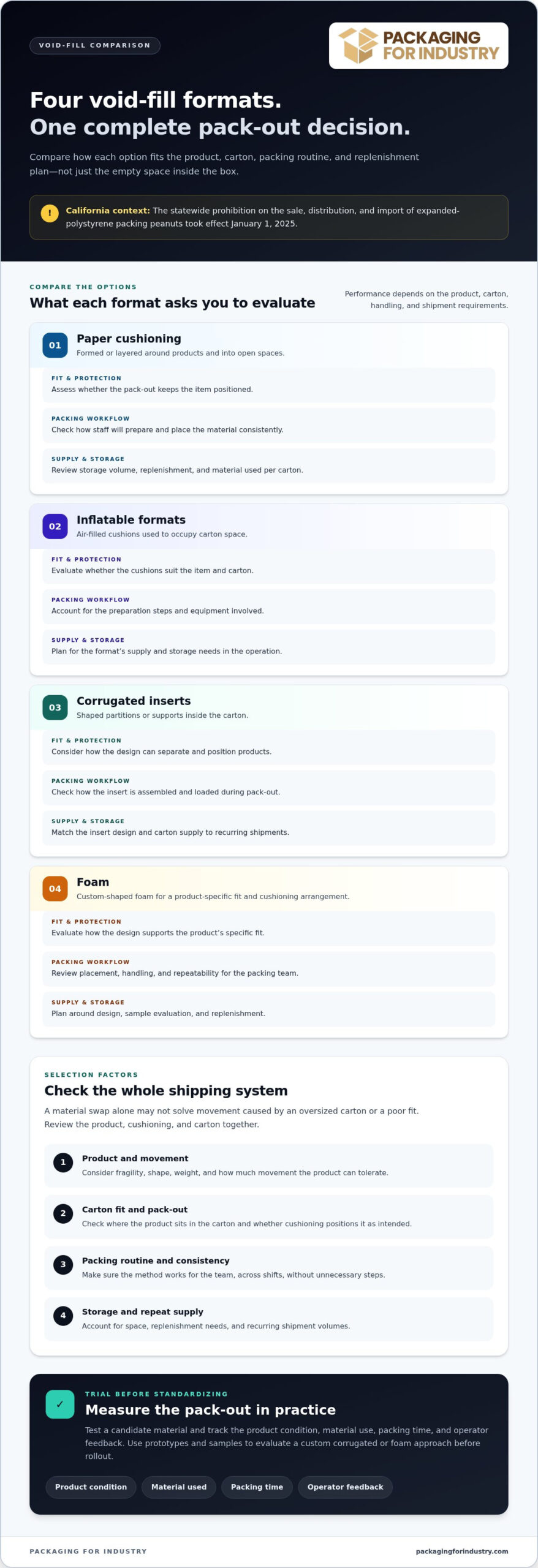
Void fill options differ in how they occupy carton space, position a product, and fit into a packing routine. Paper cushioning and inflatable formats are common market alternatives. Corrugated inserts and foam can provide more product-specific positioning. Packaging For Industry supplies corrugated boxes, foam packaging, cushioning materials, and custom packaging design. Performance depends on the product, carton, handling, and shipment requirements, so compare the complete pack-out rather than the material alone.
| Format | Fit and protection needs | Packing workflow | Supply considerations |
|---|---|---|---|
| Paper cushioning | Can be arranged around products and into open spaces; assess whether the pack-out keeps the item positioned. | Consider how staff will prepare and place the material consistently. | Review storage volume, replenishment, and material use per carton. |
| Inflatable formats | Air-filled cushions can occupy voids; evaluate their fit for the item and carton. | Account for the steps and equipment involved in preparing them for packing. | Plan for the format’s supply and storage needs within the operation. |
| Corrugated inserts | Shaped partitions or supports can separate and position products inside a carton. | Consider how the insert is assembled and loaded during pack-out. | Match insert design and carton supply to recurring shipment needs. |
| Foam | Custom-shaped foam can support a specific product fit and cushioning arrangement. | Review placement, handling, and repeatability for the packing team. | Plan around the design, sample evaluation, and replenishment process. |
Paper and inflatable void fill for adaptable shipments
Paper cushioning can be formed or layered around an item, while inflatable formats use air-filled cushions to occupy space in a carton. For either approach, observe whether employees use a repeatable amount and placement, and whether supplies are accessible at the packing station. Storage requirements and restocking cadence matter, too. A format that fits the shipment but interrupts the line may not suit a high-volume operation.
Corrugated inserts and foam for product-specific protection
For products that need controlled positioning, a corrugated insert can divide a carton or create supports around an item. PFI’s corrugated packaging and custom design capabilities can help align the insert and box with a specific pack-out. Foam is another product-specific option. Protective foam packaging, including custom die-cut foam, can be designed around the product. Evaluate these approaches when loose fill leaves placement inconsistent or products need defined separation.
Use the comparison to narrow the options, then assess them with the actual product and carton. If custom corrugated or foam packaging looks suitable, request a packaging quote for a solution tailored to the shipment and packing process.
How Los Angeles buyers can evaluate void fill for their shipments
Evaluate each option against the shipment and the work required to pack it. Product fragility, shape, weight, quantity, and expected handling all matter. Check whether the carton itself keeps each item in position. A cushioning change will not necessarily solve a carton that leaves excess space or allows the product to shift.
Match material choice to product and shipment profile
Use the product’s characteristics to narrow the options. A fragile component may call for more controlled cushioning. An irregular product may be difficult to position consistently with loose fill. For multi-part shipments, corrugated dividers or custom foam inserts may be worth evaluating when components need defined positions. Treat these as options to test, not universal prescriptions.
PFI’s custom packaging design connects product fit with the cushioning and carton arrangement. If a standard pack-out does not hold the item consistently, assess custom cushioning materials. Custom sizes are available for packaging tailored to product requirements. Compare packaging pricing alongside fit and workflow, and consider whether the proposed pack-out could help lower packaging costs while meeting the shipment’s protection needs.
For each candidate, review the practical factors that affect day-to-day use:
- Product and load: Note which items are fragile, irregular, heavy, or shipped together, and whether components need separation.
- Carton fit: Check for excess space and product movement. A different carton or insert may address fit more directly than adding cushioning.
- Pack-out steps: Observe placement, repeatability across shifts, and any extra handling required.
- Material and storage: Compare material use per shipment, storage needs, and bulk packaging pricing for recurring orders.
- Shipment pattern: Consider order volume and variation. Repeat shipments may benefit from a defined pack-out, while varied orders may require flexibility.
Include Los Angeles warehouse and delivery requirements
Receiving schedules, warehouse space, and recurring consumption affect how much packaging to keep on hand. Review who tracks inventory and how replenishment fits the receiving routine. PFI offers next-day local packaging delivery in Los Angeles, Orange, San Diego, and Riverside counties. Set reorder points around actual usage and receiving schedules, and plan nationwide shipments separately from local delivery.
For void fill alternatives to packing peanuts Los Angeles businesses are considering, compare product fit, packing steps, material use, storage, and supply needs together. The right choice depends on the product and workflow. A packaging quote can help assess cushioning and carton requirements against your shipment profile and purchasing priorities.
How to trial a packing peanut alternative without disrupting operations
Test a packaging change against real shipment conditions before making it the new standard. A controlled trial lets operations compare the current pack-out with one suitable alternative while keeping other variables steady. Use representative shipments, involve the employees who pack and receive them, and agree in advance on what a successful result needs to show. The change does not need to apply to every order at once.
Plan a controlled packaging trial
Start with a shipment that reflects routine products and handling, rather than an unusual one-off order. Record the product, carton dimensions, existing cushioning method, and relevant shipment conditions. Choose one candidate material, then keep the carton and other pack-out steps consistent where practical. This makes it easier to identify whether observed differences relate to the void fill or another change.
Use a short sequence to manage the trial:
- Document the current pack-out. Note how the item is placed, how cushioning is added, and how much material the team uses for each carton.
- Select one candidate. Choose an alternative that addresses the identified fit or workflow need, and define how it should be placed.
- Trial representative shipments. Limit the test to selected orders or a defined product group so the regular process can continue.
- Review results. Record product condition after shipment, material use, packing time, and feedback from packing staff. Where practical, include receiving-team observations about product position and condition.
- Decide and standardize. Compare observations with the criteria set before the trial. If the candidate meets operational and protection needs, document the approved pack-out for repeat use.
Turn a successful trial into a repeatable supply plan
Before expanding the change, align purchasing, warehouse, and fulfillment teams on the selected material, pack-out instructions, storage needs, and replenishment requirements. A method that works for one operator should be clear enough for other shifts to follow. Document the approved carton and cushioning method together so substitutions do not quietly change the fit or the amount of material used.
If standard materials do not fit the product or packing process, custom packaging design can help evaluate a more tailored configuration. PFI provides CAD-engineered packaging with prototypes and samples to support evaluation before rollout.
For Los Angeles teams assessing void fill alternatives to packing peanuts, a measured trial shows how an option performs in the actual pack-out without requiring a broad process change. Ground the review in shipment condition, material consumption, packing time, and staff feedback. Use the trial findings to assess whether the approach fits your operation.
Source void fill alternatives in Los Angeles with a packaging partner
A dependable void fill plan connects cushioning with the carton, pack-out method, and supply needs. Packaging For Industry provides cushioning materials, foam packaging, corrugated boxes, and custom packaging design. These products support industrial packaging for aerospace and electronics companies, medical device manufacturers, warehouses, and distribution teams that need packaging suited to their products and shipping operations.
When custom foam or corrugated packaging is a better fit
Custom foam inserts can position products that need a defined fit inside a carton, while corrugated inserts can separate or organize items within a shipment. PFI’s CAD-engineered design process supports packaging tailored to a product and pack-out. Free prototypes and samples let teams evaluate fit and handling before rollout, helping them make an informed choice about the packaging configuration.
When standard cushioning and cartons do not align with the product or workflow, custom packaging design can help develop a more suitable configuration. PFI can also combine packaging materials into a coordinated solution, supporting consistent product protection and supply.
For Los Angeles operations, local supply reliability is another practical consideration. PFI offers next-day delivery in Los Angeles County, as well as Orange, San Diego, and Riverside counties, helping manufacturers, warehouses, and distribution teams plan packaging replenishment. PFI also ships nationwide.
Request a void fill quote for Los Angeles operations
For a useful quote discussion, prepare product details, the current carton and cushioning method, shipment requirements, and recurring volumes. Include pack-out concerns such as inconsistent placement or excess space inside the carton. These details help shape a quote around suitable cushioning, custom sizing, and local supply needs.
PFI’s foam, corrugated packaging, and cushioning materials give industrial buyers options to align product protection with purchasing and warehouse requirements. Share your shipment profile to discuss a practical void fill approach for your operation.
Put your next packaging improvement into action
The right void fill should support both the shipment and the process that gets it ready to leave the facility. Use your material comparisons to choose a practical next step, whether that means adjusting the carton, refining the pack-out, or evaluating a custom fit. For operations in Los Angeles, Orange County, San Diego, and Riverside, the solution should be easy for the team to use consistently and replenish reliably.
Packaging For Industry positions its pricing at 15%-40% lower than national competitors. Actual pricing depends on the packaging requirements and order, so compare options alongside protection, workflow, and supply needs. A focused quote discussion can connect void fill alternatives to packing peanuts Los Angeles shipments require with suitable materials and custom design considerations.
Bring your product details and current pack-out into the next conversation. A clear starting point helps identify a practical path toward a more dependable packaging process.
A well-matched packaging plan helps your team protect shipments while keeping the packing process consistent.
Frequently Asked Questions
What is the best alternative to packing peanuts for shipping?
There is no single best material for every shipment. The right choice depends on the product, carton, and packing workflow. For void fill alternatives to packing peanuts Los Angeles teams are evaluating, start by checking whether the product shifts, contacts the carton walls, or needs its components kept apart. Then consider the packer’s steps, storage needs, and replenishment routine. A material that suits the product but interrupts the packing line may not be the best operational fit.
Are paper void fill and inflatable packaging suitable for industrial shipments?
Both can be considered, but suitability depends on the shipment and packing setup. Paper cushioning can be arranged around an item, while inflatable formats use air-filled cushions to occupy open space. Compare how consistently employees can position each format, the steps needed at the packing station, and how supplies fit into available storage. PFI’s industrial packaging options include cushioning materials, foam, and corrugated packaging for buyers assessing shipment-specific needs.
Can custom foam inserts replace packing peanuts?
Custom foam inserts can be evaluated as an alternative when a product needs a defined fit inside its carton. They may suit a part with an irregular outline or components that need individual positions. PFI provides custom foam packaging, including custom die-cut foam. Assess the insert with the actual product and carton, since its design needs to suit the shipment and packing method.
How do I choose void fill for fragile or irregularly shaped products?
Start with the item’s shape, fragility, weight, and position inside the carton. For a fragile component, inspect where it could contact the box. For an irregular item, check whether the cushioning holds it in a stable position without making pack-out awkward. Compare the option with the actual product and carton, then review the sample shipment’s condition and packer feedback before choosing a standard method.
How much does it cost to replace packing peanuts with another void fill material?
Pricing depends on the packaging configuration and purchasing needs, so there is no reliable universal price. Relevant details include product and carton dimensions, the selected cushioning or insert, recurring order volume, and whether custom design is needed. Share the current pack-out and shipment requirements to compare suitable materials and bulk supply needs. That gives the supplier a practical basis for pricing the proposed packaging rather than a generic material estimate.
Does PFI deliver void fill alternatives in Los Angeles?
Yes. PFI offers next-day delivery in Los Angeles County for packaging supplies, including relevant cushioning, foam, and corrugated options. This local delivery supports replenishment planning for manufacturers, warehouses, and distribution teams in the county. PFI also ships nationwide, while next-day delivery applies to Los Angeles, Orange, San Diego, and Riverside counties. Include your location and recurring supply needs when planning orders.
Can a packaging supplier help test a new void fill material before rollout?
Yes. PFI supports custom packaging evaluation with CAD-engineered design, free prototypes, and samples. These help teams assess a proposed configuration using the product and carton before adopting it for routine shipments. Operators can review how a sample fits, how it loads at the packing station, and whether the instructions are clear. Use those observations to refine the pack-out and purchasing plan before wider implementation.