
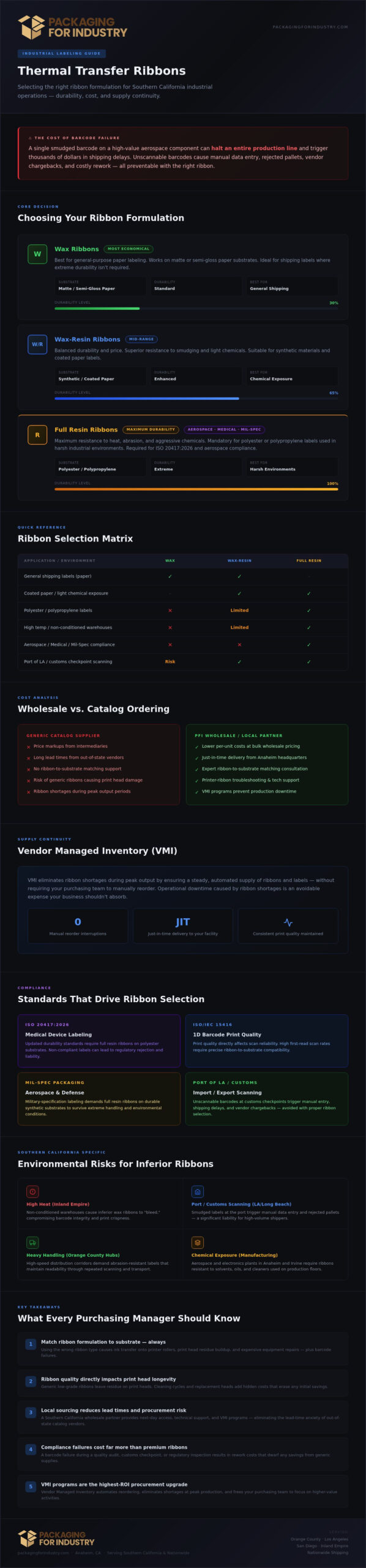
A single smudged barcode on a high-value aerospace component can halt an entire production line and trigger thousands of dollars in shipping delays. You understand that labels are more than just stickers; they’re the critical data backbone of your warehouse operations. It’s frustrating when generic ribbons from big-box catalog suppliers fail under industrial stress or run out exactly when you’re hitting peak output. If you’re sourcing wholesale thermal transfer ribbons Southern California manufacturers require for high-stakes logistics, you need a partner who understands that durability and delivery are non-negotiable for your bottom line.
We agree that operational downtime caused by ribbon shortages is an avoidable expense that your business shouldn’t have to absorb. This guide will show you how to select the right thermal transfer ribbons for industrial labeling, optimize barcode durability for harsh environments, and leverage local logistics to reduce your total procurement costs. We’ll preview the technical differences between wax and resin formulations, discuss compliance with updated standards like ISO 20417:2026 for medical devices, and explain how vendor-managed inventory keeps your Anaheim or Los Angeles facility running without interruption.
Key Takeaways
- Learn how to match wax, wax-resin, or full resin formulations to your specific label substrate to eliminate barcode smudging and shipping delays.
- Discover why sourcing wholesale thermal transfer ribbons Southern California through a local partner reduces per-unit costs and eliminates the price markups found in general catalogs.
- Understand the impact of ribbon quality on print head longevity and how to prevent residue buildup that leads to expensive equipment repairs.
- Leverage Vendor Managed Inventory (VMI) programs to ensure a steady supply of ribbons and labels, preventing production downtime in high-volume facilities.
- Ensure your labeling remains compliant with updated ISO durability standards for specialized sectors like aerospace and medical device manufacturing.
The Role of Thermal Transfer Ribbons in Southern California Logistics
Thermal transfer ribbons are the critical medium for creating durable industrial barcodes that survive the rigors of modern commerce. Unlike direct thermal printing, which relies on heat-sensitive paper, the Thermal-transfer printing process uses a heated printhead to melt a wax or resin coating onto a label substrate. This creates a permanent, high-resolution bond. For companies sourcing wholesale thermal transfer ribbons Southern California operations depend on, this technology is the difference between a seamless shipment and a rejected pallet at the Port of Los Angeles.
In the high-speed corridors of the LA/Long Beach port system, an “unscannable” barcode is a significant liability. When a label smudges or fades, it triggers manual data entry, shipping delays, and potential vendor chargebacks. Manufacturers in Anaheim and Irvine are transitioning away from retail-grade office labels toward industrial-strength systems to ensure their data remains legible from the factory floor to the final destination. This move is essential for maintaining the logistical flow required by the region’s massive distribution network.
Industrial Durability and the Supply Chain
High-quality ribbons are engineered to prevent smudging and abrasion during the heavy handling typically found in warehouses. Achieving a high first-read scan rate requires precise ribbon-to-substrate compatibility, ensuring the ink bonds correctly to the specific face sheet material. For instance, according to ISO/IEC 15416 standards for 1D barcodes, print quality directly affects scan reliability. Using low-grade ribbons for high-value component tracking introduces unacceptable risks. If a barcode fails to scan during a quality audit or at a customs checkpoint, the financial impact of the resulting rework often dwarfs any initial savings from buying cheap, generic supplies.
Southern California Manufacturing Demands
The logistics hubs of the Inland Empire and Orange County present unique environmental challenges. High temperatures in non-conditioned warehouses can cause inferior ribbons to “bleed” or lose crispness, compromising barcode integrity. Sourcing your supplies from a local wholesale thermal transfer ribbons Southern California partner provides a distinct advantage. Proximity to our Anaheim packaging supplier headquarters reduces lead-time anxiety and ensures you have immediate access to technical support. Instead of waiting for a shipment from an out-of-state catalog vendor, local businesses benefit from just-in-time delivery and hands-on troubleshooting for printer-ribbon issues.
Selecting the Right Ribbon: Wax, Wax-Resin, and Full Resin
Selecting the correct ribbon formulation is a critical cost-benefit analysis for technology that impacts both your print head longevity and label readability. For businesses managing wholesale thermal transfer ribbons Southern California inventories, matching the ink type to the substrate is the first step in preventing logistical failures. Each material tier serves a specific functional purpose within the warehouse environment.
- Wax Ribbons: These are the most cost-effective choice for general-purpose paper labeling. They work best on matte or semi-gloss paper substrates and are ideal for shipping labels where extreme durability isn’t required.
- Wax-Resin Ribbons: This mid-range option provides a balance of durability and price. They offer superior resistance to smudging and light chemicals, making them suitable for synthetic materials and coated paper.
- Full Resin Ribbons: These provide maximum resistance to heat, abrasion, and aggressive chemicals. They’re mandatory for polyester or polypropylene labels used in harsh industrial environments.
Technical Specifications for Industrial Applications
Understanding your hardware requirements is just as important as the ribbon material. Printers are designed for either “ink-in” or “ink-out” configurations; using the wrong one can lead to ink transfer onto the rollers and expensive downtime. When sourcing wholesale thermal transfer ribbons Southern California manufacturers often overlook the importance of matching the ribbon’s melting point to the printer’s speed. You need to calibrate darkness and heat settings to achieve image clarity without burning out the print head prematurely. For those in aerospace and defense, selecting a ribbon with a high chemical resistance profile ensures that labels remain legible even when exposed to hydraulic fluids, fuels, or solvents.
Application-Specific Recommendations
In medical device packaging, labels must survive sterilization cycles and long-term storage. The updated ISO 20417:2026 standard now makes label durability a mandatory requirement for the entire lifetime of a medical device, necessitating high-performance resin ribbons. Additionally, the industry-wide transition to 2D barcodes like Data Matrix requires the higher resolution provided by resin ribbons to maintain data integrity in small print areas. For outdoor storage in the high-UV environment of Southern California, a resin-based ink prevents the fading that causes scan failures. Many of our clients also integrate high-durability ribbons with custom foam inserts to ensure that kitted components remain traceable throughout their lifecycle. If you’re unsure which formulation fits your specific substrate, you can compare packaging pricing and technical specs with our team to find the most efficient solution.
Wholesale Procurement vs. Catalog Ordering: A Cost-Benefit Analysis
Many procurement managers fall into the trap of relying solely on standardized catalogs, where the convenience often masks significant per-unit markups. While catalog ordering is functional for small, one-off needs, it’s a fiscally irresponsible model for high-volume industrial operations. Transitioning to a wholesale partnership with Packaging For Industry shifts the focus from simple transaction speed to lowering your total cost of ownership (TCO).
By sourcing wholesale thermal transfer ribbons Southern California manufacturers can bypass the middleman markups inherent in national distribution models. The financial impact of this shift is most visible when calculating the ROI of ribbon durability. As discussed in previous sections, a cheap, low-quality ribbon leads to frequent re-prints and shipping errors. These errors carry a high labor cost that often exceeds the price of the ribbon itself; therefore, investing in higher-grade media actually lowers your operational spend over time.
Direct Savings and Volume Discounts
Tiered pricing structures are designed to reward high-volume manufacturing lines that prioritize long-term planning over reactive ordering. The price-per-square-inch advantage of wholesale ribbons becomes undeniable when you scale up to full pallet quantities, as the cost of the raw polyester film and ink formulation is spread across a larger volume. You can further optimize your procurement by consolidating ribbon orders with other industrial shipping supplies. This strategy reduces the administrative burden of managing multiple vendors and streamlines your accounts payable process. Additionally, local delivery eliminates the high freight costs typically associated with shipping heavy cases of ribbons from out-of-state warehouses.
Reducing Operational Downtime
The cost of a “ribbon stockout” on a busy production floor is measured in thousands of dollars per hour of idle labor. National distributors often struggle with “last mile” delays that can turn a two-day delivery into a week-long crisis. In contrast, local sourcing in Orange County and the surrounding Inland Empire ensures next-day replenishment. This proximity allows for a leaner inventory model, freeing up valuable warehouse space while maintaining a safety net for peak production periods. Evaluating the reliability of local vs. national distribution reveals that a regional partner provides the stability needed for just-in-time manufacturing environments where every minute of uptime counts.
Optimizing Print Performance in Industrial Environments
Maintaining industrial printer performance starts with the quality of the thermal transfer ribbon. High-grade ribbons are engineered with specialized back-coating technology that reduces friction and prevents the buildup of residue on the print head. This residue is a leading cause of premature equipment failure and poor image quality. When you source wholesale thermal transfer ribbons Southern California facilities depend on, you ensure that the ink formulation is consistent across every roll. This consistency eliminates the need for constant recalibration of darkness settings. There is also a direct synergy between your ribbon choice and the custom corrugated boxes you use for shipping. A label that bonds perfectly to a heavy-duty RSC box ensures your tracking data remains intact from the factory floor to the final destination.
Common issues like light print or smudging often stem from incorrect heat settings or poor ribbon-to-substrate matching. Ribbon wrinkling, another frequent headache, usually indicates improper tension or a misaligned print head. Addressing these technical hurdles early prevents the administrative burden of re-labeling entire shipments and avoids the risk of vendor chargebacks.
Warehouse Best Practices
Southern California’s climate, specifically the fluctuating humidity in coastal areas like Torrance and the high heat in the Inland Empire, can impact ribbon storage. Ribbons stored in non-conditioned spaces may experience “blocking,” where the ink layers fuse together on the roll. To prevent this, store ribbons in a cool, dry environment between 45°F and 85°F. Cleaning protocols should be non-negotiable. Every time a warehouse operator swaps a ribbon roll, they should wipe the print head with a specialized cleaning card or isopropyl alcohol. This simple step removes microscopic debris that causes “voids” in the barcode. Additionally, optimize label placement for automated conveyor and sorting systems to ensure scanners capture data at high speeds without friction-induced smudging.
Quality Control and Scanning
Implementing barcode verification at the point of application is essential for high-volume manufacturing. Our packaging kitting services rely on pre-labeled components to streamline assembly and reduce labor costs. This process requires ribbons that can withstand contact with industrial solvents or cleaners without degrading. By testing your wholesale thermal transfer ribbons Southern California supply against these specific chemicals, you guarantee that your Data Matrix or QR codes remain scannable throughout the product’s lifespan. Reliability in the scanning process is the only way to maintain the speed and accuracy required by modern supply chains.
Sourcing in Southern California: The PFI Advantage
Choosing a local partner for your wholesale thermal transfer ribbons Southern California needs provides a level of operational security that national catalog vendors cannot match. Based in Anaheim, Packaging For Industry (PFI) serves as a proactive consultant for manufacturers and distributors across Orange County, Los Angeles, and the Inland Empire. Our proximity isn’t just about geography; it’s about a shared commitment to regional supply chain stability. We provide the technical expertise to ensure your labels survive harsh transit while leveraging local logistics to keep your per-unit costs low.
By integrating your ribbon procurement with other critical components like crates and protective foam packaging, you create a unified system of protection. This holistic approach ensures that your branding, tracking data, and physical products are all optimized for the same environmental and mechanical stresses. Consolidating your supplies under one local roof simplifies your logistics and improves overall reliability.
Vendor Managed Inventory for Ribbons
One of the primary causes of production downtime is the simple oversight of running out of ribbon rolls. Our Vendor Managed Inventory (VMI) program eliminates this risk by monitoring your usage levels and automating the replenishment process. We don’t just wait for you to call; we track your inventory to ensure you always have the right formulation on hand. Utilizing a Just-In-Time ribbon program allows you to reclaim valuable warehouse space that would otherwise be occupied by months of safety stock. This efficiency significantly reduces the administrative burden on your procurement team, allowing them to focus on higher-level operations rather than tracking consumable counts.
Get Started with a Packaging Review
Optimizing your labeling system begins with a professional assessment of your current ribbon and substrate usage. We often find that businesses are overspending on high-resin formulations where a wax-resin blend would suffice, or conversely, using cheap ribbons that lead to expensive scan failures. A comprehensive review identifies these inefficiencies and provides a clear path toward lowering packaging costs. This process is essential for maintaining the “zero-failure” labeling standards required in the high-stakes Southern California industrial corridor.
To provide an accurate quote for wholesale thermal transfer ribbons Southern California supply, our team typically requires information regarding your printer models, label materials, and typical environmental exposures. Whether you’re shipping aerospace components or medical devices, we’ll tailor a solution that balances durability with fiscal responsibility. If you’re ready to stabilize your supply chain and reduce procurement stress, you can request a quote today for your Southern California operations.
Secure Your Industrial Labeling Supply Chain
Reliable labeling is the foundation of a high-performance supply chain. Throughout this guide, we’ve demonstrated how technical precision in ribbon selection prevents the smudging and fading that leads to shipping delays in the LA/Long Beach corridor. By shifting from expensive catalog ordering to a local partnership, you gain the benefit of specialized support for aerospace and medical industries while keeping your per-unit costs low. Achieving scan-rate optimization isn’t just about the ink; it’s about the logistical support behind it.
Packaging For Industry is your Anaheim-based partner for wholesale thermal transfer ribbons Southern California manufacturers trust for zero-failure performance. Our Vendor Managed Inventory (VMI) experts monitor your usage to automate replenishment, ensuring you never face a production halt. With local next-day delivery, we help you maintain a lean, efficient warehouse while ensuring your barcodes survive the most demanding transit environments. We’re here to help you eliminate professional stress and focus on your core manufacturing goals.
We look forward to optimizing your labeling operations and helping you achieve long-term logistical stability through our integrated packaging solutions.
Frequently Asked Questions
What is the difference between wax and resin thermal transfer ribbons?
Wax ribbons are primarily used for printing on paper substrates and represent the most cost-effective solution for general shipping labels. In contrast, resin ribbons are engineered for synthetic materials like polyester or polypropylene, providing maximum resistance to chemicals, heat, and abrasion. While wax is ideal for short-term use, resin is mandatory for labels that must survive the lifetime of an industrial component. We help you select the specific formulation that balances performance with your budget.
Do you offer local delivery for thermal transfer ribbons in Orange County?
Yes, we provide local next-day delivery throughout Orange County and the greater Southern California region from our Anaheim headquarters. This proximity allows us to support your production lines with faster replenishment than out-of-state catalog suppliers. By sourcing wholesale thermal transfer ribbons Southern California businesses can eliminate high freight costs and reduce the amount of safety stock they need to store on-site. Our local fleet ensures your logistics operations remain uninterrupted.
Can I use your ribbons with Zebra, Honeywell, or Datamax printers?
Our thermal transfer ribbons are fully compatible with all major industrial printer brands, including Zebra, Honeywell, Datamax, and Sato. We stock various widths, lengths, and core sizes to match the specific technical requirements of your hardware. Whether you utilize “ink-in” or “ink-out” configurations, we provide the correct roll format to ensure smooth operation. We also offer technical guidance on heat settings to optimize print head life for these specific brands.
How do I know if I need a wax-resin or a full resin ribbon?
You should choose a wax-resin ribbon if your labels are made of coated paper or synthetic materials and require moderate resistance to smudging or light moisture. Full resin is necessary if your application involves exposure to aggressive chemicals, extreme temperatures, or heavy mechanical wear. For example, medical device manufacturers often require full resin to survive sterilization cycles. We conduct packaging reviews to help you determine the most cost-effective tier that meets your durability standards.
What is the minimum order quantity for wholesale thermal transfer ribbons?
As a wholesale industrial supplier, we specialize in bulk quantities and recurring orders designed to lower your per-unit costs. While we don’t focus on small, one-time retail purchases, our stocking programs allow you to access wholesale pricing even on smaller, frequent releases. We tailor our minimums to match your specific production volume and frequency. This approach ensures you receive the best possible pricing while maintaining a consistent supply of critical labeling materials for your facility.
How can a VMI program prevent my warehouse from running out of ribbons?
Our Vendor Managed Inventory (VMI) program prevents shortages by having our team monitor your actual usage levels on a weekly or monthly basis. We establish minimum and maximum stocking levels for your ribbons and labels, then automate the replenishment process before a stockout occurs. This proactive management eliminates the need for your procurement team to track individual roll counts. It also frees up warehouse floor space by keeping only the inventory you currently need.
Do you provide ribbons for aerospace-grade labeling requirements?
Yes, Packaging For Industry specializes in providing high-performance ribbons that meet the rigorous durability standards of the aerospace and defense sectors. Our resin formulations are tested to withstand exposure to hydraulic fluids, jet fuel, and extreme environmental conditions. We understand the importance of legible, permanent tracking for high-value components. Our team can help you select ribbons that comply with mil-spec requirements and international quality standards to ensure long-term traceability throughout the supply chain.
How do I request a wholesale quote for ribbons in Southern California?
To request a packaging quote, simply visit our website and provide details about your printer models, label dimensions, and the environments your labels must survive. Our specialists will review your requirements to offer a competitive wholesale price that helps you lower packaging costs compared to standard catalog pricing. We provide custom quotes for businesses in Anaheim, Irvine, Los Angeles, and across Southern California to ensure you receive a solution tailored to your specific logistical needs.