
For many industrial operations in Southern California, the lowest unit price on a corrugated box is actually a financial trap. It’s frustrating to secure a volume discount only to see those savings erased by out-of-state freight surcharges or the high cost of storing bulky inventory in expensive local warehouse space. If you are focused on reducing packaging costs for my business in Orange County, you understand that true efficiency requires more than just a cheaper supplier. With new California packaging laws taking effect in 2026, the margin for error is shrinking for manufacturers in the aerospace, medical, and electronics sectors.
We’ve designed this guide to help you audit your current packaging spend and implement industrial-grade strategies that prioritize fiscal responsibility. You’ll learn how to eliminate hidden material waste and transition to a leaner inventory model that reclaims your valuable floor space. We will preview how local next-day delivery and custom engineering can reduce shipping damage while providing the predictable costs your operation requires. By the end of this article, you’ll have a clear roadmap to optimize your supply chain and maintain compliance without sacrificing your bottom line.
Key Takeaways
- Identify the “Catalog Tax” by auditing total landed costs and eliminating expensive out-of-state freight surcharges through local Southern California sourcing.
- Optimize material usage by measuring product-to-box ratios and selecting the correct corrugated weight, such as double-wall or triple-wall, for heavy industrial components.
- Implement a Vendor Managed Inventory (VMI) program as a primary method for reducing packaging costs for my business in Orange County while reclaiming expensive warehouse floor space.
- Prepare for California’s SB 54 regulations by verifying that your packaging materials meet 2026 recyclability standards to minimize Producer Responsibility fees.
- Leverage local partnerships that offer CAD/CAM prototyping and next-day delivery to Anaheim, Irvine, and Santa Ana to ensure just-in-time reliability.
The Orange County Packaging Audit: Identifying Hidden Costs
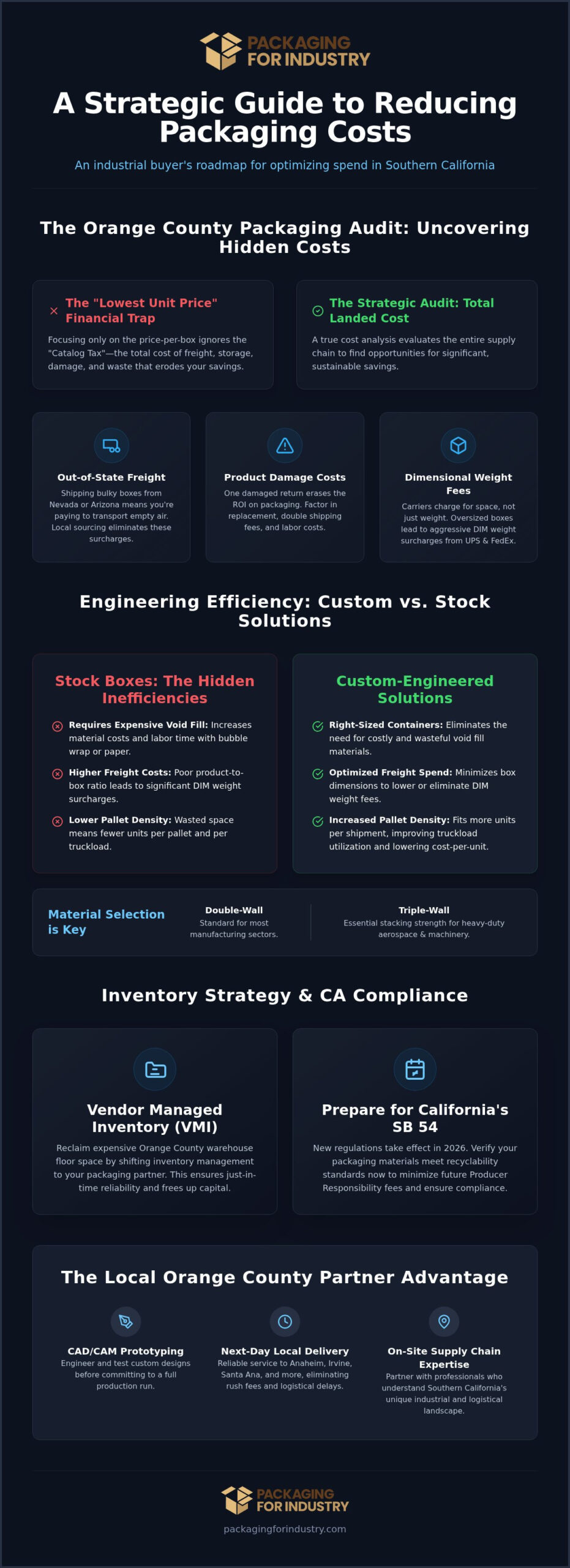
Most procurement managers look at the unit price on a corrugated box invoice and assume they’ve found a deal. This narrow focus ignores the Catalog Tax, which is the cumulative cost of freight, handling, and administrative overhead associated with out-of-state suppliers. If you’re serious about reducing packaging costs for my business in Orange County, you must evaluate the total landed cost of every item. Shipping empty boxes from Nevada or Arizona means you’re essentially paying to transport air across state lines.
Eliminating the Catalog Tax in Southern California
High-volume catalog suppliers often hide shipping costs in the fine print. While their base unit prices look competitive, the freight surcharges for bulky items like corrugated boxes or stretch film can increase your total spend significantly. We recommend you compare a local Anaheim quote against your current national distributor invoice. Local next-day delivery doesn’t just save money; it eliminates the emergency rush order fees that occur when out-of-state shipments face logistical delays.
Quantifying the Cost of Shipping Damage
Every damaged product return represents a total loss of the packaging ROI. It isn’t just the cost of the broken item; it’s the double shipping fees, the labor to process the return, and the potential loss of customer trust. When auditing your damage rates, check if you’re using generic void fill where custom foam inserts are required. Adhering to professional packaging and labeling principles ensures your high-value electronics or medical devices reach their destination intact. Relying on poor material quality often forces staff to over-pack, which adds unnecessary labor costs and increases dimensional weight (DIM) impact.
Carrier invoices from UPS and FedEx are heavily influenced by the size of the parcel, not just the weight. If your boxes are consistently too large for the contents, you’re paying a premium for wasted space. A custom design packaging audit identifies where right-sized boxes could lower your shipping invoices. This is a foundational step in reducing packaging costs for my business in Orange County as dimensional weight surcharges become more aggressive. By optimizing the product-to-box ratio, you ensure that you aren’t paying carriers to ship empty air.
Engineering Efficiency: Custom vs. Stock Packaging Solutions
Engineering is the bridge between product protection and fiscal optimization. Many manufacturers rely on stock boxes because they appear cheaper at the unit level, but these standard sizes often force you to pay for excess material and shipping “air.” To begin reducing packaging costs for my business in Orange County, start by measuring your product-to-box ratio. If your packaging is significantly larger than the item it holds, you’re likely violating EPA Sustainable Packaging Guidelines regarding waste reduction and over-packing.
Optimizing Box Dimensions to Lower Freight Costs
Custom-sized corrugated boxes eliminate the need for expensive bubble wrap or paper void fill. When you right-size your containers, you should evaluate whether a standard Regular Slotted Container (RSC) is sufficient or if a die-cut design is more efficient. Die-cut boxes are engineered to fold precisely around your product, often using less total square footage of cardboard. This precision increases pallet density, allowing you to fit more units into every shipment and improving total truckload utilization across Southern California.
For heavy industrial components, material selection is a balancing act. While double-wall corrugated is the standard for many manufacturing sectors, triple-wall provides the stacking strength necessary for heavy-duty aerospace parts or large machinery. Choosing the correct grade prevents over-engineering and ensures you don’t pay for weight you don’t need. This technical precision is a primary driver in lowering your total landed costs.
The Protective Power of Custom Foam Packaging
High-value electronics and aerospace gear require more than generic cushioning. Stock foam sheets often shift during transit, leading to costly surface abrasions or internal component failure. Custom foam inserts, utilizing polyethylene, polyurethane, or anti-static ESD foam, provide a secure fit that absorbs shock more effectively. We often recommend custom foam end caps; they protect the most vulnerable corners of your equipment while using significantly less material than a full foam wrap. You can request a free prototype to test the fit and durability of a custom design before you commit to a high-volume production run.
Beyond the materials themselves, consider the labor impact of your packaging choices. Implementing packaging kitting allows your production team to receive all necessary components pre-organized and ready for assembly. This reduces the time spent on the warehouse floor and streamlines your entire fulfillment process. If you’re ready to see how custom engineering compares to your current stock supplies, you can request a packaging quote to evaluate the potential ROI for your specific product line.
Navigating California’s 2026 Packaging Regulations (SB 54)
California’s Senate Bill 54 (SB 54) transforms packaging from a simple procurement item into a significant compliance liability. For local manufacturers, the 2026 deadlines require an immediate shift in how materials are sourced and managed. Reducing packaging costs for my business in Orange County now involves more than just unit pricing; it requires a strategy to minimize “Producer Responsibility” fees. These fees are tiered based on the recyclability and compostability of the materials you ship. Selecting non-compliant materials today will lead to higher operational costs as the state ramps up enforcement.
Material Compliance Audit for OC Manufacturers
Reviewing your current use of plastic stretch film and foam cushioning is a critical first step. The state mandates specific reduction targets for single-use plastics, which means your current inventory might require a transition to more sustainable alternatives before the 2026 cutoff. Many industrial firms are moving toward weather-resistant corrugated or sustainable wood crates to maintain durability while ensuring compliance. If your operation handles defense contracts, PFI helps you navigate military packaging compliance alongside these evolving state laws. This dual-track approach ensures your mil-spec requirements don’t conflict with California’s environmental mandates.
The Economic Benefit of Sustainable Industrial Packaging
Using compliant materials today prevents the accumulation of significant regulatory fines tomorrow. In Southern California, where waste disposal fees are among the highest in the nation, reducing the volume of non-recyclable waste directly impacts your operational overhead. Beyond avoiding fines, you should consider the following economic advantages of sustainable materials:
- Lower Disposal Costs: Recyclable corrugated and wood materials are often cheaper to process at the end of their life cycle compared to specialized plastics.
- Closed-Loop Systems: Implementing reusable packaging for internal or regional transport eliminates the recurring cost of single-use materials.
- Reduced Compliance Burden: Sourcing locally within Orange County reduces the carbon footprint associated with long-distance freight, which simplifies state-mandated reporting.
Leveraging reusable packaging systems for closed-loop industrial cycles is a proven way to stabilize your budget. By keeping pallets and specialized crates within a controlled loop between your facility and your partners, you eliminate the need for constant re-purchasing. This strategy is particularly effective for reducing packaging costs for my business in Orange County when dealing with high-frequency shipments between local distributors. Proactive compliance is not just about following the law; it’s about protecting your profit margins from the rising cost of waste.
Inventory Strategy: Reclaiming Orange County Warehouse Space
Orange County industrial real estate remains some of the most expensive in Southern California. Storing massive quantities of corrugated boxes or bulky protective foam on-site is an inefficient use of your most valuable asset. To start reducing packaging costs for my business in Orange County, you must accurately calculate the monthly cost-per-square-foot of your packaging storage area. This calculation often proves that the volume discount you secured for a massive order is actually a net loss when you factor in the rent, insurance, and labor required to manage that inventory.
The Financial Impact of VMI in Southern California
A Vendor Managed Inventory (VMI) program solves the problem of capital tied up in physical stock. Instead of purchasing months of supply in advance, your partner manages the replenishment process based on your actual consumption rates. You should check if your current supplier performs weekly or monthly usage reviews to prevent stockouts. This model ensures you always have the right amount of stretch film or custom crates on hand without over-committing your cash flow. It provides a level of supply chain stability that’s critical for aerospace and medical manufacturers who can’t afford a line stoppage.
Space Optimization for Industrial Operations
Walk your warehouse floor and identify “dead” space occupied by slow-moving supplies or obsolete box sizes. Transitioning these items to Anaheim-based stocking programs allows you to reclaim that square footage for revenue-generating activities. By implementing just-in-time packaging, you move toward a leaner operational model. This is especially beneficial for long lead-time custom items that would otherwise sit on your racks for months. Freeing up floor space for a new assembly line or CNC machine offers a much higher ROI than using that same space to store empty air.
Lean inventory management requires constant vigilance against obsolete materials. Recurring packaging reviews help you identify items that no longer fit your current product revisions. Removing these items prevents them from becoming a permanent fixture in your warehouse and ensures your team only handles active, compliant materials. This disciplined approach is a cornerstone of reducing packaging costs for my business in Orange County. It transforms your warehouse from a storage center into a high-velocity fulfillment hub.
Implementation: Choosing the Right Orange County Packaging Partner
The final phase of reducing packaging costs for my business in Orange County involves selecting a partner capable of executing the technical and logistical strategies outlined in this guide. A vendor who only sells from a static catalog cannot offer the custom engineering required to optimize high-value shipments. You need a single-source provider that integrates corrugated boxes, protective foam, stretch film, and pallets into a unified system. This consolidation reduces administrative overhead and ensures that every component of your packaging works together to eliminate transit damage.
Proximity is a critical factor for operational reliability. Verify that your partner maintains a robust local delivery range across Anaheim, Irvine, Santa Ana, and the surrounding Inland Empire. Relying on a Southern California supplier eliminates the out-of-state freight surcharges that often inflate the total landed cost of industrial supplies. Local presence also facilitates the just-in-time delivery models necessary for manufacturers to maintain lean production lines without the risk of stockouts.
Evaluating Technical Support and Prototyping
Catalog-only suppliers often fail when your operation requires a custom engineering solution for complex parts. When evaluating a potential partner, audit their CAD/CAM and prototyping capabilities. For sectors like electronics and medical devices, a digital design must be followed by a physical prototype for fit-testing and durability verification. You should ask for a comprehensive packaging review to identify immediate cost-reduction opportunities within your current workflow. Local support is especially vital for aerospace packaging, where precision and adherence to mil-spec standards are non-negotiable requirements.
Final Checklist: Getting Your Packaging Quote
Before you request a quote, gather your historical usage data and current material specifications. An accurate comparison requires a clear understanding of your annual volume and the specific performance requirements of your boxes and cushioning. A professional quote should be transparent and reflect the total value of the partnership, including delivery schedules and inventory management services. Follow this checklist to prepare for your procurement review:
- Usage Audit: Itemize your monthly consumption of corrugated boxes, stretch film, and foam.
- Spec Verification: Ensure your current material grades (e.g., double-wall vs. triple-wall) are appropriate for your product weight.
- Logistics Requirements: Define your need for VMI or just-in-time stocking to reclaim warehouse space.
- Compliance Check: Confirm all materials meet the upcoming 2026 SB 54 standards.
Taking these steps ensures that you aren’t just switching vendors, but actually optimizing your entire supply chain. If you’re ready to move beyond catalog pricing and implement a data-driven strategy, you can contact PFI for a cost-reduction analysis to see how custom engineering and local logistics can stabilize your budget for the coming year. Reducing packaging costs for my business in Orange County is a continuous process of refinement, starting with the right technical partner.
Optimizing Your Southern California Supply Chain for 2026
Achieving fiscal efficiency in industrial logistics requires a shift from buying boxes to engineering systems. By auditing the “Catalog Tax” and right-sizing your corrugated materials, you eliminate the hidden freight costs that erode your margins. Implementing VMI programs specifically for SoCal manufacturers allows you to reclaim expensive floor space while staying ahead of California’s 2026 packaging regulations. These strategies provide the predictable costs and logistical reliability needed to stay competitive in a demanding market.
Our team supports these goals through free custom prototyping and design services that ensure your high-value parts are protected without over-packing. With local next-day delivery in Orange County, we help you transition to a leaner inventory model that prioritizes cash flow. If your priority is reducing packaging costs for my business in Orange County, then auditing your total landed costs is the first step toward long-term optimization.
We’re ready to help you solve your most complex logistical challenges with precision and reliability. Let’s build a more efficient packaging system for your operation today.
Frequently Asked Questions
How can I lower my packaging costs for my business in Orange County without sacrificing quality?
You can achieve significant savings by focusing on total landed cost rather than unit price. This involves auditing freight surcharges, reducing material waste through custom engineering, and reclaiming warehouse space via VMI. By switching to a local Southern California supplier, you eliminate the high shipping fees associated with out-of-state catalog distributors. Implementing these strategies is essential for reducing packaging costs for my business in Orange County while maintaining high protection standards.
What is the ‘Catalog Tax’ and how does it affect Southern California manufacturers?
The ‘Catalog Tax’ refers to the hidden expenses of purchasing from large national distributors, such as high freight surcharges and administrative overhead. For manufacturers in the Inland Empire or Orange County, these fees often erase the perceived savings of a lower unit price. Local sourcing eliminates these markups and emergency rush order fees. Switching to a regional partner allows you to compare packaging pricing more accurately based on total landed costs.
Does custom packaging actually save money compared to stock boxes?
Custom packaging often provides a higher ROI than stock boxes by eliminating the need for excessive void fill and lowering dimensional weight surcharges. Stock boxes frequently result in shipping “air,” which increases your UPS and FedEx invoices. Custom sizes available from local suppliers ensure a precise fit for your industrial products. This optimization increases pallet density and reduces labor time on the production floor, ultimately lowering your total operational spend.
How does a Vendor Managed Inventory (VMI) program reduce warehouse costs?
A Vendor Managed Inventory (VMI) program reduces warehouse costs by shifting the burden of stock replenishment to your supplier. Instead of using expensive Orange County floor space to store bulky corrugated inventory, your partner manages the levels based on actual usage. This lean approach improves cash flow by reducing capital tied up in supplies. It also eliminates production stoppages caused by stockouts while freeing up space for manufacturing equipment.
What are the 2026 California packaging regulations (SB 54) I need to know about?
SB 54 requires all single-use packaging in California to be recyclable or compostable by 2032, with reduction targets beginning in 2026. Producers will face tiered fees based on the environmental impact of their materials. To minimize these costs, businesses should transition toward sustainable wood crates and compliant corrugated materials. Proactive compliance helps you avoid regulatory fines and reduces waste disposal fees in high-rent Southern California industrial facilities.
How can I reduce shipping damage for high-value aerospace components?
You can reduce shipping damage for aerospace components by using engineered protection like polyethylene or anti-static ESD foam inserts. Generic cushioning often fails to absorb the shocks experienced during transit, leading to surface abrasions or internal component failure. Utilizing mil-spec packaging and custom foam end caps ensures high-value gear remains secure. This technical approach is more cost-effective than processing returns or managing the reputational damage caused by shipping failures.
Why is local sourcing from an Anaheim supplier better than national distributors?
Sourcing from an Anaheim supplier is better because it provides logistical advantages like local next-day delivery and immediate technical support. National distributors ship from distant hubs, which leads to longer lead times and higher freight surcharges. A local partner understands the specific challenges of Southern California manufacturing, from high real estate costs to strict state regulations. This proximity allows for faster prototyping and more responsive inventory services compared to distant catalog suppliers.
Can right-sizing my boxes really lower my UPS and FedEx freight costs?
Right-sizing directly impacts your freight costs by reducing the dimensional weight of your shipments. Carriers charge based on the space a box occupies, not just its physical weight. If your boxes are consistently too large, you’re paying a premium for empty air. Using custom-sized corrugated boxes allows you to fit more units on a pallet and lower your per-unit shipping cost. This remains a primary tactic for reducing packaging costs for my business in Orange County.