
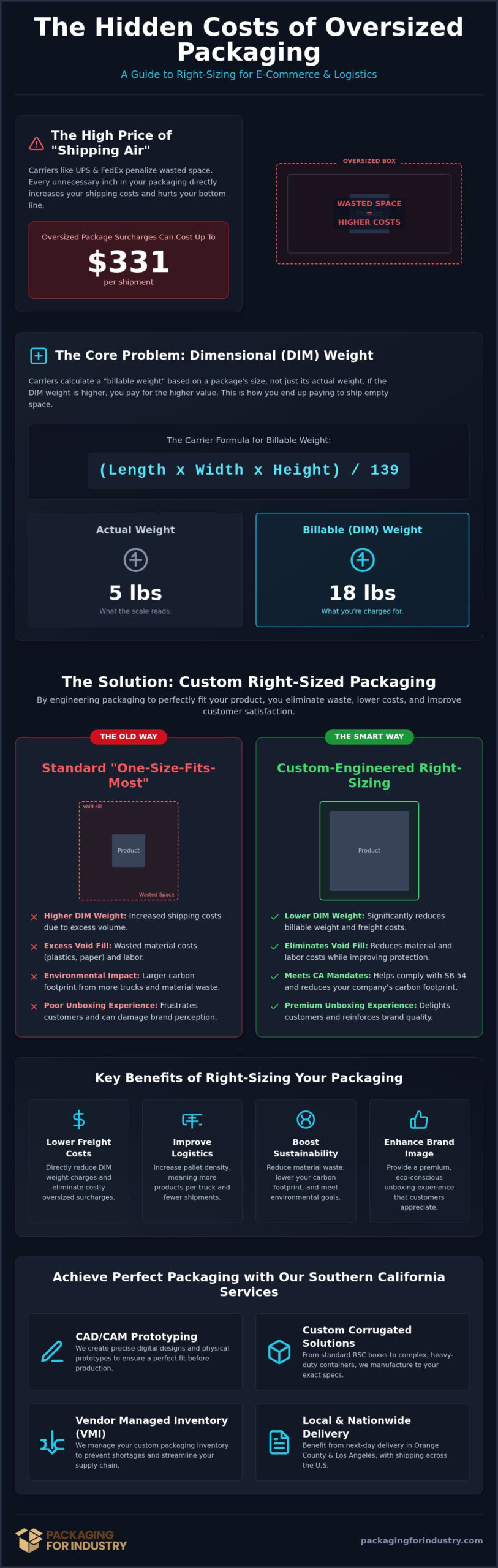
Did you know that certain UPS and FedEx surcharges for oversized packages can now cost as much as $331 per shipment? In an era where carriers have aligned on a 139 DIM weight divisor and introduced strict cubic volume triggers, shipping even a few inches of empty space is no longer just a minor inefficiency; it’s a direct hit to your profitability. Implementing right-sizing packaging for e-commerce Southern California operations has shifted from a sustainability goal to a baseline requirement for fiscal survival.
We understand the frustration of paying to ship air and the pressure of meeting California’s new SB 54 and AB 2026 mandates regarding plastic reduction. You’re likely looking for a way to protect your margins without sacrificing product safety. This guide provides a pragmatic roadmap to eliminating wasted space, lowering DIM weight surcharges, and adopting sustainable materials that resonate with your customers. We’ll examine how custom-engineered corrugated solutions and integrated foam protection can streamline your warehouse logistics while ensuring you remain compliant with local regulations.
Key Takeaways
- Understand how the 2026 DIM weight divisor of 139 impacts your bottom line and how to identify the specific cubic volume triggers that lead to expensive handling surcharges.
- Discover the specific operational steps for implementing right-sizing packaging for e-commerce Southern California businesses to reduce the total weight and volume of your outbound shipments.
- Learn why custom-engineered corrugated boxes provide a more effective sustainable solution than standard boxes filled with excess void fill, helping you meet strict California environmental mandates.
- Explore the benefits of using CAD/CAM prototyping to create precise packaging designs that eliminate wasted space while ensuring maximum product protection during transit.
- See how local Vendor Managed Inventory (VMI) programs in Anaheim and Los Angeles can prevent supply shortages of custom-sized materials while streamlining your warehouse logistics.
Why Right-Sizing is Critical for Southern California E-commerce Operations
Right-sizing is the precise engineering of packaging to match a product’s specific dimensions. This practice represents a departure from the “one-size-fits-most” approach that has traditionally dominated logistics. For businesses operating within the high-density corridor stretching from the Port of Long Beach through Anaheim to the Inland Empire, right-sizing packaging for e-commerce Southern California is no longer optional. It’s a strategic necessity to maintain operational efficiency and protect your bottom line.
When you optimize your packaging, you’re directly addressing the carrier’s use of Dimensional weight. Since major carriers currently utilize a 139 DIM weight divisor, any excess space in your corrugated boxes results in higher billable weights. Partnering with a local supplier like PFI provides a distinct advantage. Our Anaheim headquarters allows for rapid CAD/CAM prototyping and local next-day delivery across Orange County and Los Angeles. This proximity ensures you don’t have to stock massive quantities of standard boxes just to avoid long lead times from out-of-state catalog suppliers.
The Environmental Impact of Oversized Packaging
Optimizing your container size does more than lower costs; it significantly improves your environmental footprint. By increasing pallet density, you can fit more units into a single shipment. This reduces the total number of truck trips required to move goods from Southern California warehouses to their final destinations. For companies focused on packaging cost savings, right-sizing naturally aligns with California’s strict 2026 environmental mandates, such as SB 54. It eliminates the hidden waste of “shipping air,” which consumes unnecessary fuel and occupies valuable warehouse floor space.
Consumer Expectations in the 2026 E-commerce Landscape
Modern consumers, particularly Gen Z and Millennials, are increasingly vocal about “egregious packaging.” Receiving a small item in an oversized box filled with non-recyclable void fill often leads to brand backlash. By utilizing custom-engineered containers, you can eliminate the need for excessive plastic waste. This precision-engineered approach creates a premium unboxing experience that demonstrates your brand values both efficiency and sustainability. High-value brands in sectors like electronics and medical devices find that a custom-fit box provides superior protection while reinforcing a professional, eco-conscious image.
Calculating the Impact: DIM Weight and Freight Cost Reduction
Dimensional weight is the primary driver of modern shipping expenses, shifting the cost focus from how much a package weighs to how much space it occupies in a carrier’s vehicle. Since carriers like UPS and FedEx now use a standard 139 divisor for 2026 domestic shipments, shipping “air” has become an expensive liability. Every cubic inch of empty space in an oversized box increases the billable weight, often resulting in costs that far exceed the actual physical weight of the product. Implementing right-sizing packaging for e-commerce Southern California operations allows businesses to align their logistics costs with actual product dimensions rather than carrier-imposed volume penalties.
The Math of Right-Sizing: DIM vs. Actual Weight
The standard formula for calculating billable weight is (L x W x H) / 139. This calculation determines your shipping cost if the result is higher than the actual scale weight. The “tipping point” occurs when the volume of your box forces you into a higher weight bracket, even if the product itself is lightweight. For instance, reducing a box size by just two inches on each side can significantly drop the billable weight. In a high-volume warehouse environment, this marginal change translates into substantial freight cost reduction over thousands of shipments. Precision matters because carriers round each dimension up to the nearest whole inch before applying the divisor.
Reducing Surcharges with Custom Box Engineering
Carrier networks are increasingly aggressive with surcharges for bulky or inefficiently packed items. As of January 2026, “Additional Handling” surcharges are triggered at 10,368 cubic inches, while “Large Package” fees apply once a package exceeds 17,280 cubic inches. These fees can reach up to $331 per package, making precision engineering essential for any distributor. By using custom design packaging, you ensure your containers stay below these critical cubic thresholds. This approach follows Sustainable Materials Management principles by reducing material waste at the source while simultaneously protecting your margins. When you evaluate the total cost of ownership, the slight increase in per-unit price for a custom box is almost always offset by the dramatic reduction in landed shipping costs. You can request a packaging quote to compare the ROI of custom versus stock sizes for your specific SKUs.
Sustainable Alternatives: Custom Corrugated vs. Excess Void Fill
Sustainability in industrial logistics follows a clear hierarchy: reduce, reuse, and recycle. While recycling programs are essential, reduction provides the most immediate impact on both your environmental footprint and operational costs. A custom-fit box is inherently more sustainable than a standard box stuffed with biodegradable fill because it eliminates waste at the source. When implementing right-sizing packaging for e-commerce Southern California operations, you move away from the excess volume of oversized RSC boxes toward precision-engineered die-cut designs that match your product’s footprint exactly.
Standard boxes often require layers of bubble wrap or packing peanuts to prevent movement. This creates a secondary waste stream for your customers to manage. By contrast, right-sized containers utilize the structural integrity of the corrugated material itself to secure the item. For high-value components in the medical or electronics sectors, we integrate protective foam packaging only where critical protection is required. This surgical approach to material usage ensures safety without the bulk associated with traditional void fill methods.
Choosing the Right Corrugated Grade
Selecting the correct material grade is vital for maintaining stacking strength in smaller containers. While many products only require standard single-wall corrugated, heavy-duty double-wall options provide necessary crush resistance for denser industrial items. In the Southern California climate, where coastal humidity in areas like Huntington Beach or San Pedro can affect board rigidity, using weather-resistant corrugated ensures your right-sized designs don’t fail during transit. Our engineering team helps you minimize total material usage while ensuring your packaging meets the rigors of the regional supply chain.
Eliminating Plastic Void Fill
Precision-engineered inserts and corner and edge protection allow you to stabilize loads in significantly smaller containers. This shift eliminates the need for plastic-based fillers that consumers increasingly reject. Beyond the environmental benefits, filler-free packaging offers a superior unboxing experience. It looks professional, organized, and intentional. When a customer in Orange County or the Inland Empire opens a perfectly fitted box, it reinforces your brand’s commitment to quality and logistical precision. You can compare packaging pricing for these custom solutions to see how reduction at the source lowers your total material spend.
Operational Blueprint for Implementing Right-Sized Packaging
Transitioning from standard catalog sizes to a precision-engineered system requires a methodical approach. For many distributors, the initial hurdle is the perceived complexity of managing custom dimensions. However, implementing right-sizing packaging for e-commerce Southern California operations follows a logical path that yields immediate results in both freight spend and warehouse efficiency. By following this operational blueprint, you can replace guesswork with data-driven design.
Step 1: Conduct a comprehensive packaging audit. Analyze your top-selling SKUs and compare their physical dimensions to the boxes currently used. You’ll likely find that a small percentage of your product line is responsible for a large percentage of your “shipped air” costs. Identify the specific items that frequently trigger the 2026 cubic volume surcharges mentioned earlier.
Step 2: Partner with a local engineer for CAD/CAM prototyping. Working with a local partner in Anaheim allows you to bypass the delays of out-of-state suppliers. You’ll provide your product dimensions to an engineering team that uses CAD software to design a container with a perfect fit. This step ensures that every millimeter of corrugated material serves a functional purpose.
Step 3: Test designs against real-world rigors. A right-sized box must do more than just fit; it must protect. Perform standardized drop tests to ensure the integrity of the design during the high-velocity handling common in UPS and FedEx hubs. This validation phase prevents costly shipping damage and return logistics expenses.
Step 4: Transition to a Vendor Managed Inventory (VMI) program. Managing custom stock can be challenging without the right system. A VMI program ensures you always have the right-sized materials on hand without tying up excessive capital in warehouse floor space. PFI monitors your usage levels and provides local next-day delivery to keep your lines moving.
The Role of Prototyping in Design
Free prototyping from PFI is a critical resource for e-commerce companies in Orange County. It allows you to verify product fit and structural integrity before committing to a full production rollout. This iterative process refines the design for multi-modal transit, ensuring the packaging remains durable whether it’s moving by ground across the Inland Empire or by air to a nationwide customer. It eliminates the risk of ordering thousands of units that don’t meet your protection standards.
Streamlining Warehouse Logistics
Right-sized boxes naturally improve your palletization density, allowing you to store more finished goods in the same footprint. By utilizing just-in-time inventory management, you can sync your packaging deliveries with your production schedule. This approach reduces kitting and assembly time, as intuitive, custom-fit designs are often faster for warehouse staff to pack than standard boxes requiring complex void fill configurations.
Leveraging PFI’s Custom Engineering and VMI in Southern California
PFI is the preferred choice for e-commerce packaging in Anaheim and Los Angeles because we bridge the gap between industrial engineering and warehouse economics. While massive catalog suppliers offer generic sizes that force you to “ship air,” we specialize in custom solutions that solve specific carrier surcharge issues. Choosing a local partner means you aren’t just buying a box; you’re accessing a system of logistical optimization designed for the unique Southern California landscape.
Our Vendor Managed Inventory (VMI) program is the backbone of a successful right-sizing strategy. One common reason businesses stick with oversized standard boxes is the fear of running out of specialized custom stock. VMI eliminates this risk entirely. We monitor your stock levels and proactively replenish your supply from our Anaheim headquarters. This ensures that right-sizing packaging for e-commerce Southern California stays consistent across your entire SKU library without requiring you to manage complex reorder points.
Proximity is a critical factor in supply chain reliability. For businesses in Irvine, Santa Ana, and Huntington Beach, our local next-day delivery ensures you don’t need to dedicate massive amounts of warehouse floor space to packaging storage. We act as your off-site warehouse, providing just-in-time fulfillment that keeps your operations lean. This localized support is a direct alternative to the long lead times and high shipping costs associated with out-of-state catalog distributors.
Comprehensive Industrial Solutions
We provide more than just corrugated containers. Our engineering expertise allows us to integrate materials like protective foam, stretch film, and corner protection into a single, cohesive solution. This is particularly valuable for specialized sectors like aerospace, medical device manufacturing, and electronics fulfillment. Large catalog suppliers lack the technical depth to engineer these integrated systems. We offer industrial-focused support that ensures your high-value components remain secure while moving through the high-velocity hubs of the Inland Empire and beyond.
Ready to Optimize Your E-commerce Fulfillment?
Starting the process is straightforward. We offer a comprehensive packaging review where our engineers visit your site to identify immediate cost-saving opportunities. We’ll analyze your current DIM weight impact and demonstrate how a custom-engineered approach can lower your total landed shipping costs. This data-driven analysis provides the peace of mind that your logistics strategy is optimized for the current 2026 carrier environment. You can schedule a site visit to begin a packaging cost-reduction analysis tailored to your specific SKUs.
Future-Proofing Your Southern California Logistics Strategy
The 2026 shipping landscape demands more than just standard boxes; it requires a calculated approach to volume and protection. Moving beyond one-size-fits-most inventory allows you to directly combat rising DIM weight surcharges while aligning with regional sustainability mandates. You don’t have to choose between cost-efficiency and environmental responsibility when you optimize your container dimensions. Precision at the design stage translates into measurable savings across your entire distribution network.
Implementing right-sizing packaging for e-commerce Southern California operations is a strategic move toward a more resilient supply chain. PFI facilitates this through free CAD/CAM prototyping and industrial-grade protection tailored for the aerospace, medical, and electronics sectors. Our Anaheim-based team ensures your operations remain lean with local next-day delivery and Vendor Managed Inventory. These tools provide the peace of mind that your fulfillment lines will keep moving without the burden of excess warehouse space or shipping air.
It’s time to eliminate professional stress by optimizing your packaging for the modern carrier environment. Take control of your landed costs and improve your unboxing experience with precision-engineered solutions that protect your products and your margins.
Frequently Asked Questions
How much can right-sizing packaging actually save on shipping costs?
Right-sizing reduces shipping costs by lowering the dimensional (DIM) weight of your packages. Since billable weight is calculated using the 139 divisor, reducing box dimensions by even two inches can significantly drop your per-package rate. While exact savings vary by carrier zone and product weight, eliminating “shipped air” prevents you from paying for space you don’t use. This is especially critical for high-volume distributors looking to lower packaging costs.
Is custom-sized packaging more expensive than stock boxes?
Custom-sized packaging may have a higher per-unit price than mass-produced stock boxes, but the total landed cost of shipping is almost always lower. When you compare packaging pricing, you must factor in the reduction in void fill materials and the significant drop in DIM weight surcharges. Stock boxes often require expensive plastic fillers to protect products, whereas custom designs use structural corrugated integrity to ensure safety with less material.
What are the best sustainable packaging solutions for California companies?
The most effective sustainable packaging solutions for California companies focus on source reduction rather than just material type. Implementing right-sizing packaging for e-commerce Southern California operations allows you to meet SB 54 and AB 2026 mandates by reducing total plastic usage and corrugated waste. Transitioning from oversized RSC boxes to precision-engineered die-cut designs ensures you use the minimum amount of material necessary to protect your goods during transit.
How does right-sizing help avoid UPS and FedEx surcharges?
Right-sizing prevents your packages from hitting the cubic volume triggers that lead to Additional Handling or Large Package surcharges. As of 2026, packages exceeding 10,368 cubic inches often incur substantial fees. Custom engineering ensures your container dimensions remain below these specific thresholds. By optimizing the fit, you bypass the penalties that carriers like UPS and FedEx apply to inefficient, low-density shipments that occupy disproportionate space on their trucks.
Can PFI provide custom foam inserts for my e-commerce products?
Yes, PFI specializes in custom-engineered foam packaging designed to integrate seamlessly with our corrugated boxes. We provide polyethylene, polyurethane, and ESD-safe foam inserts that protect sensitive electronics, medical devices, and aerospace components. This integrated approach ensures that your high-value items are secured without the need for excessive bubble wrap or loose-fill peanuts. You can request a packaging quote for a combined foam and corrugated solution that maximizes protection.
Does PFI offer local next-day delivery in Southern California?
PFI provides local next-day delivery to businesses throughout the Southern California region from our Anaheim headquarters. This service covers major industrial hubs in Orange County, Los Angeles, and the Inland Empire. By maintaining a local supply chain, we help you reduce lead times and avoid the logistical delays associated with national catalog suppliers. This proximity is essential for companies utilizing just-in-time inventory management to keep their fulfillment lines moving efficiently.
What industries benefit most from right-sized industrial packaging?
Manufacturers and distributors in the aerospace, medical, and electronics sectors benefit most from right-sizing packaging for e-commerce Southern California. These industries often ship high-value, sensitive equipment that requires precise protection and specific material standards. Military-spec packaging and specialized kitting services also rely on right-sizing to ensure compliance and durability. Any B2B operation facing high freight costs due to bulky or fragile items will see immediate ROI from precision-engineered custom sizes.
How do I start a Vendor Managed Inventory (VMI) program with PFI?
You can start a Vendor Managed Inventory (VMI) program by contacting our Anaheim office to schedule a site audit. We’ll analyze your historical usage patterns and warehouse logistics to determine the optimal stock levels for your custom-sized boxes. PFI then takes over the monitoring and replenishment process, ensuring you never face shortages. This program allows you to focus on production while we manage the supply of your right-sized materials and custom sizes available.