
That massive national contract you signed to simplify procurement might actually be the primary driver behind your rising shipping damages and unmanageable lead times. Most procurement managers choose a large-scale catalog provider for the perceived convenience and volume discounts. You expect a streamlined supply chain, yet you’re often left dealing with the common problems with national packaging suppliers, such as generic boxes that don’t protect specialized parts and hidden surcharges that erode your margins.
It’s frustrating when a one-size-fits-all approach leads to high damage rates and unpredictable delivery schedules from distant hubs. We understand that your operation requires precision, not just a part number in a catalog. This article explores how to lower your total cost of ownership by moving away from rigid national models. You’ll discover why custom-engineered protection and reliable local inventory through Vendor Managed Inventory (VMI) outperform high-overhead catalog giants. We’ll also look at how recent 2026 shipping changes, including the 139 DIM weight divisor used by major carriers, make efficient packaging design more critical than ever for your bottom line.
Key Takeaways
- Understand why “one-size-fits-all” catalog standards from national suppliers often fail to provide the necessary protection for specialized industrial components.
- Identify how oversized stock boxes lead to significant hidden costs through dimensional weight surcharges and increased freight expenses.
- Learn the critical difference between a catalog order-taker and a packaging engineer who can design custom foam and corrugated solutions.
- Discover how to solve common problems with national packaging suppliers, such as supply chain bottlenecks, by utilizing localized Vendor Managed Inventory (VMI).
- Establish a framework to audit your total cost of ownership, looking beyond unit price to account for shipping damages and production downtime.
The Allure and Reality of National Packaging Contracts
Procurement teams often gravitate toward national packaging suppliers because the promise of scale and consistency is highly attractive. On paper, a single contract covering multiple facilities across the country suggests simplified billing and a “set it and forget it” strategy. You expect that a massive supplier with dozens of distribution hubs will offer the lowest unit prices and the most reliable logistics. However, the reality for industrial manufacturers is often quite different. These large-scale agreements frequently prioritize the supplier’s operational ease over your specific technical requirements.
This leads to the “lowest common denominator” trap. To maintain national standards, these suppliers often strip away the specialized nuances required for high-stakes industries. A corrugated box that works for a general retail distributor in the Midwest might lack the structural integrity needed for specialized aerospace packaging in Orange County. One of the recurring problems with national packaging suppliers is that their rigid catalog models cannot adapt to local production line needs. You trade custom-engineered protection for the convenience of a catalog, which often results in higher shipping damage and increased total costs.
Understanding the National Supplier Business Model
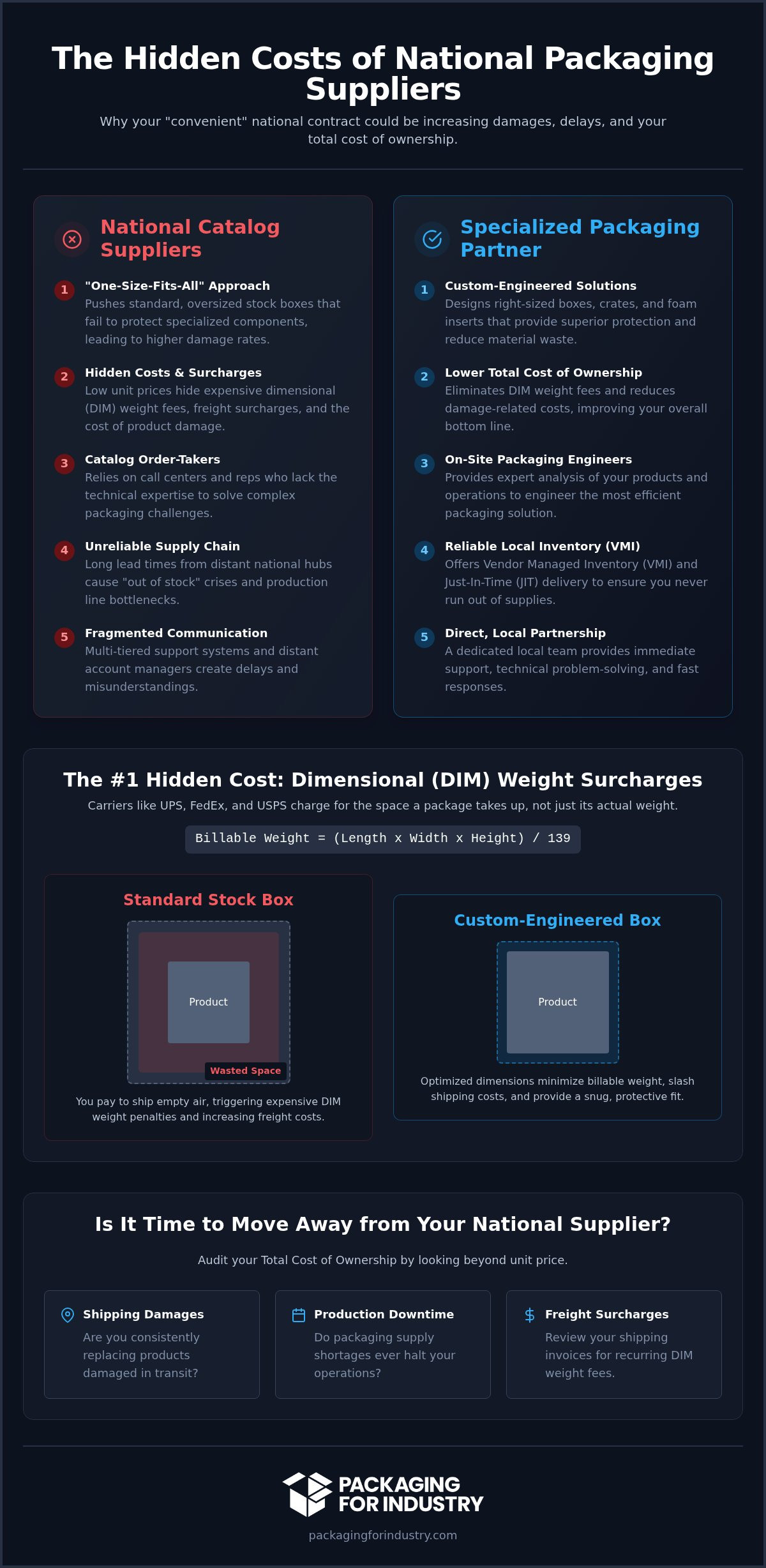
National suppliers operate with massive overhead costs. Maintaining a sprawling network of warehouses and a corporate hierarchy requires significant capital, and those costs are inevitably reflected in your pricing. To maximize their margins, these companies push “stock items” rather than tailored solutions. They want you to use a standard double-wall box from their catalog, even if a custom-sized container would save you thousands in dimensional weight charges. Their business model thrives on retail-style volume, which often ignores the precision required for packaging engineering and industrial-spec accuracy.
When “Big” Means “Slow”: Communication Breakdowns
Communication within a national framework is notoriously fragmented. When you need a custom packaging quote for a new product launch, you’re often forced through a multi-tiered support system. Your request moves from a general customer service rep to a regional coordinator before finally reaching a designer who has never seen your facility. This bureaucracy creates a significant service gap. While centralized billing might look clean on a spreadsheet, it often hides regional inefficiencies and the “soft costs” of delayed responses.
In this environment, the role of a National Account Manager is fundamentally different from a local partnership. A National Account Manager is typically a corporate liaison focused on contract compliance and high-level reporting, whereas a local partner is an on-site expert focused on technical problem-solving and immediate operational efficiency. Relying on a distant contact for local manufacturing challenges is one of the primary problems with national packaging suppliers that leads to production bottlenecks.
Hidden Costs: Dimensional Weight and Freight Surcharges
One of the most expensive mistakes a procurement team can make is equating the unit price of a box with the total cost of shipping. National suppliers push “catalog standards” because they’re easier to stock and distribute at scale. However, forcing your product into a standard 24x24x24 container when it only requires 22x22x22 is a costly oversight. You’re effectively paying to ship air. In the industrial sector, shipping empty space isn’t just a minor inefficiency; it’s a direct hit to your margins. Effective supply chain risk management requires scrutinizing these dimensions, as non-optimized packaging often triggers significant surcharges from major carriers.
The financial impact of these choices became even more severe in mid-2026. As of July 12, 2026, the USPS aligned its dimensional (DIM) weight divisor to 139, matching the standards already used by UPS and FedEx. This means that lightweight, bulky packages are now more expensive to ship across all major domestic carriers. These problems with national packaging suppliers often stem from their inability or unwillingness to provide custom-sized solutions that circumvent these DIM weight traps. When you use oversized stock boxes, you aren’t just paying for extra corrugated material; you’re paying a premium for the volume that box occupies on a truck.
The True Cost of a “Standard” Corrugated Box
A catalog box might look cheaper on a quote, but an engineered custom corrugated box often provides a better return on investment. For example, reducing a box’s height or width by just one inch can save thousands in annual freight costs for high-volume manufacturers. This optimization also extends to your warehouse floor. Custom-sized packaging allows for better pallet utilization, meaning you can fit more units per shipment and maximize your square footage. Learn how optimized box sizing reduces freight costs to see how engineering impacts your bottom line.
Freight Surcharges You Didn’t Account For
National suppliers frequently benefit from “shipping and handling” markups that obscure the true cost of logistics. Beyond the base rate, non-optimized packaging triggers additional handling surcharges and “large package” fees that quickly add up. These hidden costs are rarely discussed by catalog sellers who prioritize volume over precision. If you’re tired of seeing your shipping budget consumed by avoidable carrier fees, it may be time to request a packaging quote for a custom-engineered solution. Transitioning to right-sized packaging is one of the fastest ways to lower your total cost of ownership while improving supply chain reliability.
Catalog Sellers vs. Packaging Engineers: The Service Gap
National suppliers excel at moving high volumes of stock items, but they typically operate as order takers rather than technical consultants. When your product requires specialized protection or specific material compliance, a catalog-based approach often fails to meet the mark. One of the core problems with national packaging suppliers is their inability to provide on-site technical support or custom engineering. They offer “good enough” solutions that frequently lead to high damage rates for high-value gear. Instead of an order taker, your operation needs a partner who understands the intersection of materials science and logistics.
The gap between a catalog seller and a packaging engineer is most evident during the design phase. A national provider wants you to fit your product into their existing inventory to maximize their margins. In contrast, an engineering-minded partner analyzes the fragility of your item, the shipping environment, and the end-user experience. This consultative approach ensures that you aren’t over-packaging with expensive, unnecessary materials or under-packaging with generic stock items that invite shipping damage.
Engineering Protection for High-Value Industries
High-value sectors like Aerospace and Medical cannot rely on generic cushioning. While a national supplier might suggest standard bubble wrap or loose-fill, these materials often fail to prevent movement or provide the necessary shock absorption for sensitive components. Custom-engineered inserts, such as die-cut polyethylene (PE) or polyurethane (PU) foam, offer precision-fit protection that stock items simply cannot match. Explore our custom foam packaging solutions to see how engineered protection reduces shipping damage and ensures compliance with strict industry standards, including mil-spec requirements. This level of detail is essential for preventing the professional stress of rejected shipments or damaged prototypes.
Prototyping: Testing Before You Buy 10,000 Units
Ordering 10,000 units from a catalog without a physical fit-test is a massive operational risk. If the dimensions are slightly off or the internal protection doesn’t hold up during transit, you’re left with useless inventory and a halted production line. PFI eliminates this risk through CAD/CAM support and free prototyping. We provide physical samples for you to test on your own production floor before you commit to a bulk order. This process includes rigorous evaluation techniques, such as drop-testing and vibration analysis, to simulate real-world shipping conditions. By identifying flaws during the design phase, we prevent the costly re-orders and supply chain bottlenecks that often arise when dealing with the rigid models of national providers. Customizing your protection isn’t just about safety; it’s about optimizing your total cost of ownership and maintaining a steady logistical flow.
Supply Chain Reliability: Solving the ‘Out of Stock’ Crisis
Relying on a “Just-in-Time” strategy from a supplier 500 miles away is a high-risk gamble for any industrial manufacturer. While national hubs promise efficiency, the physical distance often creates significant lead-time vulnerabilities. One of the most disruptive problems with national packaging suppliers is their inability to respond quickly to sudden demand spikes or regional logistics bottlenecks. When a distant hub faces a stockout, your entire production line can grind to a halt because you lack a critical corrugated box or a specific roll of stretch film. This lack of regional agility forces many procurement managers into a cycle of over-ordering and stockpiling just to feel safe.
The problems with national packaging suppliers often become most apparent when a minor inventory error turns into a major production delay. Global supply chain disruptions throughout 2026 have highlighted the fragility of centralized distribution. If your packaging isn’t in a warehouse near your facility, it’s effectively non-existent when an emergency arises. By choosing a partner with local roots and sophisticated inventory capabilities, you gain the reliability needed to maintain a lean, efficient operation without the fear of a shutdown.
Vendor Managed Inventory (VMI) Explained
Vendor Managed Inventory (VMI) serves as the primary antidote to packaging shortages. This system shifts the burden of inventory tracking from your procurement team to the supplier. Instead of managing dozens of SKUs and worrying about stock levels, you allow a local partner to monitor your usage and replenish supplies automatically. This proactive approach eliminates the professional stress of “out of stock” crises. Financially, VMI allows you to free up valuable warehouse space and working capital that would otherwise be tied up in excess safety stock. Streamline your warehouse with Vendor Managed Inventory to ensure your operations never stop due to a missing component. It transforms packaging from a constant headache into a background utility that simply works.
Local Delivery vs. National Shipping
Proximity is the ultimate insurance policy for your supply chain. For manufacturers in Anaheim, Orange County, and Los Angeles, a local partner provides a level of security that national catalog sellers cannot replicate. We offer local next-day delivery across Southern California, significantly reducing the lead times and carbon footprints associated with long-haul freight. This regional agility is especially critical during “emergency order” scenarios. If you discover you’ve run out of heavy-duty pallets or ESD inserts on a Friday afternoon, a local supplier can often deliver a solution before your next shift begins. National suppliers, bogged down by centralized dispatch and distant hubs, simply can’t compete with that level of responsiveness.
Evaluating Your Supplier: Is it Time to Move Away from National?
Auditing your packaging spend requires looking far beyond the price per unit on a spreadsheet. While a national supplier might offer a lower initial bid for a thousand standard boxes, the “soft costs” associated with their rigid model often erode those savings. Identifying the recurring problems with national packaging suppliers is the first step toward reclaiming your margins. These hidden expenses include the labor spent on excessive void-fill, the administrative burden of tracking late shipments, and the capital tied up in oversized warehouse safety stock. A strategic partner helps you analyze the total cost of ownership by considering how engineering and logistical agility impact your bottom line.
Transitioning from a national contract to a regional partnership doesn’t have to disrupt your operations. In fact, a staged transition often reveals immediate efficiencies. By moving specialized or high-volume lines first, you can measure the impact of custom sizing and VMI on your freight costs and warehouse flow. This data-driven approach allows you to justify the shift through tangible improvements in shipping damage rates and pallet utilization. Many procurement teams realize the problems with national packaging suppliers only after a major shipping damage event or a stockout halts their production line.
A Checklist for Packaging Procurement Managers
Use these three questions to determine if your current national packaging supplier is still the right fit for your manufacturing needs:
- Does my supplier provide on-site CAD support and functional prototypes? If you’re forced to guess dimensions or wait weeks for samples, your design cycle is too slow for modern industrial needs.
- Are our shipping damage rates stagnant or increasing despite using “standard” protection? Generic materials like bubble wrap often fail to protect industrial-grade components during transit compared to die-cut foam.
- Am I paying for warehouse space that my supplier should be managing through a VMI program? If your floor is cluttered with months of packaging inventory, you’re subsidizing your supplier’s lack of regional hubs.
The PFI Alternative: Request a Packaging Quote
PFI acts as the “fixer” for companies tired of the impersonal, catalog-first service typical of national providers. We combine the agility of local next-day delivery in Southern California with the capability for nationwide shipping. Our process begins with a professional packaging review. We analyze your current materials, box dimensions, and carrier surcharges to identify where engineering can lower your total shipping costs. Identifying these inefficiencies is particularly critical following the mid-2026 DIM weight divisor changes that increased costs for bulky items. We don’t just sell boxes; we design systems that protect your product and your profit margins.
Optimize Your Industrial Logistics for Better ROI
Relying on a rigid national contract often creates more operational friction than it solves. As we’ve explored, the recurring problems with national packaging suppliers range from hidden dimensional weight surcharges to a total lack of technical engineering support. Transitioning to a regional partner allows your team to focus on production rather than managing packaging shortages or shipping damages. By utilizing custom-engineered corrugated boxes and protective foam inserts, you lower your total cost of ownership while ensuring your high-value parts arrive intact.
Our team at PFI provides the local agility and technical expertise that catalog sellers simply can’t match. We offer free prototyping and CAD/CAM design support to ensure a perfect fit before you commit to bulk orders. With specialized VMI programs and local next-day delivery in Southern California, we keep your supply chain moving without the burden of excess safety stock. It’s time to stop paying for empty space and start investing in a system that supports your manufacturing goals and long-term stability.
We look forward to helping you build a more resilient and cost-effective supply chain.
Frequently Asked Questions
What are the most common problems with national packaging suppliers?
The most frequent problems with national packaging suppliers include rigid “one-size-fits-all” catalog standards and significant hidden costs from dimensional weight surcharges. These suppliers prioritize high-volume stock items over engineered solutions to maximize their own margins. This often results in a service gap where technical support is replaced by corporate bureaucracy, making it difficult to get custom designs or quick responses to regional production line changes.
How do national suppliers compare to local industrial packaging companies in cost?
While national suppliers may offer lower initial unit prices on stock items, local companies often provide a lower total cost of ownership. Local partners eliminate the high overhead of national warehousing and provide regional next-day delivery, which reduces freight expenses. You also benefit from direct access to packaging engineers who optimize your designs to prevent costly shipping damages and carrier penalties that a catalog seller might ignore.
Why is custom packaging more cost-effective than catalog stock boxes?
Custom packaging is more cost-effective because it eliminates the expense of shipping empty space and paying for unnecessary void-fill. Catalog stock boxes often force you into higher dimensional (DIM) weights and extra materials to fill gaps. By right-sizing your corrugated boxes, you maximize pallet utilization and avoid the 139 DIM weight divisor surcharges that major carriers enforced in mid-2026, directly lowering your freight spend.
Can a local Southern California supplier handle nationwide shipping?
Yes, a local Southern California supplier like PFI can manage nationwide shipping while providing personalized local support for your primary hubs. We leverage established logistics networks to deliver custom solutions across the country. This model gives you the best of both worlds: the technical expertise and proximity of a local “fixer” combined with the reach necessary to support all your national distribution points reliably.
What is Vendor Managed Inventory (VMI) and how does it save money?
Vendor Managed Inventory (VMI) is a proactive service where the supplier takes full responsibility for monitoring and replenishing your packaging stock levels. This saves money by freeing up your warehouse floor space and reducing the working capital tied up in excess safety stock. It also eliminates the professional stress and high cost of production stops caused by unexpected packaging shortages that often occur with distant suppliers.
How can I reduce shipping damages caused by generic packaging?
You can reduce shipping damages by replacing generic bubble wrap or loose-fill with custom-engineered foam inserts. Die-cut PE or PU foam provides a precision fit that prevents product movement and absorbs shock during transit. Using CAD/CAM design support ensures that your high-value gear is protected by a structural solution specifically tailored to its weight and fragility, rather than relying on “good enough” stock cushioning.
What industries benefit most from switching to a custom packaging manufacturer?
Industries with high-value, fragile, or highly regulated products benefit the most from custom solutions. This includes the aerospace, medical, and electronics sectors, where component protection is critical for operational success. Manufacturers dealing with military-spec requirements also find that custom engineering provides the precision and reliability that generic catalog suppliers simply cannot offer, helping to solve common problems with national packaging suppliers in these specialized fields.
How do I request a quote for custom corrugated boxes or foam inserts?
You can request an industrial packaging quote by contacting PFI for a professional review of your current spend and shipping requirements. Our engineers provide CAD/CAM support and free prototyping to ensure your new design meets your operational needs. We analyze your current damage rates and freight surcharges to demonstrate exactly how a tailored solution will lower your total costs and improve your supply chain reliability.