
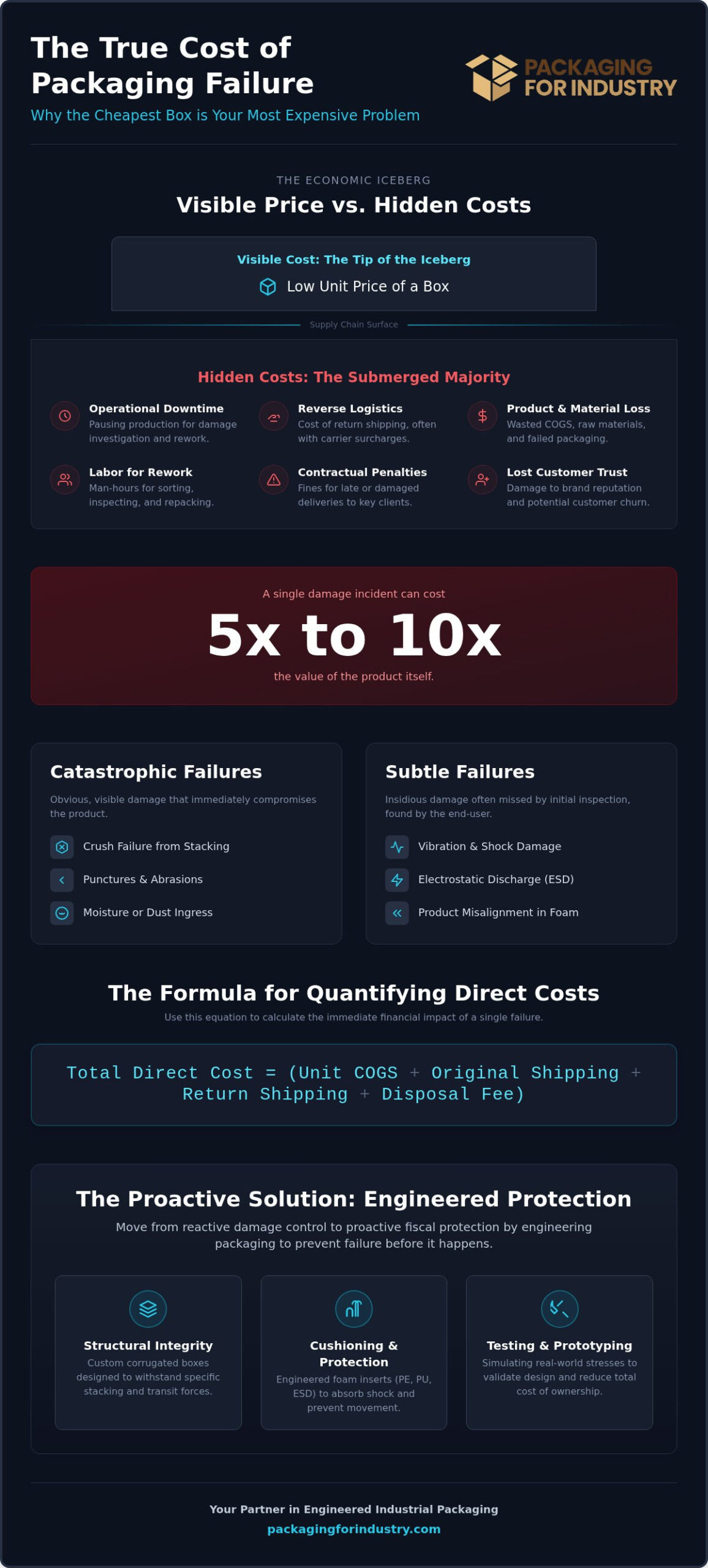
The cheapest box on your procurement spreadsheet is often the most expensive item in your warehouse. While a low unit price looks good on a quarterly report, it ignores the cascading financial impact of a single crushed corner or a failed pallet wrap. Learning how to calculate the total cost of packaging failure requires looking past the initial invoice and into the hidden expenses of reverse logistics, labor for rework, and lost customer trust. Industry estimates suggest the true cost of a damage incident can be five to ten times the value of the product itself.
You’re likely under pressure to lower unit costs while quality suffers, yet repetitive transit damage continues to erode your profit margins. This guide provides a step-by-step framework to quantify these invisible losses and build a data-driven case for optimized, custom-engineered packaging. We’ll walk through a spreadsheet-ready formula to move your operations from reactive damage control to proactive fiscal protection through better engineering and logistical flow.
Key Takeaways
- Identify the difference between catastrophic failures like crushed boxes and subtle failures such as vibration damage or electrostatic discharge.
- Learn how to calculate the total cost of packaging failure by aggregating direct product loss, raw material waste, and the price of the failed materials.
- Quantify the hidden impact of operational downtime and the man-hours lost when your quality control team must investigate transit damage.
- Assess the long-term financial risks of contractual penalties and customer churn associated with unreliable industrial shipping solutions.
- Discover how custom-engineered protection and prototyping reduce total cost of ownership by preventing damage before it reaches the customer.
Defining Packaging Failure: Beyond the Broken Box
Packaging failure is often misunderstood as a purely visual problem. In a professional industrial context, failure occurs the moment a container stops protecting, stabilizing, or identifying its contents. While a crushed box is an obvious sign of trouble, subtle failures like vibration damage or electrostatic discharge (ESD) can be far more insidious. These issues often bypass initial quality inspections only to surface at the customer’s facility, leading to expensive returns and damaged reputations. To understand how to calculate the total cost of packaging failure, you must first recognize that the unit price of a box is merely the tip of an economic iceberg. Beneath the surface lie the submerged costs of rework, transit insurance claims, and lost production time.
In high-precision sectors like aerospace or medical device manufacturing, the definition of failure expands to include any compromise in cleanliness or orientation. A subtle shift in a foam insert can lead to a misalignment that costs thousands in recalibration labor. If your packaging doesn’t maintain the product’s integrity from the assembly line to the end user, it has failed. This cascading financial impact is why a pragmatic approach to engineering is essential for protecting your bottom line.
The Three Pillars of Industrial Packaging Integrity
Industrial packaging relies on three critical pillars to maintain integrity throughout the supply chain. Structural protection ensures that custom corrugated boxes can withstand the vertical compression of high-density stacking. Cushioning and shock absorption are equally vital; specialized foam packaging prevents internal components from shifting during turbulent transport. Finally, load stabilization prevents pallet lean. If your stretch film fails to secure the load, even the strongest box won’t prevent a tip-over. Using rigorous Package testing protocols allows manufacturers to simulate these stresses and identify weaknesses before they reach the field.
Common Industrial Failure Modes
Common failure modes often stem from a mismatch between material specifications and the operational environment. We frequently see crush failure in high-turnover Southern California warehouses when lower-tier boxes buckle under the weight of stacked pallets. Without adequate corner and edge protection, even minor impacts during forklift transit can compromise an entire shipment. Environmental factors like moisture or dust ingress during long-term storage represent another significant failure point. When you analyze how to calculate the total cost of packaging failure, these environmental variables must be factored into your risk assessment to avoid catastrophic inventory loss.
Step 1: Quantifying Direct Replacement and Material Costs
Quantifying the financial impact of damaged goods begins with the most immediate line items. To understand how to calculate the total cost of packaging failure, you must look beyond the invoice price of the replacement unit. Every incident triggers a chain reaction of expenses that starts with the Cost of Goods Sold (COGS). This figure includes the raw materials and the specific labor hours already consumed in manufacturing the damaged item. If the unit is unsalvageable, that entire investment is effectively erased. Additionally, you must account for disposal and scrap fees, particularly for industrial components that require specialized waste management.
The packaging materials themselves represent wasted capital. With North American containerboard prices increasing by a net $100 per ton in the first half of 2026, every crushed box or discarded foam insert is a loss of expensive raw material. When a shipment fails, you aren’t just losing the product; you’re losing the shipping spend twice. Reverse logistics, the process of shipping damaged freight back to your facility, is notoriously inefficient. Carriers frequently apply surcharges for handling compromised containers, which can easily double the original freight cost.
The Direct Cost Formula
A pragmatic approach to damage assessment uses a standardized equation: Total Direct Cost = (Unit COGS + Original Shipping + Return Shipping + Disposal Fee). This formula highlights why hidden shipping surcharges for damaged freight are so damaging to profit margins. According to 2026 logistics data, Less-Than-Truckload (LTL) contract rates have increased by 14.3 percent year-over-year, making transit errors more expensive than ever. In high-value sectors like aerospace packaging, these direct costs are magnified. A single compromised seal or structural crack in a high-precision component often results in a total loss because safety regulations prohibit the repair of critical parts.
Material Waste and Re-Packaging Expenses
Replacement shipping requires a second set of materials for the same sale. You are now paying for additional corrugated boxes, foam inserts, and stretch film that wouldn’t have been necessary with a successful first delivery. This also creates a labor loss. Your warehouse team must stop their regular duties to unpack, inspect, and re-pack the goods. If your inventory of custom-engineered packaging is depleted by replacement shipments, you may be forced to use emergency stock or generic substitutes. These stop-gap measures rarely provide the same level of protection, which increases the risk of a repetitive failure. If your current damage rates are eating into your margins, you can request a quote for an engineered solution that stops the cycle of waste.
Step 2: Factoring in Operational Downtime and Labor Loss
While material losses are visible on an invoice, the labor drain associated with damaged shipments is often overlooked in traditional accounting. To understand how to calculate the total cost of packaging failure, you must quantify the man-hours diverted from productive work to crisis management. Every failure triggers an investigation phase. Your quality control and engineering teams must stop their current projects to diagnose whether the fault lies in the material specification, the palletization pattern, or carrier mishandling. This diagnostic time is a direct drain on your technical resources.
The most severe impact occurs when a failed component causes production line downtime. In industrial manufacturing, an assembly line is only as fast as its slowest part. If a critical sub-assembly arrives with vibration damage or structural fatigue, the entire line may stop. You are then paying for idle labor and facing missed output targets. These delays often necessitate expedited shipping to get a replacement to the customer as quickly as possible. According to 2026 freight data, fuel surcharges on Full Truckload (FTL) shipments now add 15 to 28 percent to base rates, making emergency overnight freight a massive hit to your operational budget.
The Administrative Burden of Failure
The administrative burden of a failed shipment extends across multiple departments. Procurement teams must spend time re-ordering materials and tracking replacements, while accounting staff manage the tedious process of carrier disputes and insurance claims. Customer service labor is another significant factor. Your team must manage the fallout with an upset buyer, which often involves multiple phone calls and emails to explain the delay. This creates a substantial opportunity cost. Every hour your staff spends on damage control is an hour they aren’t spending on growth-oriented tasks or improving existing systems. Accounting for these soft costs is a critical component of how to calculate the total cost of packaging failure accurately.
Logistical Friction in Southern California
Logistical friction is particularly acute in the Southern California corridor. The Los Angeles and Inland Empire regions operate on razor-thin delivery windows due to heavy port traffic and warehouse congestion. A single packaging failure can cause a missed appointment, resulting in steep re-delivery fees from local LTL carriers. When a shipment is rejected at the dock, the schedule for the entire day is disrupted. Many firms utilize Just-In-Time inventory management to keep overhead low, but this strategy leaves zero margin for error. If the packaging fails, the buffer is gone, and the production stop is immediate. High-performance packaging isn’t just about protection; it’s about maintaining the steady, logical flow of your entire supply chain.
Step 3: Assessing Long-Term Program and Brand Consequences
The financial impact of a damaged shipment doesn’t end when the replacement arrives. To understand how to calculate the total cost of packaging failure, you must analyze the long-term contractual and reputational consequences that follow a transit incident. In high-stakes sectors like aerospace and defense, contracts often include strict performance clauses. Late delivery fees and liquidated damages can be triggered the moment a failed container stops a project. These penalties aren’t just administrative nuisances; they’re direct subtractions from your project’s profitability that can’t be recovered through insurance claims.
Beyond immediate penalties, consider the “Brand Tax” associated with poor delivery performance. When a manufacturer consistently delivers damaged components, their perceived quality drops, regardless of the engineering excellence of the product itself. This leads to customer churn. Calculating the risk requires looking at the lifetime value of a lost client. If a recurring contract worth hundreds of thousands of dollars is cancelled due to unreliable delivery, the cost of that packaging failure is astronomical compared to the price of a better box. Your vendor scorecard, which tracks delivery integrity, directly influences your ability to win future bids and maintain your status as a preferred partner.
The Vendor Scorecard Impact
Vendor grading systems are a standard reality for Tier 1 suppliers, particularly in the automotive sector. These scorecards grade you on everything from labeling accuracy to the physical integrity of the pallet upon arrival. Recurring failures can lead to being “de-listed” as a supplier, which is a terminal event for many industrial programs. Implementing custom design packaging acts as a strategic insurance policy for your reputation. It ensures that your components arrive in ready-to-use condition, protecting your score and your future revenue streams.
Market Competitiveness and Pricing Power
Reliability is a marketable asset that allows for premium pricing. In industrial sectors where downtime is expensive, partners who guarantee damage-free delivery can command higher rates than those who compete on unit price alone. Conversely, many companies fall into the trap of “reactionary over-packaging” after a failure. They add layers of un-engineered bubble wrap or extra tape without a logical plan. This creates a different kind of waste. By using professional manufacturing packaging solutions, you avoid the cost of over-packaging while ensuring protection. This data-driven approach is the final piece in how to calculate the total cost of packaging failure and move toward a more profitable logistics model.
Preventing Failure: Engineering a Cost-Effective Solution
The transition from “buying boxes” to “engineering protection” is the most effective way to stabilize your bottom line. While procurement departments often focus on reducing the unit price of materials, this narrow focus ignores the systemic risks identified in previous sections. By partnering with a specialist like PFI, you move away from generic stock supplies and toward custom-engineered systems designed for the specific stresses of your supply chain. Once you understand how to calculate the total cost of packaging failure, it becomes clear that the initial material cost is secondary to the reliability of the delivery.
Prototyping plays a decisive role in this transition. Before a full-scale rollout, we test custom crates and foam inserts to ensure a precise fit. This eliminates the guesswork that leads to vibration damage or structural collapse. Testing a design in a controlled environment saves thousands in the long run by preventing field failures that trigger reverse logistics costs and contractual penalties. Proactive engineering ensures that your packaging is a tool for profit preservation rather than a recurring liability.
Operational consistency is further supported by Vendor Managed Inventory (VMI). A frequent cause of transit damage is the use of incorrect “substitute” packaging when standard stock runs out. VMI prevents these emergency failures by ensuring you always have the correct, engineered materials on hand. This level of oversight removes the temptation to use generic alternatives that don’t meet your product’s specific protection requirements. The ROI is straightforward: spending roughly 10 percent more on superior materials can save 200 percent or more in total failure costs over the life of a program.
Why Custom Engineering Outperforms Stock Supplies
Custom engineering addresses the intersection of physics and economics. We optimize box dimensions to reduce dimensional weight (DIM) charges, which is essential given that 2026 LTL rates have climbed by 14.3 percent. By eliminating excess air in the container, you lower freight spend while increasing structural integrity. We also match foam density to the specific fragility of your product to provide precise shock absorption. This methodical approach helped a Southern California manufacturer reduce packaging costs by eliminating the waste of “over-packaging” while simultaneously dropping their damage rate to near zero.
Your Next Steps for Damage Reduction
The first step toward optimization is a comprehensive Packaging Audit. This process identifies the current weak points in your shipping cycle, from improper palletization to environmental vulnerabilities in the warehouse. During this audit, you should compare the documented cost of your current failure rate against the quote for a custom-engineered solution. This data-driven comparison provides the justification management needs to move from stock supplies to high-performance protection. Applying the logic of how to calculate the total cost of packaging failure ensures that your decision is based on total cost of ownership rather than just the price of the box.
Securing Your Supply Chain Through Precision Engineering
True fiscal responsibility in logistics requires looking past the unit price of a corrugated box. We’ve explored how a single transit incident triggers a cascade of expenses, from reverse logistics surcharges to production line downtime. By mastering how to calculate the total cost of packaging failure, your team can finally quantify the true price of “cheap” stock supplies. This data-driven perspective shifts the focus from procurement savings to total cost of ownership.
Transitioning to a custom design model replaces reactive damage control with engineered certainty. As specialists in aerospace and industrial protection, we provide the technical oversight needed for high-value components. Our team offers free prototyping and CAD/CAM support to ensure every design is validated before the first shipment leaves the dock. This methodical approach eliminates the professional stress of repetitive damage and protects your vendor scorecard.
Southern California manufacturers also benefit from our local next-day delivery, ensuring your operations move with the purposeful speed of a well-oiled supply chain. We’re ready to help you eliminate logistical friction and secure your bottom line through superior engineering.
Frequently Asked Questions
How do I calculate the failure rate for my current packaging?
Divide the number of damaged units by the total number of units shipped within a specific reporting period. To understand how to calculate the total cost of packaging failure, you must also categorize these incidents by severity. Tracking the difference between minor cosmetic damage and total structural loss allows you to weight the financial impact accurately across your operational budget.
What is the industry average for acceptable shipping damage in manufacturing?
Acceptable damage thresholds vary significantly by sector and product value. While many high-volume manufacturers aim for a damage rate below 1 percent, high-precision industries like aerospace often require near-zero failure rates due to safety risks and extreme replacement costs. You should benchmark your performance against your specific contractual penalties and customer retention goals rather than generic averages.
Are custom corrugated boxes significantly more expensive than stock sizes?
Custom corrugated boxes often provide a lower total cost of ownership because they reduce dimensional weight (DIM) charges and eliminate the need for excessive void fill. While the per-unit price might be higher than a generic box, the reduction in transit damage and shipping surcharges usually offsets the initial material cost. Precise sizing also ensures maximum structural integrity during warehouse stacking.
Can better stretch film really prevent packaging failure?
High-performance stretch film is essential for maintaining load stabilization and preventing pallet lean during transit. If the film lacks the necessary containment force, the entire load can shift or collapse during abrupt stops. Using a film with the correct puncture resistance ensures that your goods remain secure, reducing the risk of catastrophic failure during the long-haul distribution cycle.
How does VMI help reduce the total cost of packaging?
Vendor Managed Inventory (VMI) prevents the use of incorrect substitute packaging that often occurs when standard stock is depleted. By ensuring a consistent supply of custom-engineered materials, you avoid the high failure rates associated with generic alternatives. This system also reduces the administrative labor costs and procurement friction associated with manual inventory tracking and emergency re-ordering.
What is the difference between direct and indirect costs of packaging failure?
Direct costs include immediate, visible expenses such as product replacement value, raw material waste, and reverse logistics fees. Indirect costs are the hidden operational drains, including production downtime, labor for quality investigations, and long-term brand damage. Identifying both categories is a critical step in how to calculate the total cost of packaging failure and justifying an investment in superior protection.
Does PFI offer free prototypes for custom packaging designs?
We provide free prototyping and CAD/CAM support to ensure a precise fit and structural integrity before your rollout begins. This engineering phase allows us to test the design against real-world stresses, identifying potential failure points in a controlled environment. Validating the packaging through a prototype saves thousands in the long run by preventing expensive field failures and repetitive damage claims.
How do I know if my product needs custom foam inserts or just standard void fill?
High-value or fragile items with sensitive internal components usually require custom foam inserts for precise shock absorption. Standard void fill often fails to prevent the internal component shifts that lead to misalignment or structural fatigue. If your current shipping cycle results in repetitive internal damage despite using generic cushioning, it’s a clear indicator that an engineered foam solution is required.