
A single back injury in your warehouse can cost more in lost productivity and insurance hikes than an entire year of high-quality shipping supplies. It’s a reality that operations managers face daily; the physical toll of manual handling often leads to the very musculoskeletal disorders that stall production and trigger OSHA audits. You understand that keeping your team safe is just as vital as keeping your shipments on schedule, but standard materials rarely prioritize ergonomic packaging design to reduce worker injury. When boxes are too bulky or lack proper handholds, your workforce pays the price in strain and fatigue.
You can protect your team and your profit margins by shifting toward a more engineered approach to safety. Whether you’re shipping heavy aerospace components or delicate medical devices, designing your materials for better weight distribution and grip makes a measurable difference. This article provides a comprehensive industrial checklist to help you evaluate your current strategy. We’ll explore how custom corrugated solutions, specialized foam inserts, and advanced stabilization techniques create a safer, more efficient environment for your team in Southern California and across the country.
Key Takeaways
- Engineering box dimensions to stay within the optimal reach zone significantly minimizes physical strain during manual handling and lifting.
- Upgrading to heavy-duty double or triple-wall corrugated provides the structural integrity needed for safer grip and more stable weight distribution.
- Switching from manual hand-wrapping to machine stretch film reduces repetitive bending and reaching, protecting your team’s long-term back health.
- Implementing VMI and packaging kitting keeps warehouse floors clear of hazards while ensuring workers only handle the specific materials needed for the task.
- Prioritizing ergonomic packaging design to reduce worker injury through custom prototyping lowers insurance premiums and improves overall operational reliability.
The Hidden Cost of Poor Packaging: Why Ergonomics Matters in 2026
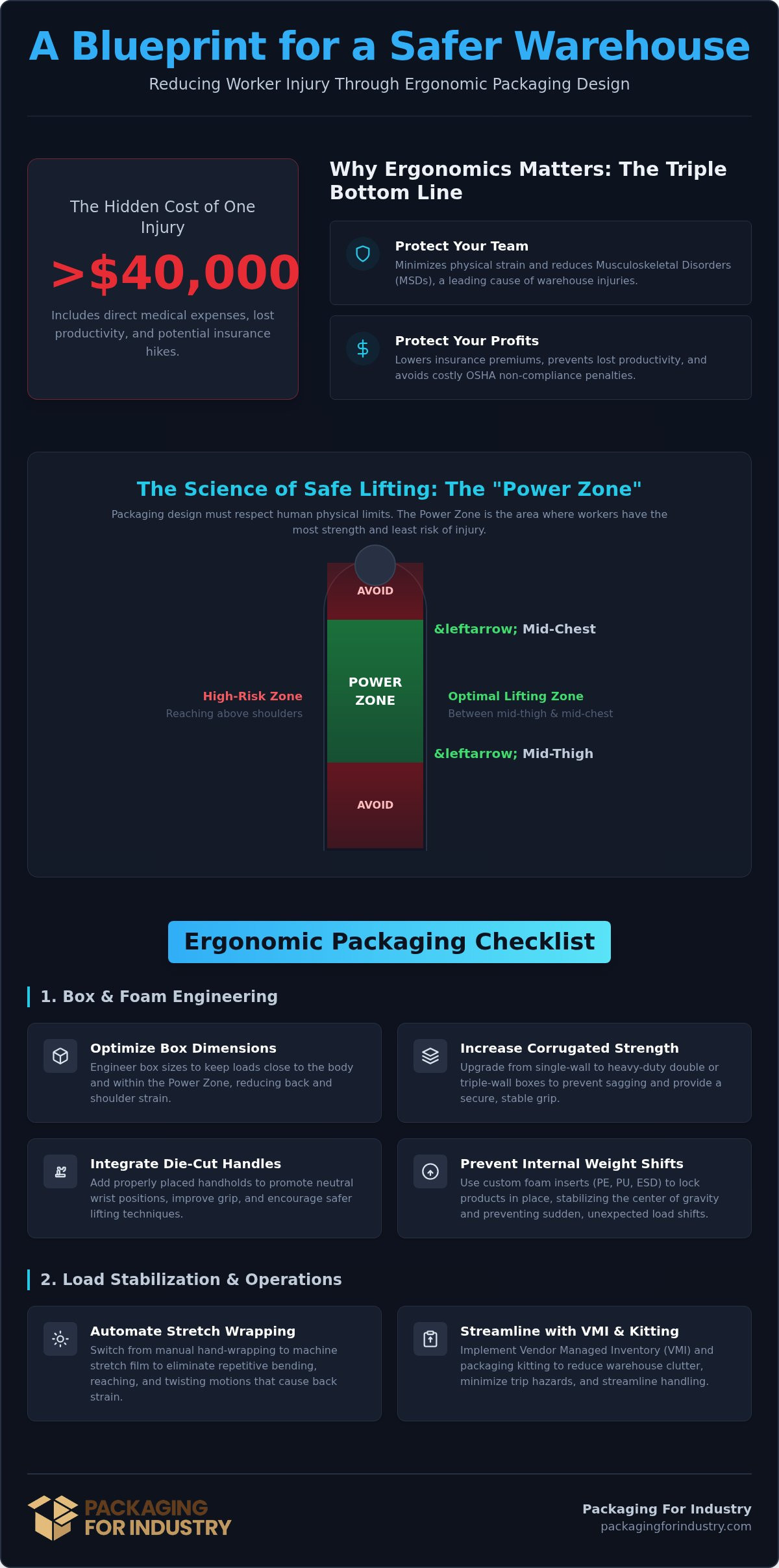
Ergonomic packaging design is not just about comfort; it’s about the scientific engineering of containers and materials to align with human physical capabilities. It’s the application of Human factors and ergonomics to the warehouse floor. By 2026, California’s logistics sector continues to face high rates of Musculoskeletal Disorders (MSDs) as shipping volumes grow. These injuries often stem from poor manual handling of non-ergonomic loads. Implementing ergonomic packaging design to reduce worker injury allows firms to protect their “Triple Bottom Line.” This includes immediate medical savings, long-term productivity gains, and a stronger brand reputation as a responsible employer.
Central to this engineering is the “Power Zone.” This is the area between the mid-thigh and mid-chest where workers have the most strength and least risk of injury. Packaging that forces a worker to reach above their head or bend to the floor violates this zone, inviting disaster. Engineering boxes that keep the center of gravity stable and within this zone is a fundamental requirement for a safe warehouse. When your packaging is designed with these physical limits in mind, you reduce the torque on a worker’s spine during every lift.
The Economic Impact of Workplace Strain
Repetitive strain from undersized handles or unstable boxes leads to more than just sore muscles. It results in long-term disability claims that can cripple a warehouse’s financial stability. When a key team member is sidelined, warehouse throughput drops, and shipping deadlines are missed. Industry professionals report that the total cost of a single industrial back injury, including direct and indirect expenses, can easily exceed $40,000. These costs aren’t just line items; they’re preventable drains on your capital. Safety isn’t an expense. It’s an investment in your operational continuity.
Regulatory Compliance and OSHA Standards
OSHA maintains strict guidelines for manual material handling to prevent overexertion. Proper packaging design helps you meet these standards without slowing down operations. Effective ergonomic packaging design to reduce worker injury incorporates clear weight labeling and “Team Lift” indicators on custom corrugated boxes. These visual cues ensure workers don’t take unnecessary risks. For those in specialized sectors, utilizing packaging for manufacturers ensures that every box is designed for the specific weight and dimensions of the product, reducing the guesswork that leads to injury. Compliance is simpler when your packaging does the heavy lifting for your safety program.
Checklist: Engineering Boxes and Foam for Safer Handling
Engineering a package for safety requires more than selecting a standard container from a catalog. The goal of ergonomic packaging design to reduce worker injury is to eliminate the physical variables that lead to strain during manual handling. When a box is too wide, it forces the worker to hold the load further from their body, increasing the effective weight on the lower back. You must assess box dimensions to ensure they stay within the optimal reach zone for the average worker. Materials that are difficult to grip or that flex unexpectedly under load create instability that leads to slips and muscle tears.
Stability is the foundation of ergonomic safety. According to the Ergonomic Guidelines for Manual Material Handling, reducing the distance a worker must reach is critical for spinal health. Beyond dimensions, you should evaluate your corrugated strength. Moving from a single-wall to a double-wall box provides the structural rigidity necessary for a secure grip. Additionally, integrating custom foam inserts prevents internal shifting. Sudden weight transfers inside a package are a leading cause of acute injury because the human body cannot always react quickly enough to a shifting center of gravity. Die-cut handles and access points should also be utilized to encourage neutral wrist positions, reducing the risk of carpal tunnel and repetitive motion strain.
Corrugated Solutions for Weight Distribution
Heavy-duty triple-wall boxes are essential for industrial shipments because they prevent “bottom-out” failures. When a container sags or breaks at the base, it causes workers to stumble or lose their footing. By designing for center of gravity stability, we ensure that the load remains predictable throughout the shipping cycle. If you are handling high-density parts, you can request a custom packaging quote to see how reinforced materials improve handling safety. Upgrading to custom corrugated boxes allows for precision engineering that matches the physical demands of your warehouse team.
Custom Foam Inserts as Ergonomic Tools
Protective materials do more than cushion products; they act as ergonomic aids. We use PE and PU foam to create “finger lifts” that allow workers to remove heavy or delicate parts from crates without prying or excessive force. Engineering precision-cut foam cavities reduces the “force to pull” required during the unboxing process, which protects the small muscles in the hands and forearms. Utilizing protective foam packaging ensures that every component is presented to the worker in a safe, accessible manner, minimizing the need for awkward reaching or straining.
Load Stabilization and Accessibility: Stretch Film and Crating
Load stabilization is a critical factor that many operations managers overlook when considering workforce safety. An unstable pallet doesn’t just risk product damage; it creates a hazardous environment for the person moving or breaking down the load. As a leading stretch wrap supplier, we prioritize materials that maintain vertical strength and prevent the stack from leaning. We focus on integrating corner and edge protection to ensure every pallet remains a predictable, solid unit. Proper stabilization ensures that the load remains centered, which is vital when a worker is using a pallet jack on a sloped loading dock in a high-traffic Southern California warehouse.
Manual vs. Machine Stretch Wrapping
Manual wrapping is inherently un-ergonomic and physically demanding. It forces an operator to walk backward in a circular motion while bending to secure the bottom of the pallet. This combination is a leading cause of warehouse trips, dizzy spells, and chronic repetitive strain. Upgrading to a machine wrapper eliminates these manual movements, allowing your team to focus on higher-value tasks. For facilities where hand-wrapping is still required, we recommend pre-stretched film. Because the film is already stretched during manufacturing, the operator doesn’t have to pull with extreme force. This significantly reduces the physical load on the shoulders and wrists. You can review our stretch film options to see how different gauges improve your wrapping efficiency.
Crate Design for Safe Unloading
When shipping heavy components for aerospace or manufacturing, the container itself must be accessible. Deep crates often force workers to bend over the side to reach the bottom, which places extreme stress on the spine. We solve this by engineering custom crates with “drop-down” sides or removable panels. These features bring the product to the worker rather than forcing the worker to reach for the product. We also replace traditional fasteners with ergonomic latches to eliminate the need for prying tools. Our custom crates can be foam-lined to dampen vibration during transit, protecting handlers from long-term nerve issues. With Southern California local shipping, we provide these large-scale custom solutions to manufacturers in Anaheim, Irvine, and the Inland Empire with minimal lead times.
Operational Ergonomics: VMI and Kitting Strategies
The layout of your facility often dictates the physical strain your team endures daily. While the box itself is a tool, the logistics of how that box reaches the packer are equally vital for safety. When you source wholesale packaging supplies, the focus shouldn’t only be on unit costs but on how those materials are staged for use. Implementing ergonomic packaging design to reduce worker injury means ensuring your team isn’t navigating around cluttered aisles or reaching into deep, overcrowded bins. Just-in-Time delivery keeps workstations clear of obstructions, which allows workers to maintain a natural, upright posture throughout their shift.
Reducing “reach frequency” is a primary goal for any safety-minded operations manager. If a worker has to walk across the warehouse floor to retrieve a specific foam insert or a roll of tape, they’re adding unnecessary physical load to their day. By organizing supplies at the point of use, you minimize the repetitive twisting and long-distance walking that lead to fatigue-related accidents. This level of organization is particularly critical in high-volume Southern California distribution centers across Riverside and San Bernardino.
Simplifying the Procurement-Safety Link
Consolidated purchasing does more than just lower your administrative overhead. It reduces the physical labor involved in receiving and unboxing dozens of separate shipments from different vendors. When you work with an industrial packaging supplier near me, you can leverage Vendor Managed Inventory services to automate this process. We monitor your stock levels to ensure that safety labels, corner protection, and high-strength boxes are always available. This proactive approach ensures your team doesn’t have to use improper, non-ergonomic substitutes because the right material was out of stock.
Kitting for Minimal Movement
Designing specialized kits is one of the most effective ways to streamline assembly and protect your workforce. Packaging kitting involves delivering a single unit that contains the box, precision-cut foam, and required fasteners directly to the assembly station. This eliminates the need for workers to reach into multiple containers or perform repetitive reaching motions to gather components. In fast-paced e-commerce environments, kitting prevents repetitive motion injuries by keeping every necessary item within a worker’s natural reach zone.
Why Choose Packaging For Industry (PFI) for Safety-First Design?
Selecting a bulk packaging supplier involves more than comparing pricing on a spreadsheet. It requires finding a partner that understands the physical reality of your warehouse floor. At Packaging For Industry (PFI), we take a consultative approach to ergonomic packaging design to reduce worker injury. We don’t just process orders for corrugated boxes; we review your entire manual handling process. Our team analyzes how your staff interacts with every container, from the moment it arrives at your receiving dock in Los Angeles to the final palletization in your Anaheim facility. This comprehensive oversight ensures that every material we provide supports a safer, more efficient workforce.
Safety is a non-negotiable metric in high-value sectors like aerospace and medical manufacturing. We specialize in these industries where precision and reliability are paramount. To eliminate the risk of rolling out an untested design, we offer free prototyping. This allows your team to test the ergonomics of a new box or foam insert before you commit to a full production run. By identifying potential strain points during the design phase, you avoid the high costs of workplace injuries and shipping damage later. Whether you need an industrial packaging supplier near me in Orange County or require nationwide shipping capabilities, our focus remains on engineering protection for both your products and your people.
From CAD Design to Your Warehouse Floor
Our engineering team utilizes advanced CAD/CAM technology to design for both product integrity and human safety. We help clients in Irvine and San Diego lower packaging costs by reducing the labor hours lost to fatigue and injury. A well-designed package reduces the time required for packing and unboxing, which naturally increases throughput. When you eliminate the physical barriers to efficiency, your total cost of ownership drops. We invite you to compare packaging pricing through the lens of a safety-first design audit.
The PFI Difference: Industrial Expertise
Moving beyond a standard catalog is essential for modern industrial safety. Custom solutions beat generic, one-size-fits-all options because they are built for your specific product weight and worker reach zones. Stock containers often lack the necessary handle placement or structural rigidity required for heavy-duty manufacturing. As a dedicated Southern California packaging supplier, we are committed to keeping your production moving with reliable, ergonomic supplies. Our local presence allows us to offer just-in-time safety upgrades and next-day delivery to facilities in the Inland Empire and across the region. Partnering with Packaging For Industry (PFI) means gaining a steady, dependable guide focused on tangible, real-world outcomes for your business.
Protect Your Workforce and Your Bottom Line
Transitioning to an engineered safety model is a strategic move that pays dividends in both worker health and fiscal stability. By following this industrial checklist-from box rigidity to automated stabilization-you eliminate the physical variables that lead to chronic strain. Implementing ergonomic packaging design to reduce worker injury transforms your shipping department from a liability center into a streamlined, proactive operation that prioritizes human physical limits without sacrificing speed.
Packaging For Industry (PFI) provides the technical oversight required to execute these safety audits effectively. We offer free prototyping for all custom designs, ensuring your team can validate the ergonomics of every handle and foam insert before a full rollout. Our specialized expertise in Aerospace and Medical packaging safety, combined with local Southern California next-day delivery, makes us a reliable partner for manufacturers in the Inland Empire and across the region who require immediate, high-performance solutions.
We’re ready to help you protect your most valuable asset while improving your operational flow. Let’s start engineering a safer future for your workforce today.
Frequently Asked Questions
What is ergonomic packaging design and how does it reduce injury?
Ergonomic packaging design is the engineering of shipping containers to align with the physical limits of the human body. By incorporating features like die-cut handles and optimal dimensions, it keeps loads within the “Power Zone” between the mid-thigh and mid-chest. This strategic approach to ergonomic packaging design to reduce worker injury minimizes the risk of spinal strain and acute muscle tears during manual handling tasks on the warehouse floor.
Can custom packaging design actually lower my workers’ compensation costs?
Yes, custom designs directly impact your bottom line by reducing the frequency of musculoskeletal disorders (MSDs). Fewer workplace injuries lead to a lower experience modification rating, or MOD factor, which insurers use to calculate premiums. By investing in ergonomic packaging design to reduce worker injury, you prevent the high-cost disability claims that drive insurance rates upward. It’s a proactive financial strategy for any high-volume shipping operation.
How do custom foam inserts help with ergonomic handling?
Custom foam inserts stabilize the center of gravity by preventing products from shifting inside the box during transit. Sudden weight transfers are a major cause of handling injuries because they catch workers off balance. We also engineer PE and PU foam with precision-cut finger lifts or cavities. These features allow workers to remove heavy parts without excessive force or awkward prying, which protects the small muscles in the hands and wrists.
What are the OSHA guidelines for manual lifting of shipping boxes?
OSHA guidelines emphasize keeping manual lifts within a safe weight range and minimizing the distance a worker must reach from their body. While there isn’t a single universal weight limit, OSHA frequently references the NIOSH lifting equation to evaluate risk. Proper packaging design supports these standards by including clear weight labeling and “Team Lift” indicators on heavy-duty corrugated boxes, ensuring your team doesn’t exceed safe physical thresholds during daily operations.
Is machine stretch wrapping significantly safer than hand wrapping?
Machine stretch wrapping is significantly safer because it eliminates the need for workers to walk backward while bending and reaching. This repetitive motion is a primary cause of warehouse trips and chronic lower back pain. Machine systems also utilize pre-stretched film, which provides superior load containment without requiring the operator to exert extreme physical force. This transition protects your workforce from the long-term cumulative trauma associated with manual pallet wrapping.
How does a Vendor Managed Inventory (VMI) program improve warehouse safety?
A VMI program improves safety by eliminating warehouse clutter and maintaining a clear floor plan. By utilizing Just-in-Time delivery, you prevent the buildup of excess pallets and boxes that create trip hazards in busy aisles. Our VMI services also ensure that critical safety supplies, such as corner protection and heavy-duty double-wall boxes, are always in stock. This prevents workers from using improper or damaged materials that could lead to handling accidents.
Do you provide ergonomic packaging prototypes for testing?
We provide free prototyping for all custom ergonomic designs to ensure they perform correctly in your specific environment. This allows your warehouse team to test handle placement, weight distribution, and unboxing ease before you commit to a bulk order. Testing a physical prototype is the most effective way to verify that your packaging design actually meets the physical needs of your staff and fits your existing conveyor or racking systems.
Which industries in Southern California benefit most from ergonomic packaging?
Aerospace, medical device manufacturing, and high-volume distribution centers in Southern California see the greatest benefits from ergonomic upgrades. These sectors often handle dense components or high-frequency shipments that put workers at risk for repetitive strain. Whether you’re an aerospace manufacturer in Anaheim or a medical supplier in Orange County, custom-engineered solutions like heavy-duty triple-wall boxes and precision foam inserts are essential for maintaining a safe and productive industrial workforce.