
The thickest foam in your warehouse might be the very reason your heavy components are bottoming out during transit. If you’ve been searching for an industrial packaging supplier near me to solve chronic shipping damage, the solution usually lies in engineering rather than just adding more material. Many procurement managers overspend on high-density materials when a lighter, more resilient option would actually provide superior protection. Learning how to choose the right industrial foam density is essential for any bulk packaging supplier focused on reducing the total cost of ownership for their clients.
You likely want to eliminate professional stress by ensuring zero-damage shipments while keeping material waste to an absolute minimum. This guide will help you balance technical specifications with fiscal responsibility so you can confidently request a custom packaging quote that fits your exact needs. We’ll analyze the physics of static loading, compare PE and PU materials, and demonstrate how to optimize dimensional weight for your Southern California operations. By the end of this article, you’ll have a clear roadmap for selecting materials that protect your products and your bottom line.
Key Takeaways
- Understand that density, measured in pounds per cubic foot (PCF), is the primary indicator of foam durability and its ability to withstand repeated impacts.
- Learn the performance differences between closed-cell polyethylene and flexible polyurethane to select the most cost-effective material for your specific application.
- Master how to choose the right industrial foam density by balancing product weight, surface area, and the fragility (G-factor) of your equipment.
- Discover how precision foam engineering reduces total packaging volume, helping you lower freight costs and avoid dimensional weight surcharges.
- See how free prototyping and custom CAD/CAM design allow you to verify product fit and protection levels before moving to full-scale production.
Understanding Industrial Foam Density: More Than Just Weight
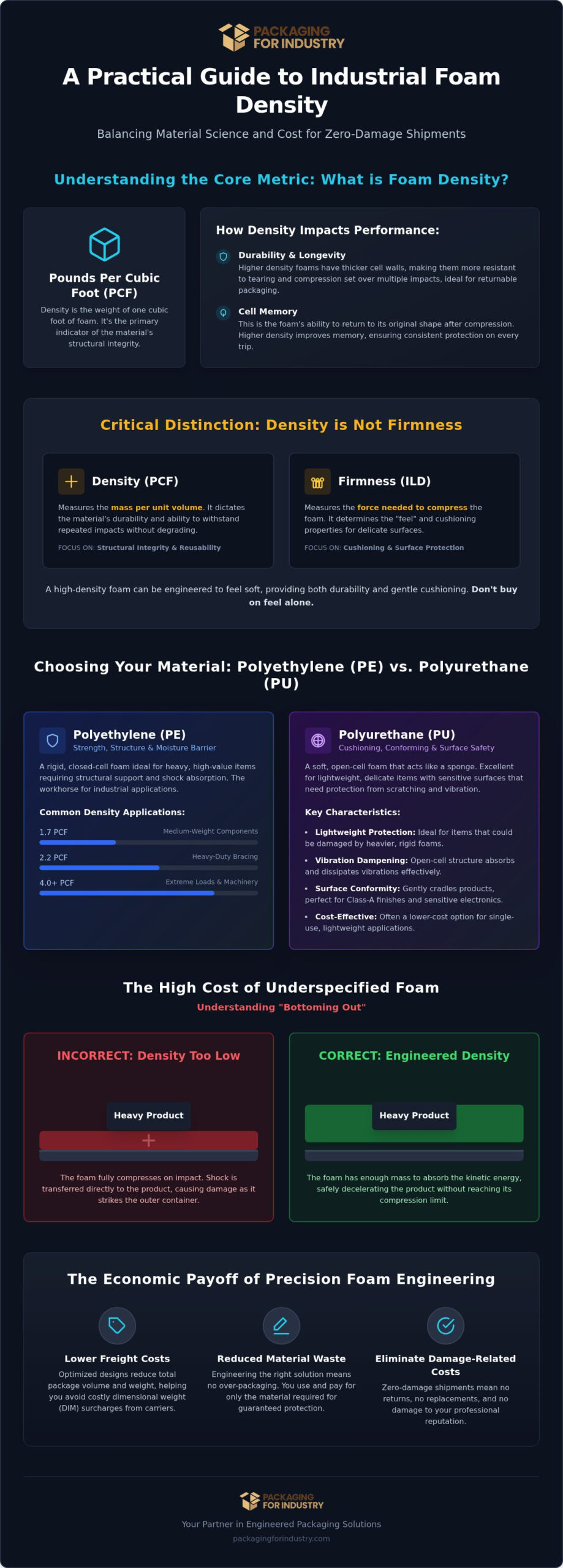
In industrial packaging applications, foam density is defined as the weight of a single cubic foot of the material and is measured in pounds per cubic foot (PCF). This metric represents the amount of actual polymer present in the foam versus the volume of air. When you examine a high-density foam under a microscope, you’ll see thicker cell walls and a more robust structure. This physical composition is why density serves as the primary indicator of foam durability and long term performance. It directly impacts the material’s cell memory, which is the ability of the foam to return to its original shape after being compressed during transit.
Many operations managers in Orange County and Los Angeles mistakenly believe that a higher density always provides better protection for fragile components. However, understanding how to choose the right industrial foam density requires looking past the weight of the material. If the density is too high for a lightweight, delicate item, the foam acts like a solid surface rather than a cushion. This causes the shock of a drop to pass directly through to the product, often resulting in the very damage you’re trying to prevent.
Density vs. Firmness (ILD): The Critical Distinction
One of the most frequent procurement errors involves confusing density with firmness. While density is measured in PCF, firmness is measured by Indentation Load Deflection (ILD). ILD tracks the amount of force required to compress the foam by 25% of its original height. It’s entirely possible to engineer a high-density foam that feels soft to the touch. This combination provides high durability and cell memory without the stiffness that might crush a sensitive medical device. Don’t fall into the trap of buying based on feel alone. Professional buyers focus on the technical specifications that match the specific weight and fragility of their cargo.
The Role of Density in Industrial Shock Absorption
Density determines the total amount of kinetic energy a material can absorb before it fails. If you select a foam with a density that’s too low for your product’s weight, you’ll experience a phenomenon known as bottoming out. This happens when the product completely compresses the foam during a drop and strikes the hard outer container or pallet. We see this often in heavy machinery shipments where standard 1.2 PCF foam is used instead of a more appropriate 2.0 PCF or higher polyethylene. Mastering how to choose the right industrial foam density ensures that your material has enough physical mass to decelerate the product safely without reaching its limit.
Comparing Industrial Foam Materials: Polyethylene vs. Polyurethane
Selecting the right material base is the logical next step in mastering how to choose the right industrial foam density. While both Polyethylene (PE) and Polyurethane (PU) are staples in Southern California warehouses, they solve entirely different logistical problems. PE is a closed-cell material designed for strength and moisture resistance, while PU is an open-cell, flexible material engineered for delicate surface protection. With 2026 market data showing significant price increases across both resins, choosing the wrong material doesn’t just risk product damage; it creates a massive hole in your procurement budget. Your choice must align with the product’s weight and its sensitivity to vibration.
Polyethylene (PE) Density Ranges and Applications
Standard 1.7lb and 2.2lb PE foams are the workhorses of the manufacturing sector. These densities provide the high load-bearing capacity required for aerospace packaging and heavy-duty automotive parts. For extreme applications, high-density PE (4lb and above) is used for bracing within custom foam lined crates to ensure heavy equipment remains stationary during sea or rail transit. PE’s closed-cell nature ensures it doesn’t absorb moisture, which is critical for preventing corrosion on precision-machined metal parts. It’s the superior choice for returnable packaging systems because it maintains its structural integrity over hundreds of shipping cycles.
- 1.7lb PE: Ideal for medium-weight electronics and industrial components.
- 2.2lb PE: The standard for heavy-duty bracing and block-and-brace applications.
- 4.0lb+ PE: Reserved for extreme weights or as a durable base for heavy machinery.
Polyurethane (PU) Density for Delicate Cushioning
Polyurethane is the preferred solution for high-fragility, lightweight items. Most PU used in industrial settings falls between 1.0lb and 1.5lb density, offering a soft cushion that absorbs micro-vibrations. This material is frequently used in convoluted “egg-crate” inserts for medical kits or as anti-static (ESD) inserts for the electronics industry. If you’re shipping sensitive semiconductor components from Orange County to nationwide distributors, ESD PU foam provides a safe, non-conductive environment. Because PU is open-cell, it’s more breathable and flexible than PE, making it easier to wrap around irregular shapes. To find the most cost-effective balance for your specific product, you can request a packaging quote that compares different PU and PE configurations.
The longevity of your custom foam inserts depends heavily on this material selection. High-density PE will outlast PU in a warehouse environment, especially if the foam is exposed to high humidity or frequent handling. However, for one-way shipments of highly sensitive equipment, the superior dampening of a lower-density PU often justifies its use. By matching the material’s physical properties to your shipping environment, you can eliminate the waste of over-packaging while ensuring your goods arrive in showroom condition.
How to Calculate the Right Foam Density for Your Shipment
Calculating the correct density is a precision engineering task, not a subjective “feel test.” While retail-focused guides suggest pushing on the material with your thumb, industrial applications require objective data to prevent catastrophic failure. Learning how to choose the right industrial foam density requires a transition from warehouse guesswork to a calculated four-step process. This methodology ensures that your protective inserts provide the exact deceleration needed to keep internal components intact during a standard 30-inch drop, which is the baseline for most industrial shipping environments.
- Determine Product Weight and Loading Area: Identify the total weight of the item and the specific surface area that will make contact with the foam.
- Identify the G-Factor: Every component has a fragility level, or G-factor, representing the maximum shock it can withstand before breaking. Sensitive medical lasers may have a G-factor of 15, while ruggedized industrial pumps might handle 75 or more.
- Establish Drop Height Requirements: Most Southern California logistics chains design for a 30-inch drop, though specialized aerospace or military contracts may require testing for 36 or 48 inches.
- Select Density for Deceleration: Choose a material mass that slows the product’s movement during impact without letting it strike the outer container.
Calculating Static Loading for Heavy Components
Static loading is the amount of pressure your product exerts on the foam while it’s sitting still. You find this by dividing the total weight of the product by the surface area in contact with the cushion (PSI = Weight / Area). If you have a heavy component with a small footprint, such as a localized mounting bracket, the pressure is concentrated. This requires higher density inserts to prevent the foam cells from collapsing under the weight. In manufacturing packaging, we see this contrast clearly when comparing heavy engine blocks to lightweight optical sensors. High static loading values typically necessitate the structural strength of closed-cell PE foam, while lower PSI ratings often allow for the superior energy dampening of open-cell PU foam.
Using Cushion Curves for Precision Engineering
Engineers use cushion curves to find the “sweet spot” where a specific foam density provides the lowest possible G-force transfer for a given static load. These graphs show that protection isn’t linear. If you use too much foam or a density that is too high, the packaging becomes too stiff. This is known as “over-packaging,” and it’s a common mistake that actually increases the shock transferred to your product. By using CAD/CAM design to optimize the amount of material, you can reduce the total box size and lower your freight costs while simultaneously improving safety. This technical approach eliminates the financial waste of using premium 2.2lb foam when a strategically engineered 1.7lb solution would actually perform better.
The Economic Impact of Foam Density Selection
Industrial foam density is an economic lever that directly influences your total cost of ownership. While many procurement managers focus solely on the price per board foot, the true financial impact includes freight surcharges, warehouse floor space, and the high cost of replacement shipments. In 2026, the industrial foam market has faced significant volatility, with polyurethane suppliers implementing price increases ranging from 12% to 22%. These rising material costs make it essential to understand how to choose the right industrial foam density to avoid over-paying for material volume that doesn’t add protective value. By engineering the density to match your product’s specific static load, you can often reduce the total amount of foam required, leading to a leaner and more profitable supply chain.
Efficiency also extends to how you manage your stock. Utilizing Vendor Managed Inventory (VMI) for your custom foam allows you to reduce your warehouse footprint. Instead of dedicating valuable square footage to bulky foam sheets, you can receive just-in-time deliveries of precision-cut inserts. This approach minimizes material waste and ensures you aren’t tying up capital in excess inventory that might degrade or take up space needed for production. When you balance technical specifications with smart inventory management, you eliminate the professional stress of stockouts and over-spending.
Optimizing Dimensional Weight (DIM)
One of the most effective ways to achieve packaging cost savings is through the reduction of dimensional weight. Carriers like UPS and FedEx calculate shipping rates based on the size of the box rather than just the actual weight. If your foam is too low in density, you’re forced to use thicker layers to prevent bottoming out, which increases the outer carton dimensions. We recently worked with a San Diego electronics firm that reduced their shipping costs significantly by switching to a higher-density, lower-profile PE foam. This change allowed them to move to a smaller box size, effectively bypassing the oversized surcharges that were eroding their margins.
Reusable Packaging and Foam Durability
For companies operating closed-loop logistics, the durability of the foam determines the return on investment for the entire packaging system. High-density PE foam is the industry standard for returnable shipping crates because it resists the crushing and tearing that occurs during repeated loading and unloading. While the initial cost of a 2.2lb or 4.0lb PE insert is higher than a single-use PU alternative, the multi-trip capability provides a much lower cost-per-shipment over time. Integrating these durable inserts with heavy-duty corrugated boxes creates a robust protection system that can survive dozens of transit cycles across the Inland Empire or nationwide.
Ultimately, the cost of a single damaged shipment of aerospace components or medical devices far outweighs the price of premium foam. The right density acts as an insurance policy against the hidden costs of damage, such as return freight, administrative labor, and damaged client relationships. When you master how to choose the right industrial foam density, you transition from simply buying supplies to engineering a strategic asset that protects both your products and your bottom line.
Partnering with a Southern California Foam Engineering Expert
Navigating the complexities of material science requires a partner who understands both engineering and economics. PFI stands as a leading Riverside packaging supplier and a trusted resource for manufacturers throughout Orange County and Anaheim. We provide the technical oversight necessary to determine how to choose the right industrial foam density for your most sensitive shipments. By combining CAD/CAM precision with local delivery capabilities, we ensure your custom foam packaging arrives on time and performs to the exact standards required by your industry.
One of the most significant advantages of working with PFI is our commitment to free prototyping. We understand that procurement managers need absolute certainty before committing to a high-volume production run. This service allows you to see and test your product within the custom-cut foam before you sign off on the final order. This proactive approach helps you confirm how to choose the right industrial foam density by verifying the physical performance of the material under actual load conditions. It eliminates the risk of purchasing thousands of inserts that don’t quite fit or fail to provide the promised G-force protection during transit.
Custom Design and Prototyping Services
Our design team begins by analyzing your product’s specific fragility and static loading requirements. This data-driven review allows us to recommend the exact density and material type, from anti-static polyurethane to high-density polyethylene. Once the design is perfected through prototyping, we can integrate the production into a just-in-time inventory model. This ensures you have the protection you need when you need it, without overwhelming your warehouse floor space with bulky supplies. For our partners in the defense and aerospace sectors, this process includes rigorous documentation to ensure every shipment meets strict contract compliance standards.
Request Your Custom Foam Quote Today
If you’re ready to lower your packaging costs and eliminate shipping damage, it’s time to consult with a specialist who understands the local logistical landscape. PFI serves high-volume and custom foam needs as a premier Anaheim packaging supplier, with service routes extending through Los Angeles, Irvine, Riverside, and the Inland Empire. We provide the stability and dependability of a long-term logistics partner, combined with the innovative capabilities of a custom engineering house. Don’t leave your product safety to chance or generic retail options that don’t account for your specific weight requirements. Take the first step toward a more reliable supply chain and request a quote to start your engineering review today.
Optimize Your Industrial Protection Strategy
Mastering how to choose the right industrial foam density is a critical step in streamlining your supply chain and protecting high-value assets. You now understand that density is a technical measure of durability and energy absorption, not just a subjective feel. By moving away from generic cushioning and toward custom-engineered PE and PU inserts, you can significantly reduce shipping damage while lowering freight costs through dimensional weight optimization.
PFI provides the technical expertise required for complex aerospace and military defense contracts, ensuring your packaging meets every compliance standard. We offer free prototyping for all custom foam designs to verify fit and protection before full production begins. With local next-day delivery available across Orange County, Los Angeles, and the Inland Empire, we serve as a steady, dependable partner in your logistical flow.
We look forward to helping you engineer a more efficient, reliable, and cost-effective packaging system.
Frequently Asked Questions
What is the most common foam density for industrial shipping?
As a leading bulk packaging supplier, we find that 1.7lb and 2.2lb polyethylene (PE) are the standard for most heavy-duty applications. These densities provide the structural integrity needed for blocking and bracing heavy equipment. For lighter cushioning, 1.0lb to 1.5lb polyurethane (PU) is the typical choice. Selecting between these requires a clear understanding of your product’s weight and the specific hazards of your shipping route.
Is high-density foam always more expensive than low-density foam?
High-density materials generally have a higher price per board foot because they contain more polymer resin. With polyurethane prices rising up to 22% in 2026, material volume is a major cost driver. However, when you request a custom packaging quote, you’ll often see that using a thinner, higher-density foam reduces the total box size. This can lower your overall costs by reducing freight charges and storage requirements.
How do I know if my product is “bottoming out” in its packaging?
Bottoming out is evident when the foam shows permanent compression or “crush marks” after a shipment. This indicates the material lacked the density to decelerate the product before it struck the outer container. If your goods arrive with corner damage despite the box being intact, your current foam is likely too soft. Our engineering team can help you identify the failure point and recommend a more resilient density.
Can I use the same foam density for both light and heavy products?
No, using a single density across different product lines is a recipe for shipping damage. Heavy items will crush low-density foam, while light items will simply bounce off high-density foam as if it were a solid surface. Learning how to choose the right industrial foam density is about matching the foam’s resistance to the item’s static load. This ensures the material provides a controlled deceleration during a drop.
What is the difference between PE and PU foam density for electronics?
Polyethylene (PE) is a closed-cell foam used for rigid support, while Polyurethane (PU) is an open-cell foam used for soft cushioning. In electronics packaging, high-density PE often secures the heavy chassis, while low-density PU protects sensitive screens or internal components from vibration. Most high-performance electronic kits utilize a hybrid approach, combining both materials to provide comprehensive protection during transit.
Does foam density affect the static-dissipative properties of ESD foam?
Density doesn’t change the chemical additives that make foam anti-static, but it does affect the material’s durability. Higher density ESD foam is more resistant to tearing and crumbling, which is vital for protecting heavy circuit boards or semiconductor tools. While the electrical resistance remains consistent, the higher density ensures the packaging doesn’t physically fail during repeated loading and unloading cycles in a warehouse environment.
How does foam density impact dimensional weight (DIM) shipping costs?
Foam density is a primary lever for reducing DIM weight surcharges. By mastering how to choose the right industrial foam density, you can often use thinner material to achieve the same protection level as thick, low-density foam. This allows you to downsize your outer corrugated boxes. Smaller box dimensions lead to lower dimensional weight ratings from carriers like UPS and FedEx, directly reducing your per-unit shipping costs.
Can I get custom-cut foam inserts in Anaheim with fast delivery?
If you’re searching for an industrial packaging supplier near me in the Anaheim area, PFI offers local next-day delivery for most stock and custom orders. We specialize in rapid prototyping and CAD/CAM design to ensure your inserts fit perfectly from the first shipment. Our proximity to the Los Angeles and Inland Empire manufacturing hubs allows us to provide just-in-time delivery that keeps your production lines moving without delays.