
The lowest price-per-unit on a corrugated box becomes a massive liability the moment a stockout halts your production line. Many procurement managers treat their vendors as simple order-takers, but implementing best practices for managing a packaging supplier relationship is the only way to move from reactive firefighting to proactive growth. You’ve likely experienced the professional stress of high hidden costs from emergency rush orders or inconsistent quality in custom foam inserts. These disruptions don’t just cost money; they erode your operational reliability and impact your bottom line.
This blueprint will show you how to transform your packaging procurement from a transactional cost into a strategic advantage that eliminates stockouts and reduces shipping damage. We’ll examine how precision engineering and localized logistics can stabilize your supply chain and improve throughput. You’ll learn how to leverage programs like Vendor Managed Inventory to reduce your warehouse footprint while ensuring your high-value goods always have the protection they need. Whether you’re operating in Orange County, Los Angeles, or shipping nationwide, these strategies will help you build a more resilient and cost-effective operation.
Key Takeaways
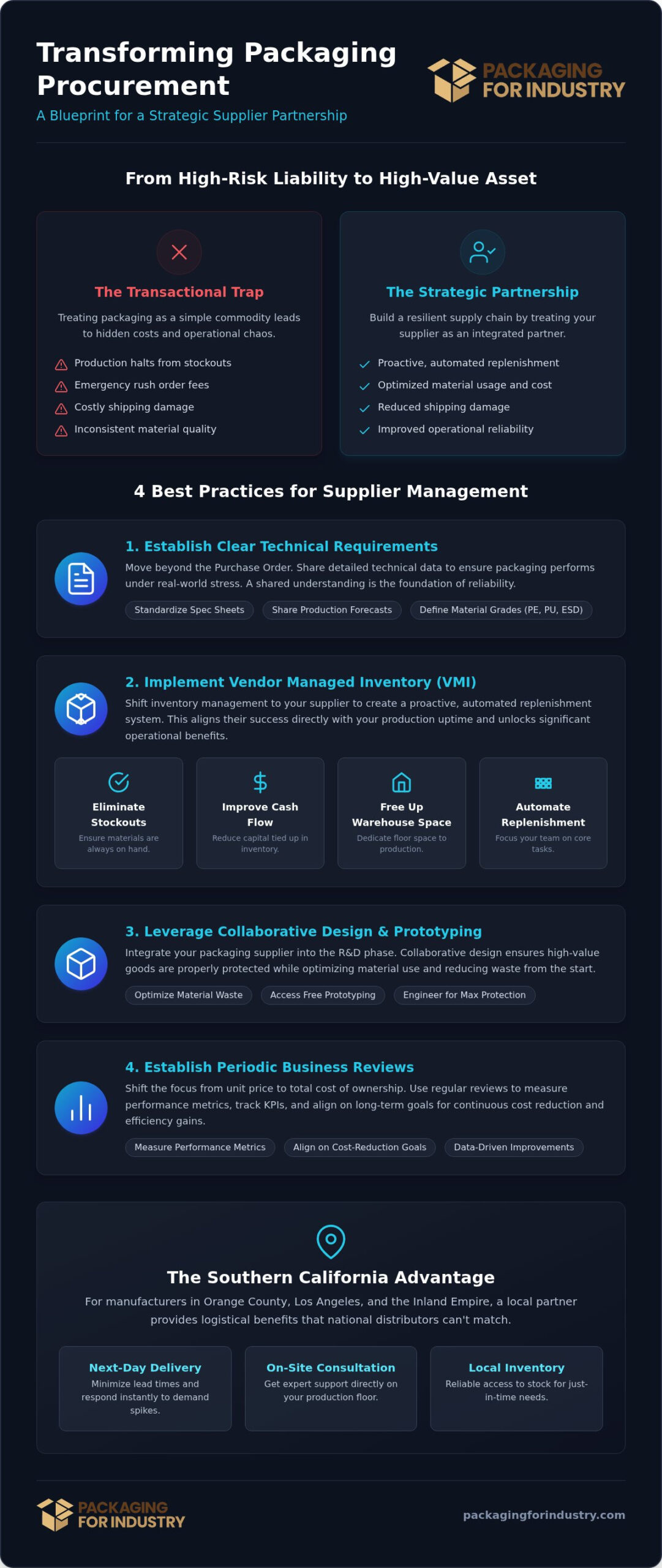
- Integrate your supplier into your production environment to ensure packaging specifications align with your actual shipping stresses and technical requirements.
- Apply best practices for managing a packaging supplier relationship by utilizing Vendor Managed Inventory (VMI) to automate replenishment and eliminate production downtime.
- Leverage collaborative design and free prototyping during product R&D to optimize material waste and ensure high-value goods are properly protected.
- Establish Periodic Business Reviews to measure performance metrics and align on long-term cost-reduction goals rather than focusing solely on unit price.
- Prioritize local Southern California expertise to benefit from next-day delivery and on-site consultative support that national catalog distributors lack.
Establishing Clear Communication and Technical Requirements
A successful industrial packaging relationship begins with a shared technical understanding of your product’s specific protection needs. Many procurement teams make the mistake of treating a purchase order as the final word in communication. However, your supplier needs to look past the PO to understand your production line and the actual shipping environment your goods face. Without this alignment, you risk receiving materials that look correct on paper but fail under the physical stresses of your supply chain. Implementing Supplier Relationship Management (SRM) principles ensures that both parties are working toward the same operational goals from day one.
Vague specifications are the primary driver of hidden costs in manufacturing. When requirements aren’t clearly defined, miscommunication often leads to transit damage, costly returns, and strained budgets. One of the best practices for managing a packaging supplier relationship is to be completely transparent about lead times and volume fluctuations. Honesty about your operational constraints allows your supplier to act as a consultant rather than just a vendor. This transparency builds the trust necessary to navigate supply chain disruptions without halting your production line.
Standardizing Your Packaging Specifications
Precision is the foundation of industrial protection. You should document every material grade used in your facility, from heavy-duty double-wall or triple-wall corrugated boxes to specific protective foam packaging densities like PE or PU. Don’t just order “foam inserts”; specify the required ESD properties or cushioning factors. We recommend sharing your product’s “Fragility Factor” with your supplier’s engineering team. This technical data allows them to design custom inserts that provide maximum protection with minimal material waste. Create a master spec sheet for all recurring orders to ensure quality remains consistent across every production run.
Forecasting and Demand Planning
Effective demand planning is another of the essential best practices for managing a packaging supplier relationship. Sharing your production schedules early helps prevent the emergency rush order fees that often inflate procurement budgets. Seasonal spikes in manufacturing can significantly impact lead times for custom materials, so your supplier needs to know when your volume will fluctuate. Use your historical data to establish realistic minimum and maximum inventory levels. This data-driven approach allows your supplier to manage their own raw material stocks more effectively, ensuring they have the capacity to support your growth without delays. By aligning your forecasts, you create a predictable logistical flow that benefits both your warehouse footprint and your bottom line.
Implementing Vendor Managed Inventory (VMI) for Operational Flow
Vendor Managed Inventory (VMI) represents the most advanced stage of a strategic partnership. Instead of managing dozens of SKUs yourself, you shift the technical burden of inventory tracking to your supplier. This transition is one of the most effective best practices for managing a packaging supplier relationship because it aligns the supplier’s success directly with your production uptime. By allowing an expert to monitor your stock levels, you move from a reactive purchasing model to a proactive, automated replenishment system. It changes the dynamic from a vendor trying to sell more to a partner trying to optimize your flow.
The most immediate result of this shift is the elimination of the “panic order.” When production lines stop because of a corrugated box or foam insert stockout, the hidden costs in labor and missed deadlines are substantial. VMI prevents these bottlenecks by ensuring that packaging materials are always available when needed. Beyond uptime, this model offers significant financial advantages. You improve cash flow by reducing the amount of capital tied up in excess warehouse stock. Additionally, freeing up floor space allows you to dedicate high-value square footage to actual manufacturing rather than storing stacks of pallets. To see how this could work for your facility, you can learn about our Vendor Managed Inventory services and how they integrate with your current workflow.
The VMI Review Cycle: Weekly vs. Monthly
The frequency of inventory audits depends on your specific manufacturing volume and lead time requirements. PFI conducts on-site inventory audits to monitor actual usage rather than relying on potentially outdated digital records. For high-volume facilities, a weekly review cycle is often necessary to adjust stocking levels based on real-time production shifts. This close monitoring is essential to improve supplier relationships, as it fosters a level of transparency that transactional vendors cannot match. In specialized sectors like aerospace or medical device manufacturing, Just-In-Time (JIT) delivery becomes a critical component of this cycle, ensuring that custom crates or ESD-safe packaging arrive exactly when the finished product is ready for shipment.
Technology and Transparency in Inventory
Reliable data is the backbone of any VMI program. By tracking historical usage patterns, your supplier can identify obsolete packaging before it wastes valuable warehouse space. Clear reporting on replenishment dates and usage rates provides the visibility needed for accurate budgeting. This level of transparency is a core part of the best practices for managing a packaging supplier relationship, as it removes the guesswork from procurement. If you are looking to optimize your current setup, you might consider how a partner can help you lower packaging costs through better inventory oversight.
Collaborative Design and Prototyping for Custom Solutions
Involving your supplier during the R&D phase of new product development is one of the most impactful best practices for managing a packaging supplier relationship. Waiting until a product is finalized to think about the box often results in oversized packaging or inadequate protection. When you bring your supplier’s engineering team into the design process early, you can leverage CAD/CAM support to optimize box dimensions and reduce material waste. This technical collaboration ensures that the final packaging is built for the specific fragility of your component, rather than a generic guess. It also helps solve the puzzle of UPS and FedEx surcharges by designing for dimensional weight efficiency from the start.
You should never roll out a custom crate or foam insert without a physical fit-test. Digital models are useful, but they don’t always account for the real-world tolerances of manufactured parts. Prototyping allows you to verify that a heavy-duty double-wall box or a custom foam insert provides the exact clearance required for safe transit. This phase is where you catch potential failures before they become expensive returns or damaged goods. A proactive “fixer” mentality during the design stage prevents professional stress once the product hits the shipping dock.
The Custom Engineering Workflow
A systematic approach to design eliminates the guesswork associated with high-value goods. Our process follows a structured path to ensure maximum reliability and cost-effectiveness:
- Technical Assessment: We analyze the product’s weight, fragility, and surface sensitivity to determine the necessary protection level.
- Material Selection: We evaluate PE versus PU foam densities and custom corrugated partitions to balance material costs with durability.
- Rapid Prototyping: We provide physical samples and conduct drop-testing to verify that the design meets your specific protection requirements.
By following this method, you ensure your Custom Design and Packaging Engineering needs are met with precision and fiscal responsibility. This structured workflow moves the relationship from a simple transaction to a consultative partnership.
Integrating Multiple Materials
Managing multiple vendors for a single package creates logistical friction. Using a single-source supplier for integrated solutions, such as foam-lined corrugated boxes, streamlines your procurement process. This is another area where best practices for managing a packaging supplier relationship pay off. You can significantly reduce kitting time on your production line by receiving pre-assembled components rather than individual pieces that require manual labor to combine. For those shipping large or sensitive equipment, understanding how these materials perform together is critical, as detailed in our guide on Engineering Custom Crates for International Transit. This comprehensive oversight ensures total accountability for the protection of your goods from the design phase to final delivery.
Performance Metrics and Periodic Business Reviews
Monitoring the health of your supply chain requires moving beyond the basic question of whether an order arrived. One of the most critical best practices for managing a packaging supplier relationship is establishing a formal review process that evaluates how your packaging performs in the field. When a shipment of heavy-duty corrugated boxes or custom foam inserts leaves your dock, its job has just begun. If your damage rates are climbing or freight claims are becoming a weekly administrative burden, your packaging is failing its primary economic purpose. A proactive supplier acts as a partner in reducing these claims by analyzing failure points and suggesting engineering adjustments before they impact your reputation with customers.
Periodic Business Reviews (PBRs) provide the necessary structure for this high-level alignment. These meetings shouldn’t be simple audits; they’re strategic sessions where you and your supplier representative align on long-term cost-reduction goals. Transparency regarding lead times and potential material shortages allows you to address supply chain disruptions before they hit your dock. By reviewing performance data together, you can identify if a specific production line is consistently experiencing stockouts or if certain custom dimensions are leading to excessive material waste. This collaborative approach ensures that your packaging strategy evolves alongside your manufacturing needs.
Key Performance Indicators (KPIs) for Packaging
To maintain a high-functioning operation, you must track specific technical and logistical metrics. We recommend focusing on the following KPIs to ensure your supplier remains accountable:
- On-Time Delivery and Accuracy: Measuring the percentage of orders that arrive within the agreed-upon window and contain the correct specifications.
- Material Yield: Tracking how effectively custom foam or corrugated sheets are utilized to minimize scrap and lower your total spend.
- Design-Driven Savings: Quantifying the financial impact of design optimizations, such as reducing the footprint of a crate to lower international shipping costs.
The Continuous Improvement Loop
The warehouse floor is often the best source of data for packaging optimization. If your team finds that certain boxes are difficult to assemble or that kitting processes are taking too long, that feedback should lead to immediate design tweaks. This feedback loop is essential for identifying packaging cost savings through material alternatives or assembly improvements. For instance, switching from a complex multi-piece insert to a single-piece custom foam design can drastically reduce labor costs. Additionally, addressing “over-packaging” helps eliminate unnecessary material use, which reduces both your environmental footprint and your dimensional weight surcharges. This relentless focus on efficiency is what separates a strategic partner from a simple vendor.
Why PFI is the Ideal Long-Term Partner for SoCal Manufacturers
Choosing a partner who understands the technical nuances of best practices for managing a packaging supplier relationship is essential for operational stability. While national catalog companies offer convenience for small office supplies, they often lack the engineering depth and local presence required for complex industrial manufacturing. PFI is a specialized bulk packaging supplier that operates as a dedicated “fixer” for your supply chain, providing a single source for everything from heavy-duty corrugated boxes to mil-spec foam and custom wood crates. As an industrial packaging supplier near me for regional manufacturers, we focus on the intersection of engineering and economics to ensure your high-value goods are protected without inflating your total cost of ownership.
Our scalability allows us to support a diverse range of clients, from growing startups requiring a reliable Anaheim packaging supplier to established aerospace and medical device leaders searching for custom boxes in Los Angeles. We don’t just sell products; we solve the persistent supply chain headaches that lead to production delays and shipping damage. By integrating our expertise into your workflow, you gain a partner who takes total accountability for your packaging inventory. This steady, dependable approach builds the long-term reliability necessary for a high-functioning industrial operation, allowing your team to focus on their core manufacturing tasks.
Southern California Logistics Advantage
Proximity is a critical factor in supply chain reliability. We provide next-day local delivery across Orange County, Los Angeles, and the Inland Empire. This localized manufacturing model significantly reduces your freight costs and carbon footprint compared to sourcing from distant national distributors. Having a local rep who can walk your warehouse floor today ensures that your packaging strategy remains agile and responsive to real-time production changes. This hands-on service model is why we’re the preferred partner for manufacturers who cannot afford the delays common with out-of-state vendors.
Getting Started with a Packaging Review
The first step in implementing best practices for managing a packaging supplier relationship is identifying the hidden inefficiencies in your current setup. PFI conducts no-obligation packaging reviews to analyze your material usage, damage rates, and warehouse footprint. During this assessment, we look for opportunities to consolidate SKUs or transition your inventory to a managed stocking program. Moving to a Vendor Managed Inventory (VMI) or Just-In-Time (JIT) model ensures you never face another production-stopping stockout. Our goal is to make the transition seamless, moving you from a fragmented collection of vendors to a holistic system of protection and logistical optimization.
Optimizing Your Industrial Supply Chain
Transforming your packaging from a line-item expense into a strategic operational advantage requires a shift in how you engage with your vendors. By moving toward managed inventory and technical collaboration, you eliminate the friction that leads to stockouts and shipping damage. Implementing best practices for managing a packaging supplier relationship creates a resilient system where quality is consistent and supply is predictable. It’s about moving beyond the purchase order to build a partnership that prioritizes your uptime and your bottom line.
PFI provides the specialized expertise necessary for high-stakes sectors like aerospace and industrial manufacturing. We don’t just supply materials; we engineer protection. Our team offers free prototyping for custom designs to ensure a perfect fit before you commit to a full production run. With our next-day delivery capabilities throughout Southern California, we provide the speed and reliability your production schedule demands. We’re here to solve your logistical headaches and keep your operations moving forward with confidence.
Let’s work together to stabilize your supply chain and reduce your total packaging spend.
Frequently Asked Questions
What is the most common mistake in managing a packaging supplier relationship?
Failing to integrate the vendor into the initial R&D phase is the most frequent error manufacturers make. This mistake ignores best practices for managing a packaging supplier relationship, often resulting in packaging that is either over-engineered or insufficient for the shipping environment. Engaging a partner early allows for technical adjustments that reduce shipping damage and prevent operational friction before the product even reaches the assembly line.
How can a Vendor Managed Inventory (VMI) program save my business money?
VMI programs improve fiscal efficiency by automating the replenishment process based on your actual usage data. This system eliminates the need for manual inventory counts and prevents the production line stops caused by packaging stockouts. By optimizing your stock levels, you reduce the warehouse footprint dedicated to packaging and improve your overall logistical flow, ensuring capital isn’t tied up in stagnant inventory.
Why is prototyping important for industrial packaging designs?
Physical prototyping provides real-world validation that a digital model simply cannot match. It allows your operations team to perform fit-tests with actual components to ensure that custom foam inserts or heavy-duty crates provide the necessary clearance and protection. This step is critical for high-value goods where even a minor measurement error can lead to significant transit damage and costly returns.
How often should I review my packaging specifications with my supplier?
A biannual review of your technical specifications is ideal for maintaining supply chain health. These reviews are essential best practices for managing a packaging supplier relationship because they allow you to adjust for changes in your product line or shipping methods. Regular audits ensure your materials continue to meet current protection standards and identify opportunities to lower packaging costs through material innovations.
Can a local Southern California supplier handle my nationwide shipping needs?
Yes, a local supplier with centralized manufacturing in Southern California can manage distribution for all your domestic locations. While you benefit from having a local representative who can visit your facility in Orange County or Los Angeles, the supplier’s logistical infrastructure ensures consistent quality and pricing for your satellite plants across the country. This model combines personalized service with nationwide scalability.
What information should I provide to get an accurate custom packaging quote?
To receive an accurate custom packaging quote, provide your product’s weight, dimensions, and fragility factor. This data allows you to compare packaging pricing between different material grades, such as double-wall versus triple-wall corrugated. We also recommend sharing your annual production volume so your supplier can identify bulk purchasing opportunities that effectively reduce your total spend.
How does optimized packaging design reduce UPS and FedEx surcharges?
Optimized design focuses on reducing the dimensional weight of your shipments to avoid “oversized” surcharges. By using CAD engineering to minimize the external footprint of a box without compromising the internal protective foam, you can often move your parcels into a lower pricing tier. This precision design ensures you aren’t paying to ship empty space, which significantly impacts your long-term shipping margins.
What is the benefit of using a single supplier for boxes, foam, and pallets?
Using a single-source supplier ensures total component compatibility and reduces logistical friction. When one partner designs the entire packaging system, from the custom pallet to the protective foam inserts and the outer corrugated box, the risk of assembly errors on your production line is virtually eliminated. This integration also simplifies your procurement process, as you only have one point of contact for technical support and billing.