
The true cost of international shipping isn’t found in the freight bill; it’s buried in the replacement costs and lost downtime of assets damaged by insufficient vibration dampening. For manufacturers moving high-value equipment across borders, relying on generic packaging is a high-stakes gamble that frequently ends in rejected shipments and fractured client trust. You need custom foam lined crates that function as calibrated engineering systems rather than just wooden boxes with generic padding.
It’s frustrating to manage unpredictable damage claims while trying to decipher which foam densities actually protect your specific electronics or aerospace components. We’ll show you how to optimize transit safety and slash damage costs through precision-engineered solutions that balance material performance with fiscal responsibility. This guide covers how to select the right materials for your cargo’s G-force sensitivity, ensure compliance with ISPM 15 standards, and establish a repeatable packaging process that protects both your bottom line and your reputation. By the end, you’ll understand how to specify the exact crate and foam combination needed for zero-damage delivery.
Key Takeaways
- Distinguish between basic void fill and precision-engineered cushioning to ensure your packaging survives the extreme rigors of international shipping.
- Identify the critical performance differences between Polyethylene and Polyurethane foams to match material density with your product’s specific G-force sensitivity.
- Learn when to transition from heavy-duty corrugated boxes to custom foam lined crates to protect high-value assets and reduce costly insurance claims.
- Streamline your procurement process by utilizing CAD-based prototyping and integrated design services to ensure a standardized, repeatable packaging workflow.
- Discover how to optimize your supply chain and lower packaging costs by identifying specific load points and sensitivity zones before the manufacturing phase.
What are Custom Foam Lined Crates and Why Do They Matter?
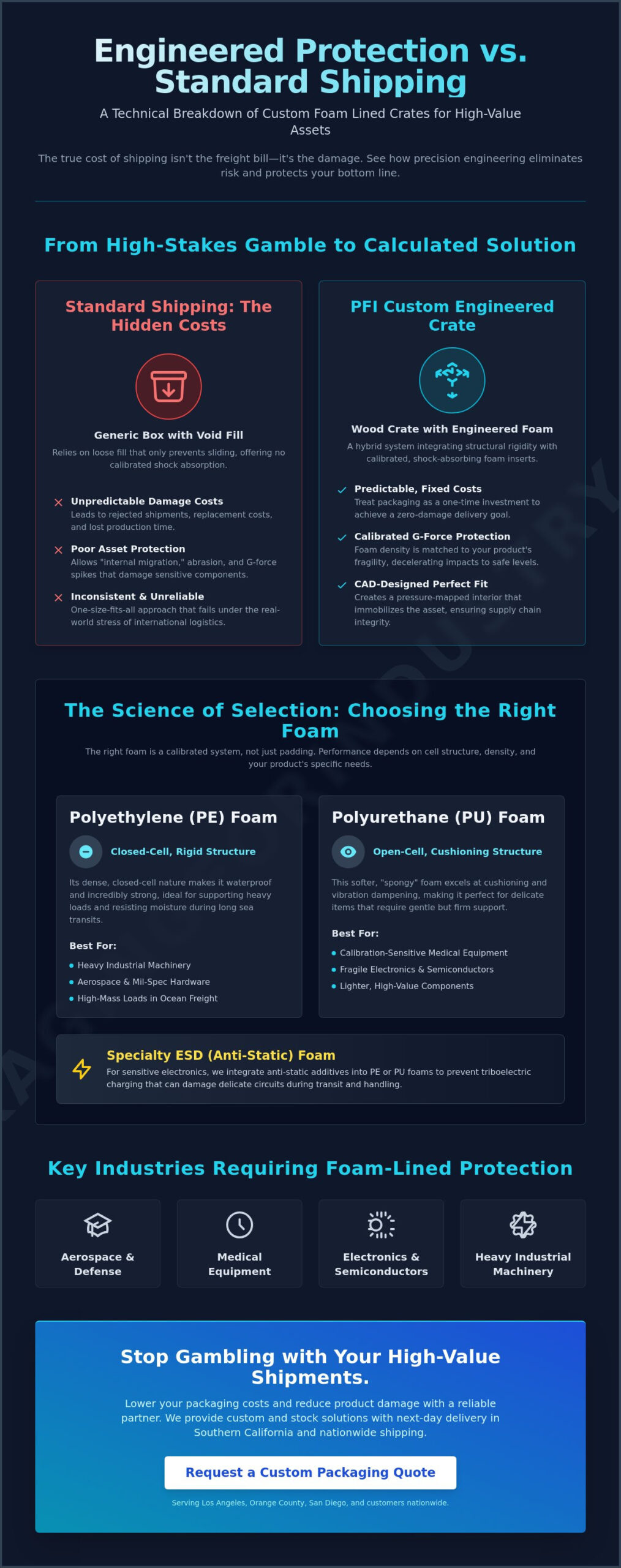
A custom foam lined crate is more than a shipping container; it’s a precision-engineered barrier against the physical realities of global logistics. This hybrid protective system integrates the structural rigidity of heat-treated wood with the shock-absorbing properties of specialized foam inserts. For manufacturers in Los Angeles, Orange County, and the Inland Empire, these crates are essential tools for moving high-value assets across international borders without the risk of catastrophic failure.
There’s a critical distinction between simple void fill and engineered cushioning. Many operations managers mistakenly use loose-fill materials or generic padding to occupy empty space. This only prevents an item from sliding. True protection requires The Science of Selection: Choosing the Right Foam to manage kinetic energy. Engineered cushioning is designed to decelerate an object during an impact, ensuring that the G-forces reaching the product remain below its critical fragility level. Without this calibration, your packaging is just a box, not a solution.
The economic impact of transit damage far outweighs the initial cost of custom engineering. When a piece of medical imaging equipment or an aerospace component arrives damaged, the costs extend beyond simple replacement. You’re looking at liquidated damages for late delivery, lost production time, and the administrative burden of insurance claims. Investing in custom foam lined crates allows you to treat packaging as a fixed, predictable cost rather than a variable risk. As an experienced custom packaging supplier, we focus on helping you lower packaging costs by eliminating the waste associated with over-packaging or under-protecting your cargo.
Beyond Standard Packaging: The Case for Customization
Off-the-shelf crates can’t account for the specific center of gravity or “internal migration” of sensitive electronics. During long ocean voyages or turbulent air freight, assets can shift within a standard crate, leading to surface abrasion or internal component failure. Custom lining creates a pressure-mapped fit that secures the asset through multi-stop logistics and rough handling at international terminals. This level of detail is necessary to maintain the integrity of your supply chain.
Key Industries Requiring Foam-Lined Protection
Aerospace and defense sectors rely on these solutions to meet stringent military-spec packaging standards while ensuring flight-critical hardware remains pristine. In the medical field, protecting calibration-sensitive gear like MRI components requires exact dampening to prevent expensive recalibration upon arrival. Even heavy industrial machinery manufacturers in San Diego and Anaheim utilize these crates to manage high-mass loads. Precision foam placement prevents the equipment’s own weight from crushing its protective barriers during the vibrations inherent in rail or sea transit.
The Science of Selection: Choosing the Right Foam for Your Crate
Selecting the internal protection for your cargo requires a technical understanding of material performance. Most suppliers treat foam and crates as separate commodities, but in industrial logistics, they function as a single integrated system. If the foam is too soft for the product’s weight, the asset will “bottom out” during a hard impact. If the foam is too rigid, the shock transfers directly through the lining to the sensitive internal components. High-performance custom foam lined crates solve this by balancing material density against the specific fragility of the cargo.
The primary choice usually falls between Polyethylene (PE) and Polyurethane (PU). Beyond simple cushioning, you must consider the cell structure. Closed-cell foams, like PE, are essential for international ocean freight because they resist moisture absorption. In high-humidity environments or during long sea transits, open-cell foams can act like a sponge, trapping moisture against your equipment and risking corrosion. For semiconductor and electronics manufacturers, we also integrate anti-static (ESD) additives into these foams to prevent triboelectric charging that can damage sensitive circuits during handling.
To ensure these materials perform under real-world stress, our design team utilizes The Engineering Process: From Concept to Prototyping to validate cushioning curves and drop-test requirements. This scientific approach removes the guesswork from your packaging spend. If you need a technical assessment of your current transit risks, you can request a packaging quote to speak with a specialist.
Polyethylene (PE) Foam for Heavy-Duty Support
PE foam is the industry standard for blocking and bracing heavy industrial equipment. Its closed-cell structure provides high tear resistance and durability, making it the ideal choice for reusable shipping crates that must endure multiple transit legs. In 2026, high-density polyethylene remains the benchmark for supporting static loads exceeding 2.0 psi while maintaining structural integrity over long-duration international transits. It doesn’t crumble or “dust” like lower-quality materials, ensuring your clean-room compatible equipment stays pristine.
Polyurethane (PU) Foam for Fragile Cushioning
For lightweight, highly sensitive instruments, open-cell Polyurethane (PU) offers superior deceleration. It’s often used in convoluted, or “egg-crate,” patterns to gently grip irregularly shaped items without applying excessive pressure. While PU provides excellent initial cushioning, it has a higher “compression set” than PE. This means it may not fully return to its original thickness after being compressed by a heavy load for an extended period. We typically reserve PU for lighter assets where the priority is maximum shock absorption rather than long-term load bearing.
Comparing Custom Crates vs. Standard Shipping Solutions
Deciding between high-performance corrugated and industrial wood crating is a matter of calculating risk against operational cost. While triple-wall corrugated boxes are effective for many heavy-duty applications, they reach a structural limit when handling concentrated loads or assets with extreme G-force sensitivity. Standard shipping solutions often fail to provide the torsional rigidity required for international sea or air freight. In these scenarios, custom foam lined crates become the necessary standard for protecting your capital investment.
The choice between a cushioned pallet and a fully enclosed crate depends on the complexity of the transit route. A cushioned pallet protects against vertical shock from forklifts but leaves the asset vulnerable to side impacts, debris, and moisture. Fully enclosed crates provide 360 degree protection, which is vital for multi-stop international logistics where cargo is frequently handled at various terminals. For companies operating closed-loop supply chains, such as those moving components between plants in San Diego and the Inland Empire, reusable crates offer a significant long-term return on investment compared to single-use packaging.
Operations managers also weigh the convenience of expanding foam-in-place against the precision of custom-cut foam planks. Foam-in-place is useful for irregular, low-volume shipments, but it lacks the repeatable density control needed for high-value industrial equipment. Precision-cut foam packaging inserts ensure every shipment is packed identically. This eliminates human error on the warehouse floor and provides a predictable level of shock absorption that standard void-fill cannot match. If you’re currently experiencing damage with standard boxes, it’s time to compare packaging pricing for an engineered upgrade.
When to Upgrade to a Custom Foam-Lined Crate
Evaluate the fragility factor, or G-rating, of your equipment. If your asset can’t survive a drop or vibration exceeding 40Gs, standard packaging is rarely sufficient. You must also assess environmental risks. International transit exposes cargo to extreme humidity, dust, and salt air. A custom crate, built to ISPM-15 standards for international compliance, provides a controlled environment that protects sensitive metal surfaces from corrosion while ensuring your shipment clears customs without delays.
Economic Advantages of Bespoke Engineering
Bespoke engineering directly impacts your bottom line by optimizing dimensional weight (DIM) costs. We design crates to the smallest possible footprint that still meets safety requirements, reducing expensive air freight surcharges. You’ll also see labor savings; pre-fit foam inserts allow warehouse teams to pack shipments faster and more consistently. Finally, demonstrating superior packaging compliance can lead to lower insurance premiums, as underwriters recognize the reduced risk of transit-related loss.
The Engineering Process: From Concept to Prototyping
The effectiveness of an industrial packaging solution is determined long before the first shipment leaves your dock. We begin the engineering process with a detailed consultation to identify the specific load points and sensitivity zones of your asset. Unlike standard providers who treat the crate and the foam as separate components, our integrated approach ensures that custom foam lined crates are designed as a single unit. This phase involves analyzing the center of gravity and the weight distribution of the equipment to determine exactly where the foam needs to provide the most support.
Once the technical requirements are established, our team moves into CAD design. This software allows us to simulate transit variables and select materials based on the performance data discussed in previous sections. For high-precision requirements, we utilize CNC foam cutting. This technology ensures a perfect fit every time and provides the repeatability necessary for standardized packaging across multiple production lines. Whether you’re shipping from Anaheim or San Diego, this precision eliminates the variances found in manual packing methods and ensures consistent protection for every unit in a bulk order.
Validating the design through prototyping is the final step before full-scale production. We don’t guess how a material will perform under stress; we test it against the real-world rigors of your supply chain. If you’re ready to eliminate the risk of transit damage and standardize your shipping process, you can request a packaging quote to begin the design process today.
Free Prototyping: Eliminating Packaging Risk
We offer free prototyping because you shouldn’t have to pay to prove a solution works. This service allows you to verify the fit and function of your crate before committing to a bulk order. Rapid prototyping also accelerates your product’s time-to-market by identifying potential packaging failures early in the development cycle. During this phase, we can simulate shock, vibration, and compression to ensure the design meets your specific internal quality standards and protects your bottom line.
Precision Manufacturing and Quality Control
Our manufacturing process utilizes both CNC routing and die-cutting to achieve complex foam geometries. CNC routing is particularly effective for high-precision projects where tolerances are tight and the equipment has an irregular shape. Once the foam is cut, we use specialized assembly techniques to secure the lining to wood or plastic crate walls, preventing the foam from shifting during transit. Every unit undergoes a final inspection to ensure compliance with Mil-Spec or industrial standards, providing you with a reliable, ready-to-use solution for your most critical assets.
PFI: Your National Partner for Custom Crating Solutions
PFI operates at the intersection of engineering and economics. We don’t just sell components; we provide an integrated system of protection. By acting as your single-source industrial packaging provider, we help you eliminate the logistical friction of managing multiple vendors. Managing separate quotes for pallets, stretch film, and custom foam lined crates wastes valuable procurement time. We streamline this process, offering bulk packaging pricing that reflects the total volume of your industrial supply chain needs.
Our nationwide shipping capabilities ensure that large-scale industrial projects receive consistent packaging quality regardless of the destination. For our clients in Orange County, Los Angeles, and the Inland Empire, we offer local next-day delivery to keep your production lines moving without interruption. This combination of national reach and local service allows you to compare packaging pricing and select a partner that understands the urgency of industrial lead times. We’re committed to lowering your packaging costs through precision design and wholesale supply reliability.
Scalable Solutions for Every Supply Chain
Managing a global supply chain requires packaging that scales with your demand. We handle high-volume wholesale orders while maintaining the precision required for bespoke engineering. To further optimize your warehouse space, we offer vendor-managed inventory (VMI) and just-in-time (JIT) packaging options. Our team specializes in complex custom shipping crates designed to survive the rigors of international transit while remaining cost-effective for bulk distribution. This scalable approach ensures you have the right materials on hand without tying up excessive capital in warehouse stock.
Why Industrial Leaders Trust PFI
We act as proactive fixers for manufacturers facing unpredictable shipping damage or regulatory hurdles. Our technical expertise extends to military packaging and aerospace standards, ensuring your cargo meets all necessary compliance protocols before it leaves the warehouse. We focus on tangible outcomes: zero-damage delivery and the elimination of professional stress. Whether you need a local packaging delivery in Anaheim or a nationwide rollout for a new product line, we provide the steady hand your logistics operation requires. PFI remains dedicated to achieving a zero-damage shipping benchmark for every high-value asset protected by our engineered solutions throughout 2026.
Optimize Your International Shipping Reliability
Protecting high-value assets during global transit requires a shift from reactive packaging to proactive engineering. By integrating precise foam densities with structural wood crating, you eliminate the variables that lead to transit damage and rejected shipments. You’ve seen how the right material selection and a repeatable design process provide both physical protection and fiscal predictability for your most critical assets.
PFI provides the specialized expertise needed to meet Mil-Spec and aerospace compliance standards while ensuring your operations stay on schedule. We offer free prototyping for fit validation and provide fast nationwide shipping along with local next-day delivery across Southern California. It’s time to stop gambling with your cargo and start securing your bottom line through optimized industrial logistics and a standardized packaging workflow.
Request a Free Prototype and Custom Crating Quote today to see how custom foam lined crates can transform your delivery success rate. We’re ready to help you build a more resilient and cost-effective supply chain.
Frequently Asked Questions
What is the best foam for heavy industrial crates?
Polyethylene (PE) foam is the industry standard for heavy loads because of its high load-bearing capacity and durable closed-cell structure. It provides the structural rigidity necessary for blocking and bracing equipment that exceeds 100 pounds. For these high-mass assets, high-density PE prevents the product from bottoming out during the vertical shocks common in forklift handling and rail transit.
Can custom foam-lined crates be reused for multiple shipments?
Yes, custom foam lined crates are frequently engineered for multiple transit cycles, especially within closed-loop supply chains between regional facilities. We utilize high-resiliency PE foam and reinforced plywood construction to ensure the internal cushioning and external shell maintain their integrity over several trips. This reusable design helps manufacturers lower packaging costs by reducing the frequency of single-use container purchases.
How do I determine the G-force rating for my equipment packaging?
You determine the G-force rating by identifying the product’s fragility level, which is the maximum acceleration or shock the internal components can withstand before failing. This data is typically found in your equipment’s engineering specifications or obtained through standardized drop testing. Our team uses this rating to calculate the precise foam thickness and density required to decelerate the asset safely during impact.
Are your wooden crates ISPM-15 certified for international export?
Every wooden crate we manufacture for international transit is heat-treated and bears the official IPPC stamp to ensure full ISPM-15 compliance. This certification is a mandatory requirement for customs clearance in over 180 countries, including the United States and the European Union. We manage all heat-treatment protocols so your high-value shipments clear customs without the risk of being seized or destroyed.
How long does the custom design and prototyping process take?
The initial CAD design and physical prototyping phase typically takes between 3 to 7 business days depending on the complexity of the cargo. We focus on rapid prototyping to help you validate fit and function without delaying your product’s time-to-market. Once you approve the prototype, we can transition into full-scale production and coordinate local next-day delivery across Southern California.
Do you offer anti-static foam for electronic component crates?
We provide Pink Anti-Static (PAS) polyethylene and polyurethane foams specifically for protecting sensitive electronic hardware. These specialized materials prevent the accumulation of electrostatic discharge (ESD) that can occur during handling or transit. Integrating ESD-safe materials into your custom foam lined crates is a critical step for semiconductor manufacturers and aerospace firms moving calibration-sensitive gear.
What information do I need to provide for a custom crate quote?
To request a packaging quote, you should provide the product’s exact dimensions, total weight, fragility rating, and the primary shipping destination. It’s also helpful to identify specific load points or any requirements for moisture barriers if the asset is moving via ocean freight. These details allow us to engineer a solution that balances material performance with your specific budgetary goals.
Is there a minimum order quantity for custom foam-lined crates?
We handle both small-batch bespoke engineering projects and high-volume industrial orders for national distribution. While we don’t enforce a rigid minimum order quantity, bulk packaging pricing is most effective when production is standardized for repeatable runs. We work with your operations team to determine the most efficient order volume based on your just-in-time (JIT) inventory requirements.