
What if the most expensive component in your supply chain isn’t the freight rate, but the high-value aerospace assembly that arrives at its destination with hairline fractures from transit vibration? For manufacturers in Los Angeles and Orange County, the cost of shipping damage goes far beyond the physical asset. It impacts your reputation and your bottom line. Utilizing expert packaging design validation services Southern California specialists provide is the only way to move from hoping a shipment survives to knowing it’s protected.
It’s frustrating to deal with excessive costs from over-engineered boxes, yet the risk of failing military specifications or aerospace standards feels even worse. You need a solution that balances fiscal responsibility with uncompromising durability. This article explains how professional validation ensures your custom corrugated and foam designs meet the latest ISTA 3E-2026 requirements and California’s SB 54 sustainability mandates. We’ll preview how rapid prototyping and CAD/CAM support can deliver zero-damage shipping cycles and faster turnarounds for your most critical industrial assets.
Key Takeaways
- Learn how professional packaging design validation services Southern California specialists prove a design’s effectiveness against impact, vibration, and compression before you ship.
- Understand the engineering process from CAD/CAM analysis to physical prototyping that ensures a perfect fit for complex industrial parts.
- Discover industry-specific validation requirements for aerospace and electronics sectors, including specialized foam and custom crate solutions.
- Identify how strategic validation accounts for Southern California’s unique logistical challenges to prevent transit damage across the Inland Empire and beyond.
- See how partnering with an engineering-focused supplier can lower your total packaging costs by eliminating over-engineered designs without sacrificing protection.
What are Packaging Design Validation Services?
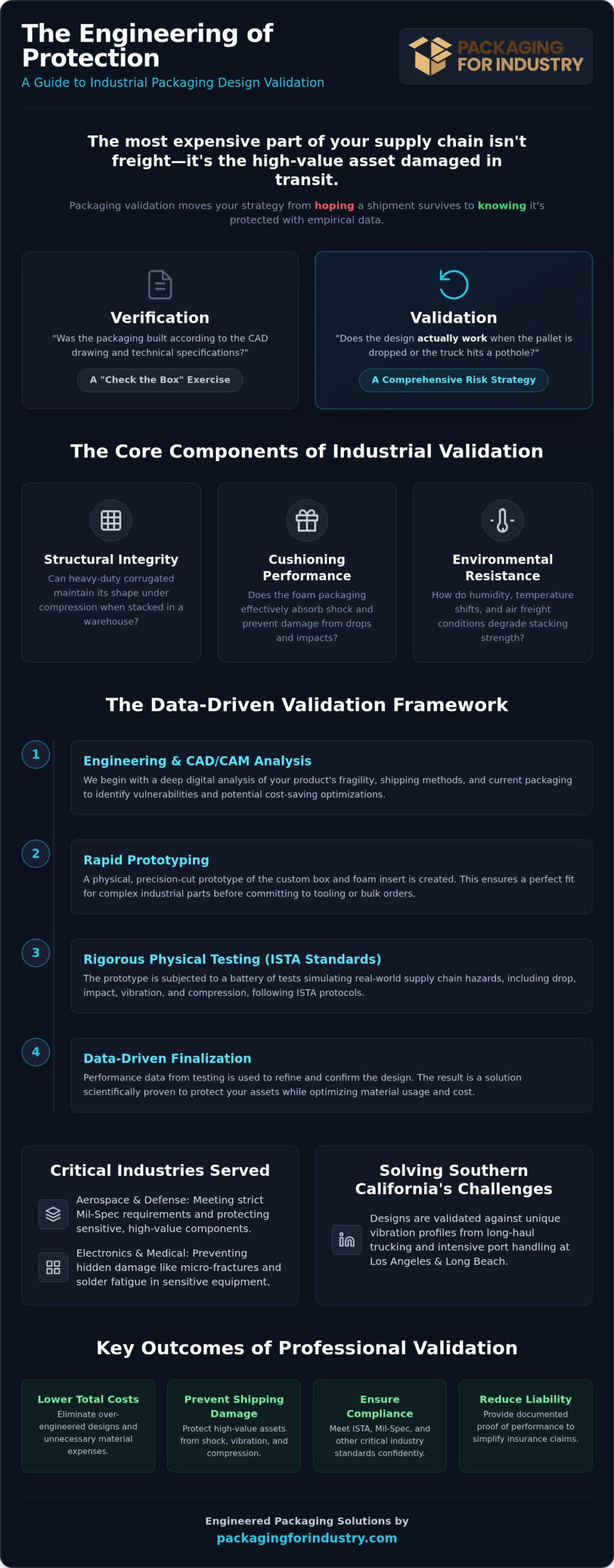
Validation isn’t a mere formality; it’s a comprehensive risk management strategy. In the context of industrial logistics, validation is the process of proving that a specific packaging design actually meets its intended protection goals. While many providers offer standard boxes, professional packaging design validation services Southern California manufacturers rely on go much deeper. They ensure that a custom corrugated box combined with precision-cut foam inserts can withstand the mechanical stresses of a modern supply chain. This process moves beyond guesswork by using data to confirm that your assets are safe.
It’s vital to distinguish between verification and validation. Verification confirms that the packaging was built according to the CAD drawing or technical specifications. It’s a “check the box” exercise. Validation, however, asks the critical question: Does it actually work when the pallet is dropped or the truck hits a pothole? It’s the difference between having a box that looks right and a box that prevents a $50,000 aerospace component from sustaining hidden structural damage during transit. For purchasing managers, validation provides the peace of mind that a design is fit for purpose before committing to a bulk order.
The Core Components of Industrial Validation
Validation relies on rigorous package testing protocols to simulate the journey from the factory floor to the end user. This technical evaluation focuses on three primary areas:
- Structural Integrity: We analyze if the heavy-duty double-wall or triple-wall corrugated material can maintain its shape under compression when stacked in a warehouse.
- Cushioning Performance: We measure G-force levels to ensure that PE or PU foam packaging effectively absorbs shock during a drop or sudden impact.
- Environmental Resistance: We evaluate how humidity levels at the Port of Los Angeles or extreme temperature shifts during air freight might degrade the stacking strength of your pallets.
Why Validation is Critical for Southern California Manufacturers
Southern California serves as a global gateway, but its logistical density presents specific challenges for industrial shippers. Manufacturers in Orange County, San Diego, and the Inland Empire face unique vibration profiles from long-haul trucking and intensive port handling at Los Angeles and Long Beach. For sensitive electronics and aerospace parts, “hidden damage” like micro-fractures or solder joint fatigue can lead to catastrophic failure after the product is installed. This creates a massive liability for the manufacturer and ruins client trust.
By utilizing specialized packaging design validation services Southern California companies can document performance through empirical data. This documentation reduces liability and simplifies insurance claims if an external event occurs. It’s a proactive way to lower packaging costs by avoiding the expensive fallout of shipping damage and the administrative burden of returns. Manufacturers looking to protect their high-value assets should request a packaging quote that integrates engineering validation to ensure their supply chain remains reliable and cost-effective.
The PFI Validation Framework: From CAD to Physical Prototype
Effective protection doesn’t happen by accident. It’s the result of a methodical engineering process that eliminates guesswork from the supply chain. At PFI, our packaging design validation services Southern California manufacturers utilize follow a rigorous framework that begins long before a single sheet of corrugated is cut. We treat packaging as a precision-engineered component of your product, not just a container. This approach ensures that every design is optimized for both physical protection and economic efficiency.
Our validation process includes a comprehensive packaging review. We analyze your current shipping methods to identify vulnerabilities or areas where you might be over-spending on materials. By aligning your designs with ISTA’s validation framework, we provide a data-driven path to reducing shipping damage while maintaining fiscal responsibility. This proactive analysis is essential for high-value sectors like aerospace and electronics, where the cost of failure is extreme.
Step 1: Engineering and CAD/CAM Support
We start with a deep digital analysis of your product’s geometry and fragility. Our team uses advanced CAD/CAM tools to design integrated protection systems that combine custom foam inserts with heavy-duty corrugated structures. We don’t just guess at material thickness; we analyze material density requirements to ensure the cushioning can handle specific G-force thresholds. This digital phase allows us to simulate fit and function, ensuring that complex parts with delicate protrusions are fully supported from every angle.
Step 2: Prototyping and Physical Fit Testing
The transition from a digital model to a physical asset is where many packaging designs fail. This is why we provide a free prototype to our Southern California clients. A physical prototype allows your team to perform in-house fit testing, ensuring the product interfaces perfectly with the foam and outer box. It’s during this phase that we often identify over-packaging. If a design is bulkier than necessary, it leads to inflated material costs and dimensional weight surcharges. We refine the prototype until it provides maximum protection with minimum waste.
Step 3: Performance Analysis and Refinement
Validation continues through iterative testing and feedback from your production floor. We don’t just focus on the shipping cycle; we also analyze how easily your team can assemble the packaging. If a design is too complex, it slows down your kitting and warehouse operations. Our goal is to create a cohesive Custom Design Packaging solution that is as efficient to pack as it is effective at protecting your goods. Before you commit to your next bulk order, you should request a custom packaging quote to see how an engineered prototype can stabilize your logistics costs.
Industry-Specific Validation: Aerospace, Defense, and Electronics
A generic box might suffice for consumer goods, but Southern California’s industrial leaders in aerospace and defense require a higher burden of proof. Every industry operates under a unique set of logistical stressors. Effective packaging design validation services Southern California providers offer must adapt to these specific regulatory and environmental demands. Whether you’re shipping a satellite component from El Segundo or semiconductor equipment from San Diego, the validation process must reflect the actual risks of your supply chain. We move beyond basic protection to ensure your packaging meets the exact ‘proof of performance’ your customers demand.
Aerospace and Aviation Packaging Requirements
Aerospace parts are often oversized. They’re heavy. They have irregular centers of gravity. Standard packaging fails here. We engineer custom crates that integrate heat-treated wood with specialized foam-lined protection to secure these assets. Validation for this sector involves ensuring that even the most delicate aviation instruments remain immobile during turbulent air freight or rough ground handling. Our Aerospace Packaging Solutions are designed to withstand international transit while adhering to strict weight and safety protocols. This engineering-first approach prevents the hairline fractures that can ground a project before it starts.
Electronics and Semiconductor Validation
Static discharge is a silent threat. For electronics manufacturers, validation focuses heavily on Electrostatic Discharge (ESD) protection. We test anti-static foam inserts and moisture barrier bags to ensure sensitive circuit boards arrive functional. It’s not just about shock; it’s about the environment. Cleanroom environments demand packaging that doesn’t shed particles, making material selection a critical part of the validation loop. We help semiconductor companies validate their shock absorption systems, ensuring that multi-million dollar manufacturing equipment survives the vibration profiles of long-haul transit across the Inland Empire.
Military-Spec (Mil-Spec) Compliance
Navigating military specifications (Mil-Spec) requires more than just heavy-duty materials. It demands a deep understanding of government-mandated durability standards. We utilize materials like triple-wall corrugated and high-density foam pads to meet these rigorous requirements. Our packaging design validation services Southern California team often references ASTM D4169 to ensure every container survives the extreme distribution cycles common in defense logistics. This level of validation provides documented proof that your packaging is compliant with federal contracts. It eliminates the risk of rejected shipments and ensures your operations remain profitable and reliable.
Strategic Packaging Validation in Southern California
Southern California is a high-stakes environment for industrial logistics. Shippers here face intense mechanical vibration during long-haul transit through the Inland Empire and extreme humidity at the Port of Long Beach. If you are searching for a Los Angeles packaging supplier that understands these local conditions, validation is the key. By using specialized packaging design validation services Southern California manufacturers can ensure their high-value assets are protected against specific environmental stressors before they leave the warehouse.
Validation acts as a strategic tool for managing the high costs of regional distribution. In a market where warehouse space is at a premium, your protection system must be as lean as it is durable. We analyze the intersection of material performance and logistical expense to ensure your supply chain remains profitable. Whether you are moving sensitive electronics through Orange County or heavy industrial equipment through the high desert, our engineering-first approach provides the data you need to ship with confidence.
Navigating the Southern California Supply Chain
Local distribution requires designs that avoid steep ‘oversize’ surcharges from carriers like UPS and FedEx. As a Riverside packaging supplier, we help you optimize box dimensions while maintaining structural integrity for palletized loads in San Bernardino. Validating your custom boxes in San Diego or Riverside ensures they withstand the rigors of local transport, which significantly reduces the carbon footprint associated with damage-related returns. This pragmatic approach balances environmental responsibility with fiscal discipline.
PFI’s Local Advantage: Anaheim and Beyond
Our proximity to major aerospace and technology hubs allows us to offer faster prototyping cycles than out-of-state competitors. If you need an Anaheim packaging supplier for an on-site review, our team can visit your facility in Orange County or Los Angeles to observe your current workflows first-hand. This local presence ensures we can quickly iterate on custom boxes in Irvine or Anaheim to meet tight production deadlines. Many clients integrate Vendor Managed Inventory (VMI) with their validated designs to ensure a seamless supply of custom boxes and foam inserts.
Why Partner with PFI for Your Custom Packaging Validation?
Finding a reliable industrial packaging supplier near me means looking for a partner that understands the intersection of engineering and economics. At PFI, we act as a seasoned consultant for your procurement and operations teams. We don’t just provide containers; we engineer comprehensive protection systems. By choosing us as your bulk packaging supplier, you gain access to experts who ensure your custom corrugated boxes and protective foam packaging work as a single, validated unit to survive the most demanding supply chains.
Our capabilities extend across a full range of wholesale packaging supplies, allowing us to manage every layer of your shipment’s safety. As a specialized stretch wrap supplier, we also validate how machine or hand film interacts with corner and edge protection to stabilize palletized loads. This holistic oversight is why our packaging design validation services Southern California manufacturers trust are essential for high-value industrial assets. We provide the stability your warehouse needs while maintaining the fiscal responsibility your purchasing department demands.
Cost-Reduction and ROI through Better Design
Many industrial companies over-spend on heavy-duty materials that don’t actually improve protection. Our validation process identifies these inefficiencies, allowing you to lower packaging costs without increasing risk. We focus on the Total Cost of Ownership by eliminating the hidden expenses of insurance claims, administrative returns, and damaged goods. Professional validation is an investment that pays for itself by stabilizing your logistics. You can explore our specific strategies for Packaging Cost Savings to see how better engineering improves your bottom line.
Comprehensive Service from Design to Delivery
The transition from a validated prototype to a full production run is seamless when you work with a single-source provider. We handle the entire lifecycle of your project, from CAD/CAM design support to final delivery at your facility. Our local expertise ensures rapid response times for manufacturers in Orange County and the Inland Empire, while our nationwide capabilities support your broader distribution needs. Before you commit to your next production cycle, you should request a custom packaging quote to see how our validated designs can improve your supply chain reliability.
Stabilize Your Supply Chain with Engineered Protection
Validation is more than a technical requirement; it’s a financial safeguard for your most valuable industrial assets. By shifting from standard catalog boxes to custom engineered solutions, you eliminate the uncertainty of shipping damage. Our packaging design validation services Southern California team provides the CAD design support and free prototyping necessary to meet rigorous aerospace and Mil-Spec standards. This engineering-first approach ensures that your protection system is optimized for both durability and cost-effectiveness.
Whether you’re navigating the vibration profiles of the Inland Empire or preparing high-value exports for the Port of Los Angeles, documented performance data is your best defense against liability. We help you lower packaging costs by identifying over-engineered materials while ensuring your products arrive in perfect condition. With local next-day delivery and specialized expertise in high-value sectors, PFI is the steady partner you need to optimize your industrial logistics and improve supply chain reliability.
It’s time to move beyond guesswork and start shipping with total confidence in your protection system. We look forward to engineering a solution that stabilizes your operations and protects your bottom line.
Frequently Asked Questions
What is the difference between packaging testing and packaging validation?
Packaging testing refers to the physical procedures like drop tests or vibration cycles used to gather data. Validation is the broader engineering process that uses this data to prove a design is fit for its intended purpose. While testing provides the data, validation provides the documented proof that your specific product survives its actual distribution cycle without damage. It’s the necessary step to confirm a protection system is ready for the supply chain.
How long does the packaging design validation process typically take?
The timeline for packaging design validation services Southern California manufacturers require depends on the complexity of the asset. A standard corrugated box with custom foam inserts can often be prototyped and validated within 3 to 5 business days. More complex aerospace projects or Mil-Spec designs may require several weeks to account for iterative fit testing and specialized material sourcing. We prioritize fast turnaround times to keep your production schedule on track.
Do I need validation for standard corrugated boxes?
Validation isn’t always necessary for stock boxes holding non-fragile items, but it’s essential for heavy or high-value industrial goods. If you ship sensitive electronics or heavy machinery, validation proves the corrugated material can handle the stacking pressure and transit vibration. It prevents the hidden structural damage that standard boxes might allow. For high-risk shipments, validation is a pragmatic investment in risk management and liability reduction.
Can PFI help with ISTA or ASTM testing standards in Southern California?
Yes, we specialize in designing packaging that adheres to ISTA and ASTM standards. We use these frameworks to ensure your custom crates and boxes meet the performance requirements of major carriers and government contracts. This is especially critical for Southern California’s aerospace and defense sectors. Adherence to documented testing protocols like ISTA 3E-2026 is often a mandatory part of the procurement process for industrial manufacturers.
Is prototyping included in your packaging validation services?
Prototyping is a standard part of our validation process at PFI. We offer free prototyping for fit and function to ensure our CAD designs translate perfectly to the physical world. This allows your team to perform in-house testing before committing to a bulk order. It’s the most effective way to identify potential issues and refine the design for maximum protection and ease of assembly on your warehouse floor.
How does packaging validation help reduce shipping costs?
Validation reduces costs by eliminating over-packaging and preventing shipping damage. Many companies spend too much on excessive materials that don’t actually improve protection. Our validation process finds the optimal balance between material density and product safety. By reducing the size and weight of the package, you lower freight charges. Most importantly, you avoid the massive expense of product returns, repairs, and insurance claims.
What industries benefit most from custom packaging validation?
Aerospace, electronics, semiconductor, and defense companies benefit the most from custom validation. These industries ship high-value, fragile, or oddly shaped assets that standard packaging can’t protect. Our packaging design validation services Southern California experts understand the specific stressors these products face during transit. Validation ensures that sensitive components arrive functional, which is vital for maintaining long-term contracts and client trust in these specialized sectors.
Do you provide validation for international export packaging?
We provide comprehensive validation for international export packaging, including heat-treated wood crates and moisture-resistant corrugated materials. Exporting via the Port of Long Beach requires protection against salt air and extreme humidity. Our designs account for these environmental factors to ensure your goods remain stable during long ocean voyages. We validate that your international shipments comply with all global shipping regulations and durability standards to ensure safe arrival.